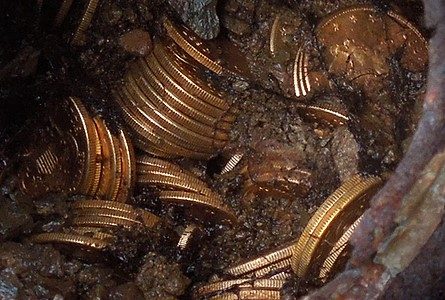
On the afternoon of August 31, 1934, two Baltimore boys, Theodore Jones, 16, and Henry Grob, 15, were digging in the dirt floor of the cellar of a three-story rowhouse at 132 South Eden Street, where Jones lived with his mother. They had formed a club and wanted a hiding place. Jones's shovel struck something round; he thought it was a medal. Grob told him it was a $20 gold piece.
By the time they had scraped out the corner they had 3,558 gold coins, found with the remains of copper containers. They ranged from tiny $1 gold dollars, which made up most of the count, to 317 double eagles, all dated in the 1830s, 1840s and 1850s. The face value was a little over $11,000, a fortune for two fatherless families living on relief in the depths of the Depression. Hours later the boys carried the coins in cigar boxes and leather bags into the Eastern District police station.
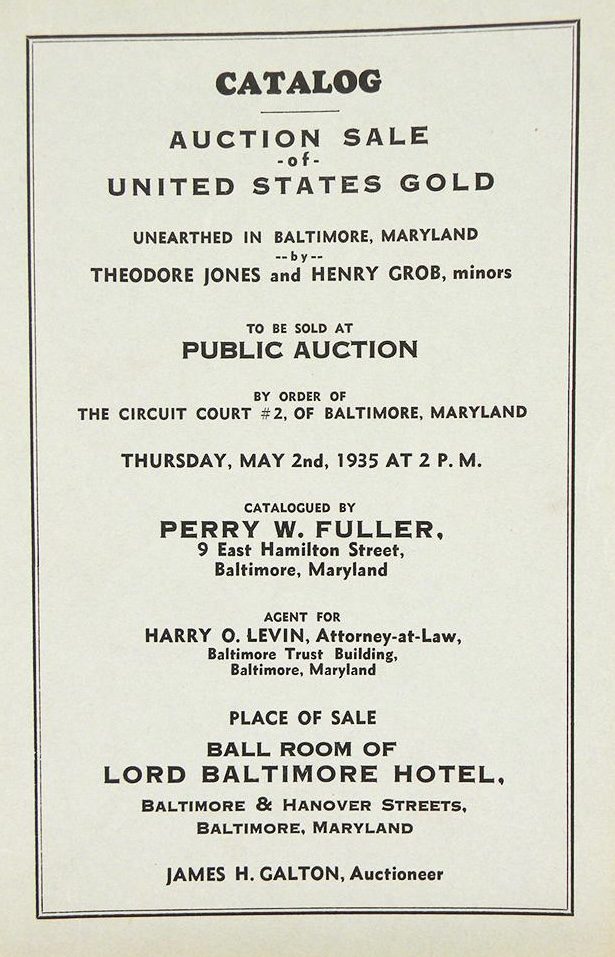
They had little choice. The federal government had recently called in privately held gold, so the boys could not simply bank it, and possession was itself a problem. News of the find spread nationally, and about a dozen claimants came forward: the estate of a local jeweler, heirs of a man who had owned the house from 1865 to 1889, and two sisters who held the ground rent on the property. Judge Eugene O'Dunne dismissed all of them in the boys' favor, and the coins were auctioned at the Lord Baltimore Hotel on May 2, 1935, in 438 lots, raising about $20,000. Collectors paid well over face value; the top lot, an 1856 double eagle from the New Orleans mint, made $105.
Appeals dragged on until 1937. Accounts of what the boys finally received differ, at about $6,000 or $7,000 each after legal costs, held until they turned 21. Henry Grob never saw any of it. In 1937 he was working in a packing plant for $16 a week when he caught pneumonia, and he died that August. Theodore Jones later worked as a shipyard machinist and died in 1977.
There was a second chapter. While the case was pending in 1935, the boys dug again and found more gold, reported as worth about $10,000. They kept quiet and gave it to their mothers. In September 1935 the Jones apartment was broken into and gold and cash were reported stolen from a trunk; a later court case over this second find was also decided for the boys.
Who buried the gold is unknown. Neighbors in 1934 recalled that the district had once been home to sea captains and sailors, and suggested a seafaring miser. The latest coins date from the 1850s, so the cache was probably buried some time after that and forgotten.
Highlights
A $20 gold piece from the New Orleans mint, the hoard's most valuable coin, which sold for $105 in 1935.
2,840 tiny $1 gold coins, the bulk of the hoard by number.
Printed for the sale at the Lord Baltimore Hotel on May 2, 1935; few copies survive.
What is in it
United States gold coins of five denominations, from $1 to $20, dated in the 1830s, 1840s and 1850s, found in copper containers; a second, smaller cache was found in the same cellar in 1935.
Size: 3,558 gold coins (first find).
| Item | Number | Notes |
|---|---|---|
| $1 gold dollars | 2,840 | |
| $2.50 quarter eagles | 65 | |
| $5 half eagles | 255 | |
| $10 eagles | 81 | |
| $20 double eagles | 317 | Including an 1856 New Orleans coin that fetched $105 at auction, the top price |
| Second find (1935) | unknown | Reported as worth about $10,000; most of it was later said to have been stolen |
Photographs
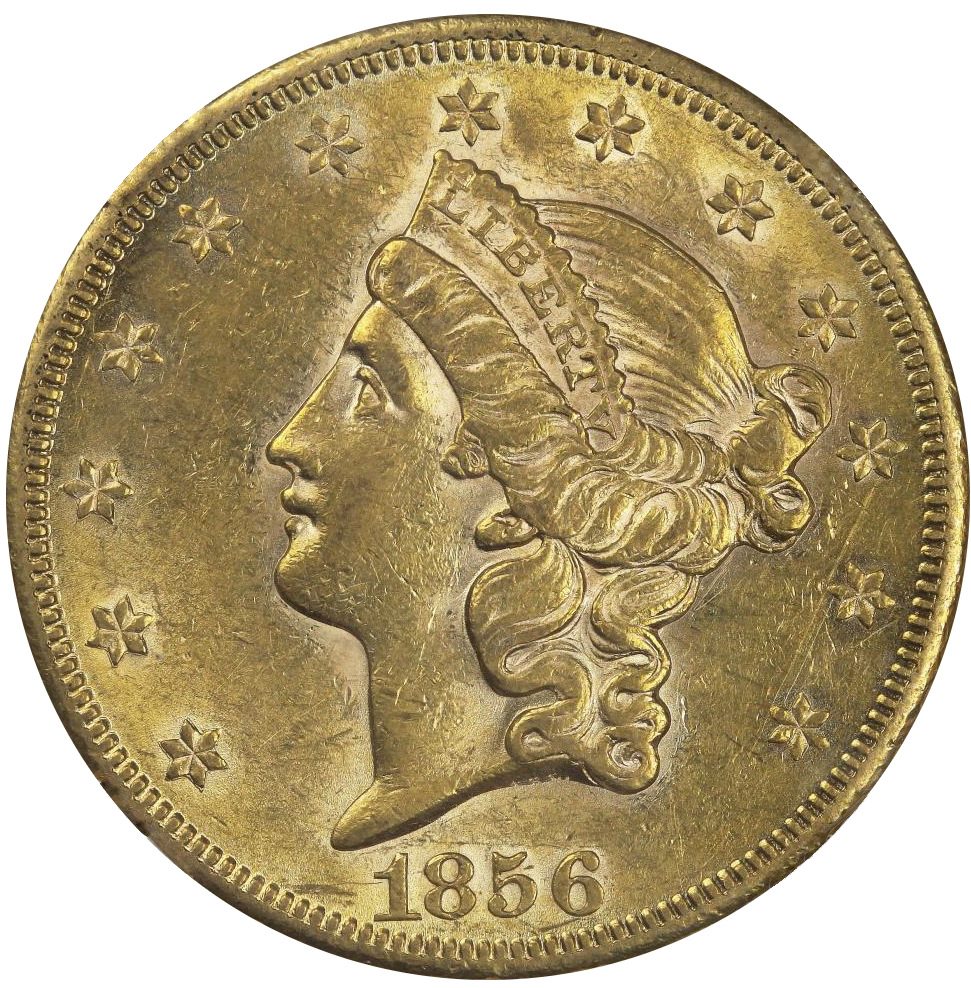
Photo: Coin: James B. Longacre, Image by Lost Dutchman Rare Coins, Public domain, via Wikimedia Commons
How it is dated
All the coins are dated in the 1830s to 1850s, so the cache was closed in or after the late 1850s. No container or document gives a firmer date, and the owner is unknown.
What happened after the find
Because of the 1933-34 federal gold restrictions the boys handed the coins to the police. A Baltimore court rejected about a dozen rival claims, including the property interests, and awarded the proceeds to the boys; the coins were auctioned in 1935, and appeals were settled in 1937.
Where sources differ
- Containers: Wikipedia says two copper pots; the Baltimore Sun (2008) says a copper jug or gallon can.
- Face value: the Sun gives $11,200; the denomination breakdown in Wikipedia adds up to about $11,427.
- Each boy's award: $6,000 (Baltimore Sun) or $7,000 after costs (Wikipedia).
- The gold law cited varies between sources (the 1933 gold order or the Gold Reserve Act of 1934).
- Auctioneer/cataloger name differs: Harry W. Fuller (Wikipedia) versus Perry W. Fuller (the catalog cover).
Questions
Who found the Baltimore gold hoard?
Two teenage boys, Theodore Jones and Henry Grob, digging in a cellar on South Eden Street on August 31, 1934. They turned the coins in to the police the same day.
What happened to the Baltimore gold coins?
After a court awarded them to the boys, the 3,558 coins were auctioned at the Lord Baltimore Hotel on May 2, 1935, for about $20,000, and dispersed among collectors.
Who buried the gold in Baltimore?
Nobody knows. The coins date from the 1830s to 1850s; neighbors in 1934 suggested a seafaring miser from the days when sea captains lived in the area.