Early modern and later hoards
1500 on · 4 hoards on this site
In 1912 workmen breaking up a cellar floor on Cheapside in the City of London put a pickaxe into a wooden box and found more than 400 pieces of Elizabethan and Jacobean jewellery: rings, brooches and enamelled gold chains, cameos, scent bottles and a salt cellar. The gems came from four continents, Colombian emeralds, Sri Lankan spinels, Burmese rubies, Indian diamonds, Afghan lapis and Persian turquoise among them. A small intaglio seal cut with the arms of William Howard, Viscount Stafford, dates the burial to between his creation as viscount in November 1640 and the Great Fire of 1666. The Cheapside Hoard is generally taken to be a goldsmith's working stock hidden during the Civil War, and most of it is now in the Museum of London. The workmen sold the pieces to George Fabian Lawrence, the dealer they knew as 'Stoney Jack', who regularly paid labourers cash for finds from London building sites; the whole hoard was shown together for the first time in more than a century at the Museum of London in 2013-14.
After 1500 the motive is rarely in doubt. Coin was plentiful but banking was thin, and in war the safest strongbox was often a pot under the floor. The English Civil War of 1642-51 alone has left over 200 known hoards. They can be very human: the Breckenbrough hoard from North Yorkshire, found in 1985 and now in the Yorkshire Museum, is 30 gold and 1,552 silver coins in a Ryedale ware jar, buried in the mid-1640s with two receipts for cheese. Hoards of this period are, overwhelmingly, savings that their owners did not live or stay to recover.
The money itself had changed, and by the nineteenth century the most valuable hoards are of gold coin. The largest found in the United States, the Saddle Ridge Hoard, came to light in 2013 when the owners of a rural property in northern California, walking their dog on a trail they had used many times, saw a rusted can poking out of the ground. Eight cans eventually held 1,427 gold coins dated 1847 to 1894, with a face value of $27,980, later assessed at about $10 million. Who buried them is unknown.
In England, Wales and Northern Ireland the Treasure Act 1996 counts coin finds as treasure once they are at least 300 years old, so seventeenth-century hoards now go through the same reporting, inquest and museum process as Roman or Viking ones; later hoards are handled under other rules. Early modern hoards cluster around wars and upheavals: in Britain overwhelmingly the 1640s, and in the American West the decades after the gold rush of 1849.
Early modern & later hoards
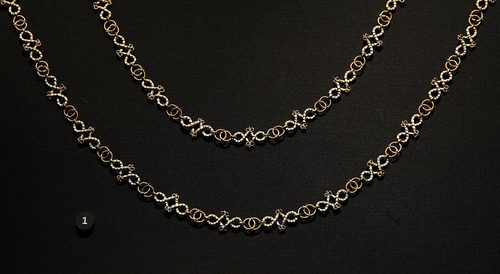
Cheapside Hoard
About 500 jewels from a 17th-century goldsmith's stock, found under a Cheapside cellar in 1912: the finest Elizabethan and Stuart jewellery anywhere.
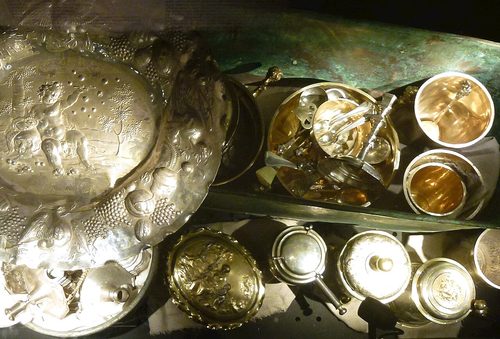
Lohe Hoard
Over 200 kg of silver: some 18,000 coins and 80 pieces of family plate packed in three copper kettles under a Stockholm cellar after 1741, found in 1937.
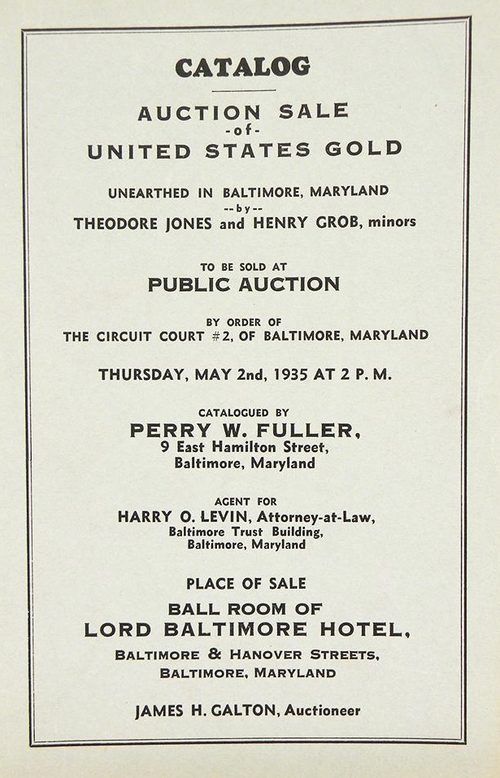
Baltimore Gold Hoard
3,558 gold coins of the 1830s-1850s dug up by two teenage boys in a Baltimore cellar in 1934, then fought over in court for three years.
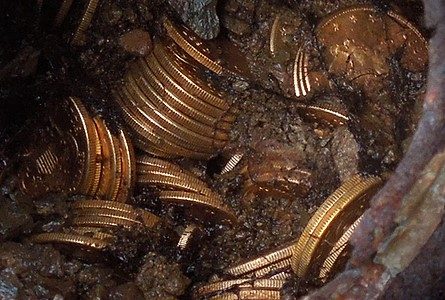
Saddle Ridge Hoard
1,427 U.S. gold coins dated 1847-1894, face value $27,980, found in eight rusted cans in California in 2013: the largest buried gold find in the U.S.