Big silver thalers, Spanish pieces of eight and gold double eagles: the coins people buried after 1500, from Civil War pots to Gold Rush cans.
The coins in hoards hidden after about 1500 are bigger and heavier than anything medieval. New silver mines in the Alps and central Europe made it possible to strike a single silver coin worth a gold one. Archduke Sigismund of Tyrol issued the first in quantity in 1486 at his mint at Hall, and in Bohemia the Counts of Schlick began striking similar coins from the silver of Joachimsthal (now Jáchymov) around 1518-20. The Joachimsthaler gave its name to the whole family: thaler in German, daalder in Dutch, and in English, dollar. A thaler-sized coin is about 40 mm across and weighs roughly 25-30 g.
Spain's version was the eight-real piece, the piece of eight or Spanish dollar, created by a monetary reform of 1497 at about 93 per cent silver. Once the mines of Potosí and Mexico were pouring out metal, the American mints at Potosí, Lima and Mexico City struck it in enormous numbers. The early ones are cobs: lumps cut from a bar and hammered, so that no two are the same shape and the design is often only half on the flan. Machine-struck round dollars from Mexico followed in the 18th century. Pieces of eight travelled to China, the Philippines and every Atlantic port, and remained legal tender in the United States until 1857.
Recognising a modern coin is usually simple: most carry a date, and machine-struck coins from the 17th century onwards are round, evenly struck and often have a marked or lettered edge to stop clipping. That makes dating a hoard much more precise than for earlier periods, because the latest date gives the earliest moment of burial. Gold returns as everyday savings in the 19th century, most memorably in the United States, where the $20 double eagle of 1849-1933 weighed 33.44 g at 90 per cent gold.
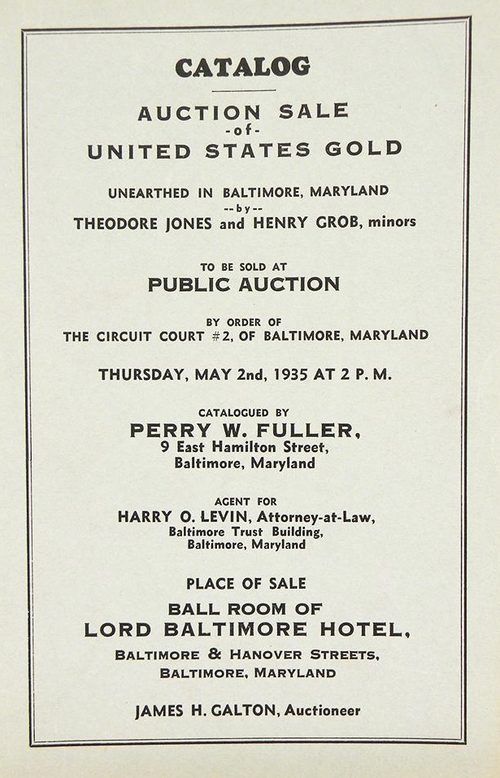
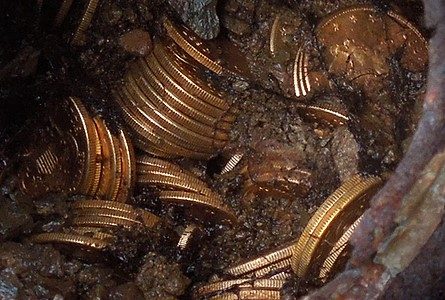
Britain's best-known group of post-medieval hoards comes from the Civil Wars of 1642-51, when soldiers' pay and plunder put cash on the move and households had good reason to bury it. The largest found so far, at Middleham in North Yorkshire, held 5,099 silver coins in three pots probably buried in the later 1640s. Under the Treasure Act 1996 coins must be at least 300 years old to count as treasure in England and Wales, so these hoards now qualify; younger gold and silver deliberately hidden by an unknown owner can still fall under the older law of treasure trove. Elsewhere the stories run up to the 20th century: just over 18,000 silver coins under the floor of a wealthy family's house in Stockholm, a cellar in Baltimore that gave up 3,558 gold coins in 1934, and the 1,427 American gold coins found in rusted cans on a California property in 2013.
Examples
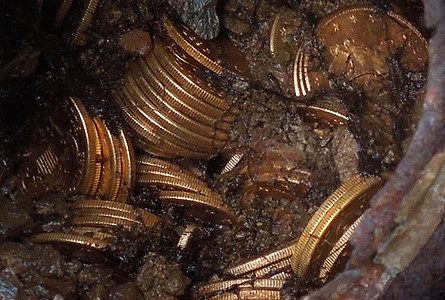
Photo: Kagin's Inc., CC BY-SA 3.0, via Wikimedia Commons
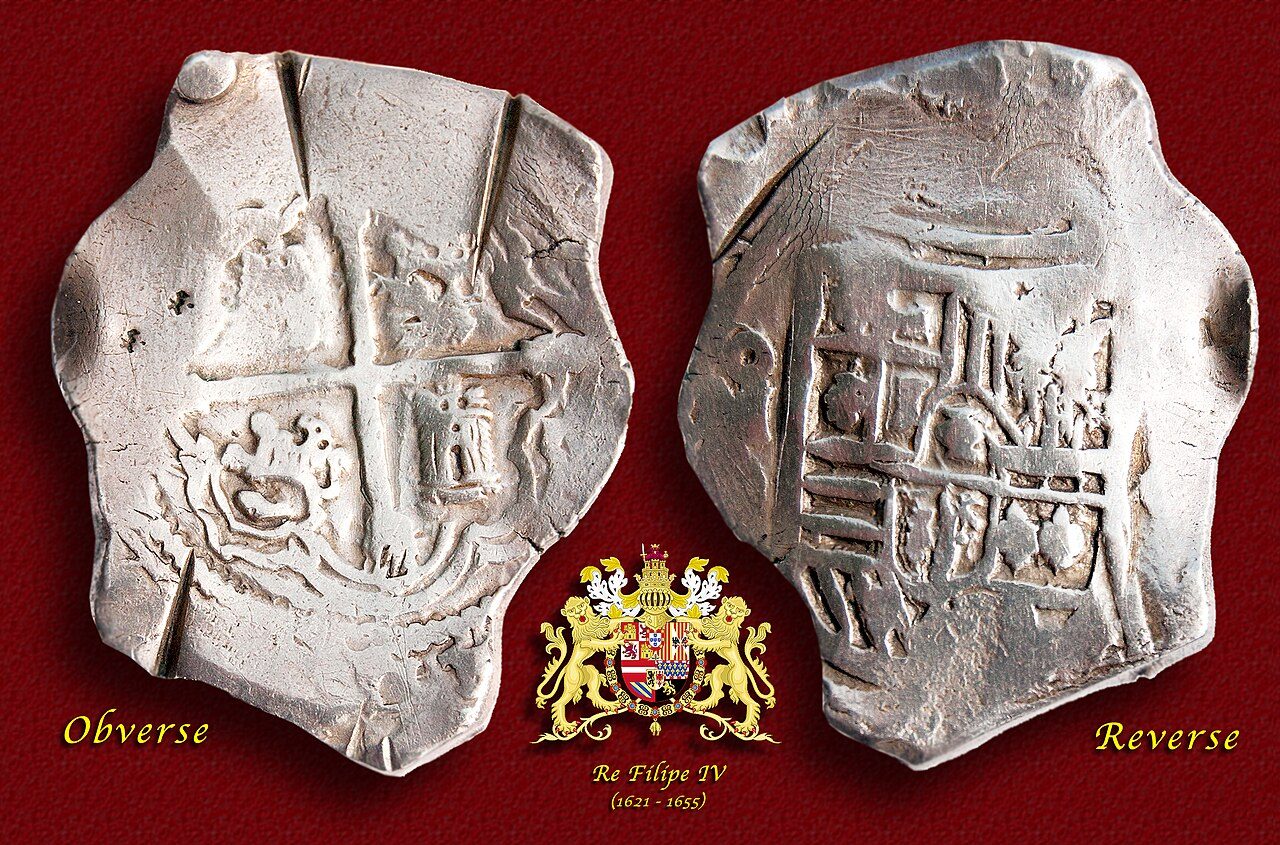
Photo: Coin: Casa de Moneda de la Ciudad de México . Composite image: Centpacrr, CC BY-SA 3.0, via Wikimedia Commons