In June 1912 a gang of workmen demolishing a building on the south side of Cheapside, a short walk east of St Paul's Cathedral, broke through a cellar floor and saw something glinting in the soil. What came up was a tangle of gold, enamel and coloured stones: the stock of a London jeweller, buried about 270 years earlier and never recovered.
The workmen did not go to the authorities. They took their finds to George Fabian Lawrence, a dealer and pawnbroker known on building sites as "Stony Jack", who paid labourers for interesting finds and also scouted for London's museums. He bought the lot and passed it to the newly founded London Museum, with Lewis Harcourt, later Viscount Harcourt, putting up the money. The Goldsmiths' Company, which owned the site, made no claim, and no treasure trove inquest was held. A few pieces went to the British Museum, the Guildhall Museum and the Victoria and Albert Museum.
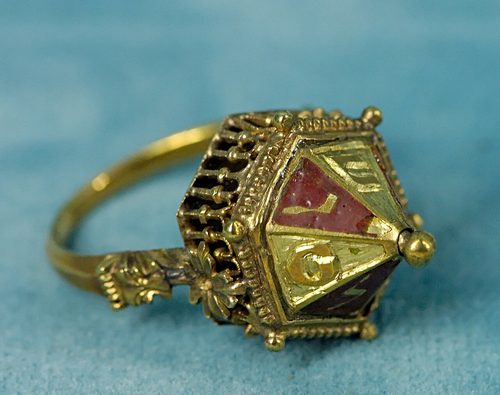
The hoard is a snapshot of a trade that spanned the globe. Colombian emeralds sit beside Indian diamonds, Sri Lankan spinels and sapphires, Persian turquoise, Afghan lapis lazuli and pearls from the Gulf. Most stones are smooth cabochons, but a few show the newer faceted rose and star cuts. There are finished pieces, such as enamelled rings and chains, a salamander brooch set with diamonds and pendants of carved amethyst grapes, alongside loose stones and a few convincing fakes made of dyed quartz. Survival matters here: jewellery of this period was usually broken up and reset as fashions changed, so very little remains outside this find.
The location fits a goldsmith's shop. Cheapside was the City's main shopping street and the heart of the goldsmiths' trade, and this stretch, known as Goldsmiths' Row, belonged to the Goldsmiths' Company. The site was rebuilt after the Great Fire of 1666, again in 1912, and now lies under the One New Change shopping centre.
Who buried the stock, and why, is not known. A small seal stone in the hoard bears the arms of William Howard, created Viscount Stafford in November 1640, so the hoard cannot have gone into the ground before then, and the fire of 1666 sets a firm upper limit. London Museum favours a date around 1640, close to the outbreak of the Civil Wars in 1642, when a jeweller might have hidden his stock before going to fight or fleeing. The historian Kris Lane has suggested a different origin: a chest of jewels assembled by the Dutch jeweller Gerald Polman, who died on the voyage home from the East Indies in 1631, and which later passed through disputed hands. Neither idea has been proved.
The whole hoard was shown together for the first time in a century at the Museum of London in 2013 to 2014. That museum has since been renamed London Museum and is moving to the old market buildings at West Smithfield.
Highlights
A Colombian emerald, originally about the size of an apple, hollowed out to hold a watch movement of about 1600 signed G. Ferlite. Nothing quite like it survives elsewhere.
A small salamander of enamelled gold set with diamonds, one of the best-known pieces in the hoard.
A gemstone carved with a portrait of the queen, one of several cameos; another, possibly ancient Egyptian, may show a Ptolemaic queen.
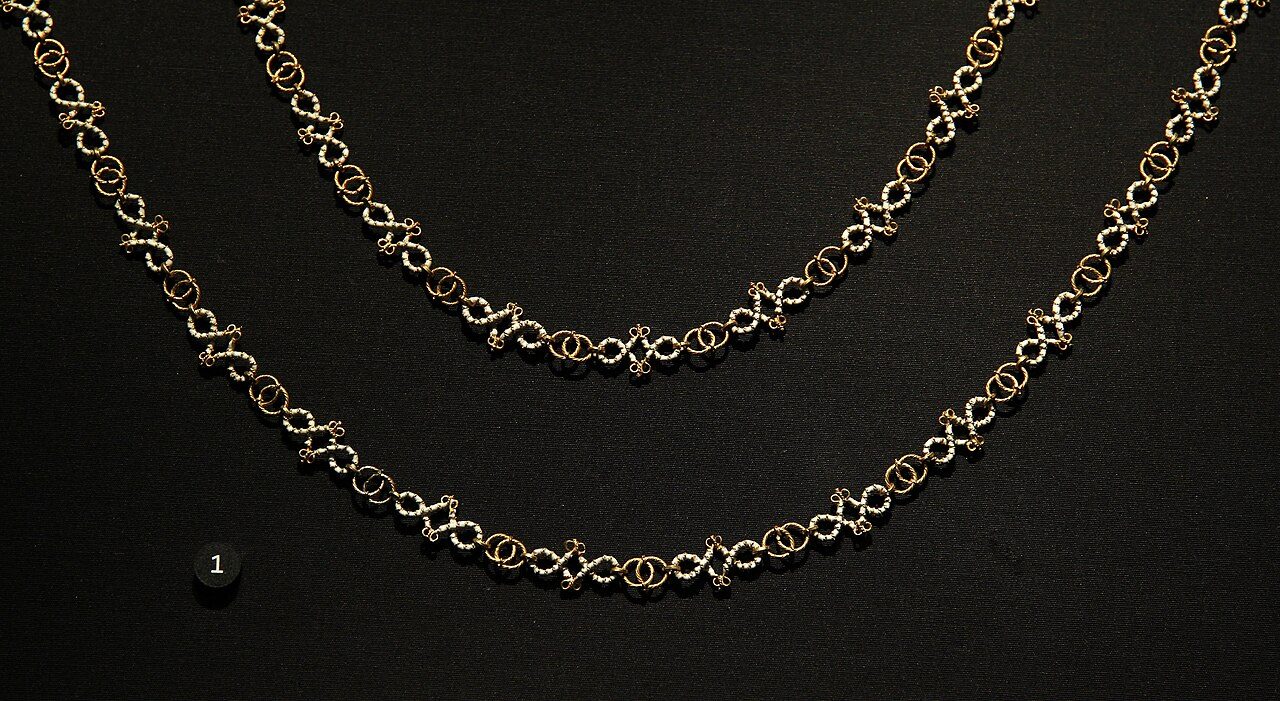
A chain of linked lovers' knots in enamelled gold, now in the Victoria and Albert Museum.
What is in it
A jeweller's working stock: enamelled gold rings, pendants, chains, buttons and hat ornaments, loose and set gemstones, cameos and intaglios, scent bottles, a watch set in an emerald and small vessels of rock crystal.
Size: about 400 to 500 items (accounts differ).
| Item | Number | Notes |
|---|---|---|
| Jewellery | most of the hoard | Rings, pendants, brooches, buttons, chains and hat ornaments, mostly in enamelled gold |
| Gemstones, cameos and intaglios | many | Loose and set stones from Colombia, India, Sri Lanka, Persia, Afghanistan and elsewhere; some fakes of dyed quartz |
| Vessels and accessories | a few | Scent bottles, fan holders, rock-crystal vessels and a salt cellar |
| Watch | 1 | Movement of about 1600 signed G. Ferlite, cased in a hollowed Colombian emerald |
How it is dated
The intaglio seal with the arms of William Howard, Viscount Stafford, cannot be earlier than his ennoblement in November 1640, which gives the earliest possible burial date. The Great Fire of September 1666 destroyed the buildings above the cellar, so the hoard must have been in the ground by then. The style of the jewellery, late 16th and early 17th century, fits that window.
What happened after the find
The finders sold the hoard to a dealer, who passed it to the London Museum with funds from Lewis Harcourt. The Goldsmiths' Company, which owned the site, did not claim it and no treasure trove inquest was held.
Where sources differ
- Object count: Wikipedia says more than 400 pieces; London Museum says around 500.
- Burial date: London Museum gives about 1640; the seal only fixes 1640 to 1666.
- Kris Lane's East Indies (Polman) origin is a hypothesis, not established.
- Which pieces will be on display when London Museum's Smithfield site opens (28 November 2026) was not confirmed.
Questions
Where can I see the Cheapside Hoard?
Almost all of it belongs to London Museum (formerly the Museum of London), which is reopening at West Smithfield on 28 November 2026. About 25 pieces are in the British Museum and about five in the Victoria and Albert Museum.
Who buried the Cheapside Hoard?
Nobody knows. The site and contents point to a goldsmith-jeweller's stock in Goldsmiths' Row, probably hidden around the start of the Civil Wars. A seal in the hoard proves it was buried after November 1640 and before the Great Fire of 1666.
How was the Cheapside Hoard found?
Workmen demolishing a building in Cheapside in June 1912 found it under a cellar floor. They sold it to the dealer George Fabian Lawrence, who arranged for the London Museum to acquire it.