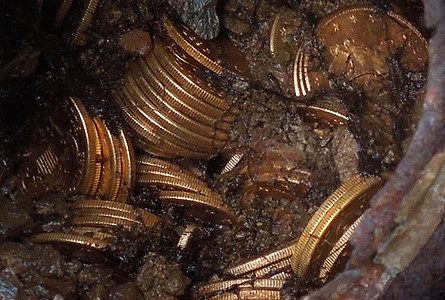
In February 2013 a couple walking their dog on their own land in Northern California noticed the edge of a rusted metal can poking out of the soil beside a path they had used for years. It was stuck fast and so heavy that they guessed it held old paint. On the way back to the house the lid cracked and showed the rim of a gold coin.
Returning with hand tools and later a metal detector, they found a second can about a foot from the first and eventually eight in all, holding 1,427 United States gold coins with a face value of $27,980. Almost all are $20 double eagles; there are fifty $10 eagles and four $5 half eagles, dated from 1847 to 1894. Nothing comparable had been dug up in the United States: the previous record, a find by city workers in Jackson, Tennessee, in 1985, had a face value of about $4,500.
The couple, who have stayed anonymous, named the find after a saddle-shaped rock on the hill above the spot. Looking back, they realized the rock and an old can hanging from a nearby tree, long since grown into the bark, may have been markers left by whoever buried the coins. They kept the location secret to protect the land from trespassing treasure hunters, saying only that it lies in the state's Gold Country.
What makes the hoard remarkable to collectors is condition. Many coins had barely circulated, and Professional Coin Grading Service graded more than a dozen as the finest or joint-finest known of their date. An 1866 San Francisco double eagle without the motto "In God We Trust" was valued at around $1 million on its own. The hoard as a whole was estimated at about $10 million.
Who buried it is unknown. Early speculation linked it to a theft of $30,000 in gold from the San Francisco Mint in 1901 by an employee, Walter Dimmick, but the U.S. Mint said in March 2014 that it had no information connecting the coins to any theft from its facilities, and the mix of dates and conditions argues against a single haul. Stories involving Jesse James, the stagecoach robber Black Bart or a secret Confederate society have no support. The most likely owner is someone who preferred a hole in the ground to a bank, saving gold over years, which would explain why the coins span almost half a century.
The numismatic firm Kagin's handled conservation and sale, mostly through an online marketplace in 2014. Because the coins were found on the finders' own land and the Mint made no claim, ownership was never disputed in court, though several people came forward claiming ancestors had buried it.
Highlights
A $20 coin from the San Francisco Mint of the year the motto was added, struck before the change; valued at around $1 million.
Graded MS62+ by PCGS and the finest known of its type and date.
Eight metal cans, some almost rusted away, in which the coins were buried.
What is in it
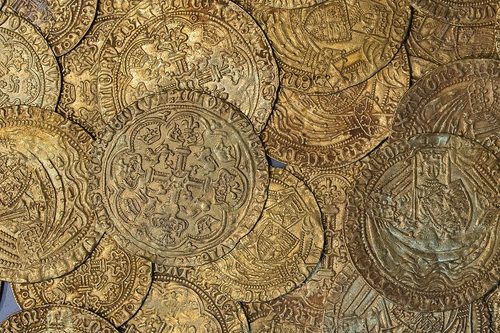
Gold coins of the United States in eight decaying metal cans: overwhelmingly $20 double eagles, with fifty $10 eagles and four $5 half eagles, many in near-mint condition.
Size: 1,427 gold coins.
| Item | Number | Notes |
|---|---|---|
| $20 double eagles | 1,373 | $27,460 face value; many struck at San Francisco |
| $10 eagles | 50 | $500 face value |
| $5 half eagles | 4 | $20 face value |
| Metal cans | 8 | The containers, badly rusted |
Photographs
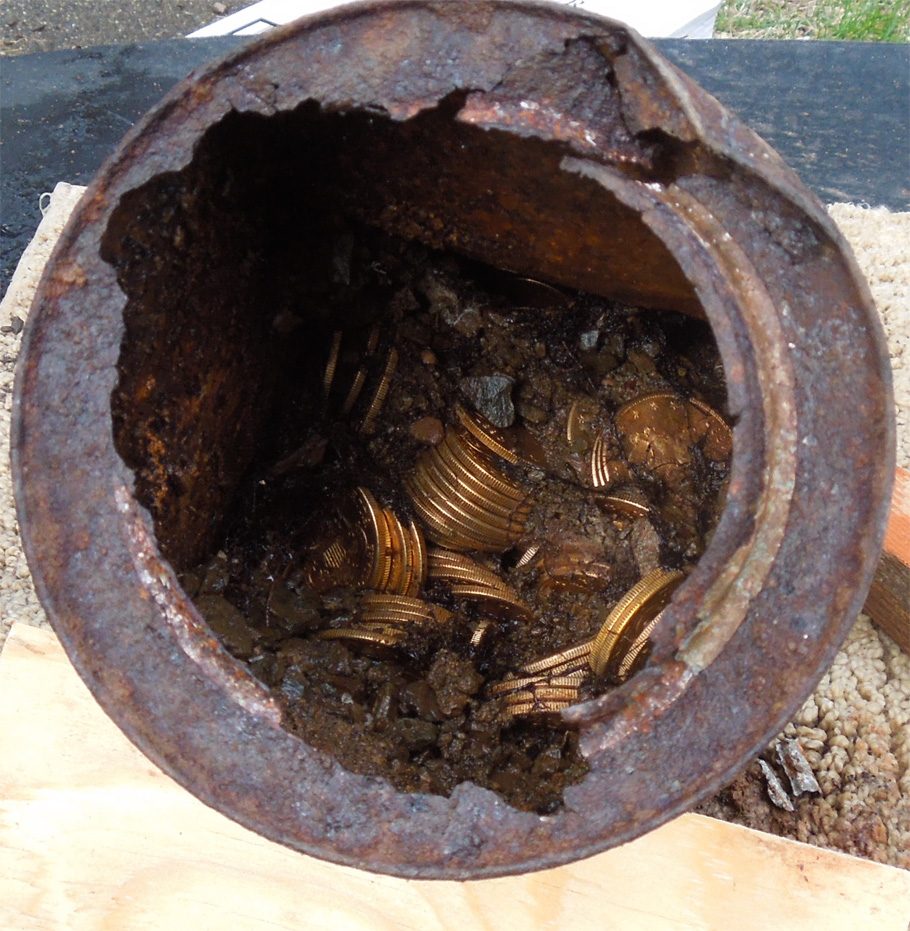
Photo: Kagin's Inc., CC BY-SA 3.0, via Wikimedia Commons
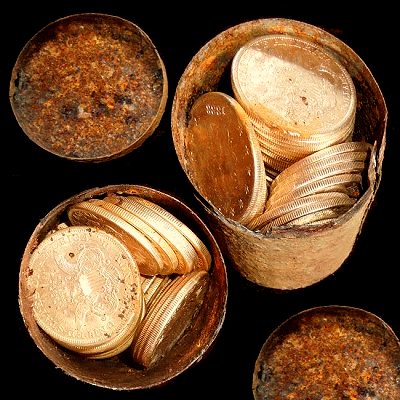
Photo: Kagin's Inc., CC BY-SA 3.0, via Wikimedia Commons
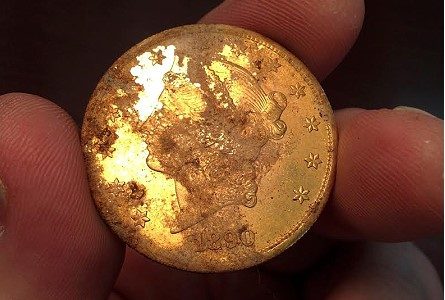
Photo: Kagin's Inc., CC BY-SA 3.0, via Wikimedia Commons
How it is dated
The coins run from 1847 to 1894, so the last were added in 1894 or later. Nothing else, such as the cans themselves, has been published to narrow the date. The spread of dates and the mix of worn and pristine coins suggest savings built up over years rather than a single deposit.
What happened after the find
Found on the finders' own land, so they owned it outright; the U.S. Mint investigated and made no claim. Under federal tax rules, treasure trove counts as taxable income in the year it comes into undisputed possession.
Where sources differ
- Exact location is deliberately undisclosed; the map point is a generic position in California's Gold Country.
- The PCGS press release gives a face value of 'about $27,000'; Wikipedia gives $27,980 with a breakdown by denomination.
- Who buried the coins, and when after 1894, is unknown.
- The share of coins struck at San Francisco is not published; 'many' is used.
Questions
Where was the Saddle Ridge Hoard found?
On private land in Northern California's Gold Country. The owners have never disclosed the exact place, to keep treasure hunters off their property.
How much was the Saddle Ridge Hoard worth?
The 1,427 coins had a face value of $27,980 but were estimated at about $10 million in 2014, because many were rare dates in exceptional condition.
Was the Saddle Ridge Hoard stolen from the San Francisco Mint?
No evidence links it to the 1901 Mint theft, and the U.S. Mint said so in 2014. The varied dates and wear suggest a private stash built up over many years.