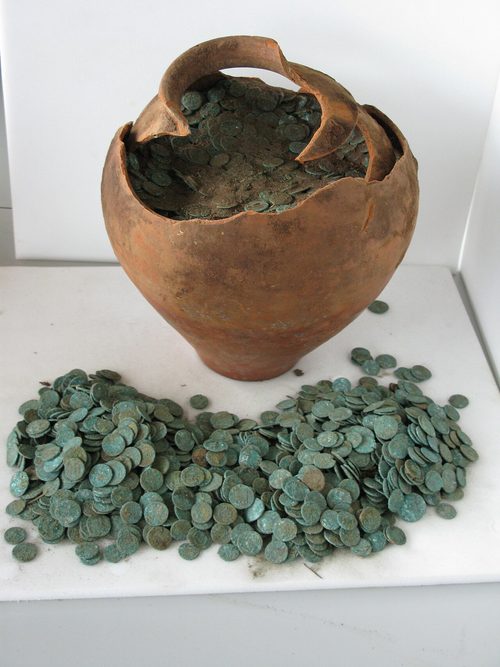
Most big coin hoards turn up in fields. The Beau Street Hoard came from the middle of a Roman town, found by professional archaeologists rather than a detectorist. In 2007 Cotswold Archaeology was excavating on Beau Street in Bath, about 150 metres from the Roman Baths and the temple of Sulis Minerva, ahead of the building of a new hotel and spa. Beneath the floor of a Roman building, in a small pit about 40 by 30 cm set against a masonry wall, they found a solid mass of corroded coins.
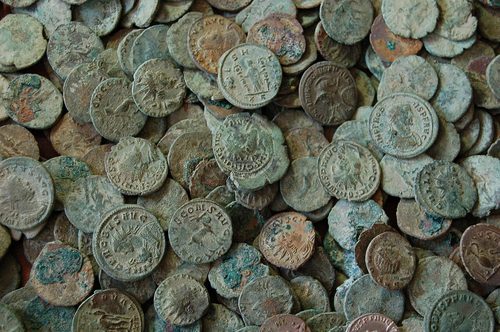
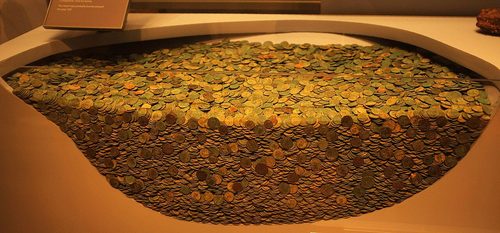
Rather than pick it apart on site, the team recorded its position, boxed the whole block in a wooden crate and lifted it out by crane for study at the British Museum. X-rays showed that the coins had been packed in separate bags; six were visible at first and two more emerged during conservation, eight in all. Traces of the leather survived, preserved by the copper salts from the coins. Early estimates of up to 30,000 coins were revised downwards as conservators separated and cleaned every coin to the point where it could be identified, and the final count was 17,577. It is the largest hoard ever found in a Roman town in Britain.
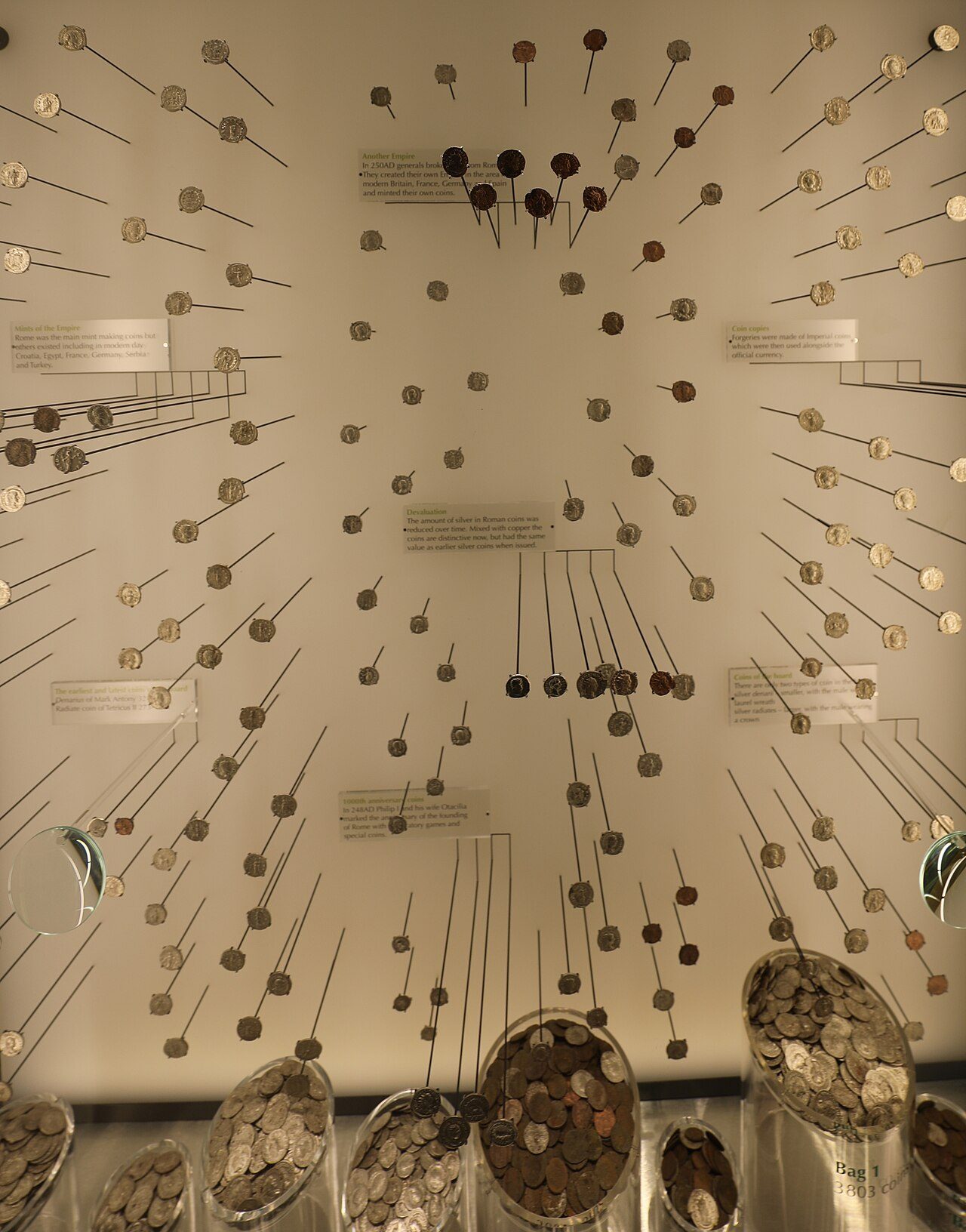
The bags were not filled at random. One held almost nothing but denarii, the old silver coins of the early Empire, running from a coin of Mark Antony struck in 32 BC, already about three centuries old when it was buried, down to Gordian III in the 240s. Four held radiates of the mid-3rd century with a fair amount of silver. The remaining three were filled with the badly debased radiates of the late 260s and 270s, some little more than bronze. The owner, or a series of owners, seems to have sorted money by its metal content, keeping the older, better silver apart.
That careful sorting fits the period. The middle of the 3rd century was a time of runaway inflation, rival emperors and the breakaway Gallic Empire, which held Britain from 260 to 274. Good coins were hoarded and bad ones spent. Whether the Beau Street money was put together over decades and buried in one go, or added to over time, is not known; the latest coins in most bags date to around 272-274.
Why it was never recovered is also unknown. The site itself had a history: in the 1860s, when a hospital extension was built here, a Roman bathing suite with an underfloor hypocaust was uncovered, though whether it belonged to a private house or a public building is unclear.
The hoard went through the Treasure Act process and was bought for the Roman Baths with a Heritage Lottery Fund grant of £372,500 and public donations. It went on display there in 2015.
Highlights
A legionary denarius struck in 32 BC, the oldest coin in the hoard and roughly three hundred years old when it was buried.
A single bag of over 1,700 denarii, kept apart from the radiates, shows how carefully good silver was separated from debased coin.
Remains of the leather bags survived on the coins, preserved because copper corrosion kept the bacteria that rot leather at bay.
What is in it
Roman denarii and radiates spanning about three centuries, sorted into eight leather bags that had fused into a single block.
Size: 17,577 coins.
| Item | Number | Notes |
|---|---|---|
| Bag of denarii (bag 6) | 1,795 | 1,771 denarii from 32 BC to the 240s, the latest of Gordian III, with a few radiates |
| Bags of good-silver radiates (bags 1, 3, 4, 5) | 9,653 | mostly higher-silver radiates up to the 260s-270s |
| Bags of debased radiates (bags 2, 7, 8) | 3,692 | low-silver coins up to 272-274, some almost pure bronze |
| Loose coins | 2,437 | not attributable to a bag |
How it is dated
The latest coins, found in several of the bags, were struck in 272-274, so the hoard was buried in or soon after that time. The span of the denarii shows that some of the money had been saved, or passed down, for decades.
What happened after the find
As treasure under the Treasure Act 1996, the hoard was offered to museums. Bath and North East Somerset Council bought it for the Roman Baths with a Heritage Lottery Fund grant awarded in March 2014 and public donations.
Where sources differ
- Find year: Cotswold Archaeology and the Heritage Lottery Fund say 2007; Wikipedia says 2008.
- Opening of the display: Cotswold Archaeology gives 14 March 2015; Wikipedia says January 2015.
- Whether the hoard was deposited in one event or added to over time is not known.
- The leather: some reports say animal skin pouches; the earliest reports thought it was a wooden box.
Questions
Where can I see the Beau Street Hoard?
At the Roman Baths in Bath, a short walk from where it was found. It has been on permanent display there since 2015.
How many coins are in the Beau Street Hoard?
17,577, once every coin had been separated and cleaned at the British Museum. Early estimates of up to 30,000 proved too high.
Who found the Beau Street Hoard?
Archaeologists from Cotswold Archaeology, during an excavation ahead of building work on Beau Street. It is the largest hoard found in Britain by professional archaeologists.