In August 2009 a man who had taken up metal detecting only a month before was sheltering from rain beside a public bridleway near Shrewsbury when he decided to switch on his machine. After a few shotgun cartridges and a single Roman coin, he hit a clump of coins and then a pot full of them. He dug the pot out himself, but took it to the Portable Antiquities Scheme Finds Liaison Officer for Shropshire and Herefordshire and later led him and county archaeologists to the spot for a small excavation.
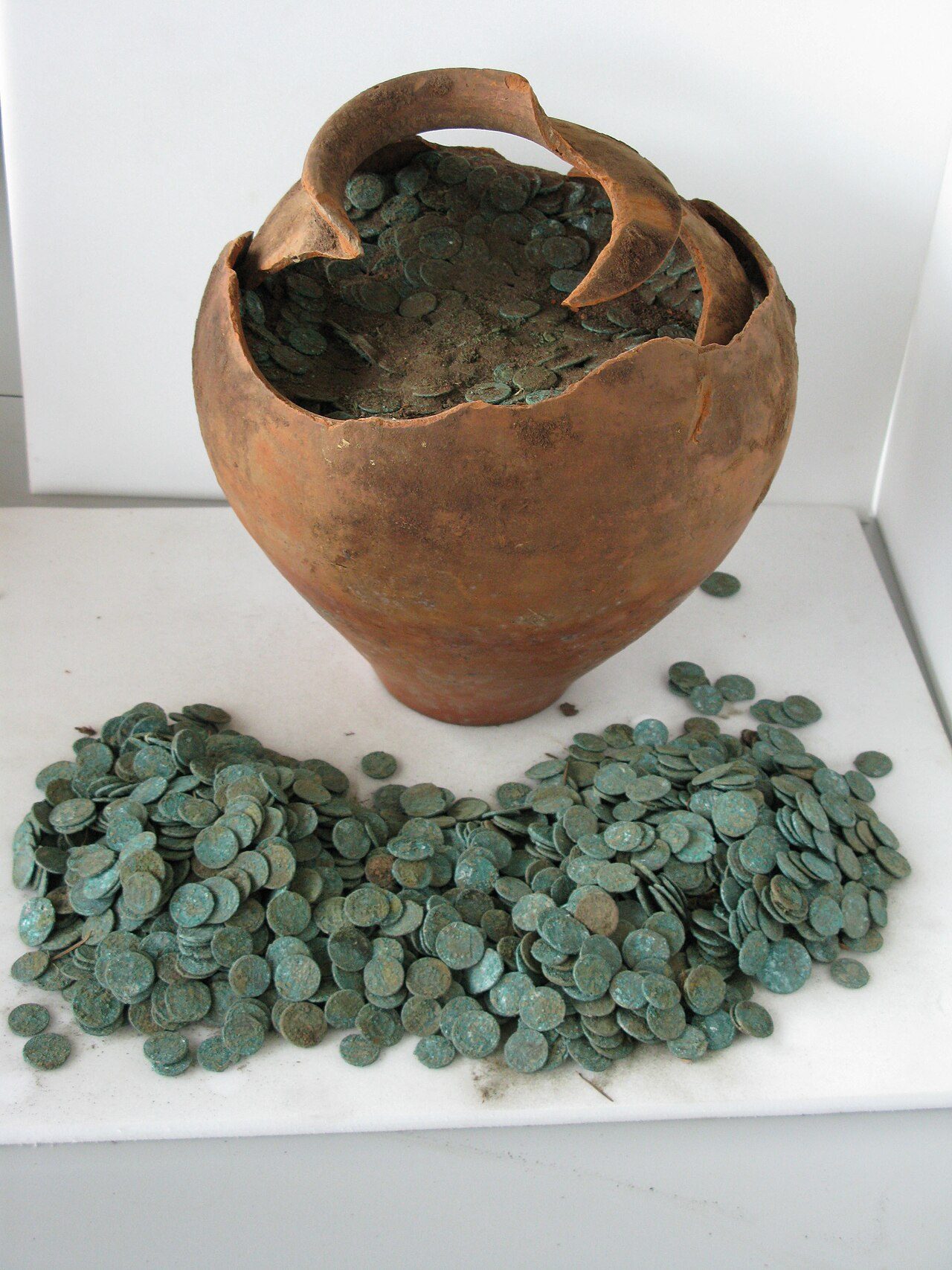
The pot was a large brown storage jar. With its coins it weighed about 32 kg. Its top had broken off, and about 300 coins lay scattered round it. The excavation showed that a large stone had been set over it, probably as a marker, and the coins inside had gone in at two different times. The lower layers date to around AD 320; the upper ones to 333-335. Whoever buried the jar seems to have kept it partly full for some years and then topped it up before sealing it.
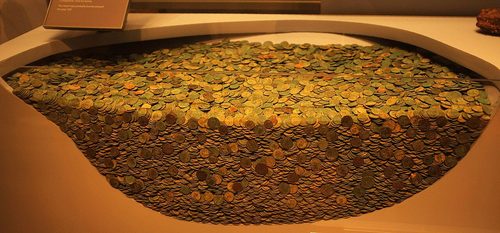
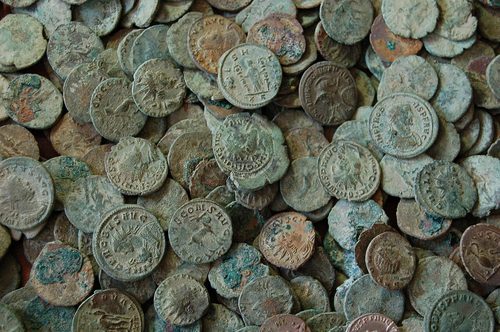
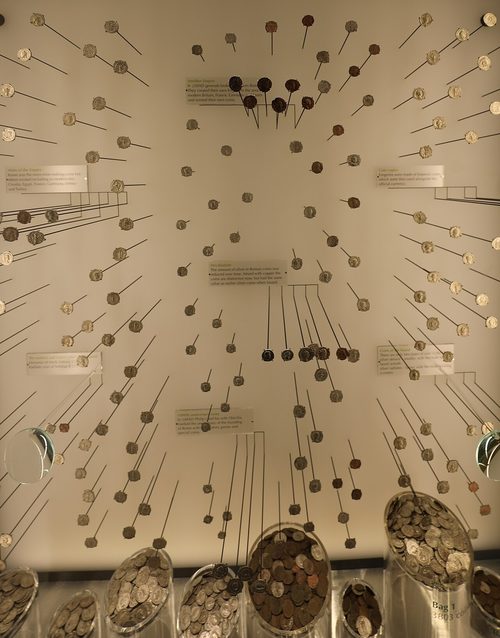
When the coins had been cleaned at the British Museum the total stood at 9,315. Almost all are nummi, the small bronze coins, some with a thin silver wash, that were the everyday small change of Constantine the Great's later reign and of the early years of his sons. A few much older radiates of the later 3rd century had found their way in too.
Two finds near the bottom of the jar add a human touch. A scrap of cloth survived because copper salts from the coins stopped it decaying, and an iron nail lay with it. They may be the remains of a cloth bag fastened with the nail; the excavators also considered whether they were placed as a small offering.
Under Constantine, Britain produced food for export to other parts of the Empire, and the Finds Liaison Officer has suggested the money could have been earned by a farmer or farming community from the harvest and dipped into as needed. Its value was modest: the inquest heard that it was probably worth less than a year's pay for a legionary soldier.
The way the hoard came out of the ground is a reminder of the rules. The coroner praised the finder for not disturbing the layers inside the pot, but criticised him for detecting without permission. When the hoard was declared treasure in 2011, that mattered: under the Treasure Act a finder who was trespassing can receive a reduced reward or none.
Highlights
A large brown pottery jar, displayed with its coins, that held the hoard under a marker stone.
A fragment of cloth preserved by copper salts, found with an iron nail at the base of the jar; perhaps the remains of a bag, perhaps an offering.
What is in it
Bronze and silver-washed nummi of Constantine I and his sons, with a few older radiates, in a large pottery storage jar, along with a scrap of cloth and an iron nail.
Size: 9,315 coins.
| Item | Number | Notes |
|---|---|---|
| Nummi | almost all | AD 313-335, late reign of Constantine I and his sons Constantine II, Constantius II and Constans |
| Radiates | a very few | AD 260-293 |
| Scattered coins | about 300 | recovered round the broken top of the pot |
| Other finds | 2 | an iron nail and a piece of cloth near the bottom of the jar |
How it is dated
The latest coins in the upper part of the jar were struck in 333-335, and those at the bottom are at least ten years earlier. The jar was therefore filled in stages and finally sealed in about AD 335.
What happened after the find
A coroner's inquest on 25 October 2011 declared the coins treasure under the Treasure Act 1996. Because the finder had no permission to detect on the land, his share of any reward could be reduced or withheld. Shropshire Council's museum service acquired the hoard.
Where sources differ
- Early reports estimated at least 10,000 coins; the final count is 9,315, and some reports say 'more than 9,000'.
- The 32 kg figure (70 lb) includes the pot; the coins alone were not weighed in any source consulted.
- The harvest-payment explanation is a suggestion by the Finds Liaison Officer, not established fact.
- The amount of any reward paid is not published in the sources consulted.
Questions
Where can I see the Shrewsbury Hoard?
In the Roman gallery of Shrewsbury Museum and Art Gallery, which is run by Shropshire Council. The pot is shown with its coins.
How old is the Shrewsbury Hoard?
The coins were struck between about AD 313 and 335, with a few older ones, and the jar was sealed around 335. That makes the hoard about 1,690 years old.