The Roman town of Cunetio lay beside the River Kennet near the modern village of Mildenhall in Wiltshire, and grew from a small settlement into a market centre for the area. In 1978 metal detectorists working there found a hoard of Roman coins packed into two containers, a large pottery jar and a lead box. According to the Wiltshire Museum, the finders did not report the discovery at first, and archaeologists were able to make only a brief recovery of the remains.
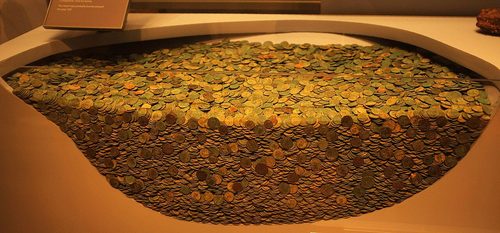
The size of the find soon became clear. When the coins were counted at the British Museum the total came to 54,951, which makes it the largest hoard of Roman coins yet found in Britain. Even that figure is partly an estimate, because a small block of fused coins was kept intact for future study. Together the coins weigh well over 180 kg.
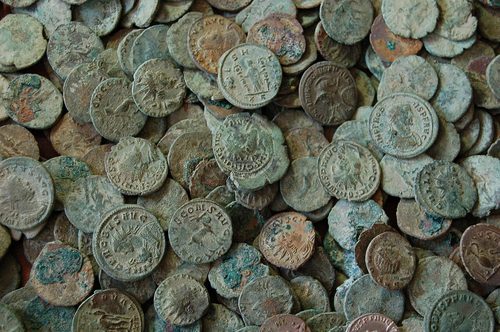
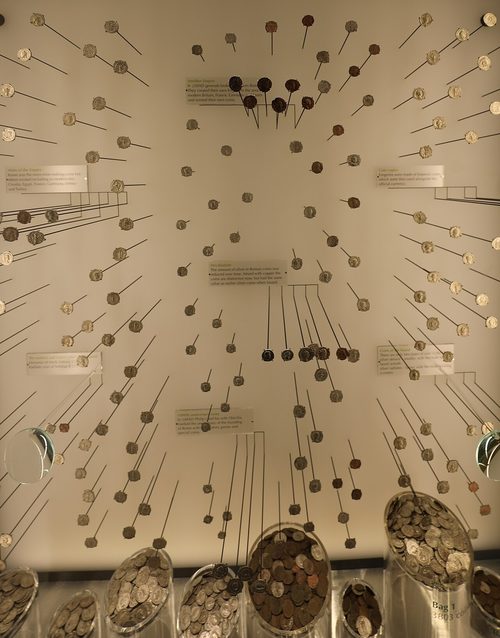
They are almost all radiates, so called from the spiked crown the emperor wears on them. In the middle of the 3rd century these coins were meant to be silver, but repeated debasement left most of them as bronze with a thin silver wash. The hoard spans roughly the 250s to the 270s. Most of the coins were struck by the Gallic Empire, the breakaway state founded by Postumus in 260 that held Britain and Gaul until 274.
Sadly, the contents of the jar and the lead box were mixed before they could be studied, so it is not known whether the two containers held different groups of coins or were filled at different times. That loss is the main reason the Cunetio hoard has taught less about how it was buried than later finds such as Frome, whose coins were lifted in recorded layers.
Hoards of this kind are common in late 3rd-century Britain, a period of inflation, rival emperors and coastal raids, and the usual explanation is that owners hid savings and failed to return. At Cunetio the scale suggests a wealthy owner or a store of money linked to the town's markets. The town has produced other coin finds, including a smaller hoard in 1960.
The two halves of the find were separated for forty years: the coins went to the British Museum and the jar to the Wiltshire Museum in Devizes. In 2018 the British Museum lent a hundred coins so that they could be shown with their jar for the first time since 1978. The site of the town was later surveyed and excavated for the television programme Time Team in 2009.
Highlights
The large pottery vessel that held part of the hoard, on show at the Wiltshire Museum in Devizes.
Coins of Postumus, Victorinus and the Tetrici make up the bulk of the hoard, a record of the breakaway western empire of 260-274.
What is in it
Tens of thousands of base-silver radiate coins of the third-century crisis, most of them issues of the breakaway Gallic emperors, held in a large pottery jar and a lead container.
Size: 54,951 coins (partly estimated). Weight: over 180 kg (base silver and bronze coins).
| Item | Number | Notes |
|---|---|---|
| Radiate coins | 54,951 | from about AD 250 to the 270s; the majority from the Gallic Empire founded by Postumus in 260 |
| Containers | 2 | a large pottery storage jar and a lead box; the coins were mixed before anyone recorded which came from which |
How it is dated
The latest coins date to around the mid-270s and the Wiltshire Museum puts the burial at about AD 274, the year the Gallic Empire was reabsorbed by Aurelian.
What happened after the find
Accounts say the detectorists did not report the find at first, and archaeologists could make only a brief recovery. The coins were deposited at the British Museum in 1978; the legal process followed at the time is not described in the sources consulted.
Where sources differ
- The total of 54,951 includes an estimate for a block of coins kept unseparated.
- The weight (over 180 kg, 390 lb) comes from Wikipedia only.
- The circumstances of discovery are thinly published: the Wiltshire Museum says the detectorists did not report the find; how it reached the British Museum is not documented in the sources consulted.
- The end date of the coin series is given loosely (AD 250-275 in Wikipedia; burial c. 274 per the Wiltshire Museum).
Questions
What is the largest Roman coin hoard found in Britain?
The Cunetio Hoard from Wiltshire, with 54,951 coins, found in 1978. The Frome Hoard of 2010, with 52,503 coins, is the next largest.
Where are the Cunetio coins now?
The coins are in the British Museum. The pottery jar that held part of them is displayed at the Wiltshire Museum in Devizes, which borrowed a hundred coins to show beside it in 2018.
Why is it also called the Mildenhall Hoard?
Cunetio lies beside the village of Mildenhall in Wiltshire, so the find is sometimes named after it. It is unrelated to the Mildenhall Treasure of silver tableware from Suffolk.