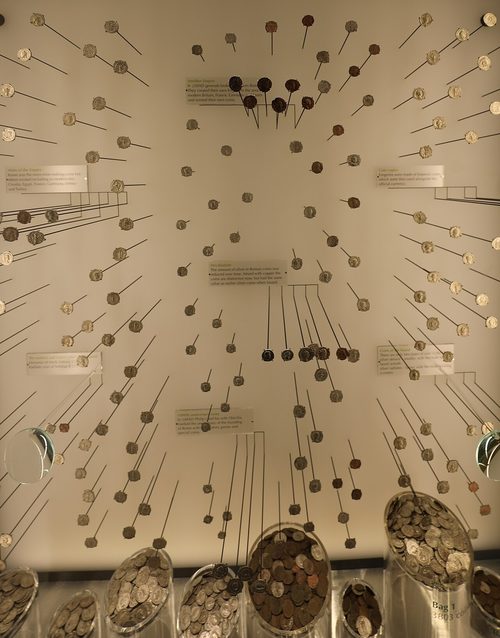
In November 2013 a metal detectorist searching farmland near Seaton in east Devon found Roman coins in the ground. He reported it straight away to the local Finds Liaison Officer of the Portable Antiquities Scheme and the county's historic environment team, and an excavation was organised with AC Archaeology, the finder, the landowners and county staff. The coins were kept in a strongroom at the Devon Heritage Centre and then taken to the British Museum to be counted, cleaned and identified.
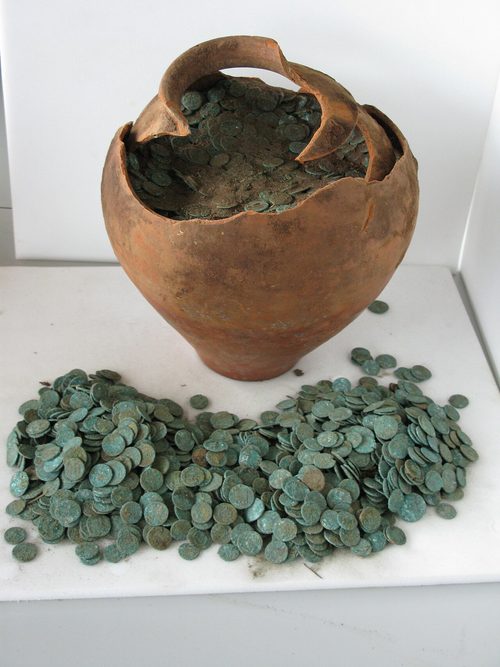
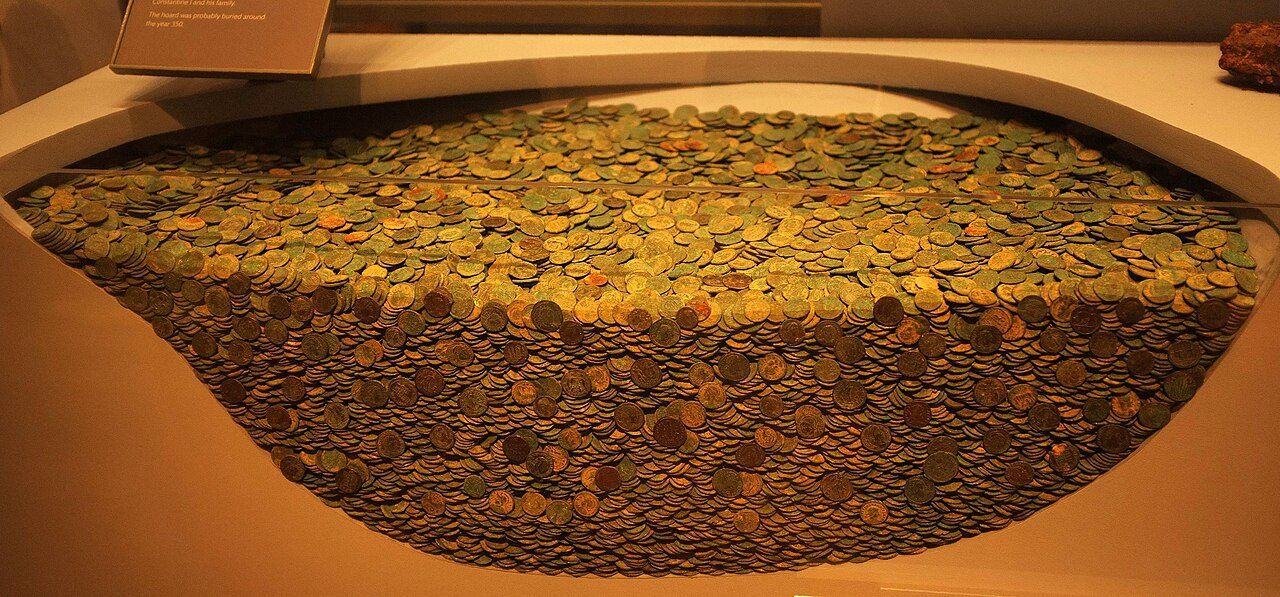
The excavation showed that the coins had been buried as one group in a small pit on their own. The lozenge-shaped outline of the deposit, and scraps of material that survived among the coins, suggest they were packed in a bag of cloth or soft leather. The total came to 22,888, one of the largest Roman coin hoards ever found in Britain and by far the largest from Devon.
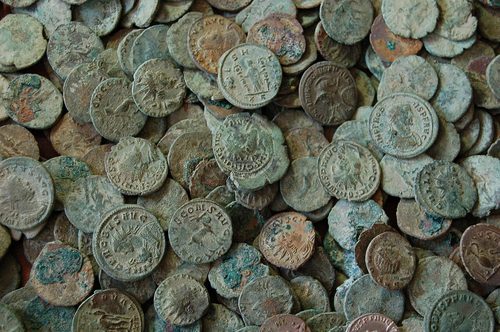
Almost all of them are nummi, the small copper-alloy coins issued in huge numbers between about 330 and 341 under Constantine the Great and his sons. They include the commemorative types struck to celebrate Rome and the new capital at Constantinople. A handful of older coins reach back to the 260s, and the latest were struck in 347-348, when Constantius II and Constans ruled jointly. Constans was the last legitimate emperor to visit Britain.
In spite of its bulk, the hoard was not a fortune. The archaeologists estimated that its value would have been roughly four gold solidi, perhaps enough to feed four soldiers for a year or pay a labourer for two. Why someone buried so much small change is unknown. The coins were found near the Roman site at Honeyditches, where remains of a Roman fort and a possible villa have been identified, so the money may have belonged to someone living or trading there.
One of the coins has its own small fame. A nummus of Constantine I, struck at Lyon in 332 for the founding of Constantinople, was chosen as the millionth object recorded on the Portable Antiquities Scheme database, and the hoard was announced in September 2014 to mark that milestone.
After the hoard had gone through the Treasure Act process, the Royal Albert Memorial Museum in Exeter raised the money to buy them with support from local donors, businesses and the public, and acquired the hoard in July 2016. It is a good example of how prompt reporting and a recorded excavation keep a hoard's context intact.
Highlights
A copper-alloy coin struck at Lyon in AD 332, with the personified city of Constantinople on one side and Victory on a ship's prow on the other.
Coins struck in the 330s to celebrate the cities of Rome and Constantinople, part of the flood of small change issued as the new capital was founded.
What is in it
Small copper-alloy coins (nummi) of Constantine the Great's family, with a few older radiates, buried in a fabric or leather bag in an isolated pit.
Size: 22,888 coins.
| Item | Number | Notes |
|---|---|---|
| Nummi of AD 330-341 | about 99% | common coins of Constantine I, his sons and the commemorative issues for Rome and Constantinople |
| Earlier and later coins | a few hundred | from the late 260s up to 347-348 |
How it is dated
The latest coins date to AD 347-348, giving the earliest possible date of burial. With 99% of the coins struck between 330 and 341, the money seems to have been gathered during the 330s and 340s and buried soon after the last issues arrived.
What happened after the find
Reported immediately by the finder and excavated by archaeologists. The coroner declared the hoard treasure under the Treasure Act 1996, and the Royal Albert Memorial Museum, Exeter, acquired it in July 2016 after a fundraising campaign.
Where sources differ
- Rankings differ: the hoard is variously called the third- or fourth-largest from Britain, and early press reports gave 'over 22,000' coins.
- No total weight was found in the sources consulted.
- The exact relationship to the Roman site at Honeyditches is unknown.
Questions
Where is the Seaton Down Hoard?
At the Royal Albert Memorial Museum (RAMM) in Exeter, which bought it in 2016. It has been on display there since 2017.
Was the Seaton Down Hoard valuable in Roman times?
Not very. The 22,888 small copper-alloy coins were worth roughly four gold solidi, perhaps a year's rations for four soldiers.
Why is the Seaton Down Hoard famous?
Besides its size, one of its coins was the millionth find recorded by the Portable Antiquities Scheme, which the British Museum announced with the hoard in 2014.