Roman hoards
c. AD 1-450 · 19 hoards on this site
More coin hoards have been recorded from Roman Britain than from any other province of the empire. A survey published in 2018 counted over 3,260 Iron Age and Roman coin hoards from England and Wales, with a peak of more than 700 from the four decades between AD 253 and 296, and new ones still surface at around fifty a year. The biggest are staggering. The Cunetio Hoard, found in 1978 at a small Roman town in Wiltshire, held 54,951 coins struck between about 250 and 275. The Frome Hoard, dug out of a single pot in Somerset in 2010, held 52,503 coins dating from 253 to 305 and weighed about 160 kg, including the largest group ever found of the usurper Carausius, who ruled Britain on his own account from 286 to 293.
Those numbers flatter the money. The Roman system ran on gold, silver and bronze coins whose metal content the state kept changing. Under Augustus the silver denarius was struck at 84 to the Roman pound, about 3.9 g, and a legionary was paid 225 of them a year; the gold aureus weighed about 8 g and was worth 25 denarii. Through the third century the silver coinage was debased until the 'radiates' that fill Cunetio and Frome were mostly copper with a thin trace of silver. Constantine's gold solidus, struck at 72 to the pound (about 4.5 g) from around 312, then held its weight for centuries. A pot of 50,000 late radiates is a heavy thing but not a fortune; a few dozen solidi might be. The weight explorer sets hoard weights against Roman pay.
The textbook explanation is safekeeping: an owner buried savings, meant to come back, and did not. That reading underlies the old habit of matching hoard peaks to invasions and civil wars, a link that recent work on the British data finds increasingly hard to sustain. Frome is the awkward case. The pot was too big and too fragile to lift out full without breaking, and Sam Moorhead of the Portable Antiquities Scheme has suggested that the coins may be communal offerings poured into it in place rather than a purse to be recovered. Both kinds of hoard surely existed side by side, and the evidence of how a pot was filled and where it was placed matters as much as its contents.
Silver plate tells a different story. The Hoxne Hoard, found in Suffolk in 1992, was packed into an oak chest with smaller boxes and bags inside: 14,865 gold, silver and bronze coins and about 200 pieces of silver tableware and gold jewellery. The latest coins put its burial after AD 407, at the very end of Roman Britain. Outside the frontier, at Hildesheim in northern Germany, soldiers preparing a shooting range in 1868 found about seventy silver vessels of the first century AD, the largest Roman silver find from beyond the empire's borders; whether it was a commander's dinner service or loot is still argued. Britain has the densest record, but not the biggest single finds: a coin hoard from Misrata in Libya is larger than Cunetio, and finds reported from Evreux in France and Komin in Croatia are said to have run to 100,000 and 300,000 coins.
Roman hoards
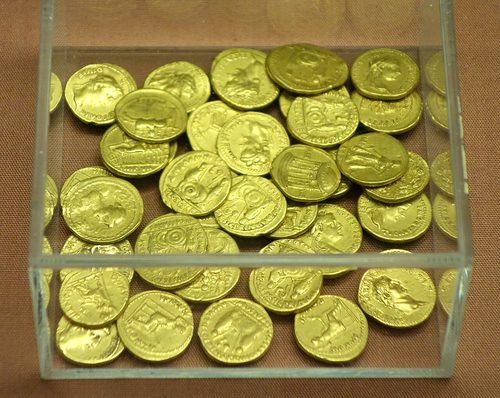
Bredgar Hoard
34 Roman gold aurei from Julius Caesar to Claudius, buried in Kent around AD 43, the year of the invasion, and found by a house-builder in 1957.
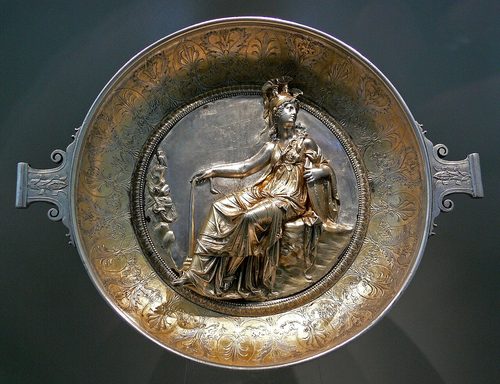
Hildesheim Treasure
Over 70 pieces of Augustan Roman table silver, dug up by Prussian soldiers near Hildesheim in 1868: the largest Roman silver find beyond the frontier.
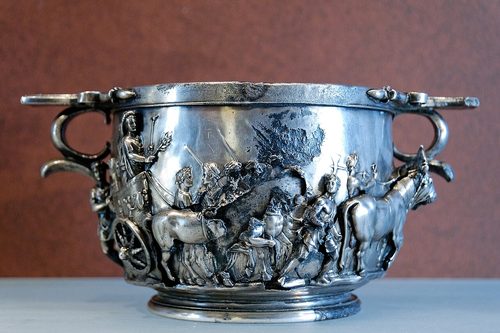
Boscoreale Treasure
More than 100 pieces of Roman silver and about 1,000 gold coins, hidden in a villa's wine-press room when Vesuvius erupted in AD 79 and found in 1895.
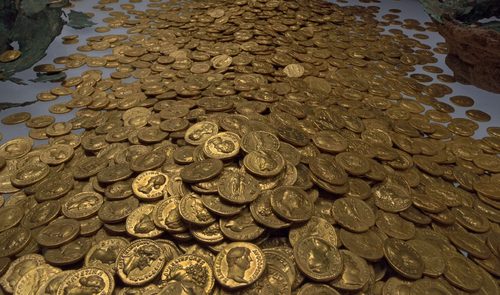
Trier Gold Hoard
Over 2,500 Roman gold aurei, 18.5 kg, torn from a cellar by a digger in Trier in 1993: the largest surviving hoard of Roman gold coins.
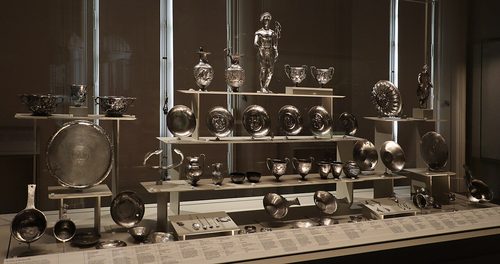
Berthouville Treasure
About 90 silver offerings to Mercury, some 25 kg in all, ploughed up in a Normandy field in 1830: the richest Roman temple treasure known from Gaul.
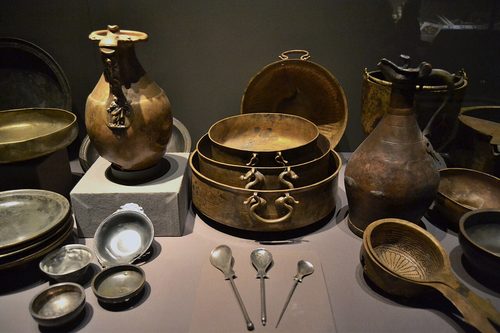
Neupotz Hoard
Over 1,000 objects and about 700 kg of Roman metalwork, booty lost in the Rhine around AD 260 and dredged up by a gravel works at Neupotz in 1967-1997.
Cunetio Hoard
54,951 Roman radiate coins, buried around AD 274 in a jar and a lead box at Roman Cunetio, Wiltshire: the largest coin hoard from Roman Britain.
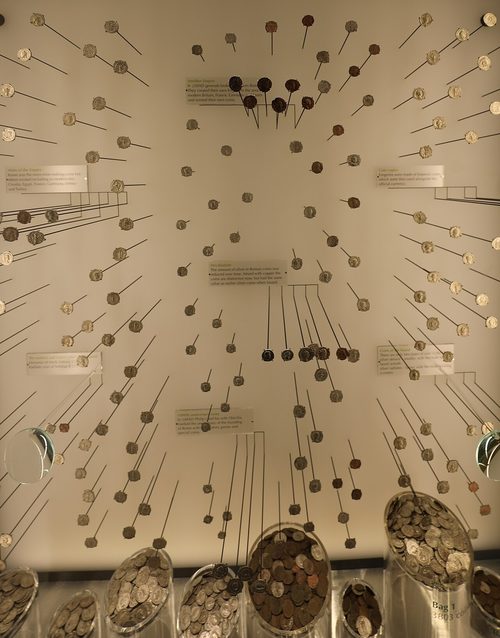
Beau Street Hoard
17,577 Roman silver and base-silver coins in eight leather bags, buried under a building 150 m from the Roman Baths at Bath around AD 274.
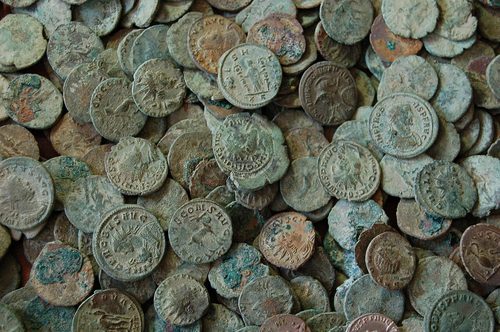
Frome Hoard
52,503 Roman coins, about 160 kg, poured into one pot near Frome, Somerset, around AD 290, including the largest group ever found of the usurper Carausius.
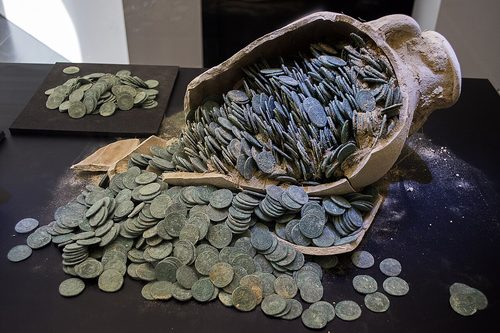
Tomares Hoard
About 53,000 freshly minted Roman bronze coins, some 600 kg packed in 19 amphorae, hit by a digger in a park near Seville in April 2016.
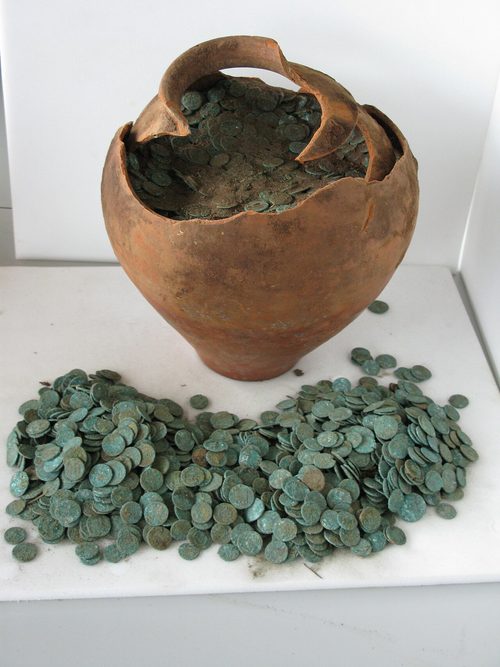
Shrewsbury Hoard
9,315 bronze Roman coins of Constantine's family in a storage jar near Shrewsbury, filled in two stages and sealed around AD 335 under a marker stone.
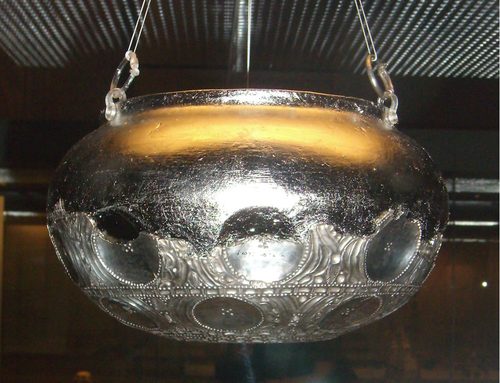
Water Newton Treasure
Nine silver vessels and some 18 votive plaques marked with the Chi-Rho, ploughed up at Roman Durobrivae, 1975: the earliest known Christian church plate.
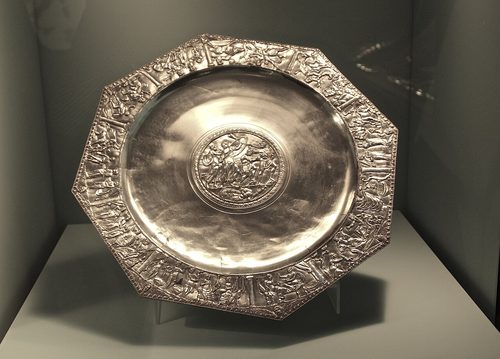
Kaiseraugst Treasure
270 pieces and 58 kg of late Roman silver, buried in a Rhine fortress around AD 351 and scooped up by a digger in 1961, including the Achilles dish.
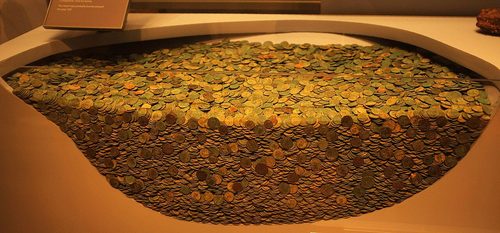
Seaton Down Hoard
22,888 copper-alloy Roman coins buried in a bag near Seaton, Devon, around AD 348; one became the millionth Portable Antiquities Scheme find.
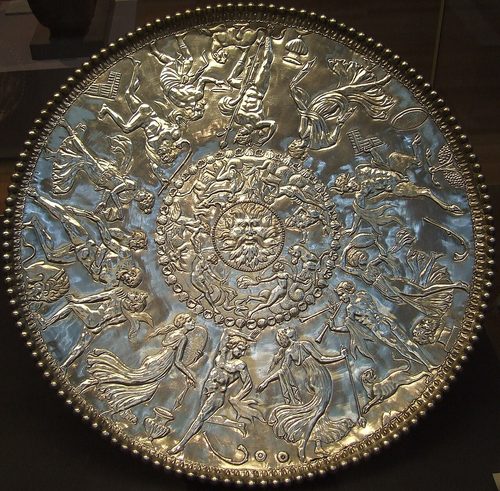
Mildenhall Treasure
Thirty-four pieces of 4th-century Roman silver tableware ploughed up at West Row, Suffolk, in 1942, led by the 8.3 kg Great Dish of Oceanus and Bacchus.
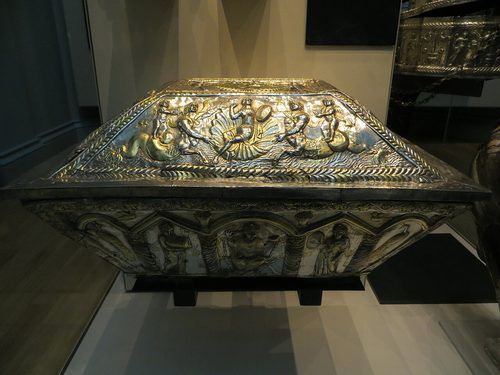
Esquiline Treasure
Late Roman silver of an aristocratic family, found on Rome's Esquiline Hill in 1793, with the Projecta wedding casket. Most is in the British Museum.
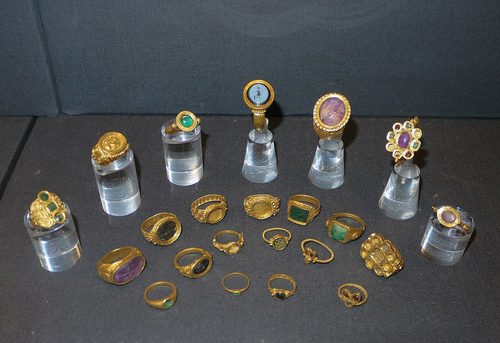
Thetford Hoard
81 late Roman objects from Thetford, Norfolk: 22 gold rings, a satyr belt buckle and 36 silver spoons and strainers, many dedicated to the god Faunus.
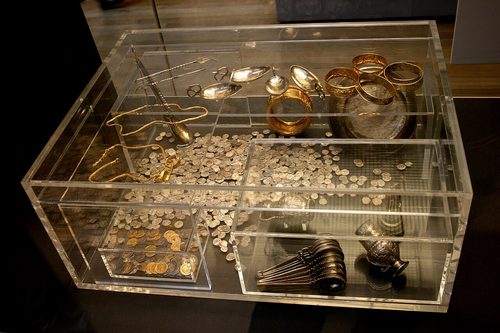
Hoxne Hoard
A Suffolk oak chest packed after AD 407 with 14,865 gold, silver and bronze coins, a gold body-chain, pepper pots and nearly 100 silver spoons.
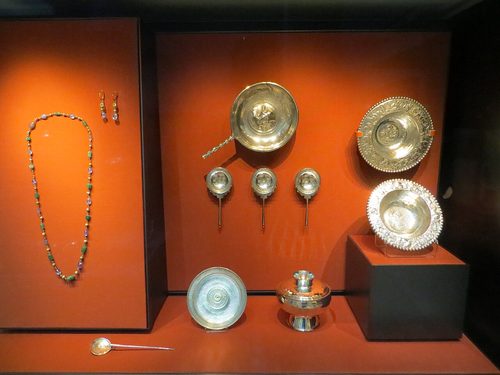
Carthage Treasure
Late Roman silver tableware and jewels of the Cresconii family, 31 objects found on the Byrsa hill at Carthage in the mid-19th century.
Sources
- Iron Age and Roman Coin Hoards in Britain (Bland et al., Oxbow 2018), catalogue record
- Review of Iron Age and Roman Coin Hoards in Britain (Bryn Mawr Classical Review)
- Cunetio Hoard (Wikipedia)
- Frome Hoard (Wikipedia)
- Denarius (Wikipedia)
- Pay (Roman army) (Wikipedia)
- Aureus (Wikipedia)
- Solidus (Wikipedia)
- Hoxne Hoard (Wikipedia)
- Hildesheim Treasure (Wikipedia)