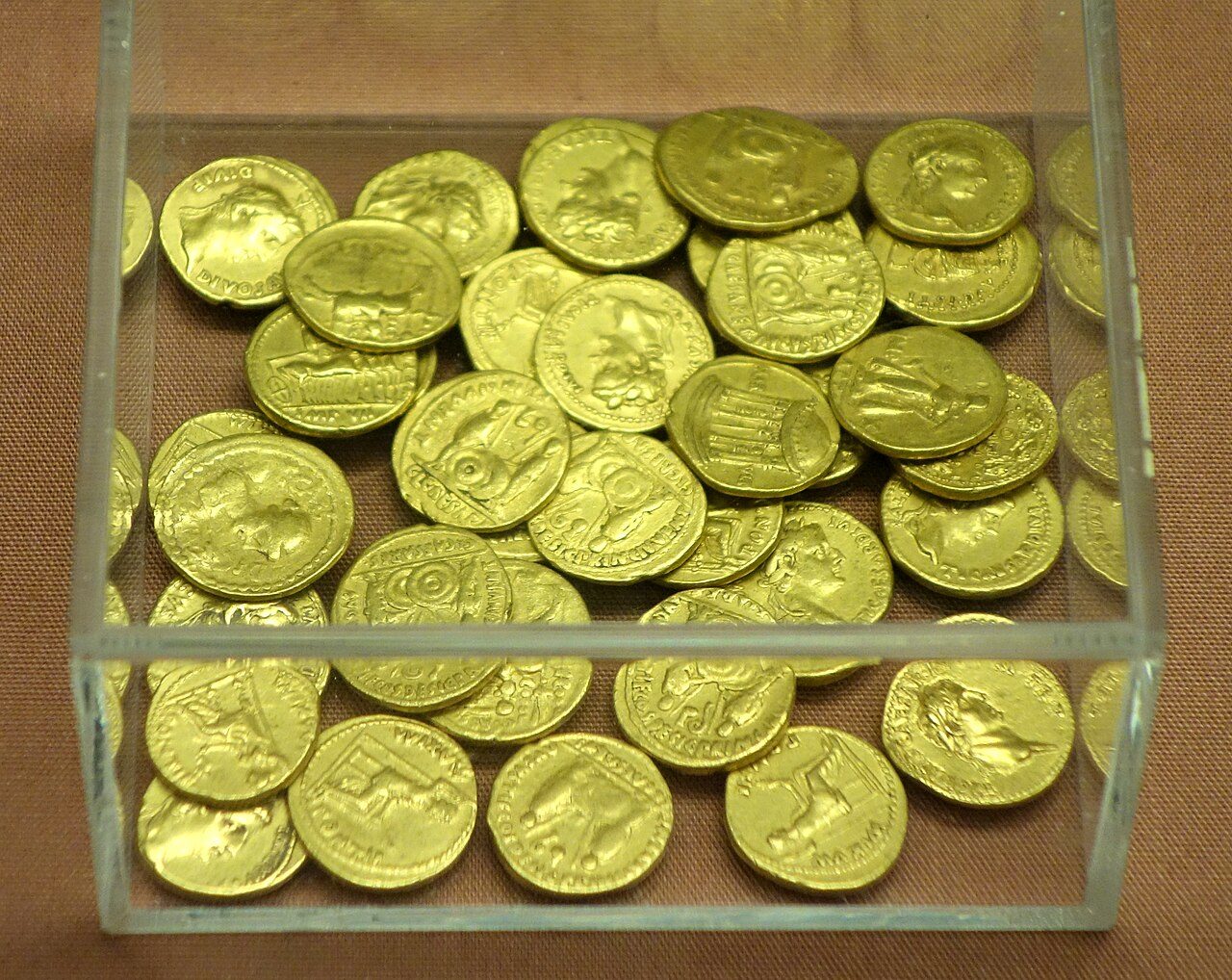
On 29 July 1957 a man digging the foundations for his new bungalow in Bredgar, a village near Sittingbourne in Kent, turned up a small group of gold coins. There were 34 of them, all Roman aurei, and they were declared treasure trove and passed to the British Museum. The owner named the bungalow 'Treasure Trove'.
The coins cover the first ninety years of Roman imperial gold. The oldest is an aureus of Julius Caesar issued in 45 BC. Twelve are of Augustus and seventeen of Tiberius, whose long reign is well represented. One honours Nero Drusus, the father of the emperor Claudius, and the last three are aurei of Claudius himself, struck in AD 41-42.
That last date gives the hoard its fame. Claudius launched the invasion of Britain in AD 43, and one of its first great battles was fought at the crossing of the River Medway in Kent. A purse of gold that ends with coins of 41-42, buried in north Kent, fits that moment remarkably well. It is the earliest gold hoard yet found from Roman Britain.
A sum like this was far beyond the means of an ordinary soldier, and the mixture of old and new coins looks like savings built up over years. The usual suggestion is that it belonged to an officer in the invasion army who buried his money before battle, perhaps at the crossing of the Medway, and was killed or moved on before he could retrieve it. That is an attractive story but cannot be proved. The coins could equally have come into British hands by some other route, and no other objects were found with them to settle the question.
News of the find appeared in the Kent Messenger in August 1957, and the coins were published the following year in the Journal of Roman Studies and in Archaeologia Cantiana, the county's archaeological journal. Ordnance Survey field archaeologists visited in 1963 to fix the findspot, which lay on the line of a drain to the house. No excavation is recorded, so nothing is known of any container or of the ground the coins were buried in.
Small as it is, the Bredgar hoard is one of very few finds that can be tied so closely to a single historical event. A set of electrotype copies, on long-term loan from the British Museum, was placed in Maidstone Museum so that the hoard could be seen in the county where it was found.
Highlights
The oldest coin in the hoard, struck in 45 BC, nearly ninety years before the hoard was buried.
Three coins of AD 41-42, struck under the emperor who ordered the invasion of Britain, which date the burial to the time of the conquest.
What is in it
Thirty-four gold aurei of the first Roman emperors, spanning about ninety years from Julius Caesar to Claudius.
Size: 34 gold coins.
| Item | Number | Notes |
|---|---|---|
| Julius Caesar | 1 | an issue of 45 BC |
| Augustus | 12 | |
| Tiberius | 17 | the largest group |
| Nero Drusus | 1 | struck in memory of Claudius's father |
| Claudius | 3 | AD 41-42, the latest coins |
How it is dated
The three latest coins are aurei of Claudius dated AD 41-42, so the hoard cannot have been buried before then. Its usual date of about AD 43 rests on the absence of later issues and on the link with the invasion, which began in that year.
What happened after the find
Declared treasure trove after its discovery in 1957 and acquired by the British Museum. Electrotype copies were lent to Maidstone Museum.
Where sources differ
- The link with an officer of the invasion army killed at the Medway is speculation.
- A Wikimedia Commons photograph of the British Museum display is captioned '37 gold aurei'; the Kent HER, Wikipedia and the coin breakdown (1+12+17+1+3) give 34.
- Whether the electrotypes are still displayed at Maidstone Museum is not confirmed.
Questions
Where is the Bredgar Hoard?
The original coins are in the British Museum in London. Electrotype copies were lent to Maidstone Museum in Kent.
Why is the Bredgar Hoard linked to the Roman invasion?
Its latest coins date to AD 41-42 and it was found near the Medway in Kent, where Claudius's army fought in AD 43. Many think a Roman officer buried it then, though that cannot be proved.