Before the coins, there were pigs. Excavators on a hilltop near Hallaton in south-east Leicestershire recovered 6,901 fragments of animal bone, and 97 per cent came from pigs, most of them between seven and twelve months old. On an ordinary Iron Age farm, pig is a minor part of the bones thrown away. Here perhaps three hundred young animals had been killed, and many joints were buried still articulated, as if offered rather than eaten.
The site came to light in November 2000, when a member of the Hallaton Fieldwork Group took a second-hand metal detector to a field where the group had picked up Roman pottery and found coins scattered in the clay. More turned up the next day, along with a silver ear from a helmet. He reported them to the county archaeologist, and University of Leicester Archaeological Services excavated the hill with local volunteers, one of the most important community archaeology projects of its time.
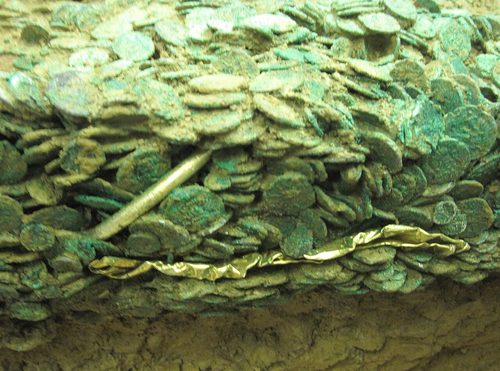
The excavators found a boundary ditch, probably with a palisade, running across the east-facing side of the hilltop, and a likely processional route leading up to it. Most of the coins lay in fourteen separate hoards in the entranceway. With 5,294 coins in all, it is the largest group of Iron Age coins found in Britain, and 4,835 can be assigned to the Corieltavi, the people of the East Midlands. The find increased the number of known Corieltavian coins by about 150 per cent.
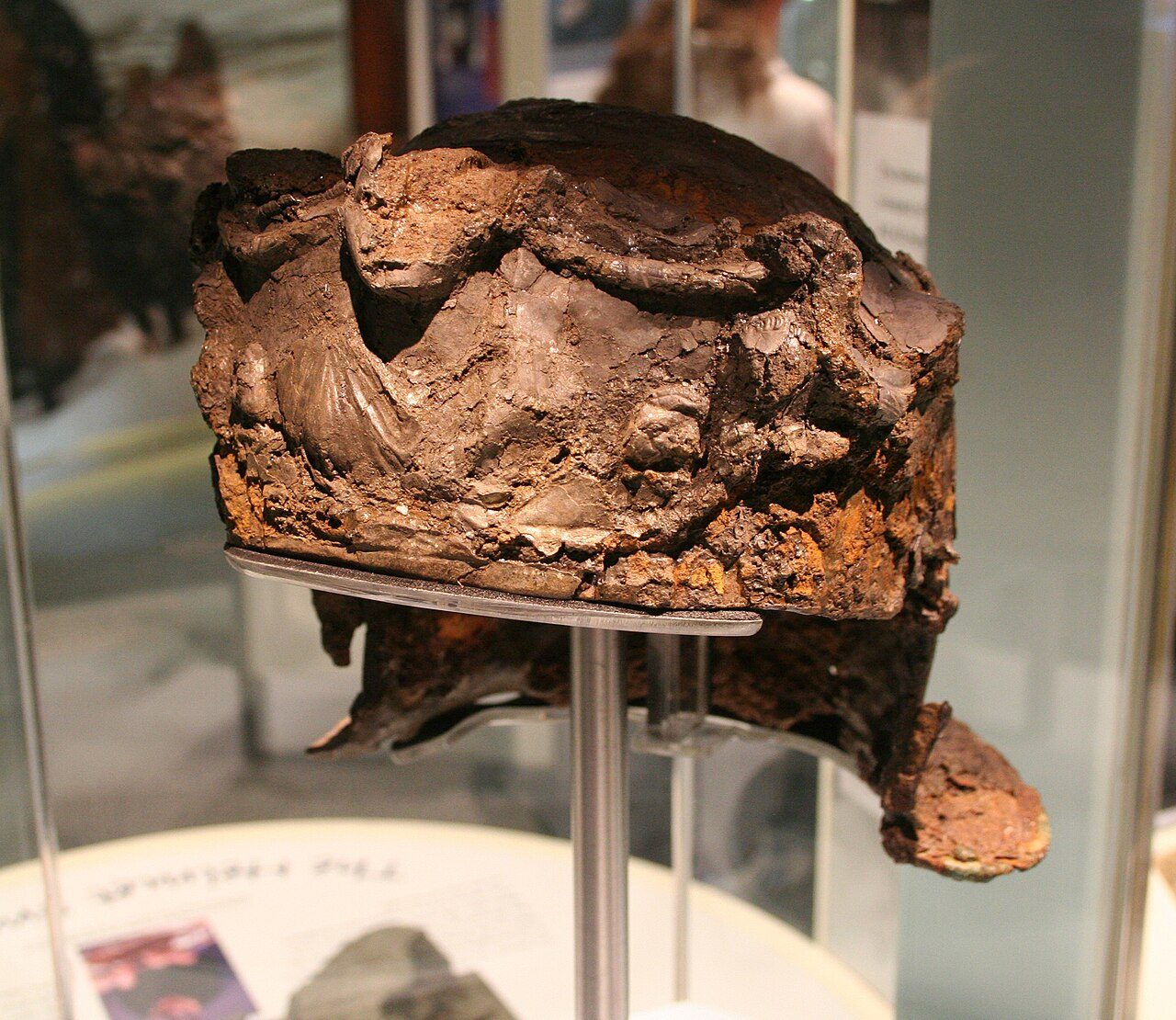
Among the coins was a Roman cavalry parade helmet of iron sheathed in silver and touched with gold leaf, the only Roman helmet from Britain with most of its silver-gilt plating still attached. It was found in fragments, many smaller than a fingernail, and spent nine years being reassembled at the British Museum. One cheekpiece shows an emperor on horseback crowned by Victory while his horse tramples a barbarian. Why a Roman helmet ended up at a British shrine is unclear: it could have been a diplomatic gift or war booty, but the view favoured at the British Museum is that it belonged to a Briton who rode with the Roman army.
The coins date the deposits to the AD 40s and perhaps the 50s, the years of the Roman invasion. Analysis of the dies suggests that several rulers in the East Midlands were striking coins at the same time, so the region was probably not one kingdom with a single policy towards Rome. The excavators read the hill as an open-air shrine with no building, a type not recognised in Britain before, where offerings of coin and meat were made while the political world around it was changing.
The treasure was acquired by Leicestershire County Council, which raised about £1 million for the purchase and the helmet's conservation, including a £650,000 Heritage Lottery Fund grant and support from the Art Fund. It is shown at Harborough Museum, about nine miles from the site.
Highlights
An iron Roman cavalry parade helmet, made around AD 25-50, covered in silver sheet with gold-leaf details, found with six cheekpieces and traces of a seventh. Reassembled from thousands of fragments over nine years.
A cheekpiece showing a mounted emperor crowned by the goddess Victory, a defeated barbarian beneath his horse's hooves.
Thousands of silver units of the East Midlands rulers, many inscribed with names, giving numismatists a new type series for the region.
A Roman Republican silver coin dated by Leicestershire museums to 211 BC, described as the oldest Roman coin found in Britain.
What is in it
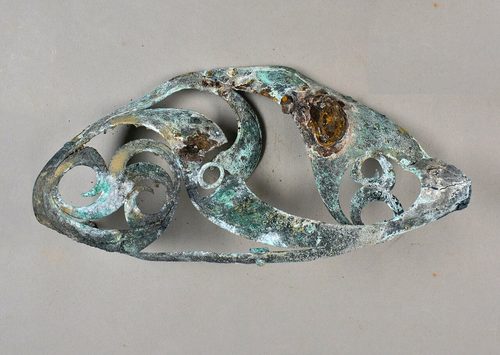
Silver and gold coins of the local Corieltavi with a few Roman ones, buried in 14 separate hoards at the entrance of a ditched hilltop enclosure, together with a Roman cavalry parade helmet, a silver bowl, ingots, a decorative mount and a huge deposit of pig bones.
Size: 5,294 coins (5,296 in some accounts).
| Item | Number | Notes |
|---|---|---|
| Coins | 5,294 | 4,835 attributed to the Corieltavi; others include a few Roman issues, among them a Republican denarius dated by local museums to 211 BC |
| Roman cavalry parade helmet | 1 | iron, covered in silver sheet with gold leaf; found with six cheekpieces and remains of a seventh |
| Silver bowl, ingots and a decorative mount | the bowl is described by the museum as unique; two ingots | |
| Animal bone | 6,901 fragments | 97% pig, perhaps around 300 animals |
Photographs
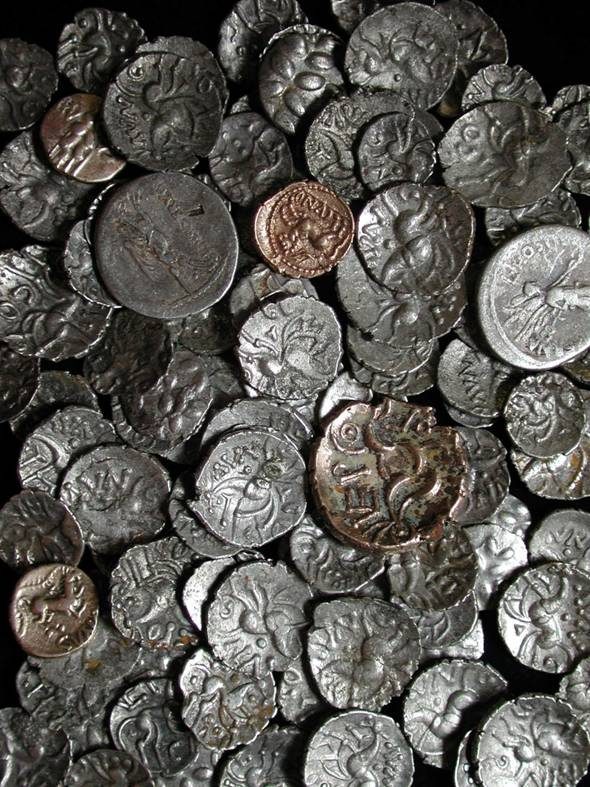
Photo: Portable Antiquities Scheme, CC BY-SA 3.0, via Wikimedia Commons
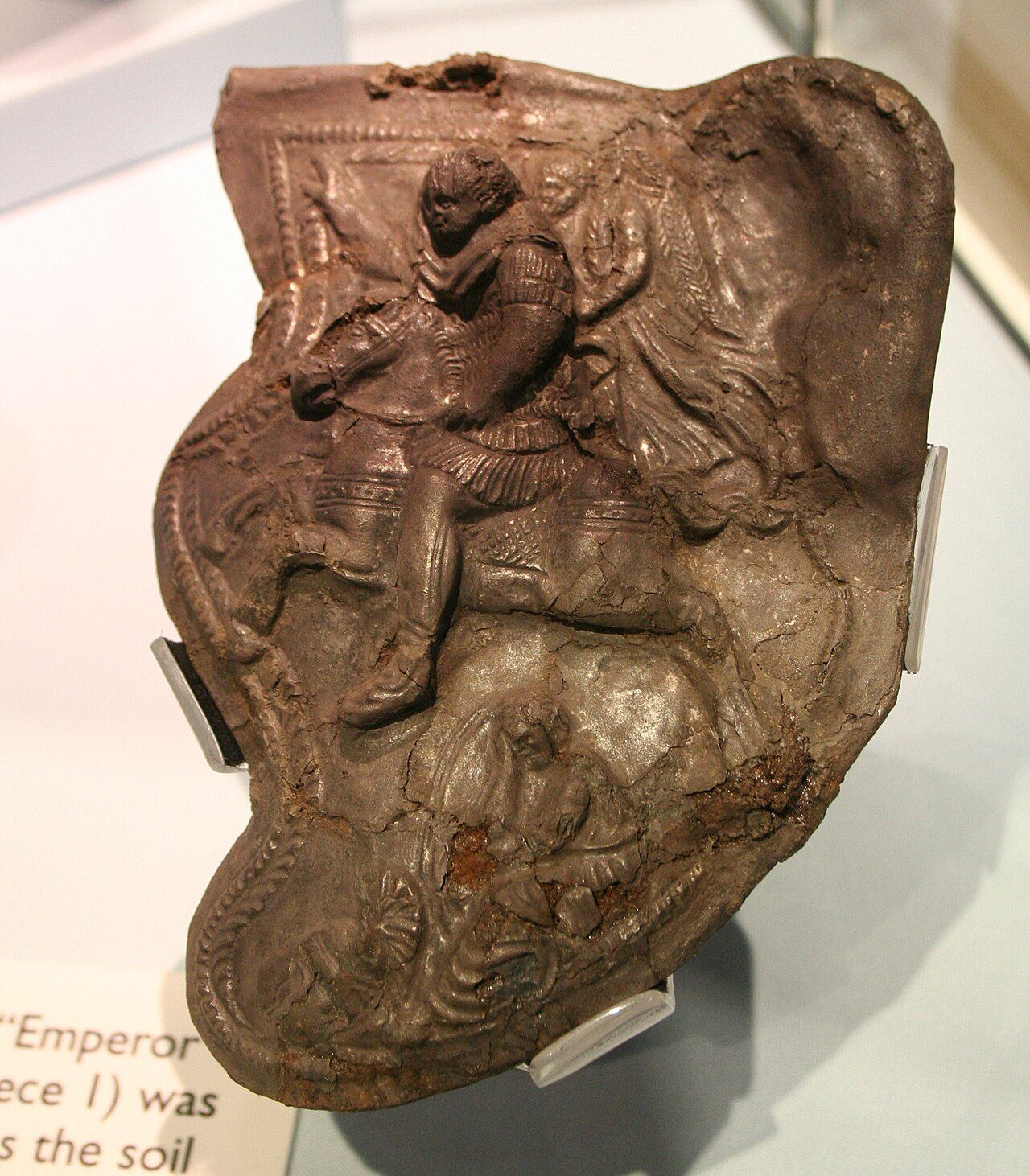
Photo: Prioryman, CC BY-SA 4.0, via Wikimedia Commons
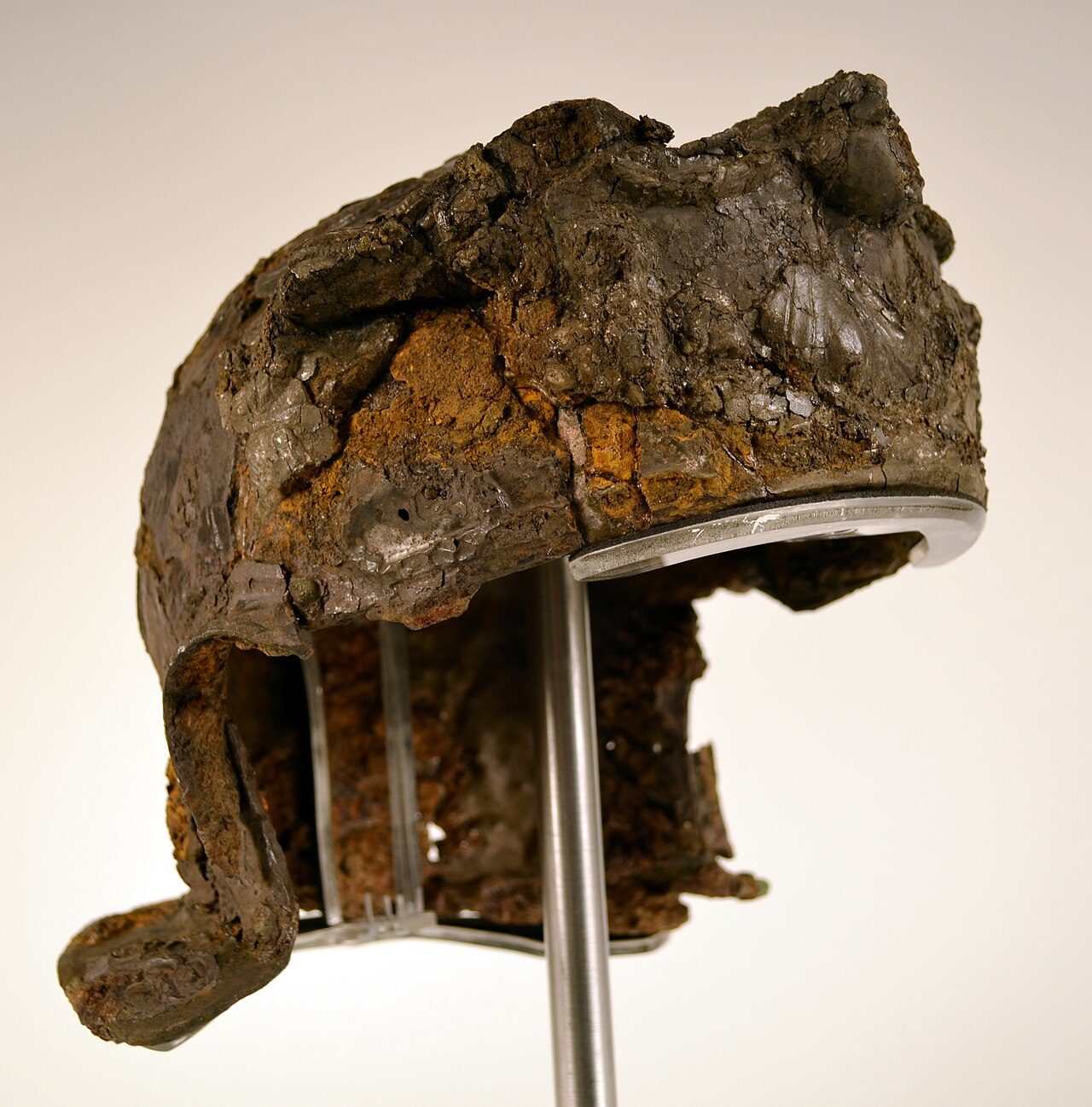
Photo: Leicestershire County Council, Wendy Scott, 2012-07-11 15:05:38, CC BY-SA 4.0, via Wikimedia Commons
How it is dated
Coin specialists at the British Museum date the fourteen coin deposits to the AD 40s, possibly continuing into the AD 50s. The helmet is stylistically dated to about AD 25-50. All the activity on the hilltop falls within a few decades of the Roman conquest of AD 43.
What happened after the find
The coins were declared Treasure at an inquest in 2003. Leicestershire County Council acquired the hoard; the helmet alone was valued at £300,000, split equally between the finder and the landowner under the Treasure Act.
Where sources differ
- Coin total: 5,294 Iron Age coins (Current Archaeology, Harborough Museum project officer) versus 'some 5,296 Iron Age and Roman coins' (British Museum blog cited by Wikipedia). Whether the Roman coins are inside the 5,294 is not stated.
- The number of pigs (around 300) is an estimate by the excavators.
- Who owned the helmet and why it was buried is not known.
- Wikipedia gives the first discovery as about 130 coins; Current Archaeology says the finder found more than 200 before reporting.
Questions
Where can I see the Hallaton Treasure?
At Harborough Museum in Market Harborough, Leicestershire, which has a gallery devoted to it, including the Roman helmet and its cheekpieces and a selection of the coins.
Why was there a Roman helmet in an Iron Age shrine?
Nobody knows for certain. It may have been a gift from Rome or a trophy, but British Museum specialists think it most likely belonged to a local Briton who served with Roman cavalry around the time of the conquest.
How many coins are in the Hallaton hoard?
About 5,300: 5,294 by the count published by the excavation team, 4,835 of them issued by the Corieltavi of the East Midlands.