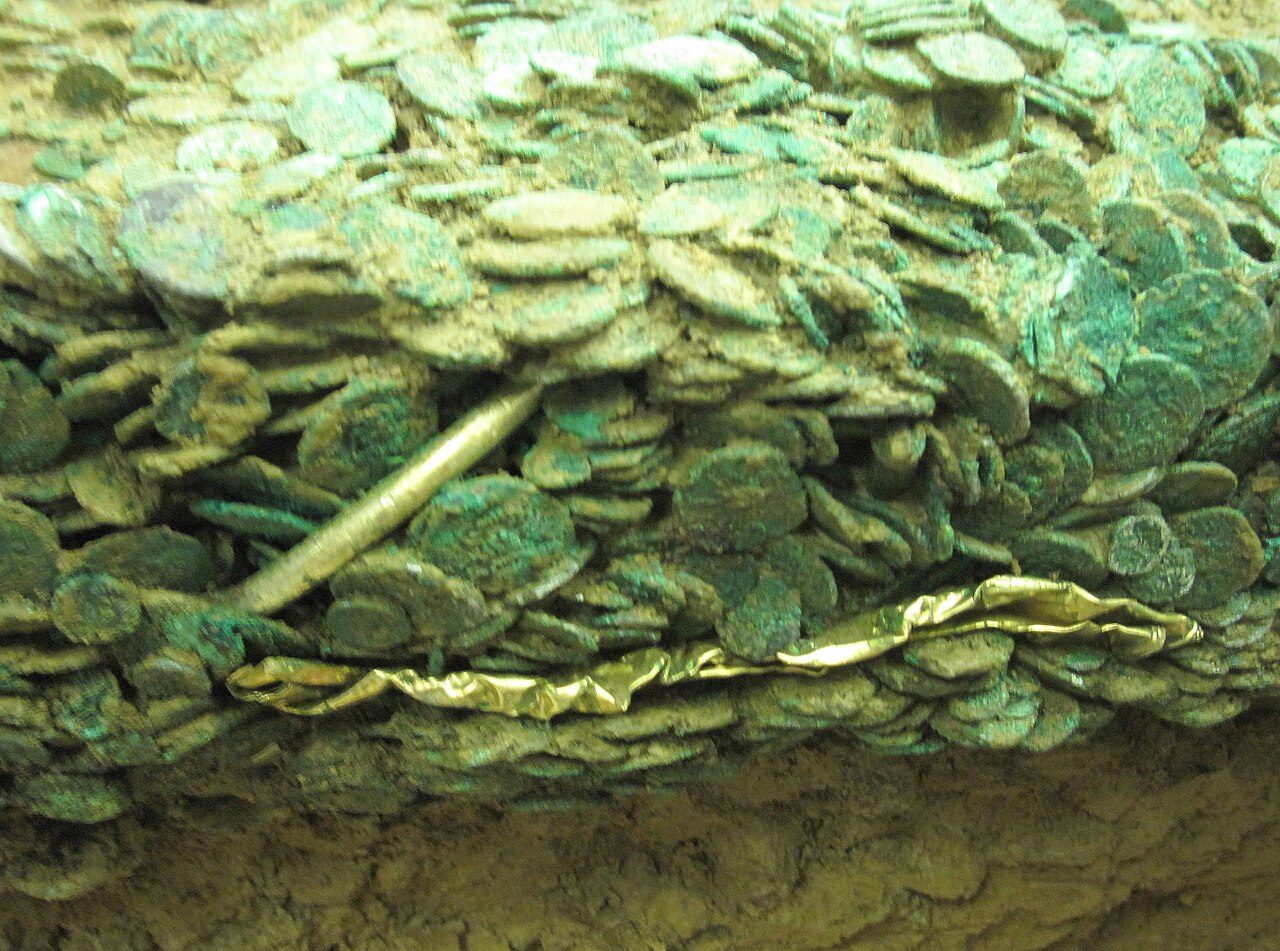
When archaeologists lifted it in the summer of 2012, the Grouville hoard came out of the ground as one solid slab: tens of thousands of coins welded together by corrosion and clay, about 1.4 metres long and heavy enough to need a crane. It took Jersey Heritage conservators until 2017 to take the block apart coin by coin, and the final tally, 69,347, is the largest number of Iron Age coins ever found together.
The find ended a very long search. Two local metal detectorists had heard, in the early 1980s, that a farmer had once pulled up silver coins in a pot while grubbing out a hedge. They did not know the exact spot, and the landowner allowed them only a few hours' detecting a year after harvest. Early in 2012 they found about sixty silver and one gold Celtic coin, and soon after a faint signal led them to the main mass. They covered it up again and called Jersey Heritage, so the hoard could be excavated with its surroundings recorded.
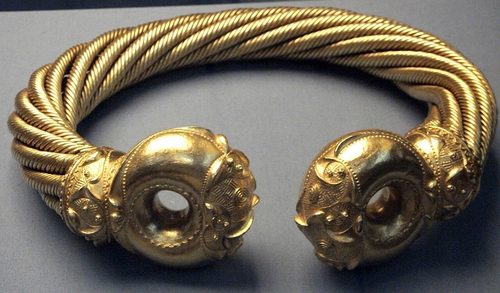
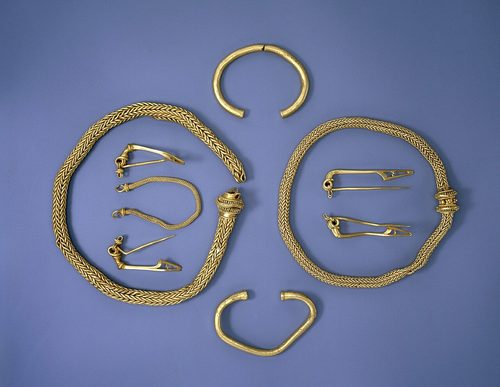
That restraint paid off. The block was kept intact and cold-stored for two years while it was X-rayed and scanned; when dismantling began in 2014, every coin was recorded in three dimensions as it came out, and one 15 cm cube was left untouched for future research. Inside and around the coins lay gold neck torcs, silver bracelets, ingots, gold sheet, glass beads and what was left of a leather purse.
Almost all the coins were struck by the Coriosolitae, a Gaulish people whose territory lay around the Rance estuary in Brittany, across the water from Jersey. A small share came from neighbouring groups and even from the Durotriges of Dorset. The usual reading is that the hoard was hidden during the upheaval of Caesar's campaigns in Gaul in the 50s BC, when the Coriosolitae were among the Armorican peoples who fought Rome. Others argue it may have been a temple deposit, which would explain why nobody came back for it.
Excavation also found post-holes, burnt daub, pottery, slag and furnace lining near the hoard, and some coins had been cut in half, raising the possibility of metalworking or even minting on the spot. A geophysical survey in the 2020s picked up what may be the ditches of a late Iron Age farmstead, suggesting that Jersey was inhabited and connected to the coin economy of the mainland rather than an empty refuge.
Jersey has no Treasure Act. The find was reported to the island's Receiver General, and in December 2021 the Government of Jersey bought the hoard for £4.25 million, under an agreement that shared the proceeds between the finders and the landowner. It stays on the island in the care of Jersey Heritage.
Highlights
Billon staters of the Coriosolitae, fused into a single block; one 15 cm cube has been kept intact as a research archive.
Gold neck rings visible at the edge of the block during excavation, later freed by conservators; up to 13 are reported in recent accounts.
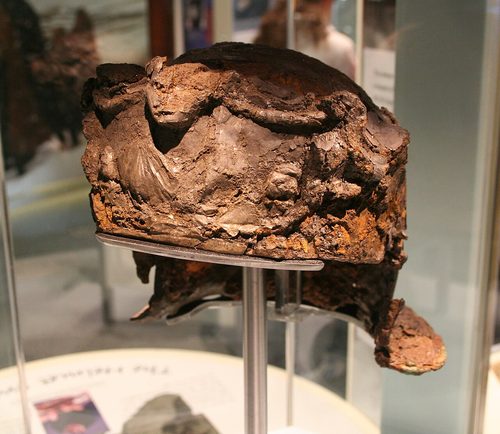
The remains of a leather purse, rare survival of an organic container, now part of the La Hougue Bie display.
What is in it
A single mass of base-silver Celtic coins, almost all struck by the Coriosolitae of north-eastern Brittany, with gold torcs, silver bracelets and ingots, gold sheet, glass beads and the remains of a leather purse.
Size: 69,347 coins plus jewellery and ingots. Weight: the block weighed about 750 kg to a tonne with its clay.
| Item | Number | Notes |
|---|---|---|
| Coins | 69,347 | staters and quarter-staters of billon (debased silver); over 94% Coriosolite, the rest from more than 20 other groups including the Osismii and the Durotriges of southern England |
| Gold torcs | up to 13 | neck rings found at the edge and inside the mass |
| Gold staters | 23 | reported in 2025 coverage of the research |
| Other | silver bracelets and ingots, gold sheet, fine silver wire, glass and bone beads, a brooch, a leather purse |
Photographs
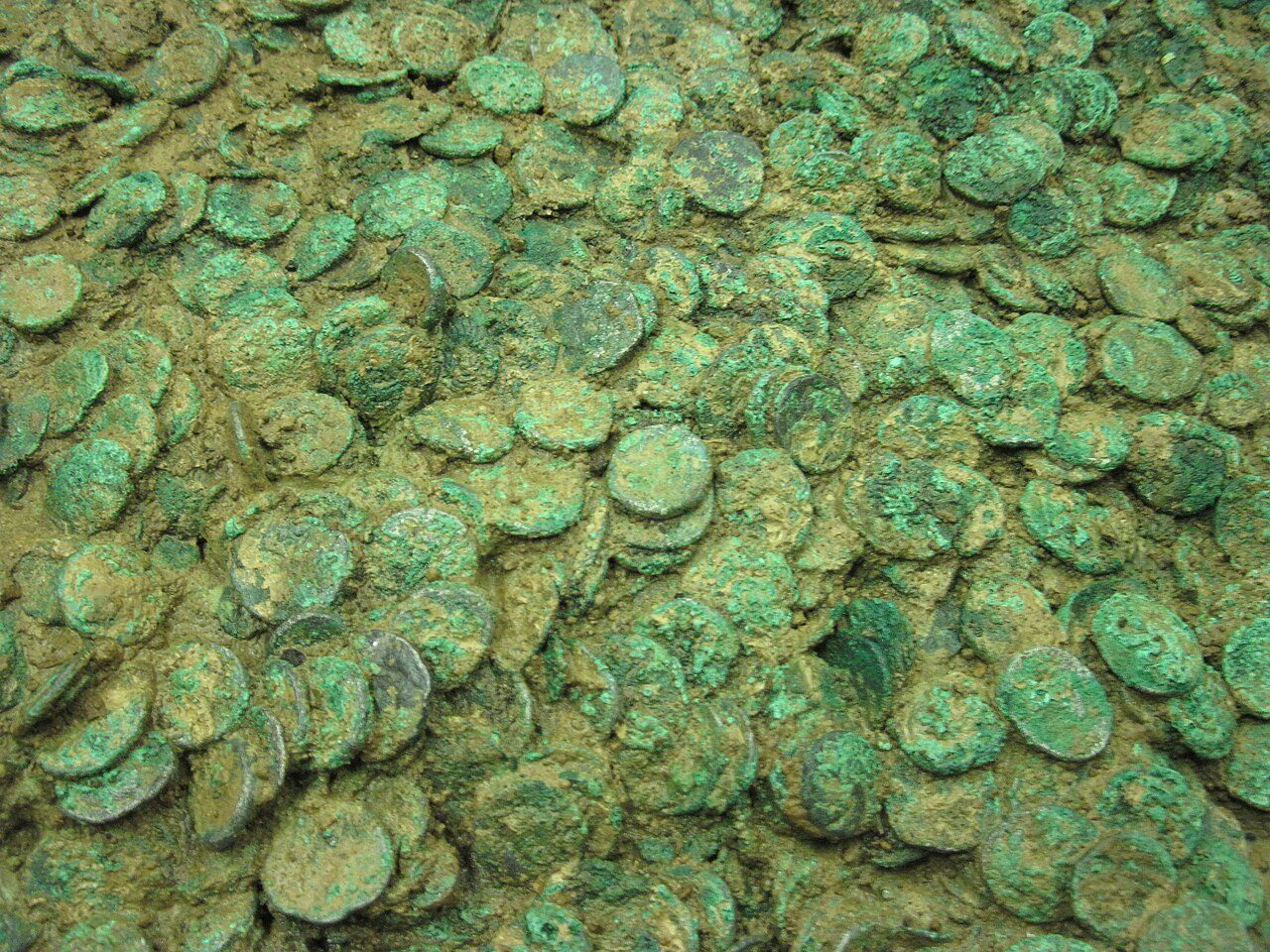
Photo: Man vyi, Public domain, via Wikimedia Commons
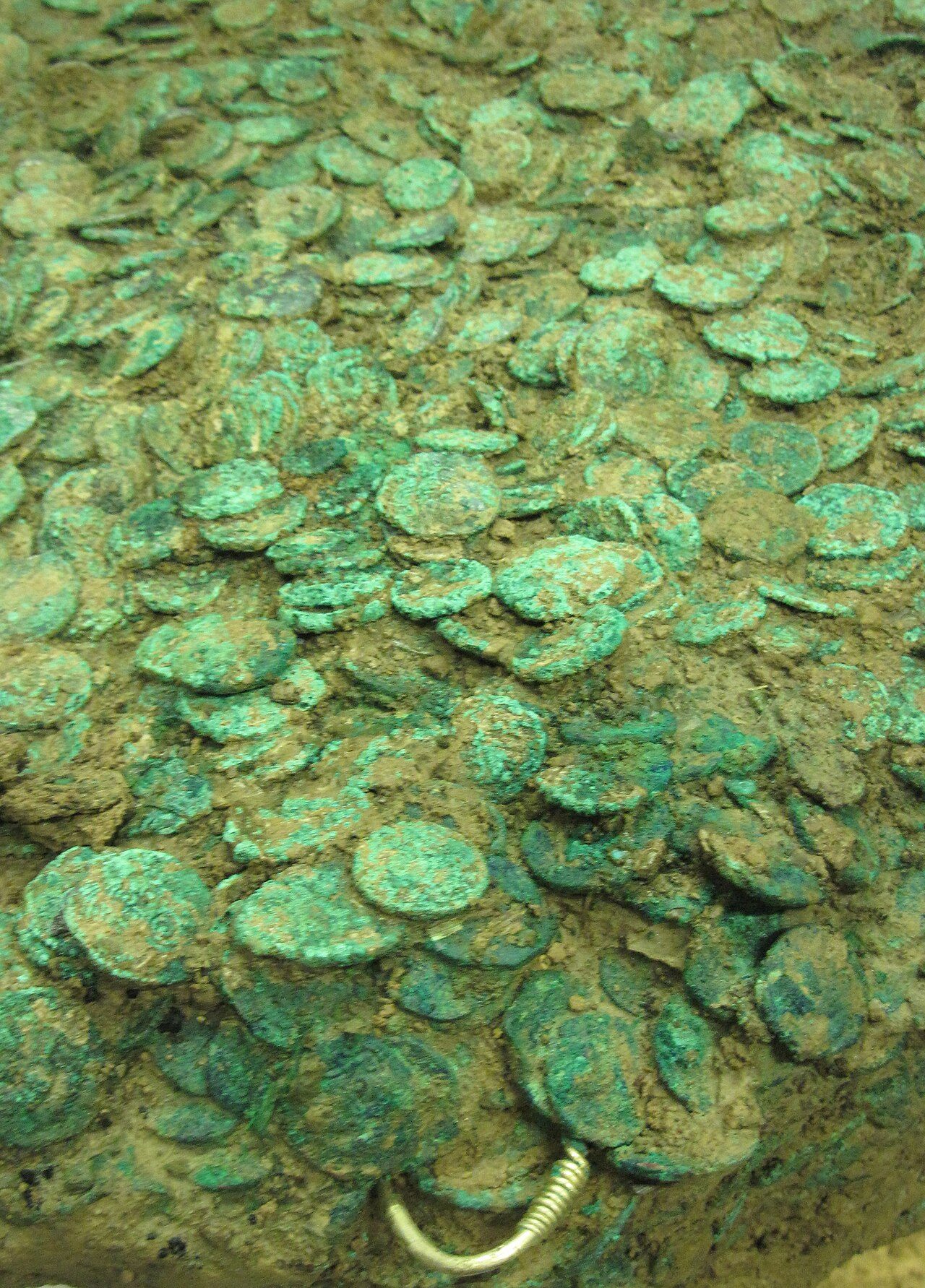
Photo: Man vyi, Public domain, via Wikimedia Commons
How it is dated
The coins are mid-1st-century BC Armorican issues and none is later than the period of Caesar's Gallic War. Burial is therefore placed roughly between 60 and 30 BC; the precise year depends on how the latest issues are dated.
What happened after the find
Jersey has no equivalent of the UK Treasure Act. The hoard was reported to the Receiver General, and the Government of Jersey bought it for £4.25 million in December 2021, with the proceeds shared between finders and landowner by agreement.
Where sources differ
- Weight of the block: about 750 kg (BBC, Wikipedia) versus 'around a ton' (Current Archaeology).
- Block dimensions: 140 × 80 × 20 cm (Wikipedia) versus about 140 × 70 × 15 cm (Current Archaeology).
- Coin totals in reports range from 'at least 68,000' to 'almost 70,000'; 69,347 is the Guinness-verified figure.
- Number of gold torcs: 'up to 13' in a 2025 report; earlier reports mention two or more. Not confirmed from Jersey Heritage.
- Wikipedia describes the coins as Celtic and Roman; specialist accounts describe them as Armorican Celtic issues. Any Roman element is unverified.
- Burial date given as c. 50-60 BC (BBC) or c. 30-50 BC (Smithsonian).
- Why it was buried (flight from Rome, temple deposit, mint or workshop stock) is debated.
Questions
How many coins are in the Jersey hoard?
69,347, the figure verified by Guinness World Records after conservators separated every coin. That makes it the largest Iron Age coin hoard known, ahead of finds such as Cunetio in Roman Britain.
Where can I see the Le Câtillon II hoard?
At La Hougue Bie Museum in Grouville, run by Jersey Heritage, where the exhibition 'Searching for Jersey's Celts' shows coins, gold torcs and ingots from the hoard.
Who buried the Grouville hoard?
Almost certainly people connected with the Coriosolitae of Brittany, whose coins make up the bulk of it. It is usually linked to the turmoil of Caesar's conquest of Gaul in the 50s BC, though some scholars see it as a sacred deposit.