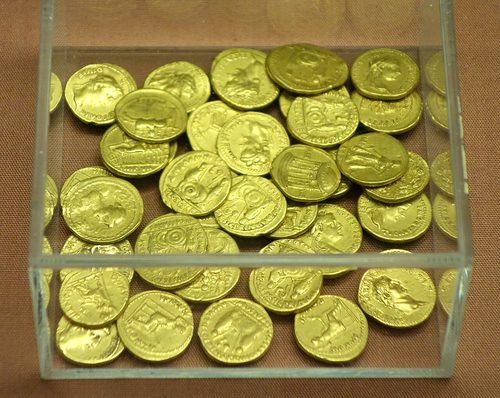
In April 1997 two metal detectorists searching a field at Patching, on the South Downs edge north-west of Worthing, with the landowner's permission, found five late Roman gold coins. They reported them to the coroner's officer, who took them to Worthing Museum, where they were identified as solidi of Arcadius, Honorius and Valentinian III. At the British Museum two of the Valentinian coins were recognised as Visigothic copies.
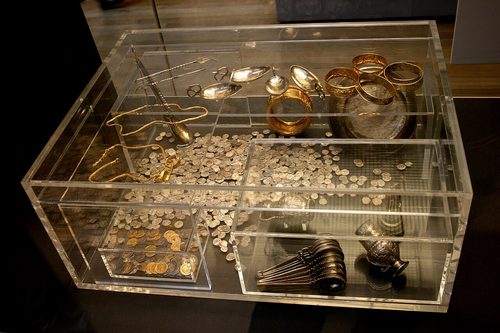
The finders went back with their detectors and a mini digger and recovered seventeen more solidi, two gold rings, twenty silver coins and a quantity of scrap silver before they were persuaded to stop. Worthing Museum and the Sussex Archaeological Society then ran a small emergency excavation with the finders checking the spoil. It found no pit or building, but it did find two land drains, one laid in the late 19th century and one around the Second World War, running along the line of the scattered coins. The hoard had evidently been broken up when the drains went in, and the workmen may have pocketed some of it.
What survived makes Patching the latest hoard of Roman coins known from Britain. Its newest coin is a Visigothic solidus in the name of Libius Severus, who became emperor in 461, half a century after Roman rule in Britain had ended. The coins span 337 to 461, besides one worn Republican denarius, so they had been gathered over several generations. The older silver had circulated in Britain and is worn; the late Visigothic gold is almost as fresh as the day it was made and was probably assembled on the Continent before being brought to Britain.
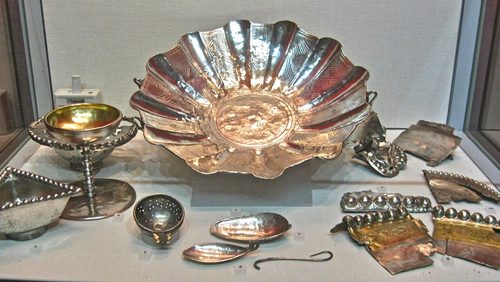
The hoard is more than money. There are 54 pieces of scrap silver weighing 317.58 g, close to a Roman pound, including fragments of late Roman spoons, a pin, buckle tongues and a small chape from a sword scabbard. That fitting resembles types found in Germanic graves on the Continent of the later 5th century. The two gold rings are plain heavy bands, probably made for the thumb; analysis showed the gold was barely refined river gold. Together they show a society in which coins were valued for their weight of metal, alongside hacksilver, rather than as currency.
Patching lies about 2 km from the early Anglo-Saxon cemetery on Highdown Hill, which was in use when the hoard was buried, and the findspot can be seen from its ramparts. Whether the owner was a Briton, an incoming Saxon or someone who served on the Continent cannot be known, but the hoard is rare first-hand evidence for a poorly understood period in Sussex, when 5th-century settlements are known from only a handful of sites.
Highlights
A Visigothic gold coin naming the western emperor Libius Severus (461-465), the latest coin in the hoard and the latest in any Roman hoard from Britain.
A small peg-shaped silver fitting from the tip of a sword scabbard, related to Continental Germanic types of the later 5th century.
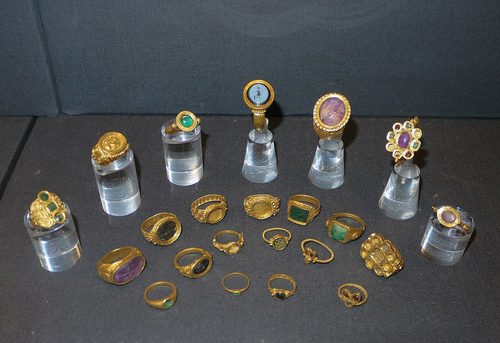
Simple hammered bands with a central keel, made from alluvial gold. Jewellers judged them too large for most fingers, so they were probably worn on the thumb.
A siliqua of Constans from Siscia of a type not previously recorded, and siliquae of Constantine III and Theodosius II never before found in Britain.
What is in it
Late Roman and Visigothic gold and silver coins, collected over more than a century, with two plain gold rings and a Roman pound or so of cut silver scrap.
Size: about 100 items: 50 coins, 2 rings and 54 pieces of scrap silver.
| Item | Number | Notes |
|---|---|---|
| Gold solidi | 23 | 13 Roman (Gratian to Valentinian III) and 10 Visigothic imitations, the latest naming Majorian and Libius Severus |
| Silver coins | 27 | whole or fragmentary miliarenses and siliquae from Constantius II to Valentinian III, Visigothic issues, and a worn Republican denarius of 49 BC |
| Gold rings | 2 | plain keeled bands, probably thumb rings; one perhaps unfinished |
| Scrap silver | 54 | 317.58 g in all: sheet and bar, pieces of late 4th-century spoons, a pin, buckle tongues and a sword-scabbard chape |
How it is dated
The latest coin, a solidus naming Libius Severus, was struck after his accession in 461, so the hoard was buried after that date. The near-mint condition of the late Visigothic coins suggests burial not very long afterwards, in the 460s or 470s, but there is no firm end date.
What happened after the find
Declared treasure trove at an inquest in Chichester in July 1997, one of the last cases under the old common law. It was valued in September 1997, just after the Treasure Act came into force. The British Museum waived its claim, and Worthing Museum raised the reward with help from the Heritage Lottery Fund, the MGC/V&A Purchase Fund and the Friends of Worthing Museum, putting it on display on 7 April 1998.
Where sources differ
- Counts vary between sources: the 1997 press release gives 22 solidi, 25 silver coins and 50 pieces of bullion (before the last finds); Sally White's 1998 note gives 23 solidi, 27 silver coins and 54 pieces of scrap; Walton and Moorhead (Internet Archaeology 41) list 23 solidi, 3 miliarenses, 26 siliquae and a denarius (53 coins); Worthing Theatres and Museums says 50 coins and about 329 g of hacksilver.
- The burial date after 461 is not fixed; suggestions range from the 460s to the late 5th century.
- Part of the hoard may have been removed when the land drains were laid.
Questions
Where is the Patching Hoard?
It belongs to Worthing Museum and Art Gallery in West Sussex, which bought it in 1997-98. The museum has been redeveloping its galleries, so check before visiting.
Why is the Patching Hoard important?
It is the latest hoard of Roman coins found in Britain, buried after AD 461, long after Roman rule ended. Its mix of coins, hacksilver and a Germanic scabbard fitting shows how precious metal was used in 5th-century Sussex.
Sources
- Sally White, 'The Patching Hoard', Medieval Archaeology 42 (1998), 88-93
- White et al., 'A Mid-Fifth Century Hoard of Roman and Pseudo-Roman Material from Patching, West Sussex', Britannia 30 (1999)
- Walton and Moorhead, 'Coin use post c. AD 440', Internet Archaeology 41
- Patching Hoard (Worthing Theatres and Museums)