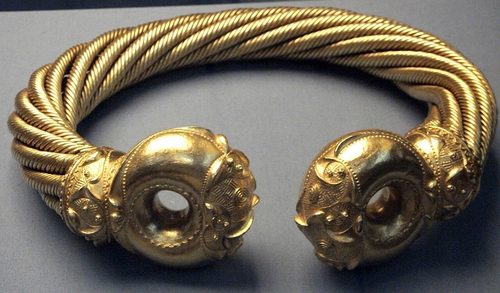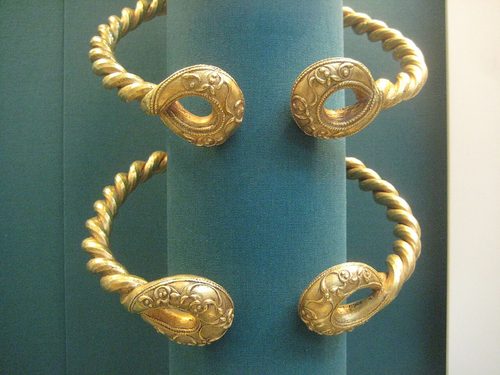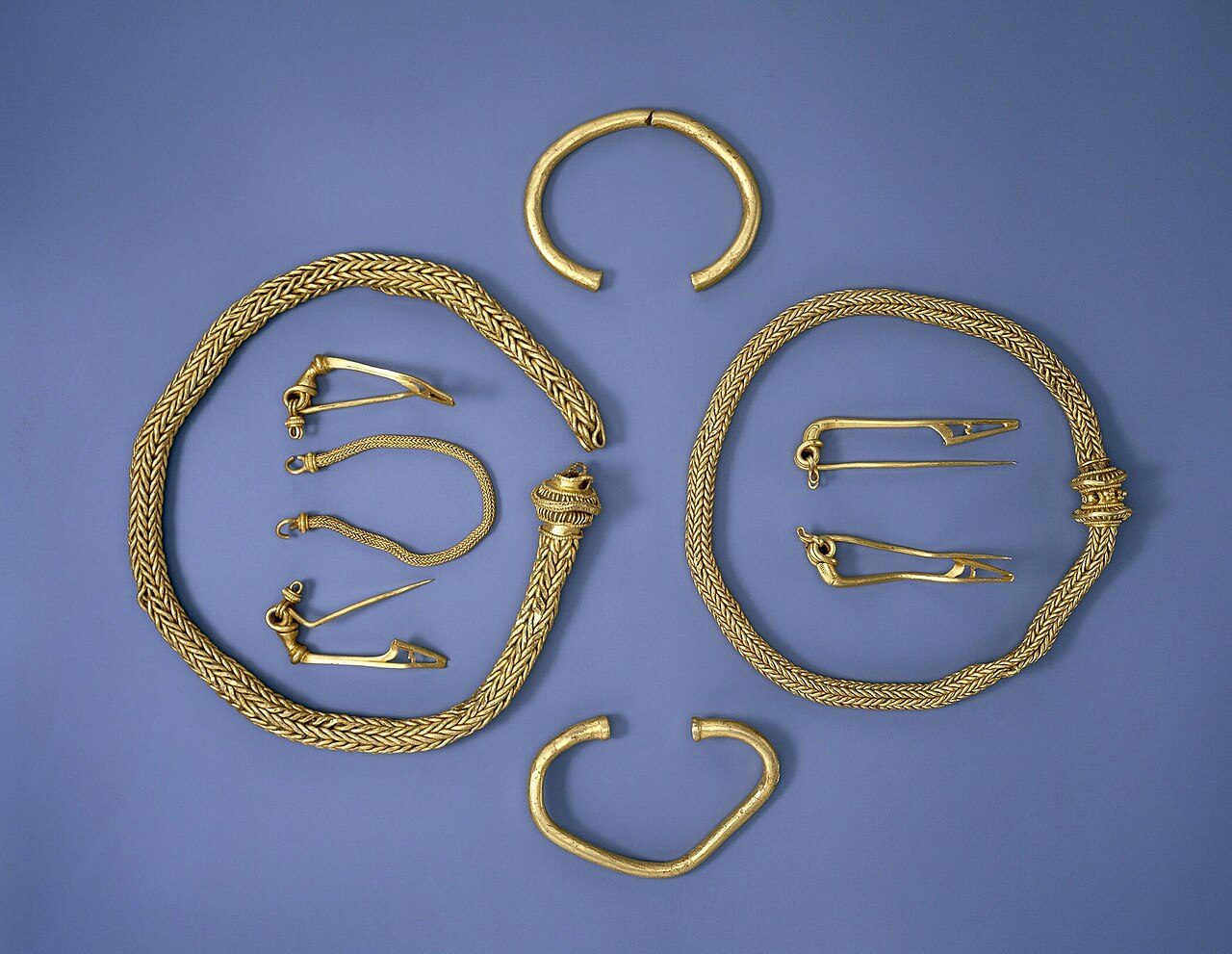
The two Winchester torcs do not look like any other British Iron Age neck rings. Instead of twisted bars or ropes of wire, they are made of fine gold wire worked into a flexible woven chain, finished with terminals decorated in tiny gold granules and filigree. The techniques are Mediterranean, at home in the workshops of the Roman or Hellenistic world, yet the jewellery was buried in a Hampshire field decades before the Roman invasion.
The hoard was found in the autumn and winter of 2000 by a metal detectorist working a ploughed field near Winchester over several visits. He reported the first pieces, the brooches, through the Portable Antiquities Scheme, and archaeologists from the British Museum examined the spot. They found no sign of a settlement, temple or burial. The jewellery seems to have been buried on its own, probably on a small hilltop that was then wooded.
There are two matching sets. Each has a torc, a pair of bow brooches and a bracelet. One pair of brooches is still linked by a gold chain, the way such brooches were worn to fasten a cloak at both shoulders; the chain for the other pair was not found. One bracelet had been broken in half. The gold is very pure, 91 to 99 per cent by X-ray fluorescence analysis, and the whole group weighs about 1.16 kg. One torc is noticeably larger than the other, which has led to the suggestion that the sets were made for a man and a woman.
Gold brooches are rare in Iron Age Britain; this was only the third find of its kind. The brooches are of late La Tène types and allow the hoard to be dated to about 75-25 BC. The combination of local forms with foreign craftsmanship is the puzzle. A British Museum curator who studied the hoard described the torcs as made outside Britain but to British taste, chunky and showy pieces that a Roman would never have worn.
The most popular explanation is diplomacy. In the decades after Caesar's expeditions to Britain in 55 and 54 BC, Rome cultivated relations with rulers in southern England, and lavish gifts were one way to do it. The hoard has been linked, speculatively, with Commius, a Gaulish leader who first served Caesar, later turned against him and is recorded as ruling the Atrebates of southern Britain. Whether these were his, or a gift to someone like him, cannot be proved.
The jewellery was declared treasure at a coroner's inquest and valued at £350,000, at the time the highest reward under the Treasure Act 1996, shared between the finder and the landowner. The British Museum bought it with a £90,000 grant from the National Art Collections Fund and support from the British Museum Friends and the National Heritage Memorial Fund.
Highlights
A flexible gold chain neck ring about 48 cm long and 516.7 g, with granulated terminals, made using Mediterranean techniques.
About 44 cm long and 332.1 g, decorated with both granulation and filigree.
A pair of gold bow brooches joined by a gold wire chain, a way of fastening a cloak across the chest.
What is in it
Two sets of gold jewellery, each with a torc, a pair of brooches (one pair still joined by a chain) and a bracelet, all of 91-99% gold.
Size: 10 pieces (9 objects, one bracelet in two halves). Weight: 1,158.8 g (about 1.16 kg).
| Item | Number | Notes |
|---|---|---|
| Torcs | 2 | chain neck rings of interlinked wire rings, 516.7 g and 332.1 g, with granulated and filigree terminals |
| Brooches | 4 | two pairs, about 20-22 g each |
| Chain | 1 | gold wire, linking one pair of brooches; 23.6 g |
| Bracelets | 2 | penannular; one complete (94.1 g), one broken in two halves |
Photographs
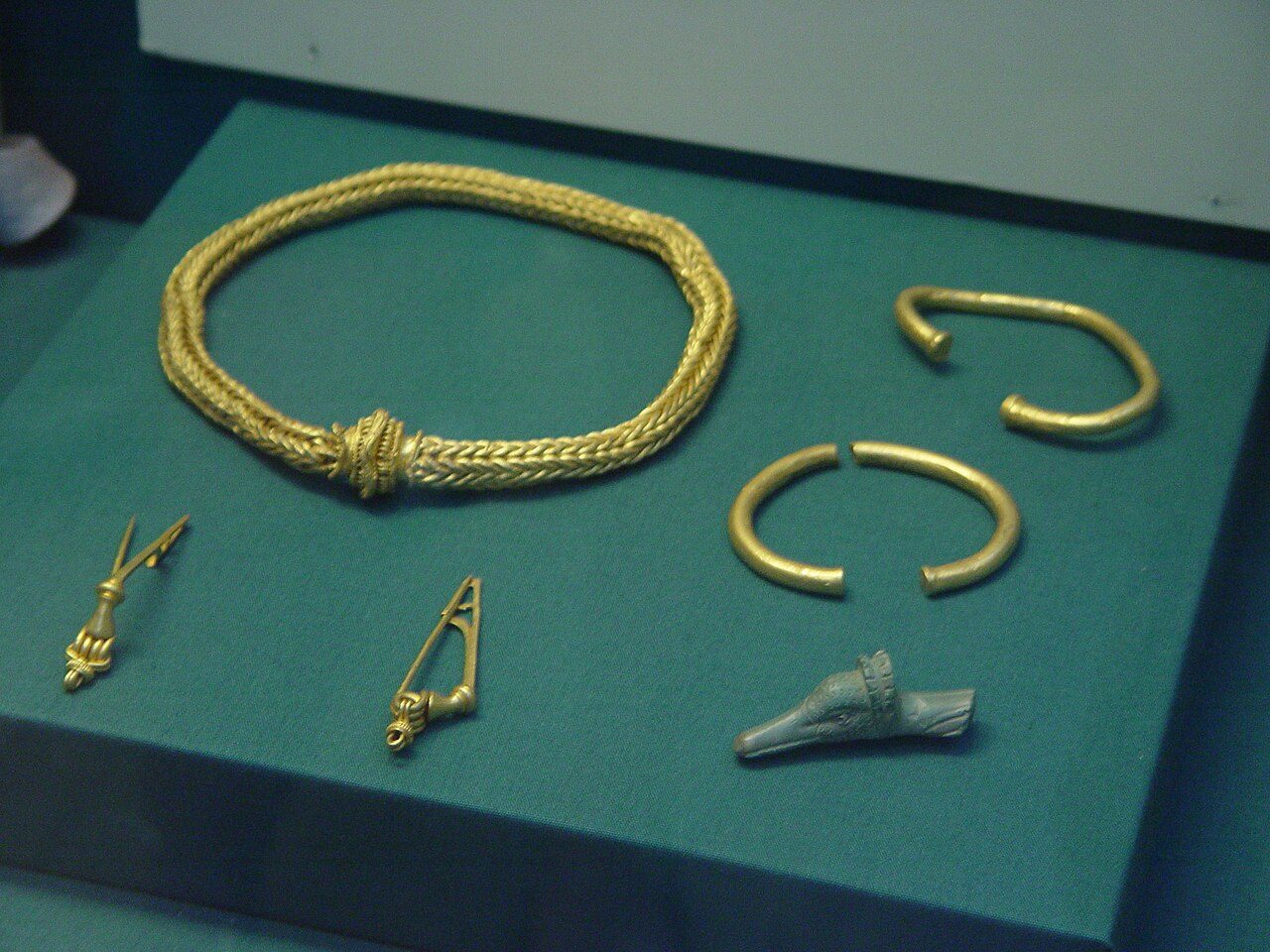
Photo: Portable Antiquities Scheme from London, England, CC BY 2.0, via Wikimedia Commons
How it is dated
There are no coins. The brooches are of late La Tène types that place the hoard between about 75 and 25 BC; the torcs, which have no close parallels, are dated by association.
What happened after the find
Declared treasure at a coroner's inquest and valued at £350,000, then the highest award under the Treasure Act 1996, shared between finder and landowner. The British Museum acquired it with help from the National Art Collections Fund (£90,000), the British Museum Friends and the National Heritage Memorial Fund.
Where sources differ
- Who made or gave the jewellery is unknown; the link to Commius is speculation.
- Whether the sets were made for a man and a woman is an inference from the torc sizes.
- The item-by-item weights come from Wikipedia's table (citing the Treasure Annual Report); not checked against the report itself.
Questions
Where is the Winchester Hoard?
In the British Museum in London, which acquired it in 2001 after it was declared treasure.
Why do archaeologists think the Winchester gold was a Roman gift?
The torcs are British in form but made with techniques used in Roman and Hellenistic workshops, and the hoard dates to the decades when Rome was courting British rulers after Caesar's expeditions. A diplomatic gift is the most widely suggested explanation, though it cannot be proved.