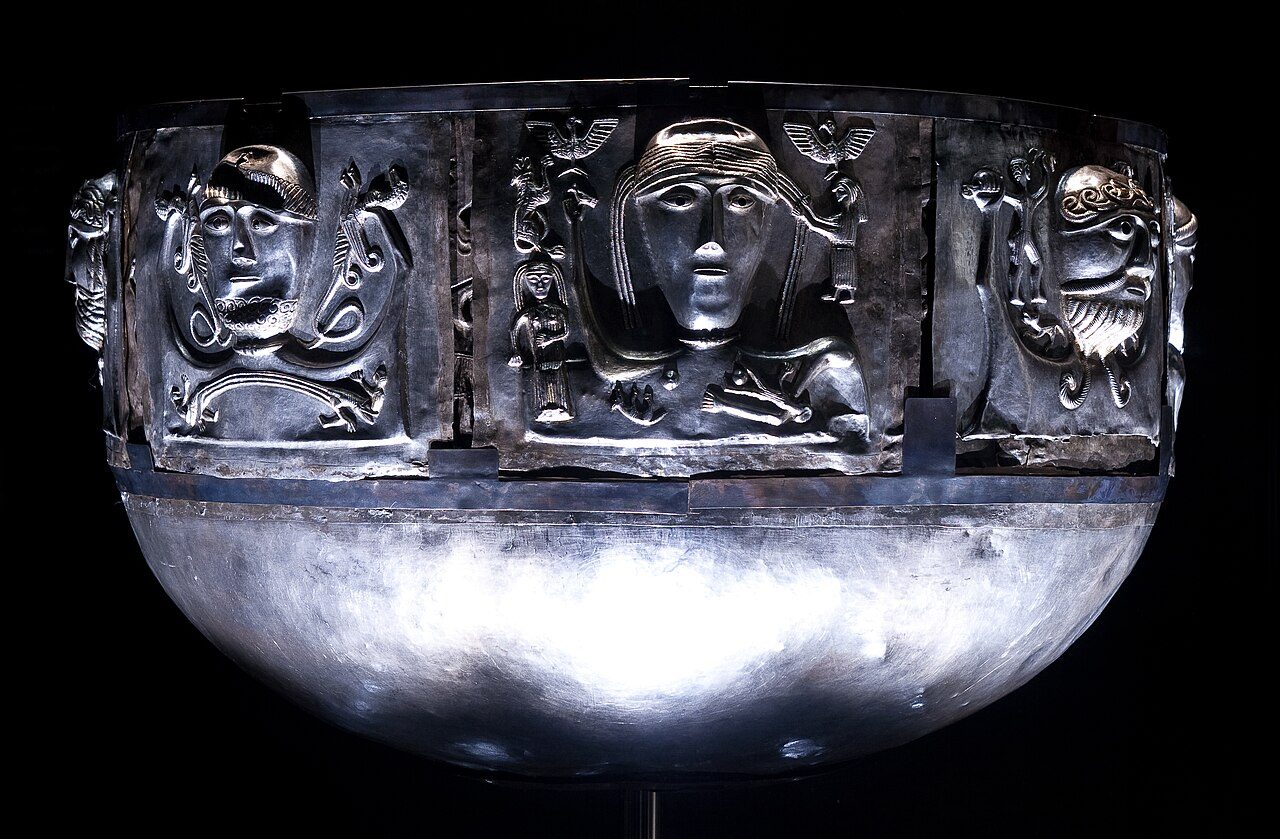
On 28 May 1891 men cutting peat in Rævemose, a small bog beside the larger Borremose in Himmerland, northern Jutland, came on sheets of embossed silver. Lifted out, they proved to be the parts of a single great cauldron, taken to pieces in antiquity and packed neatly into its own rounded base. Reassembled, it measures 69 centimetres across and 42 high and weighs just under 9 kilograms, the largest piece of silverwork known from Iron Age Europe.
As a hoard it is unusual: one object, deliberately dismantled. The rim and the twelve decorated plates had been taken off and stacked inside the bowl before it was laid down. Botanists who studied the bog at the time of the find thought the spot was dry ground when the cauldron was deposited and that peat later grew over it, which would make the careful stacking look like concealment. A new investigation in 2002 concluded that the bog may already have existed, which fits better with the many other offerings that Iron Age people in Denmark made in lakes and bogs. The National Museum of Denmark treats it as a sacrifice to the powers above.
Whatever the intent, the cauldron had come a long way. Its seven outer plates each carry a huge bearded or female head; the five inner plates show more crowded scenes. The best known shows a seated figure with antlers, holding a torc in one hand and a serpent in the other, among stags and other animals. Another has a line of foot soldiers and horsemen, with carnyx war-trumpets, moving past a large figure who holds a man head-down over a vessel. There are elephants and lions, creatures no one in Jutland would have seen.
The technique of high relief hammered from behind, finished with punches and partly gilded, belongs to the Thracian silversmithing tradition of the lower Danube, while helmets, shields and trumpets on the plates are Celtic. The National Museum suggests it was made between about 150 BC and the birth of Christ, where Celtic and Thracian peoples lived side by side, probably in south-west Romania or north-west Bulgaria. Lead-isotope studies point to silver from several sources and tin solder consistent with Cornish ore; glass for the inlaid eyes is of an eastern Mediterranean type. At least three silversmiths worked on it, and later repairs are cruder than the original work.
How it reached Denmark is unknown. One theory ties it to the Cimbri, a people from Jutland who campaigned in central and southern Europe at the end of the 2nd century BC and might have brought it home as booty; others favour a diplomatic gift or trade. Scholars also disagree on how to read the scenes and on the right order of the plates. That uncertainty is part of its fascination: a Danish bog find that holds the richest narrative imagery surviving from the Celtic world.
Highlights
An inner plate with a cross-legged figure wearing antlers, a torc in one hand and a serpent in the other, often linked to the Gaulish god Cernunnos.
Foot soldiers with shields and carnyx trumpets march below a row of horsemen, while a giant figure dips a man into a vat.
The central medallion of the base shows a bull brought down by a woman with a sword and dogs; the bull's head stands clear of the plate and is the most accomplished work on the vessel.
Seven large heads of gods and goddesses, some holding small figures or animals, with gilding and glass-inlaid eyes.
What is in it
A single dismantled silver cauldron: a bowl-shaped base, five inner and seven outer decorated plates, two pieces of tubular rim and a fragment of an iron ring, all stacked inside the base.
Size: 15 main pieces (base, 12 plates, 2 rim fragments) plus an iron fragment. Weight: just under 9 kg (silver (gilded)).
| Item | Number | Notes |
|---|---|---|
| Base plate | 1 | Rounded bowl with a medallion of a bull, a woman with a sword and dogs at its centre |
| Inner plates | 5 | Long rectangular scenes: the antlered figure, the procession of warriors, a wheel-bearing god and others |
| Outer plates | 7 | Each with a large bust of a god or goddess; an eighth is missing |
| Rim fragments | 2 | Sections of silver tubing; an iron ring once sat inside them |
Photographs
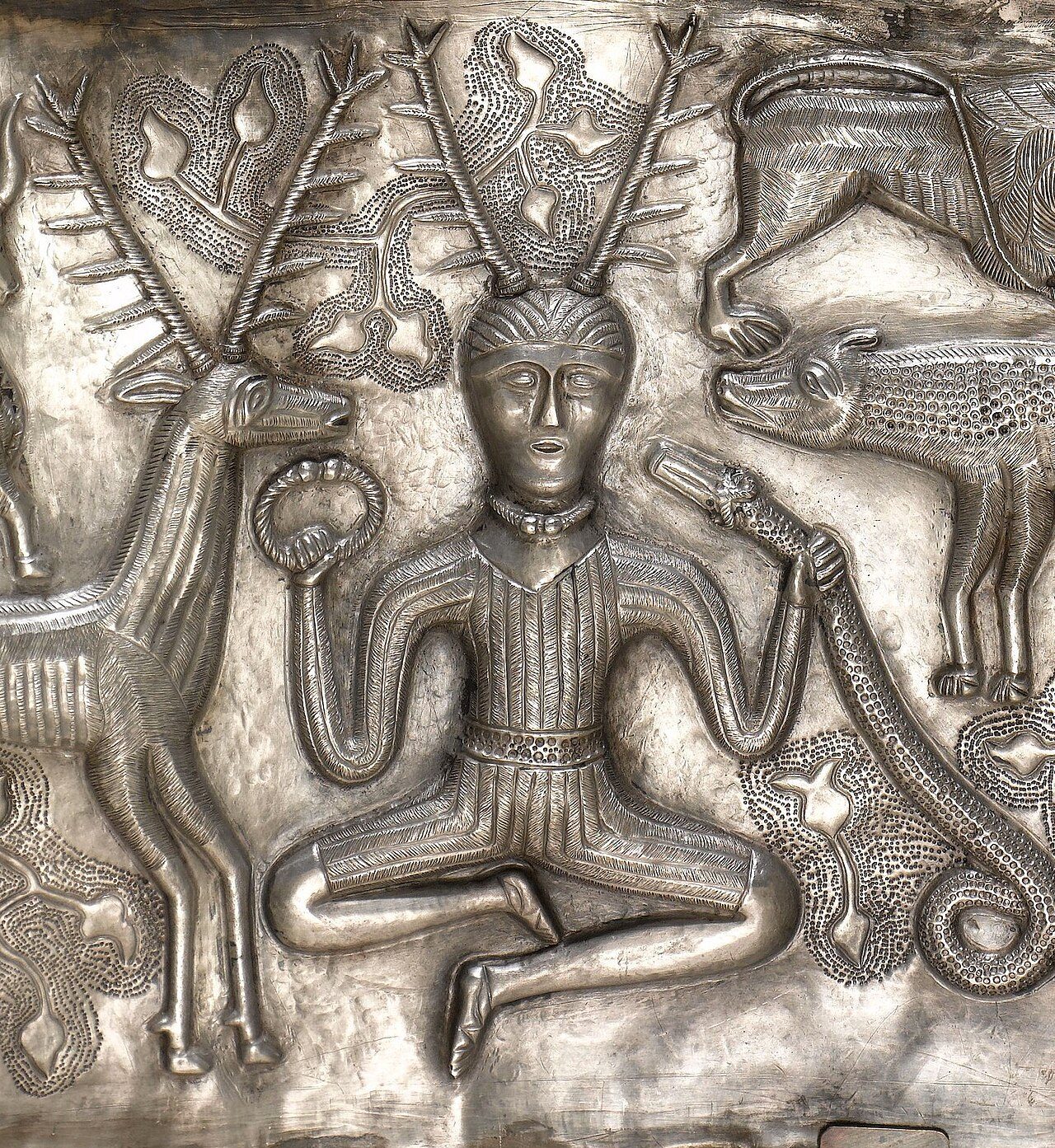
Photo: Nationalmuseet, Roberto Fortuna og Kira Ursem, CC BY-SA 3.0, via Wikimedia Commons
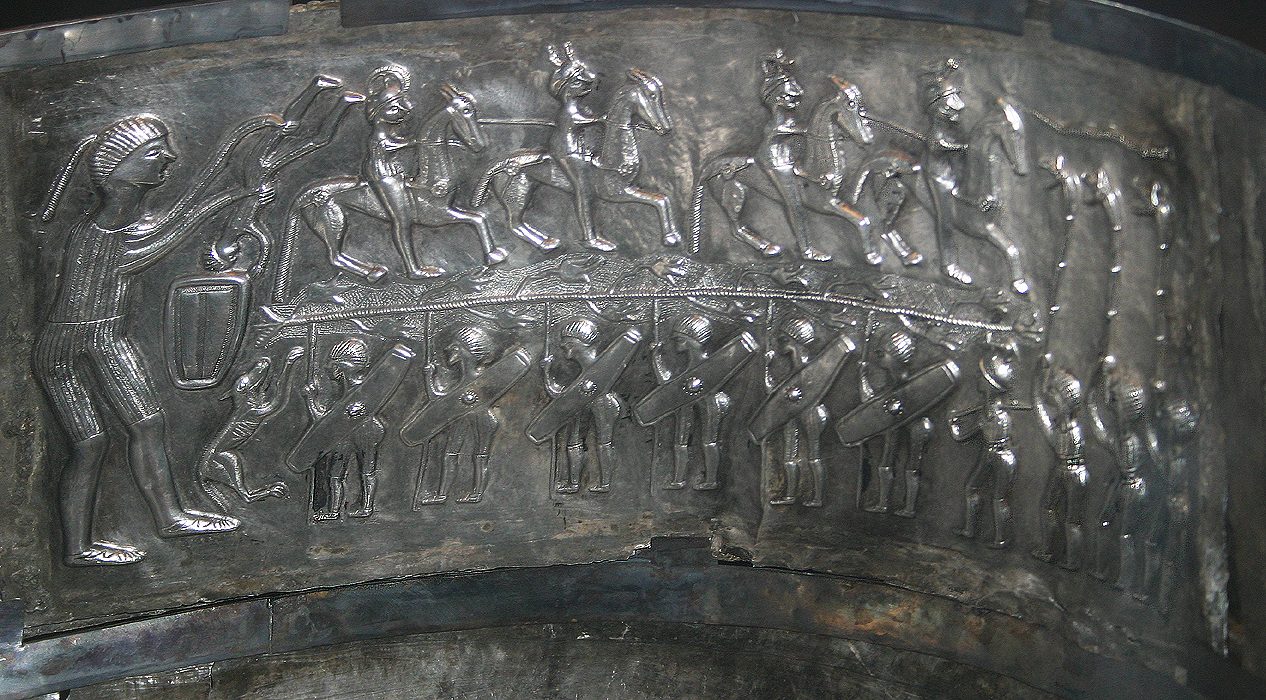
Photo: Unknown, CC BY-SA 3.0, via Wikimedia Commons
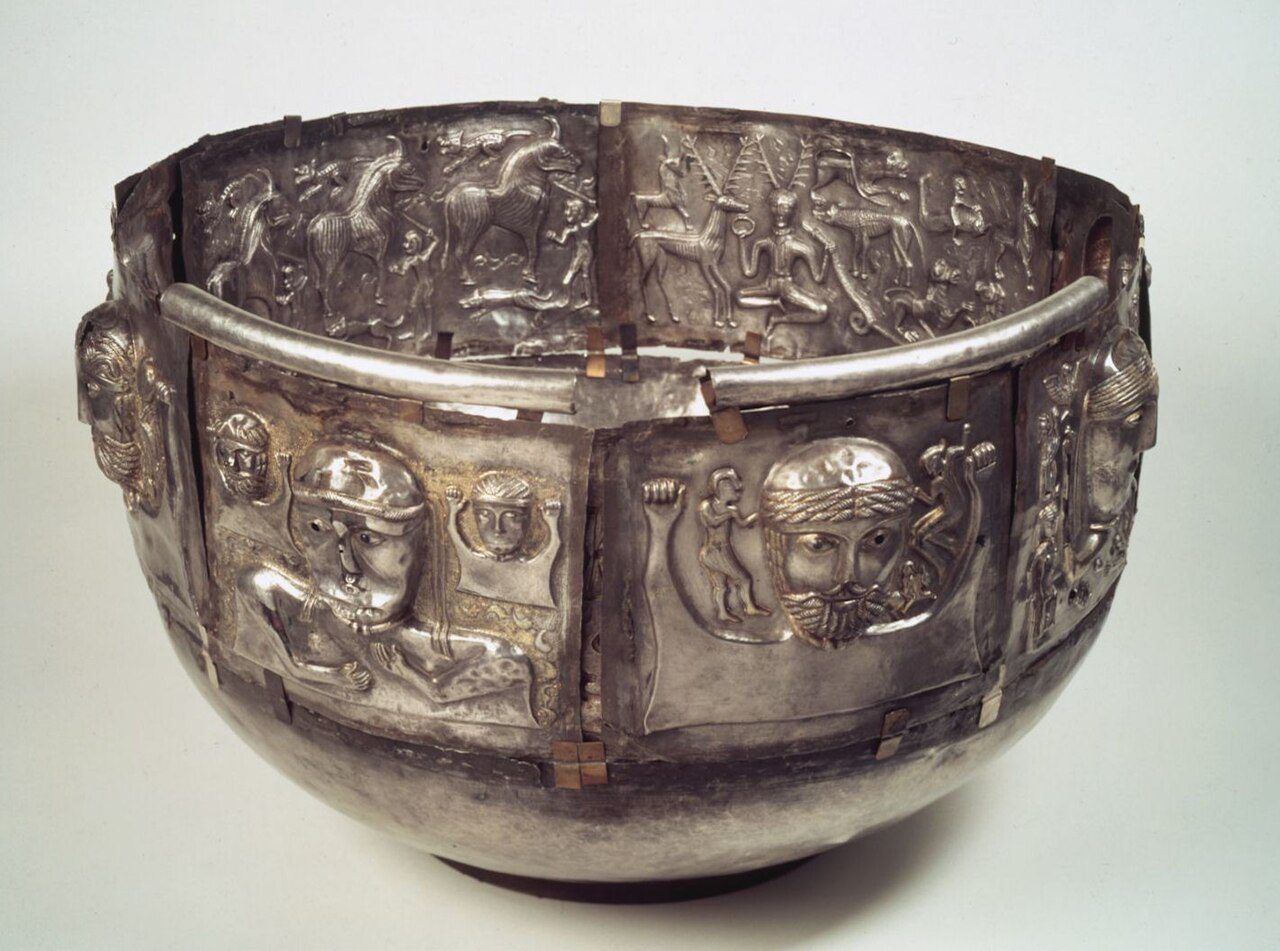
Photo: Nationalmuseet, CC BY-SA 3.0, via Wikimedia Commons
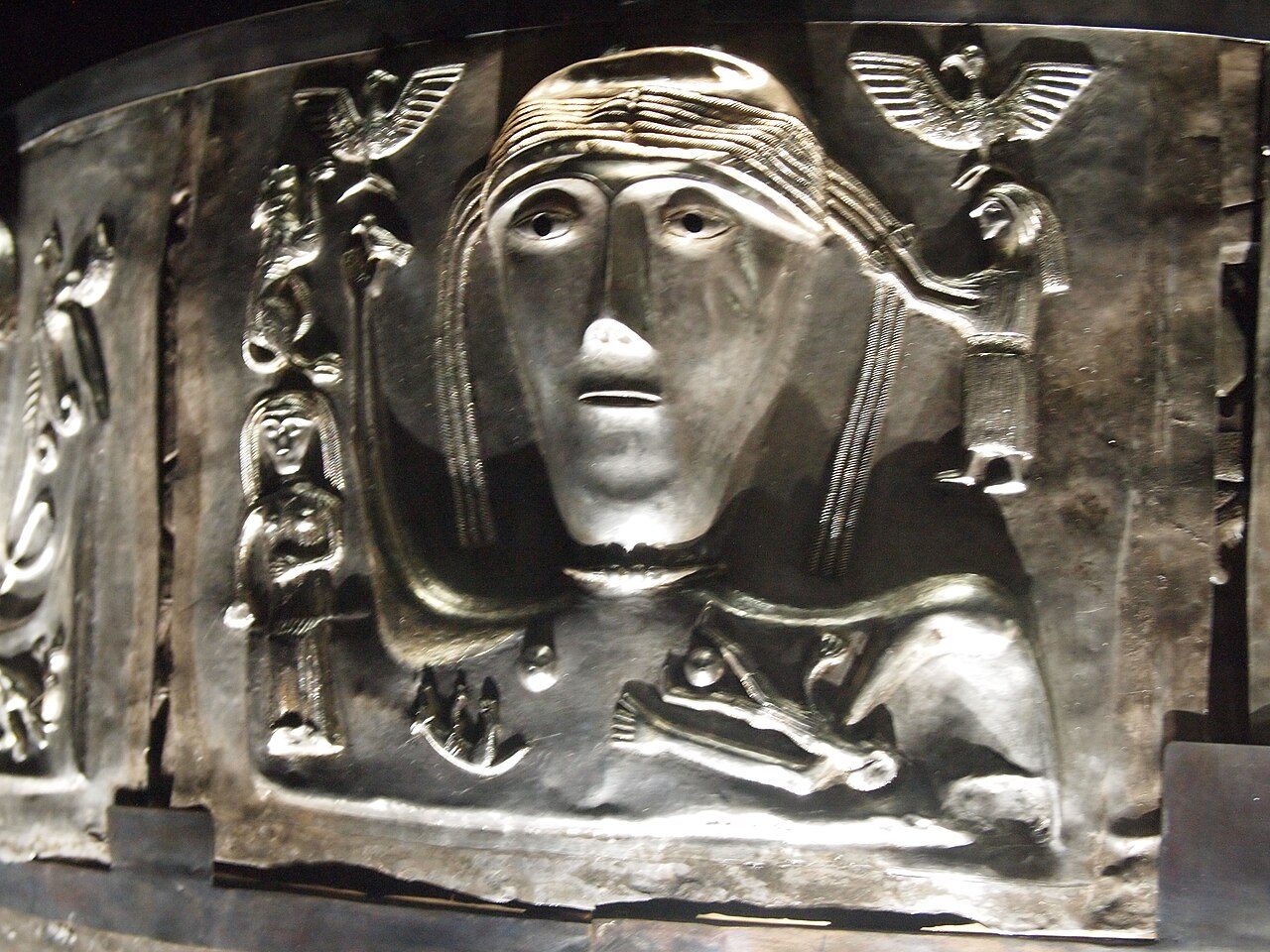
Photo: Kim Bach, CC BY-SA 3.0, via Wikimedia Commons
How it is dated
The cauldron itself is dated by style and by comparison with Thracian silver and Celtic coinage to roughly 150 BC to the birth of Christ, though some studies of beeswax on the plates have given later dates, and broad estimates run from 200 BC to AD 300. The deposit must be later than manufacture and the long period of repairs, but nothing found with it dates it closely.
What happened after the find
As a find of precious metal the cauldron was treated as treasure trove (danefæ) and passed to the National Museum; the Danish state paid the finders a large reward, over which they reportedly quarrelled.
Where sources differ
- Date of manufacture: 150 BC to the birth of Christ (National Museum of Denmark), but radiocarbon dates on beeswax and other studies range from about 200 BC to AD 300.
- Place of manufacture: Thracian-Celtic contact zone on the lower Danube (National Museum of Denmark) versus north-west Gaul (Olmsted).
- Whether the find spot was dry land or open bog when the cauldron was deposited (1891 study versus 2002 study).
- The Cimbri link is a hypothesis.
- Count of 15 pieces is my tally of base, 12 plates and 2 rim fragments; it is not a published figure.
Questions
Where is the Gundestrup cauldron now?
The original is in the National Museum of Denmark in Copenhagen. Full-size replicas are in the National Museum of Ireland and in French museums including the Musée d'archéologie nationale at Saint-Germain-en-Laye.
Is the Gundestrup cauldron Celtic?
Partly. The objects shown, such as helmets and carnyx trumpets, are Celtic, but the silverworking technique is Thracian, and it was found in Denmark. Most scholars see it as made where Celtic and Thracian cultures met, probably on the lower Danube.
Why was the Gundestrup cauldron in a bog?
It was taken apart and placed in a small bog, probably as an offering, a common practice in Iron Age Denmark. Some early researchers thought it had been hidden on dry land that later turned to bog.