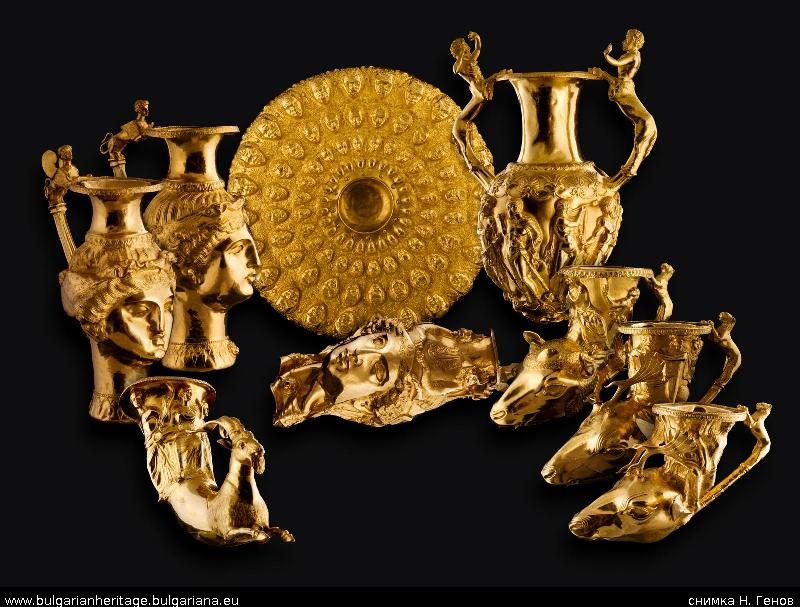
On 8 December 1949 three brothers were digging clay for a tile works beside the railway station at Panagyurishte, in the hills of central Bulgaria, when their spades struck metal. What came out of the ground was a set of nine gold vessels weighing a little over six kilograms, the richest single find of ancient gold made in Europe in the years after the Second World War. A curator from the local museum recognised at once that the pieces were Thracian, and the set was handed to the state.
The nine pieces belong together as a drinking service. The phiale is a broad, shallow bowl for pouring libations; its surface is covered in concentric rings of tiny embossed heads and acorns around a central boss. The largest piece is an amphora-rhyton, a two-handled jar whose handles take the form of centaurs and which has small spouts low on the body so that wine could be poured out in a stream. The other seven are rhyta and jugs: three shaped as the heads of women, wearing elaborate headdresses, and four ending in the heads or foreparts of animals, including goats and deer.
Almost every surface carries figures drawn from Greek myth and ritual. Scholars have identified Heracles, Theseus, Dionysos and a number of goddesses, while the frieze around the amphora shows armed men converging on a door, read by some as a scene from the story of the Seven against Thebes. The craftsmanship is Greek in its figure style but the shapes, especially the animal-headed rhyta, belong to a tradition shared by Thracian and Persian courts. That mix is typical of the Odrysian kingdom, which controlled much of Thrace in the 5th and 4th centuries BC and absorbed influences from both its neighbours.
The phiale carries an inscription giving its weight in two systems, Greek drachmas and Persian darics. It is a small detail with a large implication: precious vessels in this world were also stores of value, weighed and counted like coin, and a ruler's table service doubled as part of his treasury.
Nobody knows who buried the set or why. The pieces are dated to around 300 BC, and the usual suggestion is that they were hidden during a period of upheaval, such as the Macedonian campaigns or the Celtic incursions into Thrace in the early 3rd century BC. Some writers have linked the service to the Odrysian king Seuthes III; this is an attractive idea but cannot be proved, since the vessels were found by chance and without any recorded archaeological context.
Today the treasure is one of Bulgaria's national emblems. It has been lent to exhibitions across Europe, North America and Japan, and its custody has itself been a matter of debate between the national museum in Sofia, the archaeological museum in Plovdiv and the town of Panagyurishte, which asks to show its treasure at home for part of each year.
Highlights
A libation bowl covered in rings of embossed heads and acorns. An inscription records its weight in drachmas and darics.
The largest vessel, with centaur handles and spouts near the base. Its frieze of armed men at a door is often read as the Seven against Thebes.
Three vessels modelled as the heads of women in rich headdresses, each topped by a small handle and decorated with tiny relief figures.
Drinking horns that end in the heads or foreparts of goats and deer, with Greek mythological scenes worked around the neck.
What is in it
A complete drinking service in gold: one phiale (libation bowl), one amphora-rhyton and seven rhyta, three of them shaped as women's heads and the others ending in the heads or foreparts of animals.
Size: 9 vessels. Weight: about 6.16 kg.
| Item | Number | Notes |
|---|---|---|
| Phiale | 1 | Shallow libation bowl with rings of embossed heads; inscribed with its weight in Greek and Persian units |
| Amphora-rhyton | 1 | Two-handled vessel with spouts at the base and a frieze of armed men at a door |
| Rhyta and head-shaped jugs | 7 | Three in the form of female heads, the rest with animal heads or foreparts (goats and deer) |
Photographs
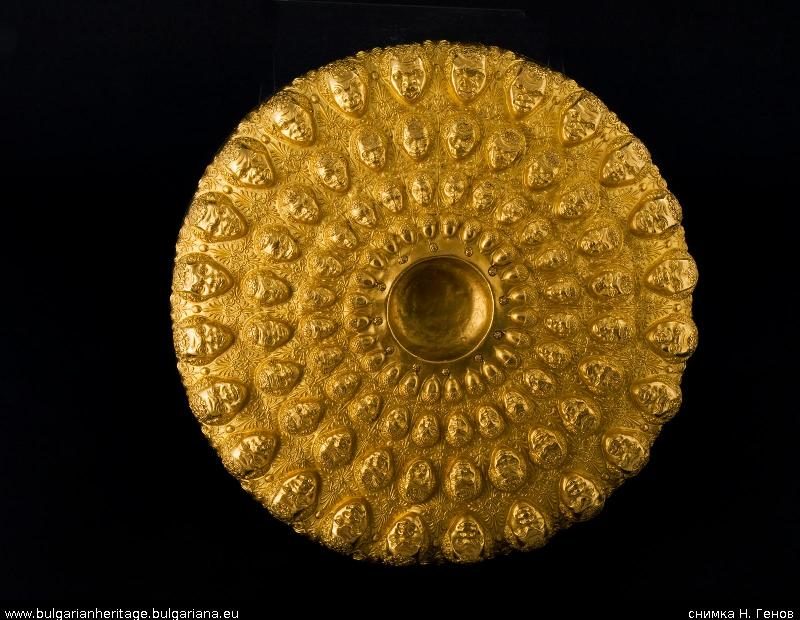
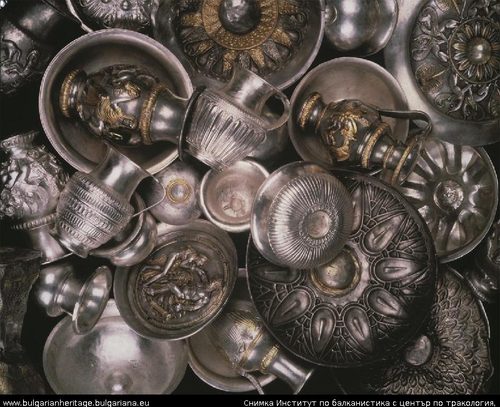
Photo: Николай Генов, CC BY 3.0, via Wikimedia Commons
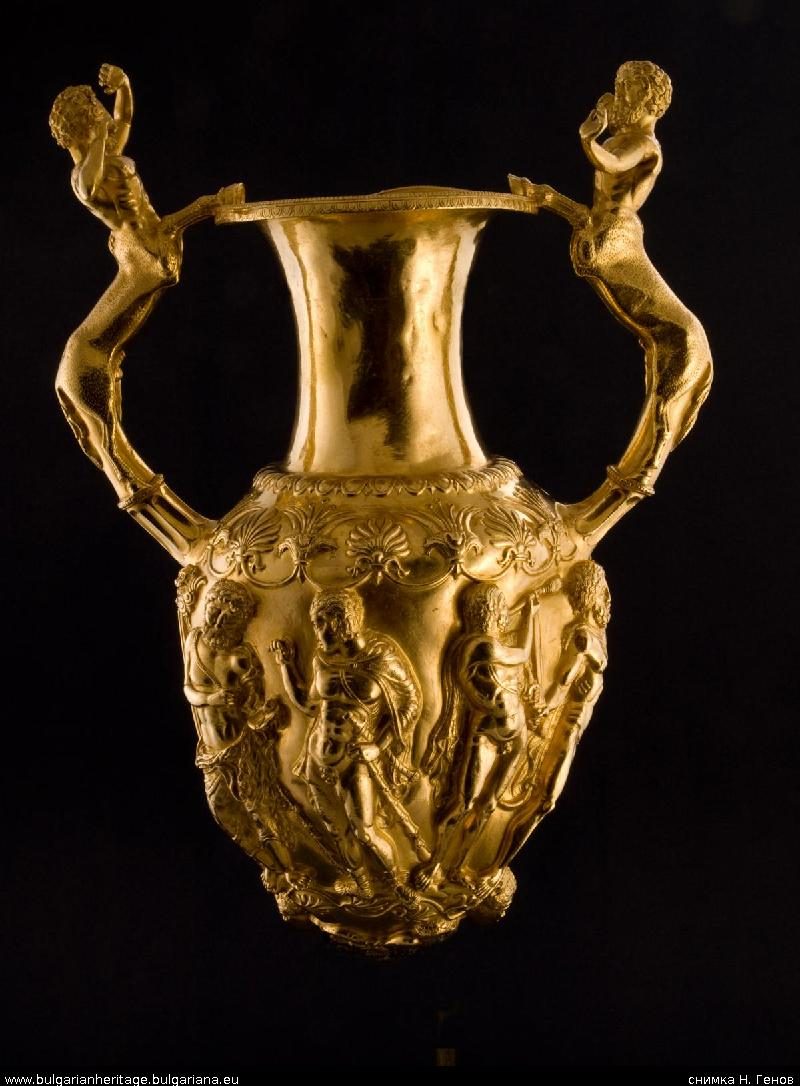
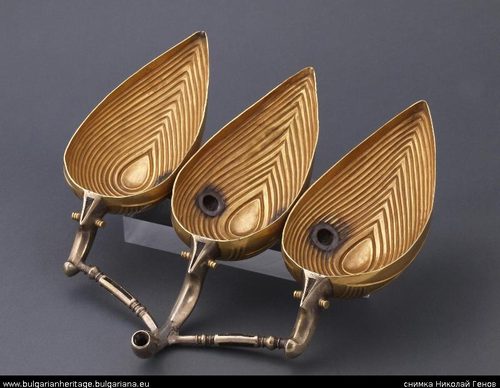
Photo: Николай Генов http://bulgarianheritage.bulgariana.eu/jspui/handle/pub/74, CC BY 3.0, via Wikimedia Commons
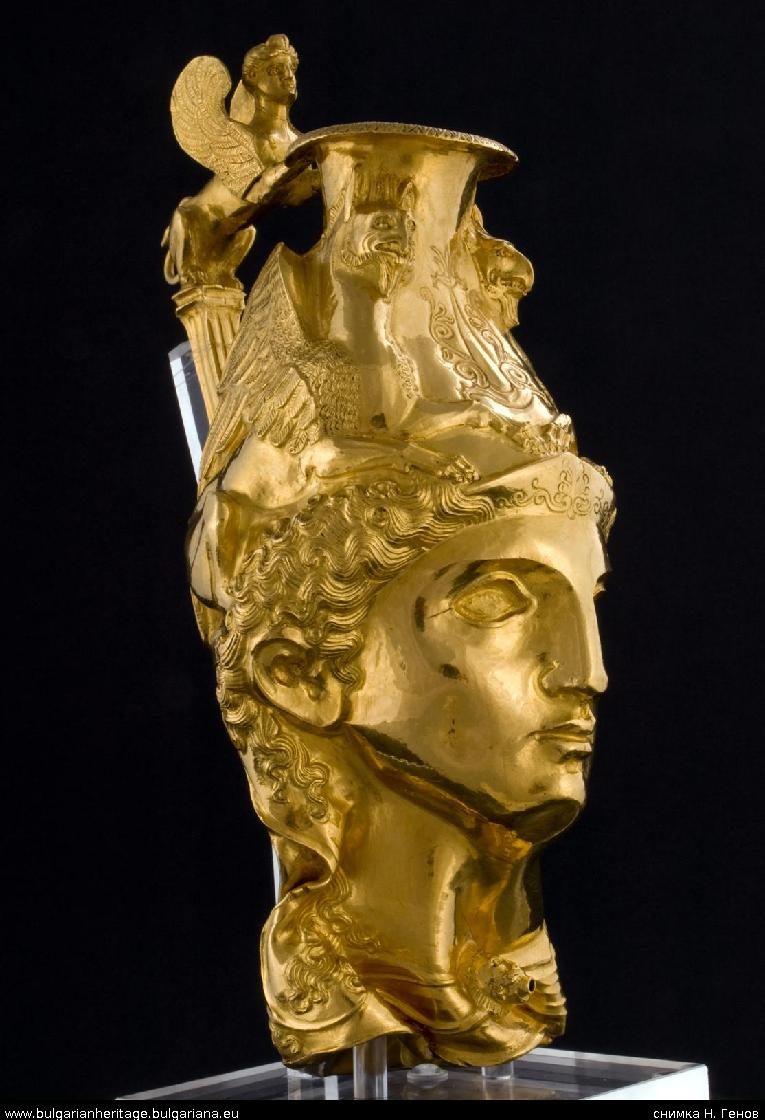
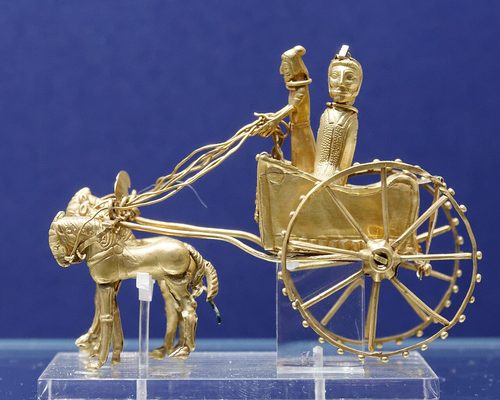
Photo: Николай Генов, CC BY 3.0, via Wikimedia Commons
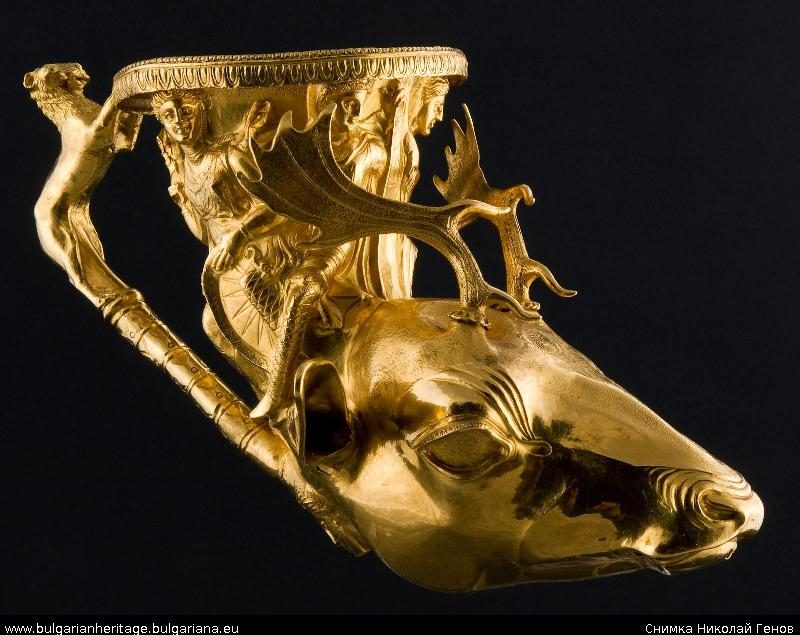
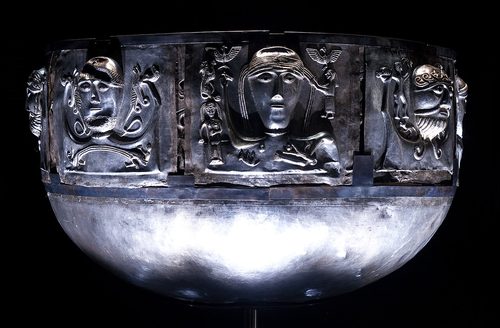
Photo: Николай Генов http://bulgarianheritage.bulgariana.eu/jspui/handle/pub/559, CC BY 3.0, via Wikimedia Commons
How it is dated
There are no coins and no excavated context, so the date rests on style. The figure work and the vessel types are compared with Greek and Thracian metalwork of the late 4th and early 3rd centuries BC, which gives a date of around 300 BC for the set and a deposit not long after.
What happened after the find
The find was handed to the Bulgarian state in 1949 and became national property; it is registered in a state museum's inventory and lent abroad only by government agreement.
Where sources differ
- Gold purity: Wikipedia gives 24-carat, Bulgarian news and heritage sites give 23-carat.
- Custody: Bulgarian National Television (2022) says the vessels belong to the National Museum of History, Sofia; other reports say the treasure was first entered in the Plovdiv Regional Archaeological Museum's inventory; Wikipedia's infobox lists Plovdiv.
- Dating is given variously as late 4th to early 3rd century BC (most sources) and 5th to 4th century BC (some popular sources).
- The link to Seuthes III and the reason for burial (Celtic or Macedonian invasions) are hypotheses, not established facts.
Questions
Where can I see the Panagyurishte Treasure?
The originals move between the National Museum of History in Sofia, the Regional Archaeological Museum in Plovdiv and the History Museum in Panagyurishte, and are often lent to exhibitions abroad. Each of the three Bulgarian museums keeps a replica set, so check with the museum before travelling to see the real gold.
How much gold is in the Panagyurishte Treasure?
The nine vessels weigh about 6.16 kg in total. They are high-purity gold, given as 23-carat by Bulgarian sources.
Who owned the Panagyurishte Treasure?
It was almost certainly the table service of a Thracian ruler or noble around 300 BC. Some scholars suggest the Odrysian king Seuthes III, but there is no inscription naming an owner.