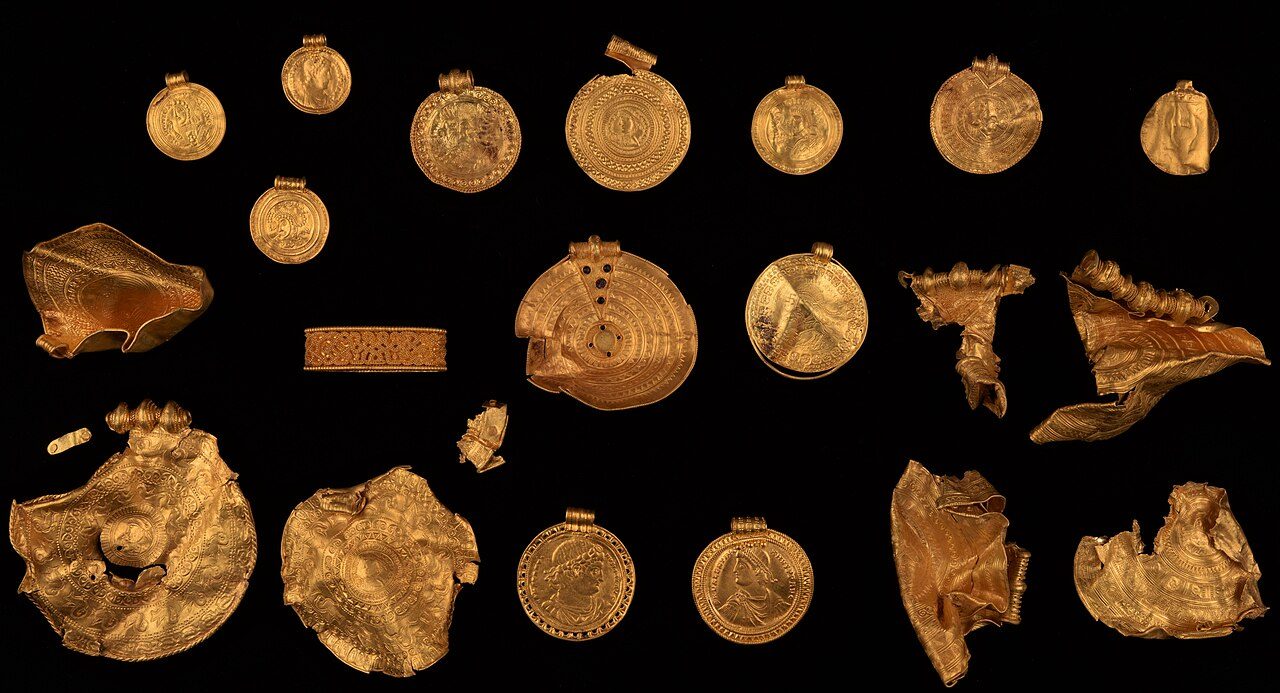
On a cold December day in 2020 two metal detectorists searching a field at Vindelev, about eight kilometres north-east of Jelling in eastern Jutland, began finding thin discs of gold just below the surface. They reported the find, and archaeologists from Vejle Museums and the National Museum of Denmark recovered 23 gold objects weighing just under 800 grams. Most lay within two small patches a few metres apart; ploughing had dragged a few of the largest pieces further and torn one bracteate into three parts found as much as 90 metres apart.
The bulk of the hoard is bracteates, the stamped gold pendants that Scandinavians made in imitation of Roman imperial medallions in the 5th and 6th centuries. Vindelev's are exceptional in size and finish. One, catalogued as X10, measures 13.8 centimetres across and weighs 123.7 grams, the largest bracteate known; four others rank among the ten largest. They have elaborate loops and several concentric bands of stamped decoration, and some had been folded or rolled up before burial. Specialists used CT scanning to unfold them digitally and read their designs.
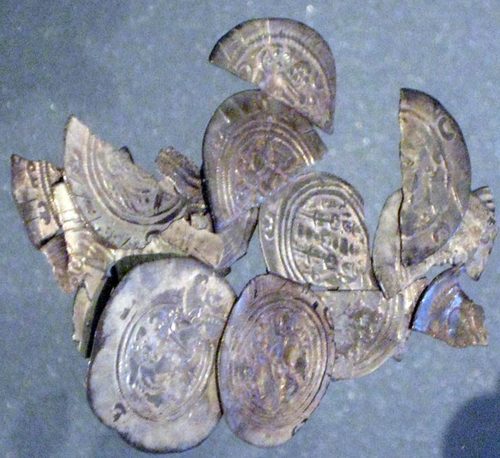
Alongside the bracteates were four Roman gold solidi of Constantine I, Constans, Valentinian I and Gratian, each fitted with a decorated frame and loop to be worn as a pendant, and the gold filigree mouthpiece of a sword scabbard. A close parallel for the frame on the Valentinian coin has been identified on a coin from a hoard in Poland, suggesting the same workshop outside the empire and a long chain of gift exchange.
Many of the bracteates carry runic inscriptions. In 2023 runologists at the National Museum published a reading of the text on bracteate X13 that includes the phrase 'he is Wodan's man', which they argue is the earliest known reference to the god Odin, older than the inscription on a 6th-century brooch from Nordendorf in Germany that previously held that place. The reading, and the idea that the crowned heads on bracteates show human rulers rather than gods, are still debated.
Excavations in 2021 found about 840 postholes from a group of buildings, including a large longhouse within which the gold had been buried, and radiocarbon dates showed the buildings and the deposit belong to the same period. The archaeologists interpret the site as a chieftain's residence a few kilometres from Jelling, where Danish kings were buried four centuries later. Why the gold went into the ground is unknown. It may have been hidden in a time of war, or offered to the gods during the crisis that followed the volcanic eruptions of around 536, when crops failed for several years; one theory links many 6th-century Scandinavian gold hoards to that disaster.
Highlights
At 13.8 cm across and 123.7 g, the largest gold bracteate ever found. It was rolled up before burial, so its central image is only partly visible.
A C-type bracteate showing a head above a horse, with a runic text read in 2023 as including 'he is Wodan's man'.
Four solidi of 4th-century emperors, struck at Trier and Thessaloniki, framed and looped to be worn as jewellery.
A band of gold filigree about 6 cm wide from the mouth of a sword scabbard, undamaged and dated to the early 6th century.
A large medallion with no central image but a setting for a missing inlay and coloured glass in its triangular loop.
What is in it
Gold bracteates, several of record size and many with runic inscriptions, four Roman gold coins turned into pendants, a sword-scabbard mouthpiece and smaller pieces.
Size: 23 finds (some are fragments of the same object). Weight: about 795 g.
| Item | Number | Notes |
|---|---|---|
| Bracteates and medallions | 16 | Thin stamped gold pendants, mainly A-type (male head) and C-type (head over a horse); several over 10 cm across |
| Roman solidi as pendants | 4 | Constantine I, Constans, Valentinian I and Gratian, each framed with a decorated border and loop |
| Scabbard mouthpiece | 1 | Gold filigree, about 6 cm wide, the youngest piece |
| Fragments and fittings | 2 | Small pieces, including a repair fitting torn off by ploughing |
Photographs
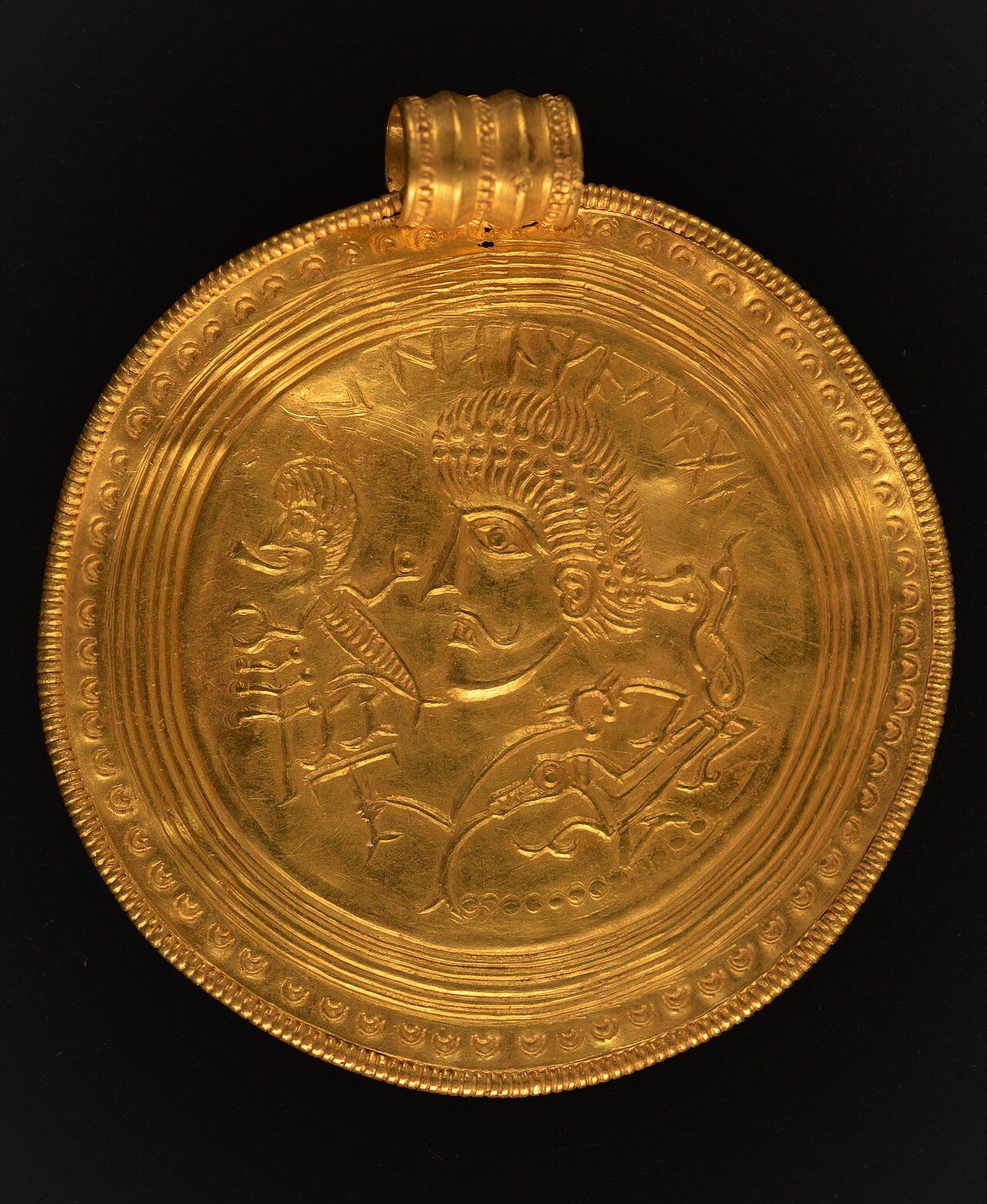
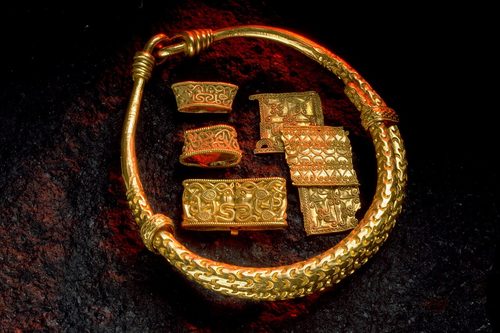
Photo: Vejlemuseerne / Konserveringscenter Vejle, CC BY-SA 4.0, via Wikimedia Commons
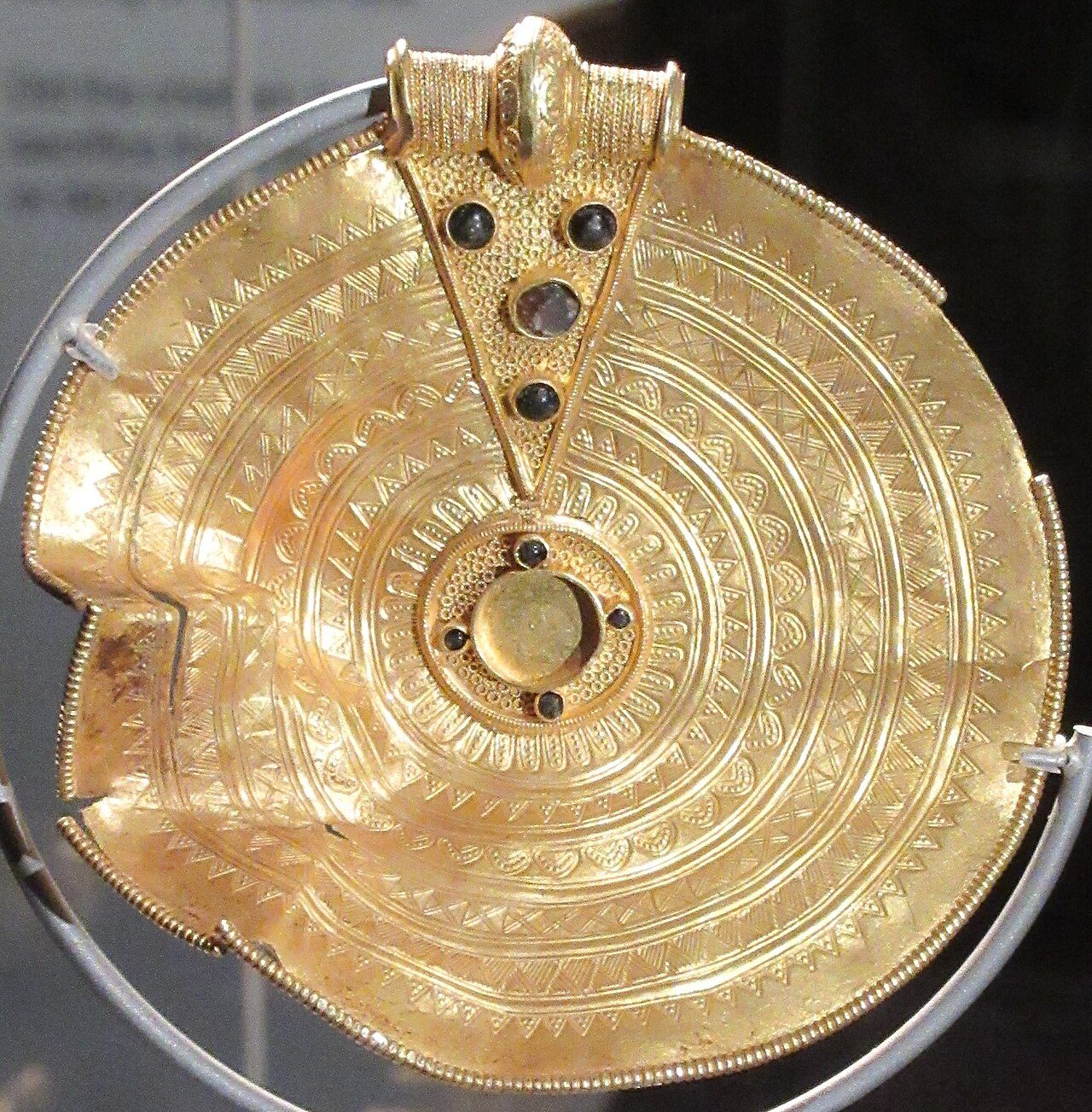
Photo: Oleryhlolsson, CC BY-SA 4.0, via Wikimedia Commons
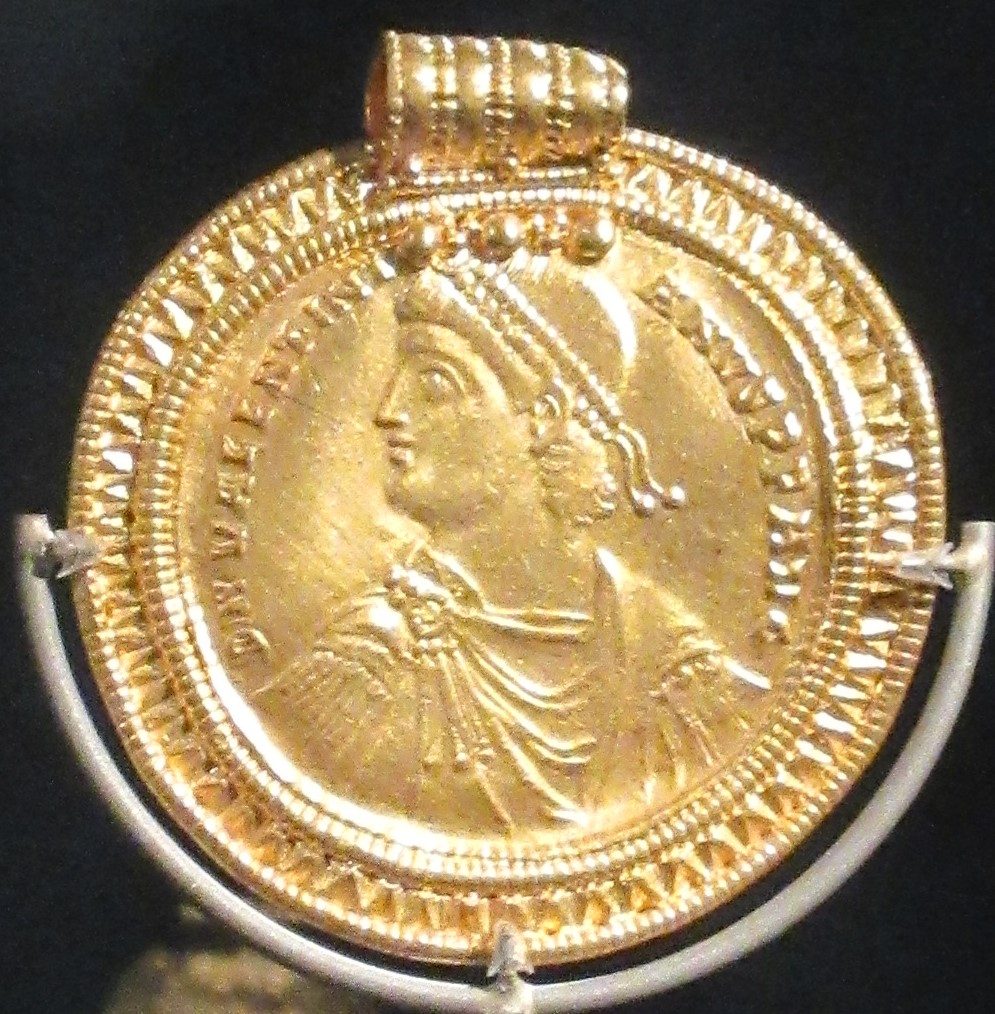
Photo: Oleryhlolsson, CC BY-SA 4.0, via Wikimedia Commons
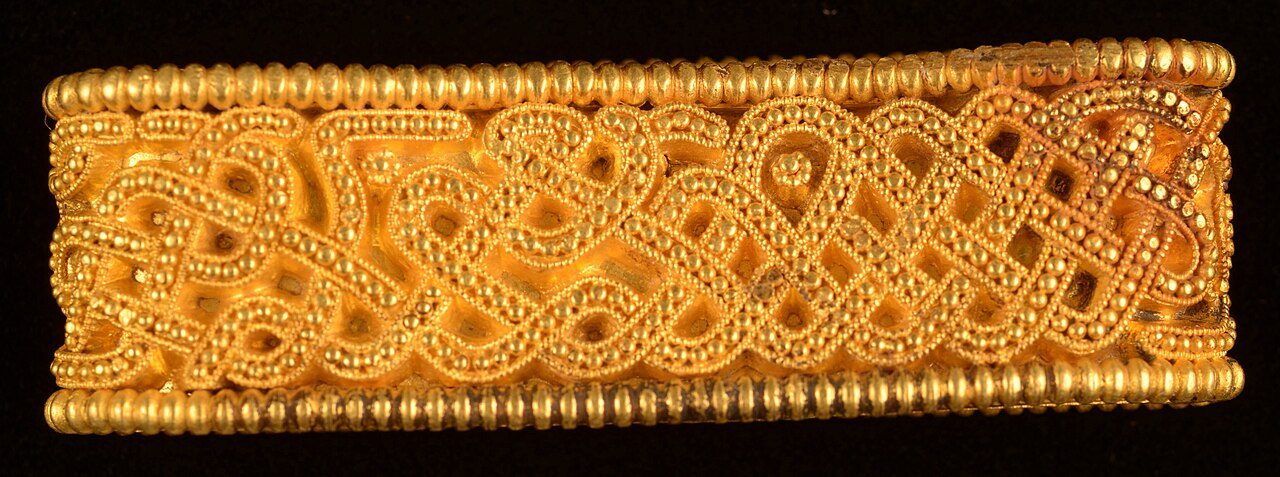
Photo: Vejlemuseerne / Konserveringscenter Vejle, CC BY-SA 4.0, via Wikimedia Commons
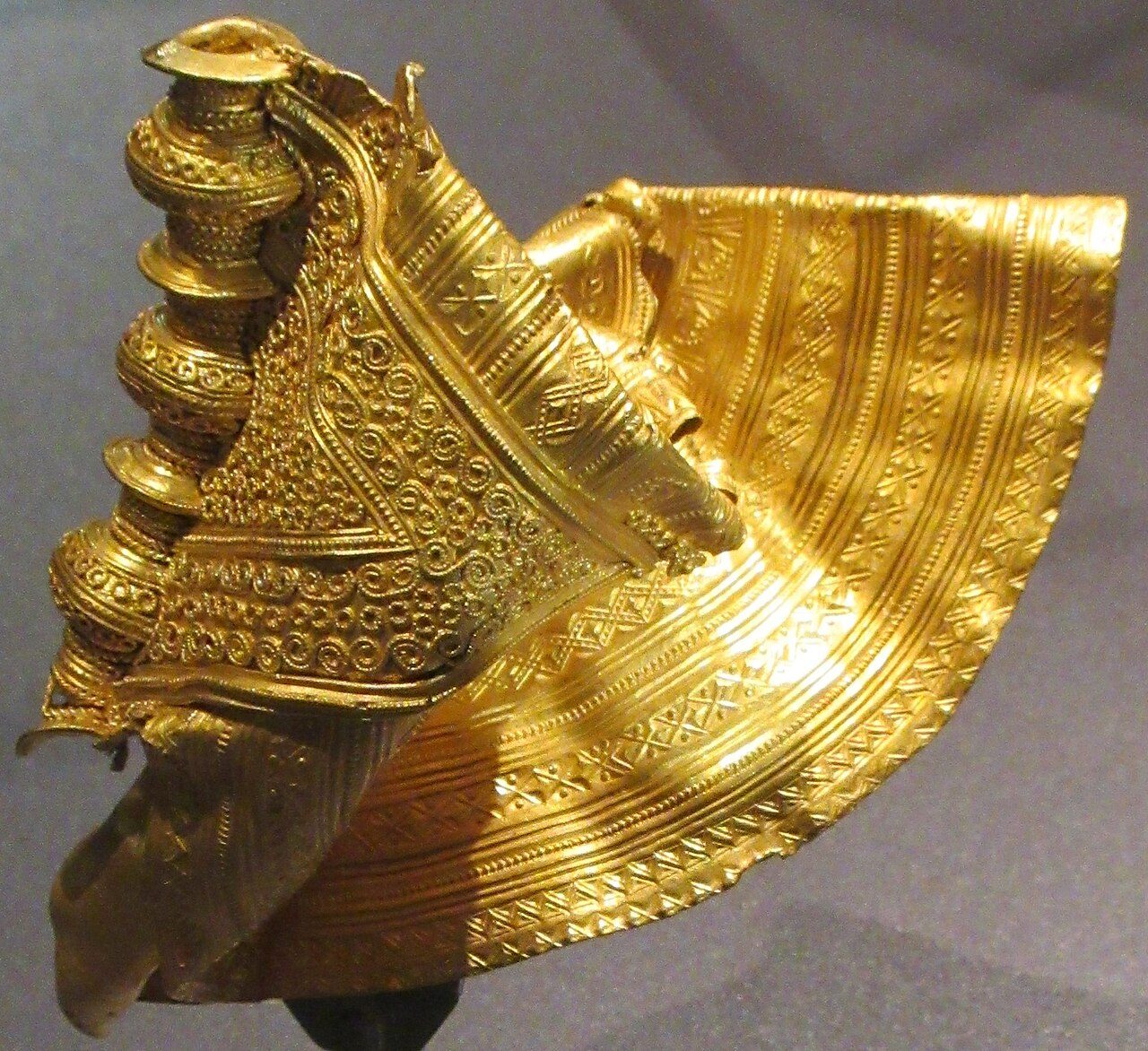
Photo: Oleryhlolsson, CC BY-SA 4.0, via Wikimedia Commons
How it is dated
The bracteates are dated by style to the later 5th century, older than most comparable finds. The scabbard mouthpiece, the youngest piece, is dated to the early 6th century, so the deposit falls in the early to mid-6th century. Radiocarbon dates from soil on the objects and from the postholes of the surrounding buildings agree.
What happened after the find
Gold from antiquity found in Denmark is danefæ (treasure trove) and belongs to the state; the detectorists reported the find and it passed to the National Museum of Denmark, which runs Kongernes Jelling.
Where sources differ
- Weight: Wikipedia gives 794 g; Kongernes Jelling gives 795.6 g.
- Date of the bracteates: Wikipedia (citing Morten Axboe) gives the second half of the 5th century; Kongernes Jelling says the runes on one bracteate date to the beginning of the 400s.
- The breakdown of the 23 finds into categories is approximate; some find numbers are fragments of the same bracteate.
- The reading of X13 as naming Odin, and its status as the earliest reference to him, is the interpretation of the National Museum runologists; alternatives exist.
- Danefæ status and any reward are not stated in the sources I could read; the law line relies on how Danish law treats such finds.
Questions
Where can I see the Vindelev Hoard?
It is on display at Kongernes Jelling, the National Museum of Denmark's museum at Jelling, a few kilometres from the find spot, in an exhibition running until 29 December 2026. It was previously shown in Vejle (2022) and at the National Museum in Copenhagen (until February 2024).
Does the Vindelev Hoard mention Odin?
Runologists at the National Museum of Denmark read part of the inscription on bracteate X13 as 'he is Wodan's man', which they consider the oldest known reference to Odin. Other scholars read the bracteate images differently, so the point is still debated.
How big is the largest Vindelev bracteate?
Bracteate X10 is 13.8 cm in diameter and weighs 123.7 grams, making it the largest gold bracteate ever found.