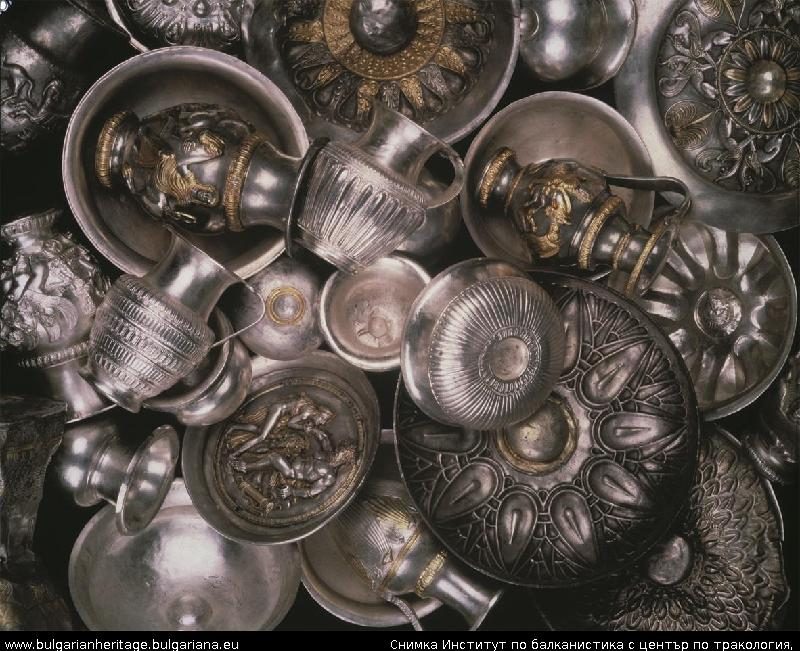
In the autumn of 1985 a villager in Rogozen, in north-west Bulgaria, was digging a trench to water his garden when he turned up a mass of silver vessels. He kept the find to himself for several months, worried that archaeologists would dig up his plot. In early January 1986 he took the 65 pieces to the village mayor, who called the regional museum in Vratsa. Within days its archaeologists had opened the ground a few metres from the first spot and lifted another 100 vessels. Together they make the largest Thracian treasure ever found in Bulgaria.
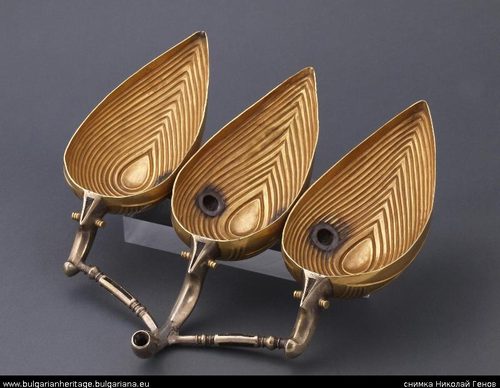
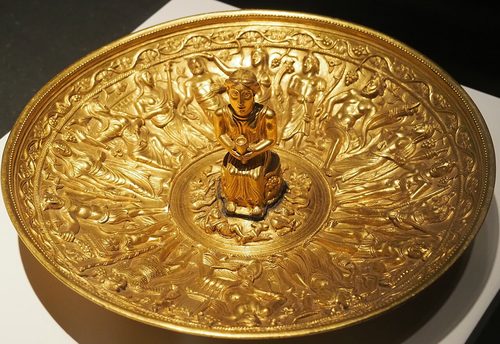
The hoard is entirely made up of vessels for drinking and for pouring offerings: 108 phialae, the shallow bowls used for libations, 54 small jugs and three beakers, weighing about 20 kilograms in all. Many are plain or simply fluted. Others are decorated in gilded relief: rosettes and lotus buds, lions bringing down deer, horsemen, and on one celebrated phiale a scene of Heracles with the priestess Auge, labelled in Greek. A jug known as the Goddess between Centaurs shows a female figure flanked by fantastic creatures above a frieze of dogs attacking a kneeling bull.
What makes Rogozen exceptional is writing. A number of the vessels carry short inscriptions in Greek letters, scratched or dotted into the silver. Several name Kotys I, king of the Odrysian Thracians from about 383 to 359 BC, sometimes with a place name, so that a phiale may be marked as belonging to Kotys and coming from a particular town. One bears the name of his son Kersebleptes, and one names the craftsman who made it. Six settlement names appear in all, giving historians a rare glimpse of how the Odrysian kings drew silver from the towns of their realm.
The styles range widely, from the late 6th to the mid-4th century BC, and include pieces that look Greek, Persian and local. That suggests a collection built up over generations, partly from gifts and tribute that the Odrysian court passed on to local rulers in the north-west, perhaps chiefs of the Triballi, the Thracian people of this part of the Danube plain. Why it was buried is unknown. A popular explanation links the burial to the upheavals of the 340s and 330s BC, when Philip II of Macedon campaigned in Thrace, but there is no direct evidence.
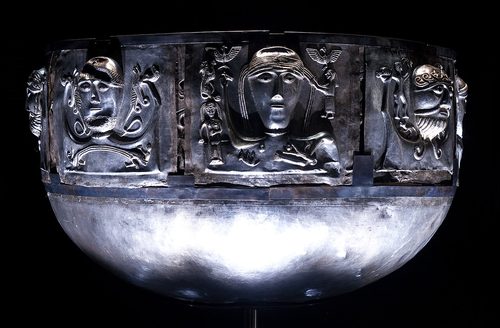
The second group was excavated and recorded by archaeologists, which makes Rogozen better documented than most Thracian treasures. The hoard was quickly shown abroad, including at the British Museum in 1986, and has been a centrepiece of Bulgarian exhibitions since. The National Museum of Denmark even compares the animals on one Rogozen jug with those on the Gundestrup cauldron, made in a related tradition centuries later.
Highlights
A silver bowl with a gilded relief of Heracles seizing the priestess Auge, both named in Greek letters.
A gilded silver jug whose frieze shows a lion bringing down a deer, a theme repeated across Thracian metalwork.
Jug no. 158, with a goddess flanked by centaur-like creatures above a bull attacked by dogs.
Several vessels are inscribed with the name of King Kotys I and a place of origin, such as the phiale reading in Greek 'of Kotys, from Beos'.
What is in it
A huge service of silver drinking and libation vessels, many partly gilded: shallow phialae, jugs and a few beakers, made over about two centuries in different workshops.
Size: 165 vessels. Weight: about 20 kg.
| Item | Number | Notes |
|---|---|---|
| Phialae | 108 | Shallow libation bowls, many with gilded relief decoration |
| Jugs | 54 | Small pitchers, some with figured friezes; one source gives 55 |
| Beakers / cups | 3 | |
| First group (1985) | 65 | Found by the householder |
| Second group (1986) | 100 | Excavated by archaeologists about 4 m away |
Photographs
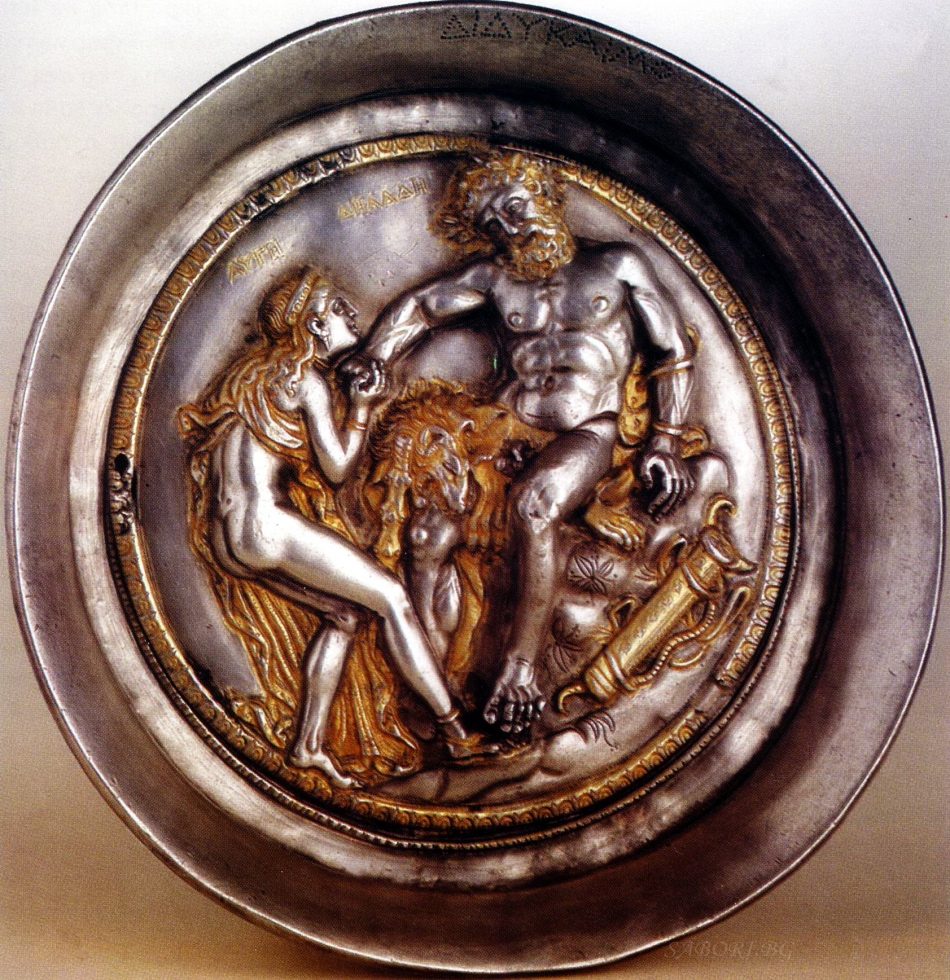
Photo: Daznaempoveche, Public domain, via Wikimedia Commons
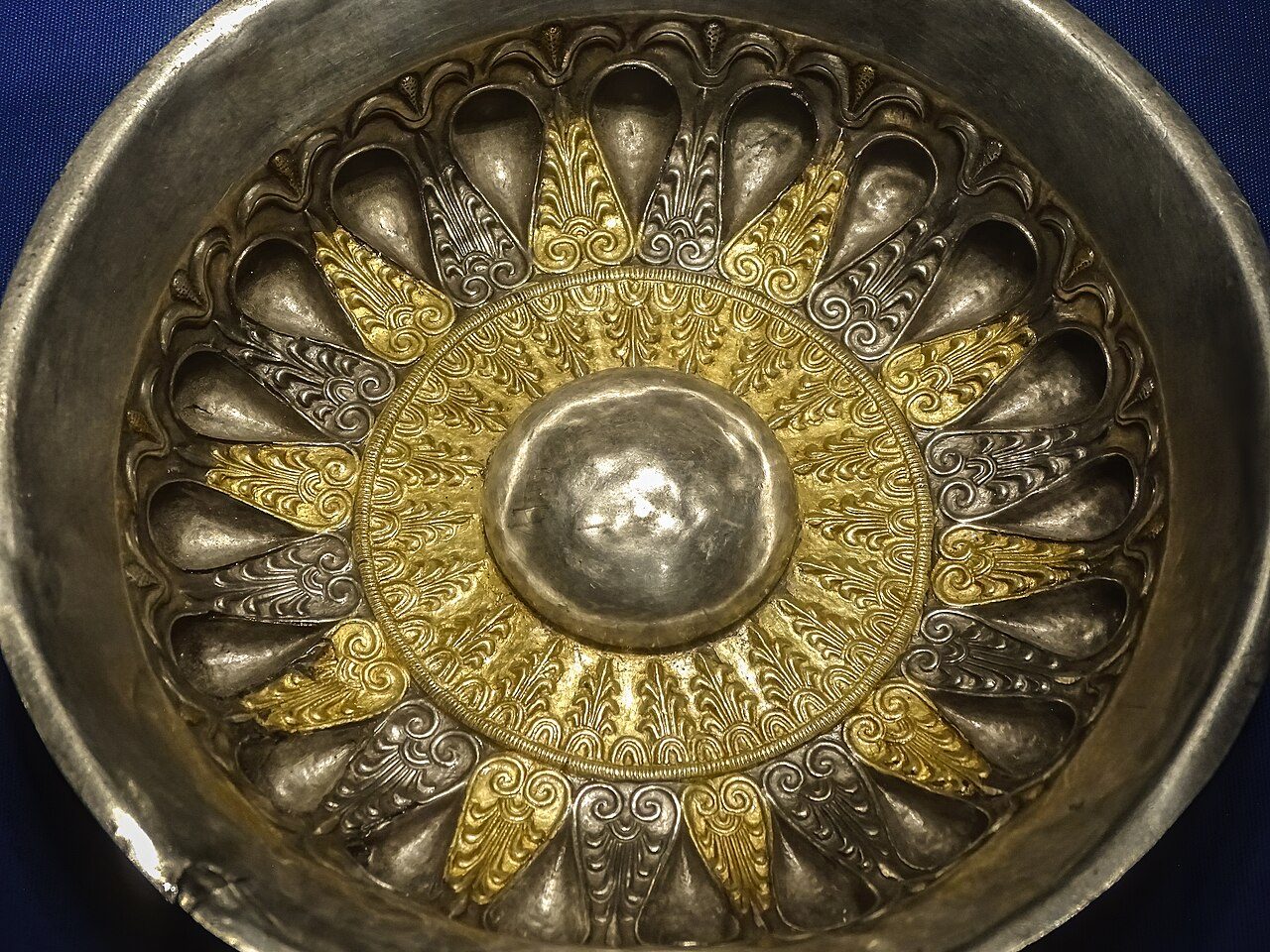
Photo: Adam Jones, CC BY-SA 2.0, via Wikimedia Commons
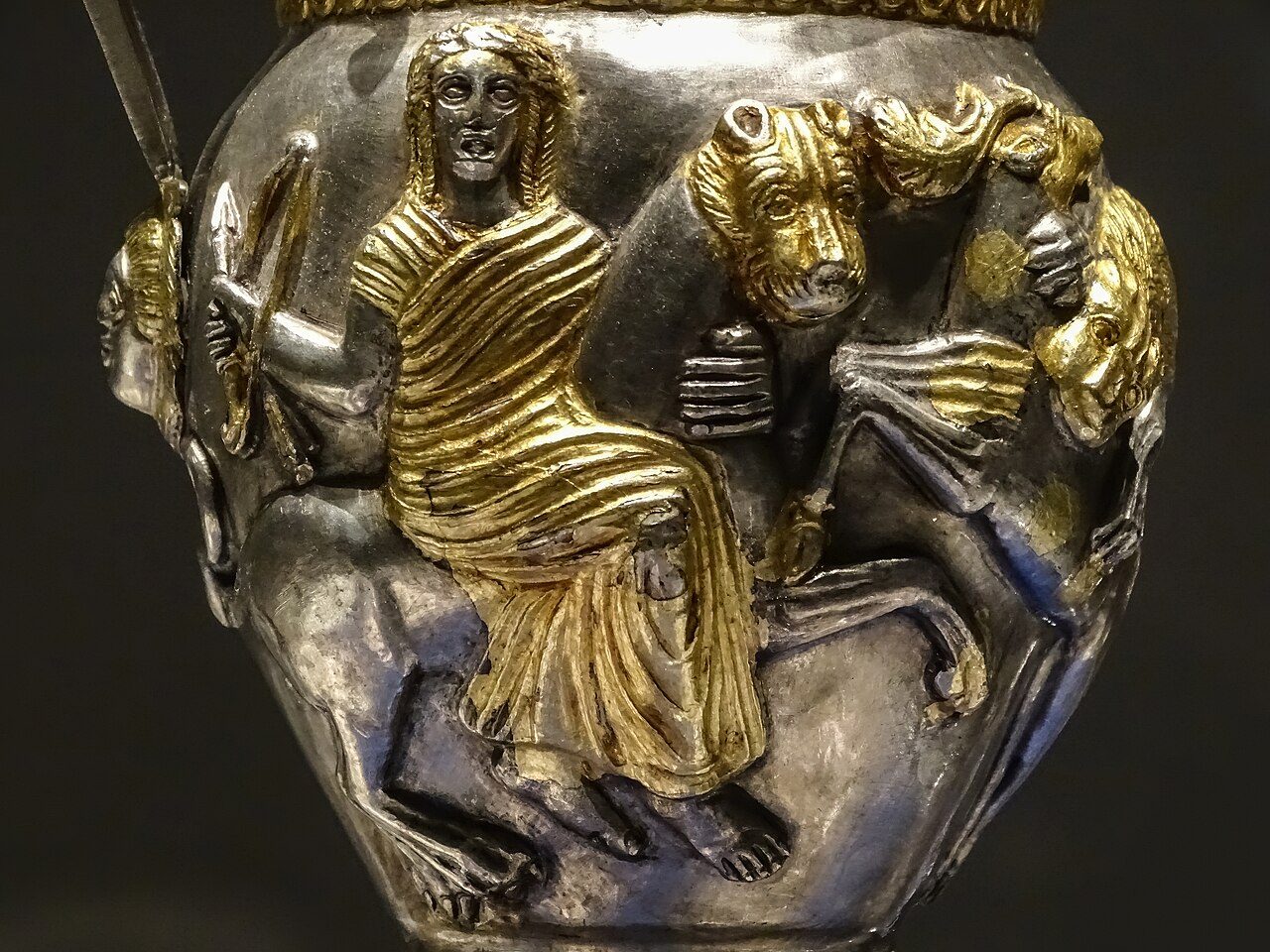
Photo: Adam Jones, CC BY-SA 2.0, via Wikimedia Commons
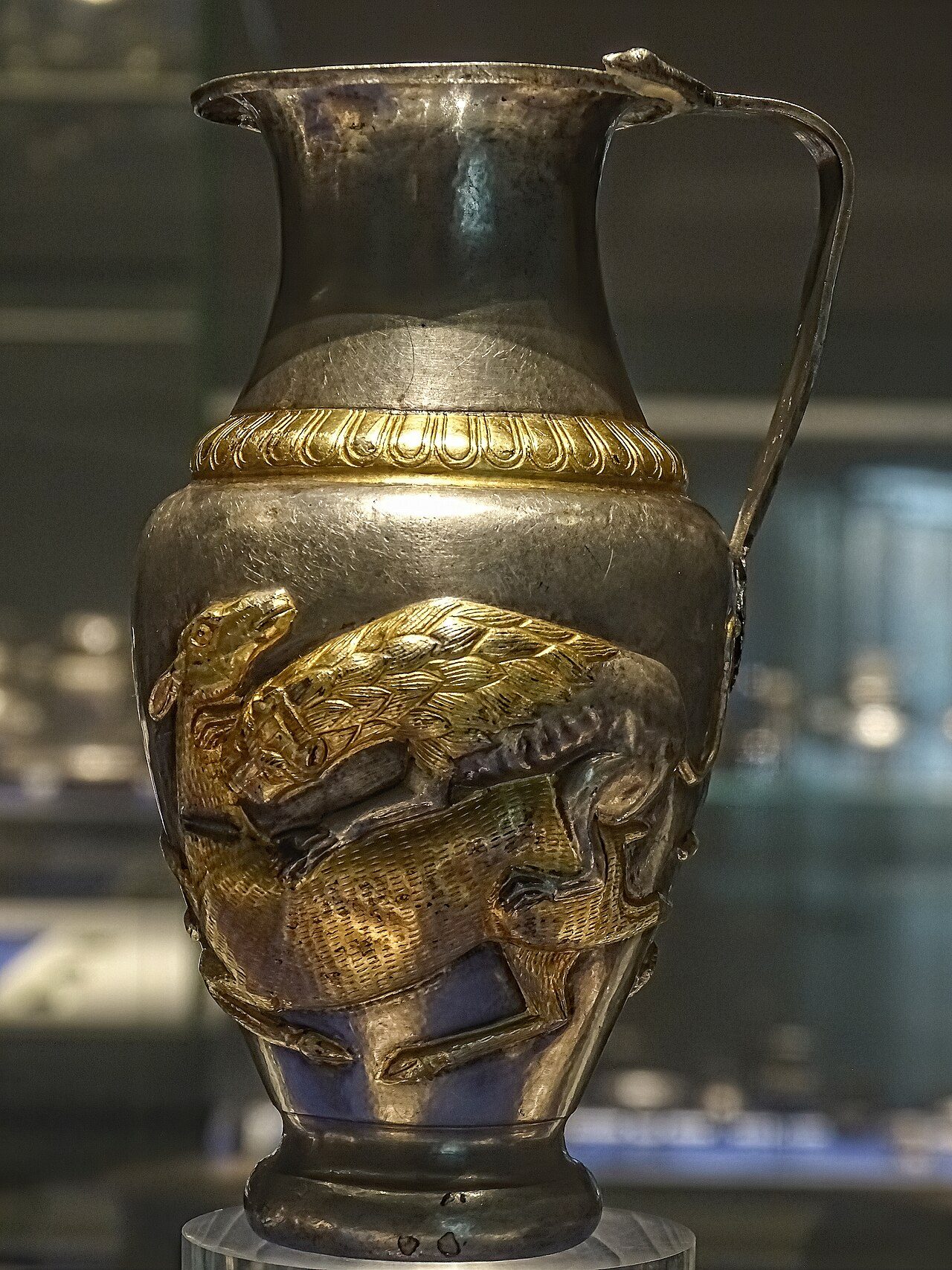
Photo: Adam Jones, CC BY-SA 2.0, via Wikimedia Commons
How it is dated
The inscriptions give the firmest anchor: Kotys I reigned from about 383 to 359 BC, and his son Kersebleptes ruled after him, so the hoard cannot have been closed before the middle of the 4th century BC. The vessels themselves span from the late 6th century BC onward on stylistic grounds.
What happened after the find
The householder handed the first group to the village mayor, who reported it to the regional museum in Vratsa; museum archaeologists then excavated the rest. The hoard is state property.
Where sources differ
- Breakdown: Bulgarian Wikipedia gives 108 phialae, 54 jugs and 3 cups (165); English Wikipedia gives 108, 55 and 3, which does not add up to its own total of 165.
- Date of the excavation of the second group: English Wikipedia gives 6 January 1986; Bulgarian Wikipedia says early January 1986.
- The connection of the burial with Philip II's campaigns is a hypothesis.
- Weight is given only as 'about 20 kg' or 'more than 20 kg'.
Questions
Where is the Rogozen Treasure displayed?
Most of it is in the Regional Historical Museum in Vratsa, north-west Bulgaria. Fifteen vessels are on long-term loan to the National Museum of History in Sofia.
How many objects are in the Rogozen Treasure?
There are 165 silver vessels, mostly phialae (libation bowls) and jugs, weighing about 20 kg together.
Why are the inscriptions on the Rogozen vessels important?
They name Odrysian kings, especially Kotys I, along with places and craftsmen. That lets historians link the silver to a known royal dynasty and see how precious vessels moved around the Thracian kingdom.