In 1968 the driver of a mechanical digger clearing ground for new houses on the Belstead Hills estate, on the south-west edge of Ipswich, turned over five heavy gold neck rings. They had lain together just below the surface for some two thousand years. A sixth torc turned up shortly afterwards in a nearby garden, in soil that had been shifted from the building site.
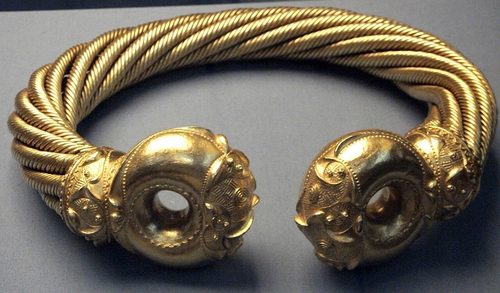
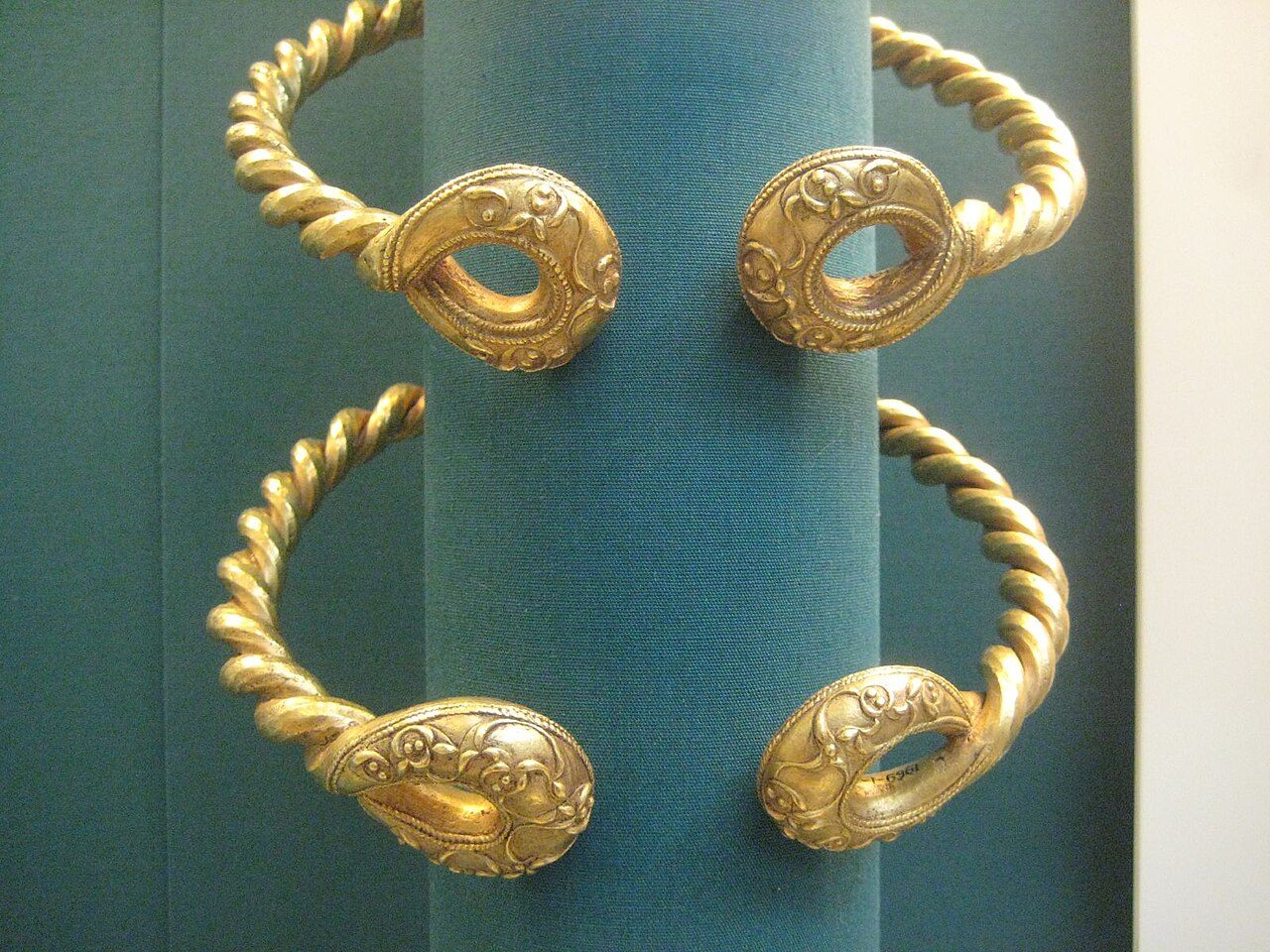
Each torc is made of two thick rods of gold alloyed with silver, twisted together and bent nearly into a circle, with a ring-shaped terminal at each end. The first five each weigh between about 27 and 33 ounces, roughly 0.8 to 1 kg, and are about eight inches across. Four have terminals with raised, curving decoration of the kind seen on the torcs from Snettisham in Norfolk; the fifth has plain terminals. The sixth has a hoop built from two pairs of bars and probably comes from the same workshop.
What makes the group unusual is that it is unfinished. The plain torc is at an earlier stage of work than the others, and the decorated ones still carry tool marks from chasing and chiselling. Rather than a set of worn ornaments offered to the gods, it looks like a goldsmith's stock, or a patron's commission, hidden before it was complete. The terminals were cast by the lost-wax method onto the twisted hoops, and each torc has a slightly different design on its two ends.
The Ipswich find is often ranked second only to Snettisham among British Iron Age hoards. It shows that the distinctive East Anglian torc style was not confined to one site, and its unfinished state gives a rare view of how these objects were made. Torcs of this weight would have been worn by a small elite, and the metal alone represented great wealth. The county record compares the sixth torc with single finds from Ulceby in Lincolnshire and Glascote in Staffordshire, a sign that the same workshop tradition reached well beyond East Anglia.
The torcs were declared treasure trove and acquired by the British Museum, where they have been displayed alongside the Snettisham material. Ipswich Museum shows replicas.
Highlights
Four torcs have cast ring terminals with raised curvilinear ornament of the Snettisham class, each end slightly different from its partner.
One torc has undecorated terminals, apparently left at an earlier stage of manufacture, a rare look at work in progress.
Found later in a garden, its hoop is made of two pairs of bars rather than two rods; it is thought to come from the same workshop.
What is in it
Six neck rings of gold alloyed with silver, each with a hoop of twisted rods and cast ring terminals; several are unfinished.
Size: 6 torcs. Weight: each of the first five about 27-33 ounces (roughly 0.8-1 kg).
| Item | Number | Notes |
|---|---|---|
| Torcs found 1968 | 5 | four with embossed terminals of Snettisham type, one with plain ring terminals at an earlier stage of manufacture |
| Torc found later | 1 | hoop of two pairs of bars, in soil moved from the original spot about 60 m away |
Photographs
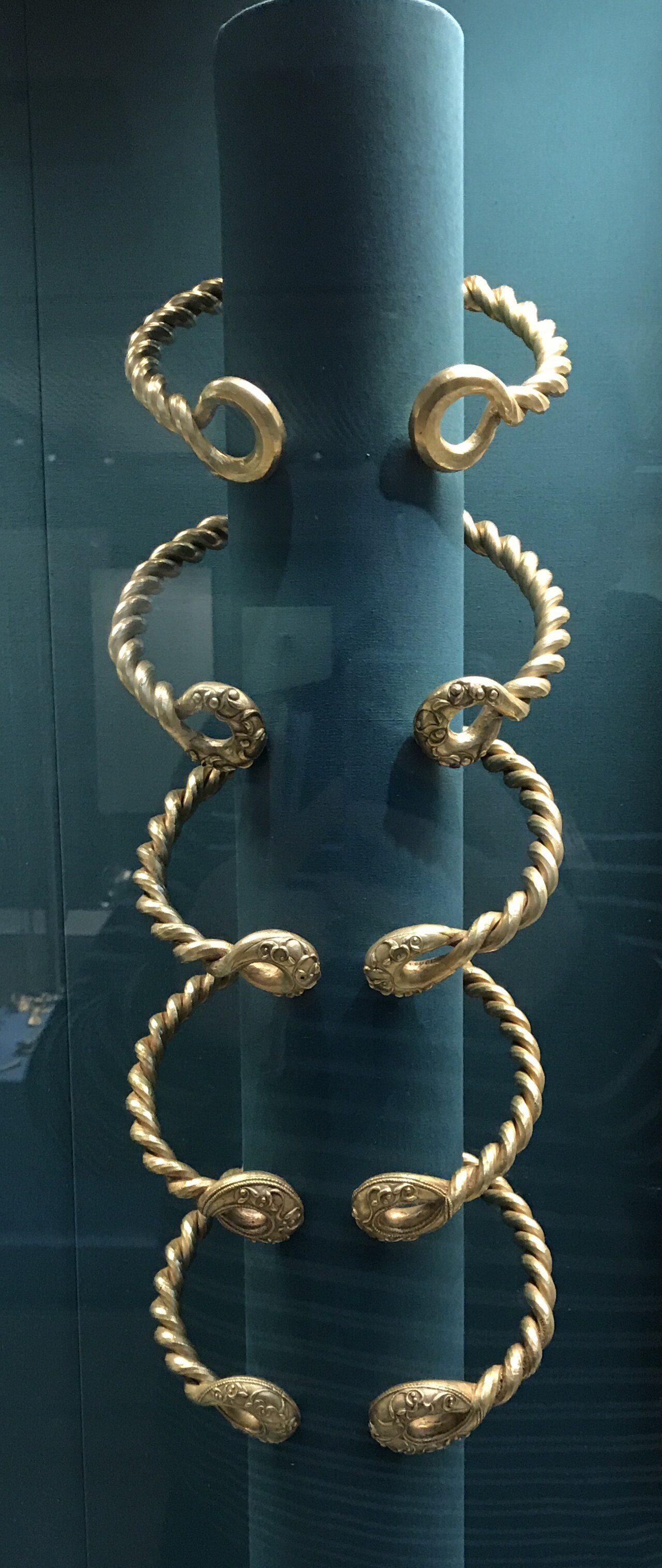
Photo: Matthew Ford, CC BY-SA 4.0, via Wikimedia Commons
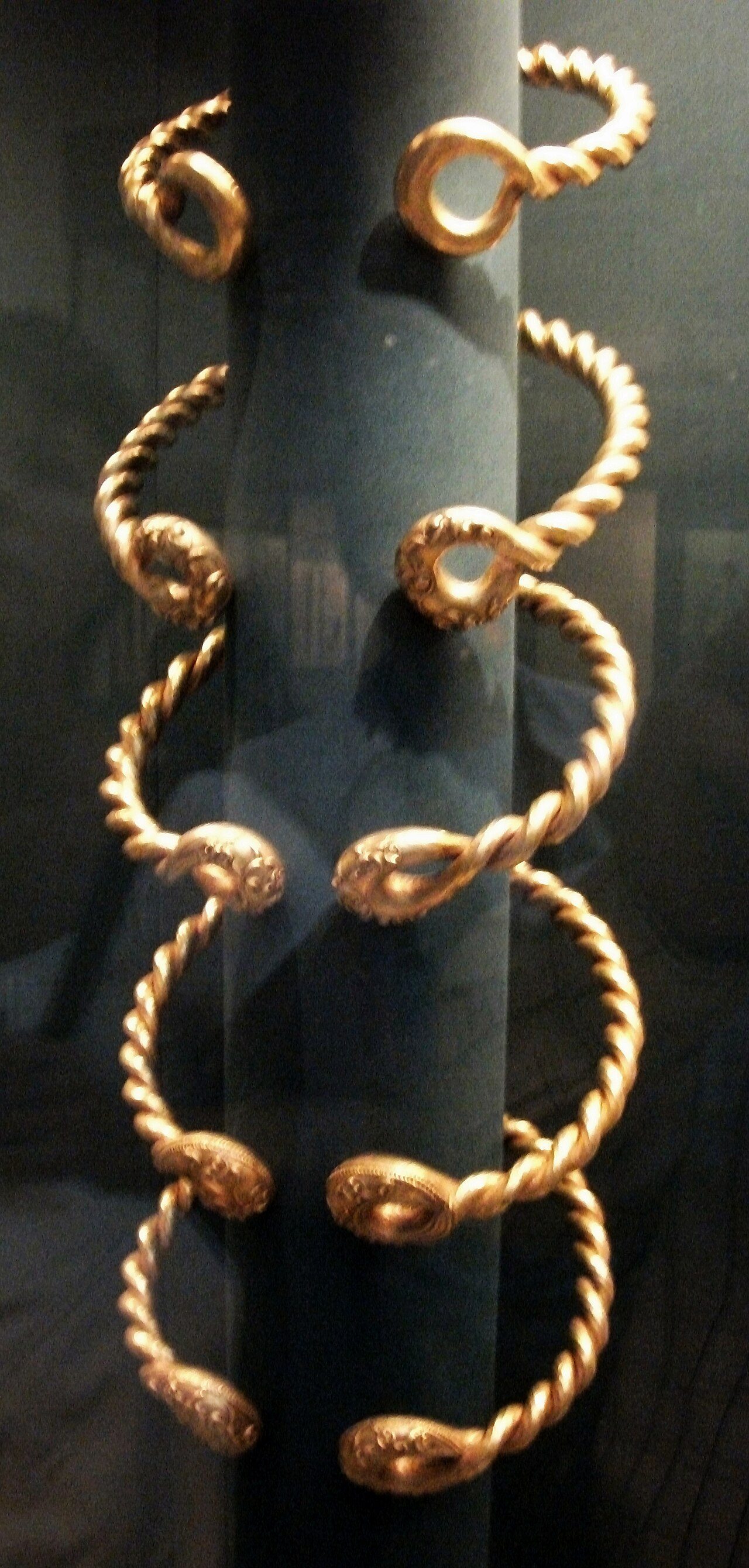
Photo: Johnbod, CC BY-SA 3.0, via Wikimedia Commons
How it is dated
There are no coins with the torcs, so they are dated by style. The British Museum dates them to about 150-50 BC; British Museum specialists have also suggested around 75 BC from the composition of the gold. When they were buried is not known independently.
What happened after the find
The torcs were declared treasure trove and acquired by the British Museum. Wikipedia reports finder rewards of £45,000 for the first five and £9,000 for the sixth.
Where sources differ
- Year of the sixth torc: 1969 (Wikipedia) or 1970 (Suffolk Historic Environment Record).
- Date of manufacture: about 75 BC (Wikipedia, citing British Museum experts) or 150-50 BC (British Museum catalogue).
- Weights are given in ounces in the county record without specifying troy or avoirdupois; the metric conversion is approximate.
- The reward figures (£45,000 and £9,000) come from Wikipedia without a cited source and could not be checked.
- The British Museum catalogue entry describes one torc as found 'with three other similar examples', which does not match the five-torc count elsewhere.
Questions
Where are the Ipswich torcs?
In the British Museum in London, in the Iron Age displays. Ipswich Museum shows replicas.
Why are the Ipswich torcs unfinished?
Several still show tool marks, and one has plain terminals that were never decorated. The likeliest explanation is that they were a goldsmith's work in progress or stock, hidden for safety.