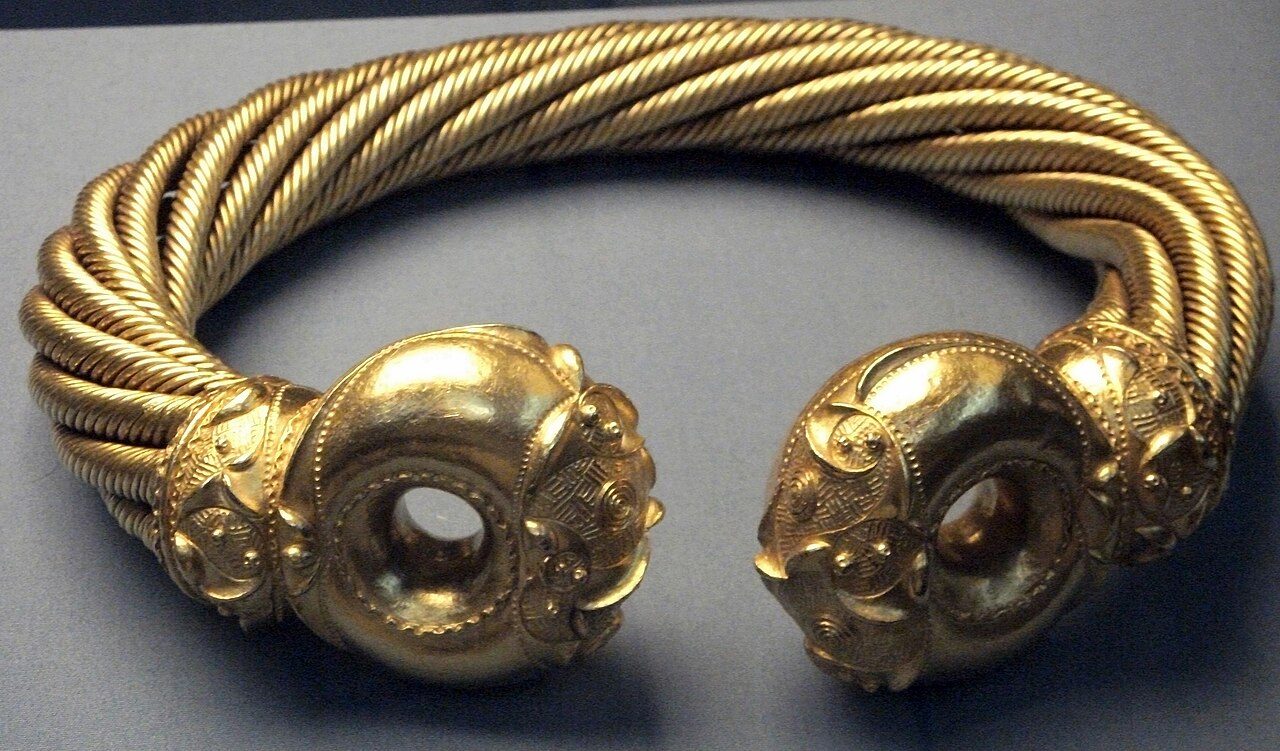
In November 1948 a plough cutting deeper than usual on Ken Hill, a low rise above the Wash in north-west Norfolk, dragged up what the tractor driver took for a piece of an old brass bedstead. The next day more 'twisted wire' came up. It was gold, and the curator of archaeology at Norwich Castle Museum soon identified it as a group of Iron Age neck rings more than two thousand years old.
That was the first of at least fourteen separate hoards found in one field, lettered in the order they were discovered. Two years later, in 1950, ploughing turned up the most famous object of all, the Great Torc, with a broken torc threaded through its terminals and a bracelet beside it. Single torcs surfaced through the 1960s and 1970s, and it was widely assumed the field was exhausted.
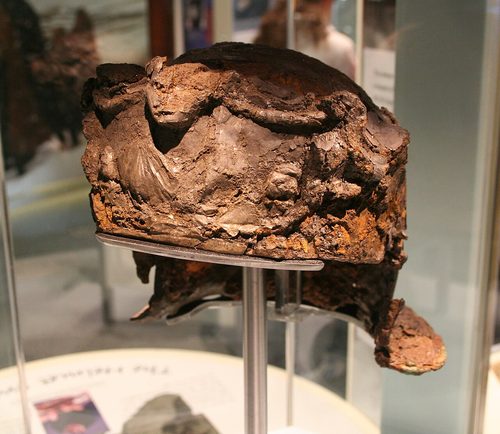
It was not. In August 1990 a metal detectorist recovered more than 500 fragments of gold, silver and bronze alloys that had been packed into an upturned bronze helmet. He reported the find, and from December 1990 a British Museum team under Ian Stead excavated the hilltop over three seasons to 1992. They found several more pits. In one, as reported at the time, two bronze bracelets lay at the top, then two silver torcs, then ten gold ones, an ordered packing that a hurried thief would hardly have bothered with.
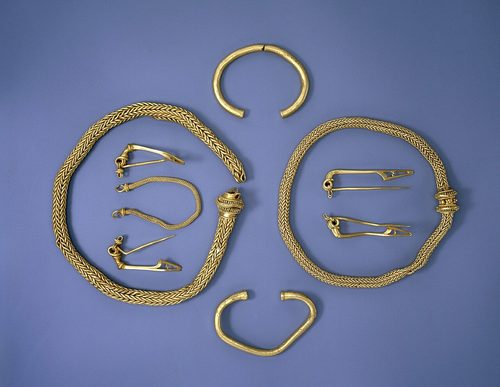
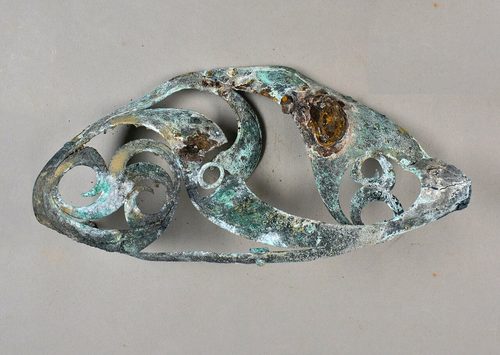
Snettisham has produced more than sixty complete or near-complete torcs and hundreds more in fragments. For comparison, only about 85 have been found in the rest of Britain. Alongside the neck rings are bracelets, finger rings, ring-shaped ingots and scrap, and a few gold coins. The metal ranges from almost pure gold through electrum to silver and bronze; recent scientific work found that some bronze torcs were gilded with mercury, the earliest known use of the technique in Britain, and that repeated hammering, heating and pickling had enriched the surfaces of the gold wires.
Who owned it all is a matter of inference. North-west Norfolk lay in the territory later ruled by the Iceni, and the quantity and quality of the metal point to a powerful community or ruling group. Many of the torcs had been deliberately cut up. One reading is that this was bullion held in a treasury; another, now more widely favoured, is that the hilltop was a sacred place where valuables were offered and kept out of circulation. Excavation found ditches and enclosures and signs of feasting, and in the Roman period a square stone building, possibly a temple, stood in the field.
The quantity is what sets Snettisham apart. A single torc can be admired as a work of art; dozens of them, sorted by metal and buried in pits on one hill, show that gold-working, wealth and ritual in late Iron Age Britain were organised on a scale that the sparse written record never hints at. After more than a decade of study, curators at the British Museum and Cambridge published the full account of the finds and excavations as a free open-access book.
Highlights
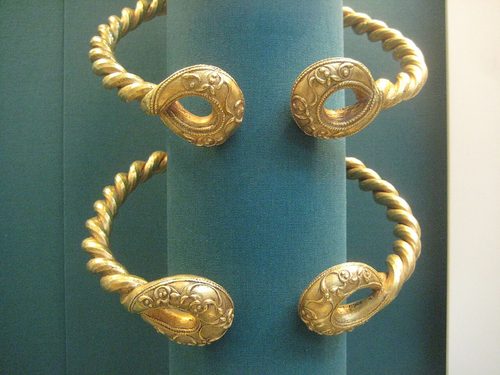
Made from 64 gold-alloy wires twisted into eight ropes, with hollow ring terminals cast and decorated in the British La Tène style. It weighs 1,084 g and is about 20 cm across.
Excavation showed each hoard was packed in a particular order; one pit held bronze bracelets on top, then silver torcs, then ten gold torcs, giving a rare look at how a deposit was arranged rather than just what it contained.
More than 500 fragments of torcs and other metalwork had been packed into an upturned bronze helmet, later pieced back together by British Museum conservators.
Bronze torcs gilded with mercury, the earliest known examples of the technique in Britain.
What is in it
Neck rings (torcs) of gold, electrum, silver and gilded bronze, many complete and many deliberately cut up, with bracelets, finger rings, ring-shaped ingots, scrap metal and a few gold coins, buried in separate pits across a single field.
Size: more than 1,200 metal objects from the field in all.
| Item | Number | Notes |
|---|---|---|
| Torcs | over 60 complete or near-complete | hundreds more represented by fragments; the Norfolk Historic Environment Record counts nearly 180 torcs, 75 of them complete |
| Ingot rings and bracelets | over 100 | figure from the Norfolk Historic Environment Record |
| Coins, ingots and other metal | about 170 pieces | figure from the Norfolk Historic Environment Record |
| 1990 detector find | more than 500 fragments | gold, silver and bronze alloys, originally packed into an upturned bronze helmet |
Photographs
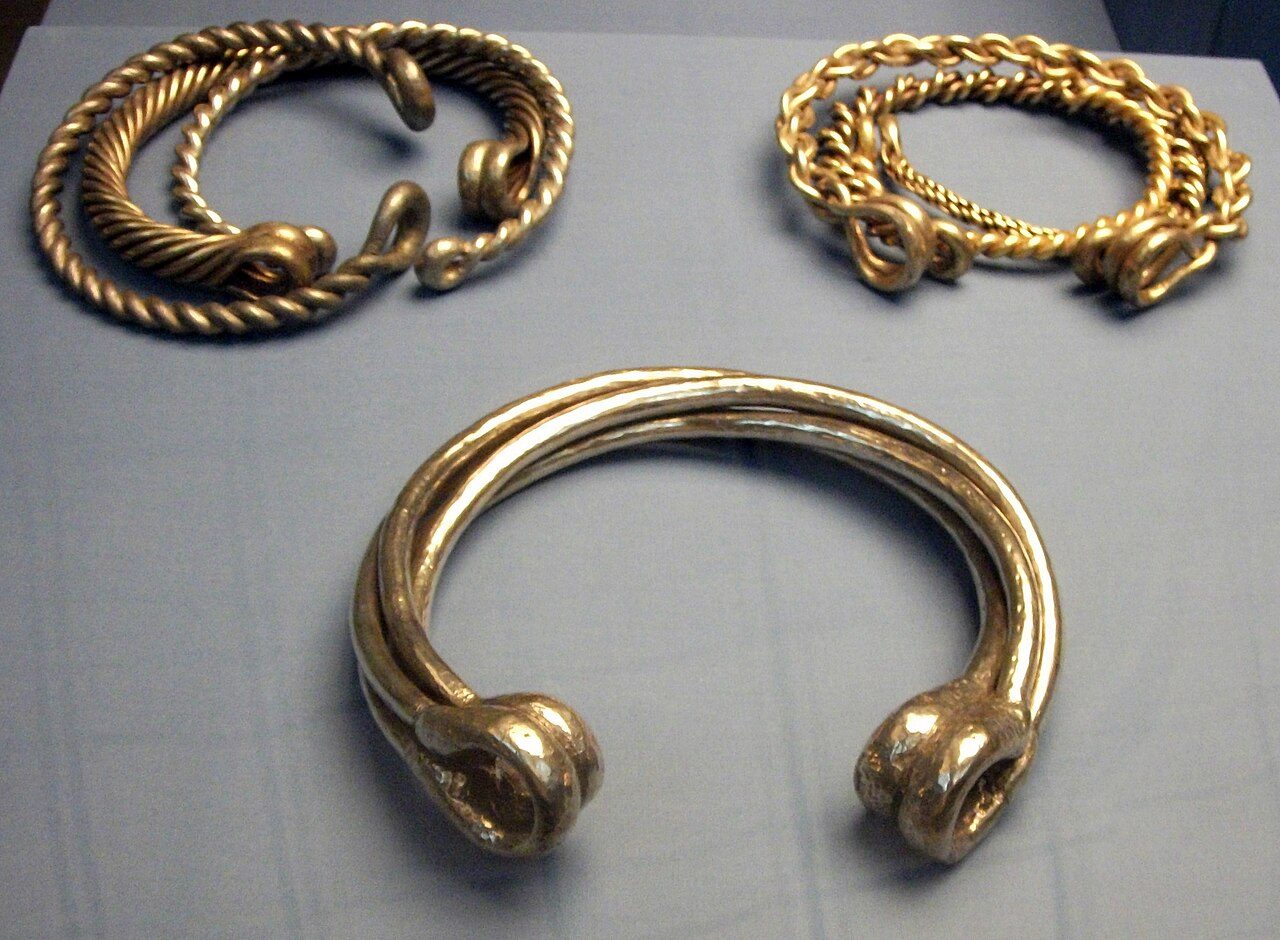
Photo: Johnbod, CC BY-SA 3.0, via Wikimedia Commons
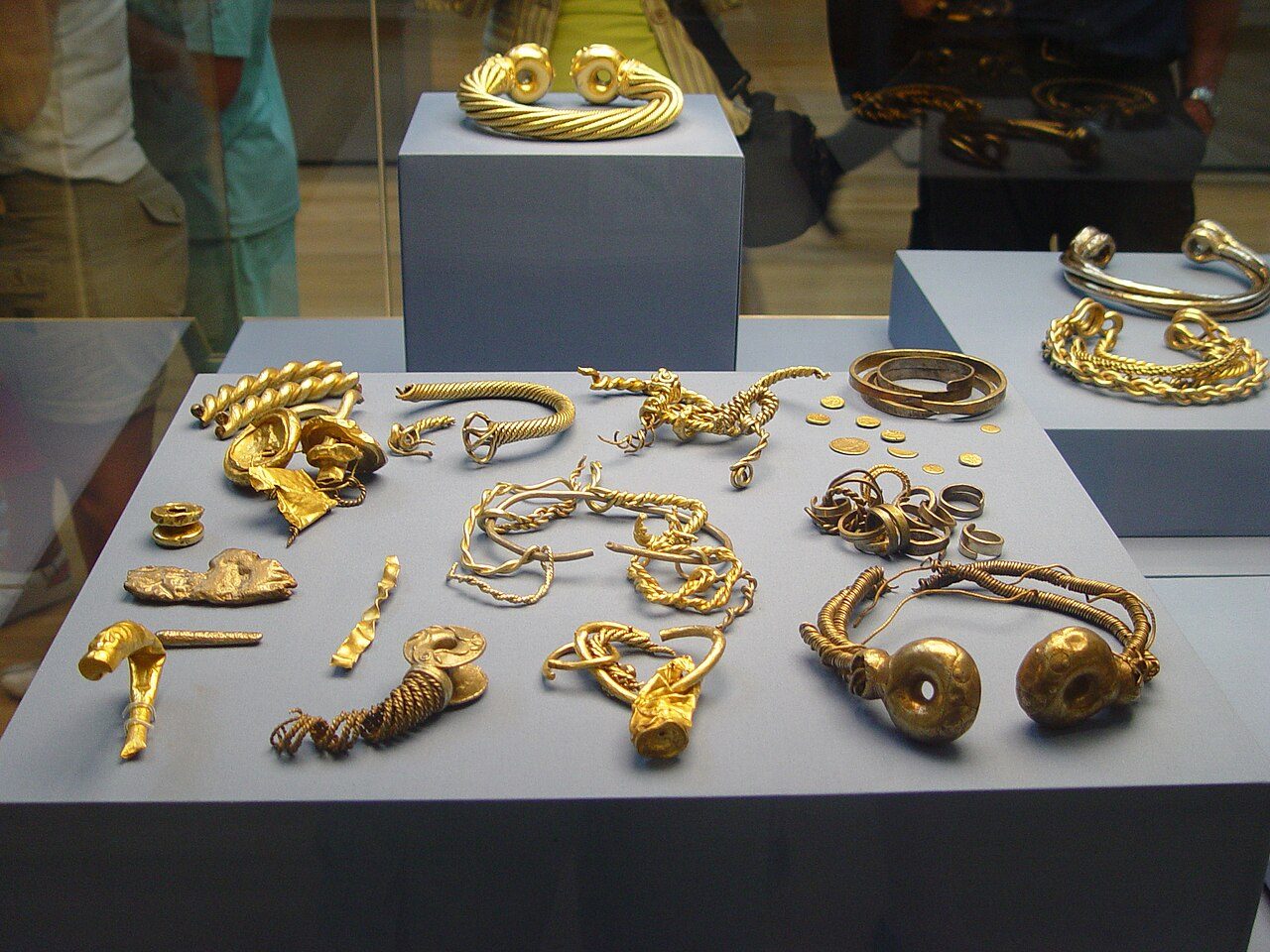
Photo: Portable Antiquities Scheme from London, England, CC BY 2.0, via Wikimedia Commons
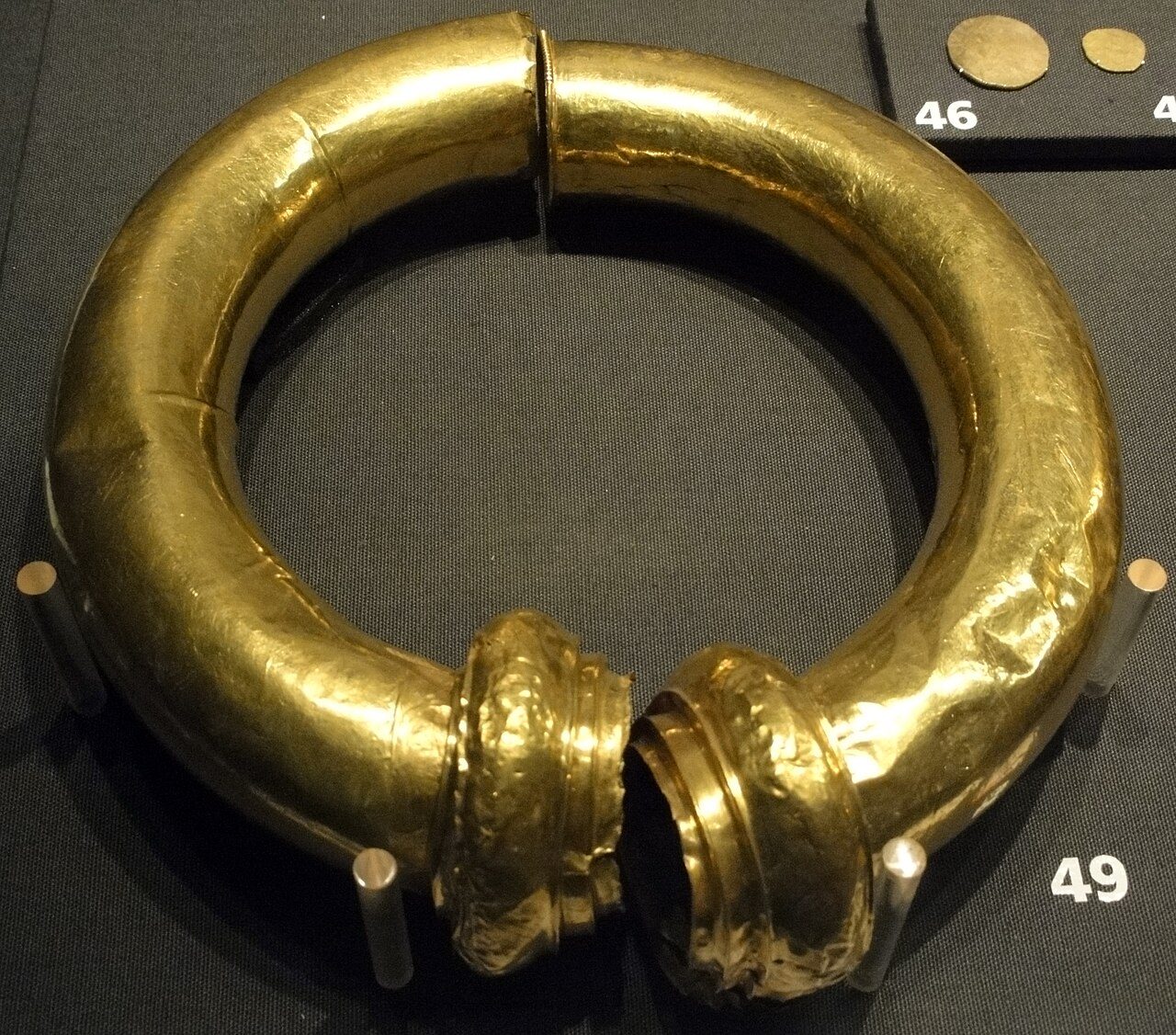
Photo: Fæ, CC BY-SA 3.0, via Wikimedia Commons
How it is dated
Most of the hoards are dated by a small number of gold coins buried with them, including one found lodged in a terminal of the Great Torc; these point to burial around 60 BC. The British Museum dates the making of the Great Torc to about 150-50 BC on style. Some hoards may be a little later, and the field remained in use into the Roman period.
What happened after the find
The early finds were the subject of treasure trove inquests, and the Great Torc was bought by the British Museum with help from the National Art Collections Fund. The 1990 detector find was reported and led directly to the British Museum's excavation.
Where sources differ
- Counts differ by source: Current Archaeology and the 2024 publication give over 60 complete or near-complete torcs; the Norfolk Historic Environment Record gives nearly 180 torcs, 75 complete. The difference likely reflects what counts as 'near-complete' and which finds are included.
- The burial date is given as around 60 BC (Cambridge/Current Archaeology), around 75 BC (Wikipedia, from the Great Torc's coin) and probably around 50 BC (British Museum record for the Great Torc).
- Whether the hoards were a treasury or votive offerings is debated.
- No published total weight for all the hoards was found.
Questions
Where can I see the Snettisham Treasure?
Most of it is in the British Museum in London, where the Great Torc is on display with other torcs from the site. Norwich Castle Museum holds and displays a significant group from the early finds.
How old is the Great Torc from Snettisham?
It was made in the late Iron Age, roughly 150-50 BC, and probably buried in the middle of the first century BC. A gold coin found in one of its terminals helps date the burial.
Who buried the Snettisham hoards?
Nobody knows for certain. The area was later Iceni territory, and the hoards are usually linked to a wealthy local community or ruling group; many archaeologists now see the hilltop as a sacred site where precious metal was offered.
Sources
- Fields of gold: understanding the Snettisham hoards (Current Archaeology)
- The Snettisham hoards (University of Cambridge, Department of Archaeology)
- NHER 1487: Snettisham Iron Age Treasure (Norfolk Heritage Explorer)
- The Great Torc from Snettisham, 1951,0402.2 (British Museum collection)
- Snettisham Hoard (Wikipedia)
- Wikidata Q2295839 (CC0)