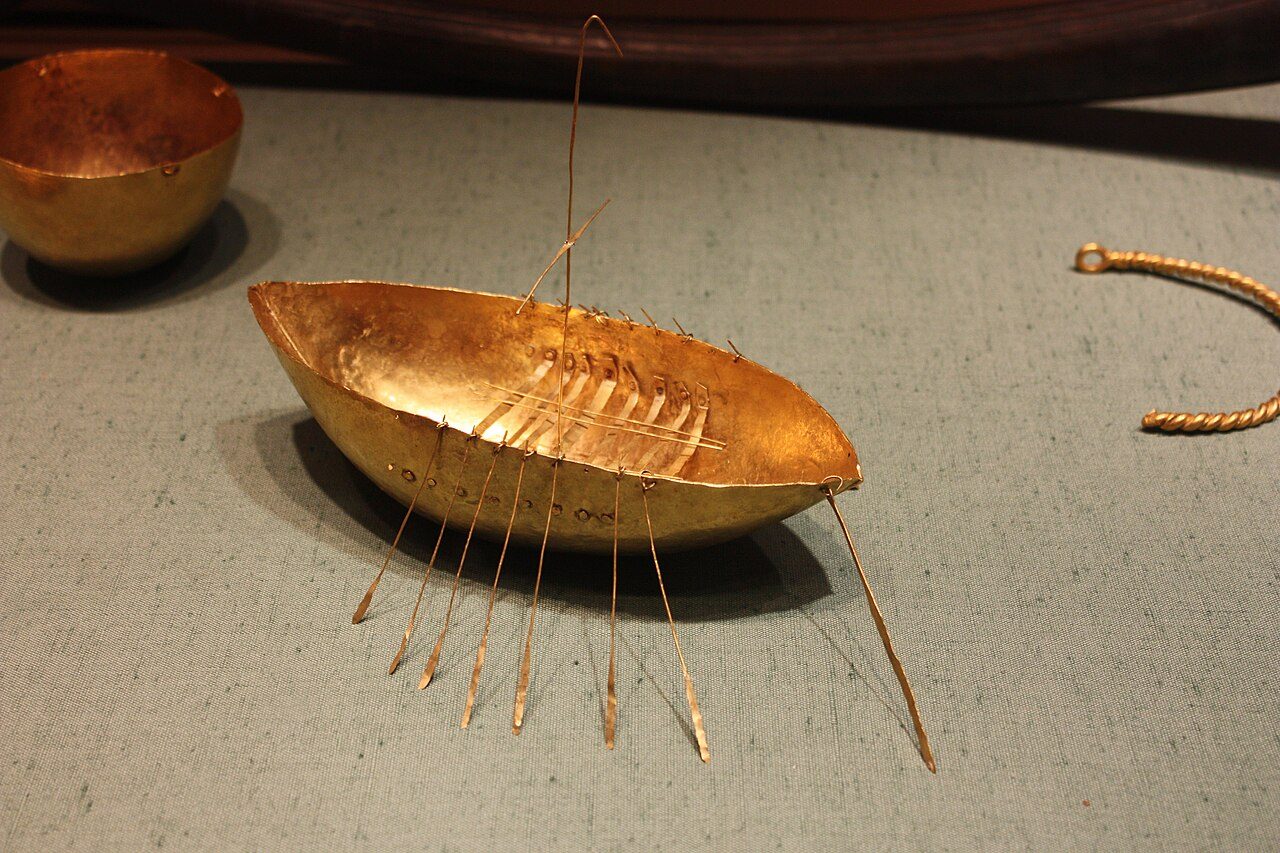
The Broighter boat is about the length of a hand: a hull of beaten gold no thicker than paper, with thwarts for the rowers, two rows of tiny oars, a steering oar, a mast and yard, and even grappling hooks and a forked pole. It was found in February 1896, crushed by a plough, along with six other gold objects in a field at Broighter, near Limavady, on the low ground beside Lough Foyle.
Two ploughmen were double-ploughing, one team following the other to cut deeper, when the share caught what looked like a lump of mud about 14 inches down. Back at the farm the pieces were washed in a sink before anyone realised they were gold. The farmer sold the group to a Derry jeweller, who passed it to the antiquary Robert Day, who sold it to the British Museum for £600.
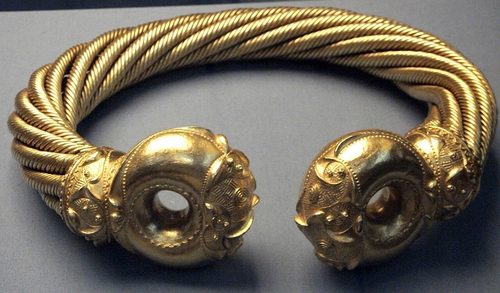
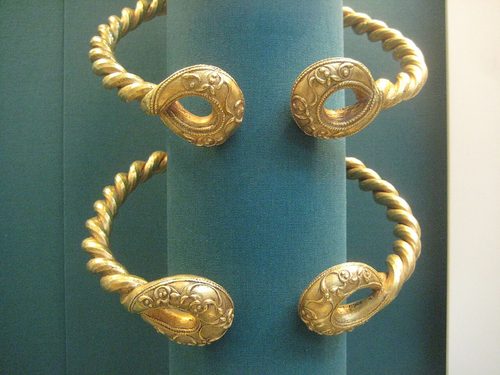
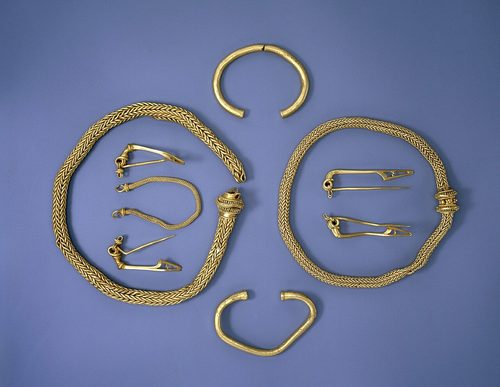
The finest piece after the boat is the collar, a hollow gold tube bent into a ring with buffer terminals and a twist-lock fastening. Its surface is covered in flowing tendrils and spirals, raised by beating back the background, with extra pieces applied and the background incised with fine curved lines. The National Museum of Ireland calls it the finest example of Irish La Tène goldwork. Beside it are a small bowl with suspension loops, perhaps a model of a feasting cauldron, two chain necklaces of a type made in the Roman world, and two twisted bar torcs of a kind more familiar from south-east England.
That mix is part of the puzzle. Analysis suggests the gold of all the pieces is similar, yet the styles range from Irish to Roman, so some objects may have been imported and others reworked locally. The boat and the closeness of the sea led Arthur Evans, writing in 1897, to see the hoard as a votive offering, perhaps to a sea god, a figure later identified with Manannán mac Lir, though the evidence for worship of that god in the 1st century BC is thin.
The interpretation mattered in law. The Royal Irish Academy argued that the gold was treasure trove, hidden with the intention of recovery and therefore the property of the Crown, which would allow it to come to Dublin. The British Museum argued it was a votive offering, abandoned on purpose and so not treasure trove. In 1903 a court in London found for the Crown, noting that the objects had been packed closely together, and the hoard went to Dublin. Ironically, the National Museum of Ireland now regards an offering to a god as a likely explanation.
The boat appeared on the last Irish pound coin, issued in 2000, and the collar's design on a 1996 British pound coin. The hoard stays in Dublin, a frequent subject of calls for it to be shown nearer its find spot.
Highlights
A model vessel about 18 cm long with benches, two rows of oars, a steering oar, mast and yard; badly crushed by the plough and pieced back together.
A hollow tubular torc with buffer terminals, a twist-lock fastening and raised La Tène tendril ornament, about 19 cm across.
A small bowl beaten from a single sheet of gold with suspension loops, perhaps a model of a cauldron.
Two loop-in-loop chains with clasps matching Roman and Etruscan types, probably made in the Roman world.
What is in it
A model gold boat with its oars, steering oar and fittings, a hollow buffer-terminal collar decorated in Irish La Tène style, a small bowl or model cauldron, two loop-in-loop chain necklaces and two twisted bar torcs, one a fragment.
Size: 7 objects.
| Item | Number | Notes |
|---|---|---|
| Model boat | 1 | about 18 cm long, about 85 g, with benches, oars in two rows, a steering oar, mast and yard, grappling tools |
| Collar (buffer torc) | 1 | hollow tube about 19 cm across with relief ornament and a twist-lock fastening |
| Bowl | 1 | beaten from one sheet, about 9 cm across, with suspension loops; perhaps a model cauldron |
| Chain necklaces | 2 | loop-in-loop chains with clasps of Mediterranean type; one triple, 39.6 cm long |
| Bar torcs | 2 | twisted bars in British style, one complete (18.6 cm), one a half-circle fragment |
Photographs
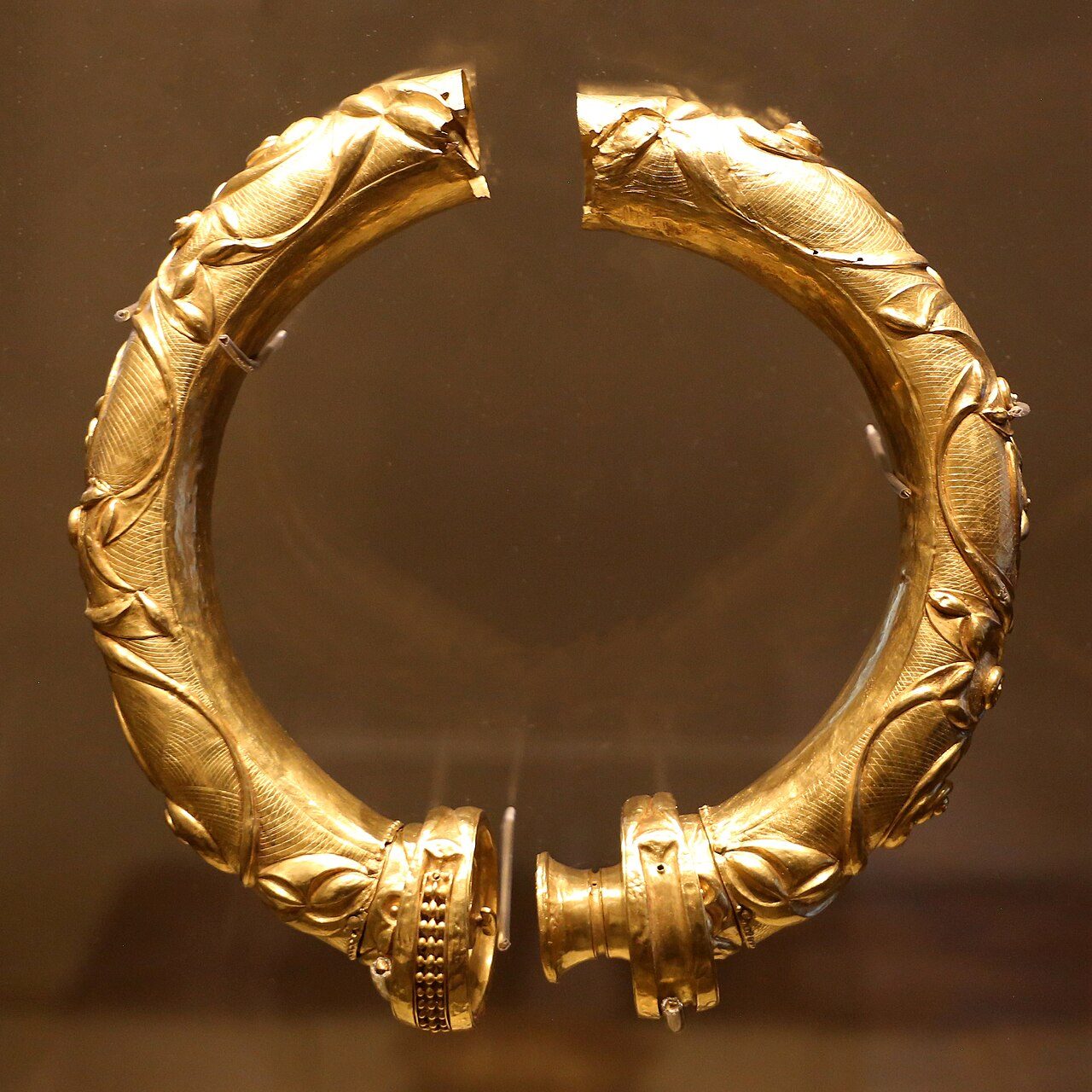
Photo: Sailko, CC BY 3.0, via Wikimedia Commons
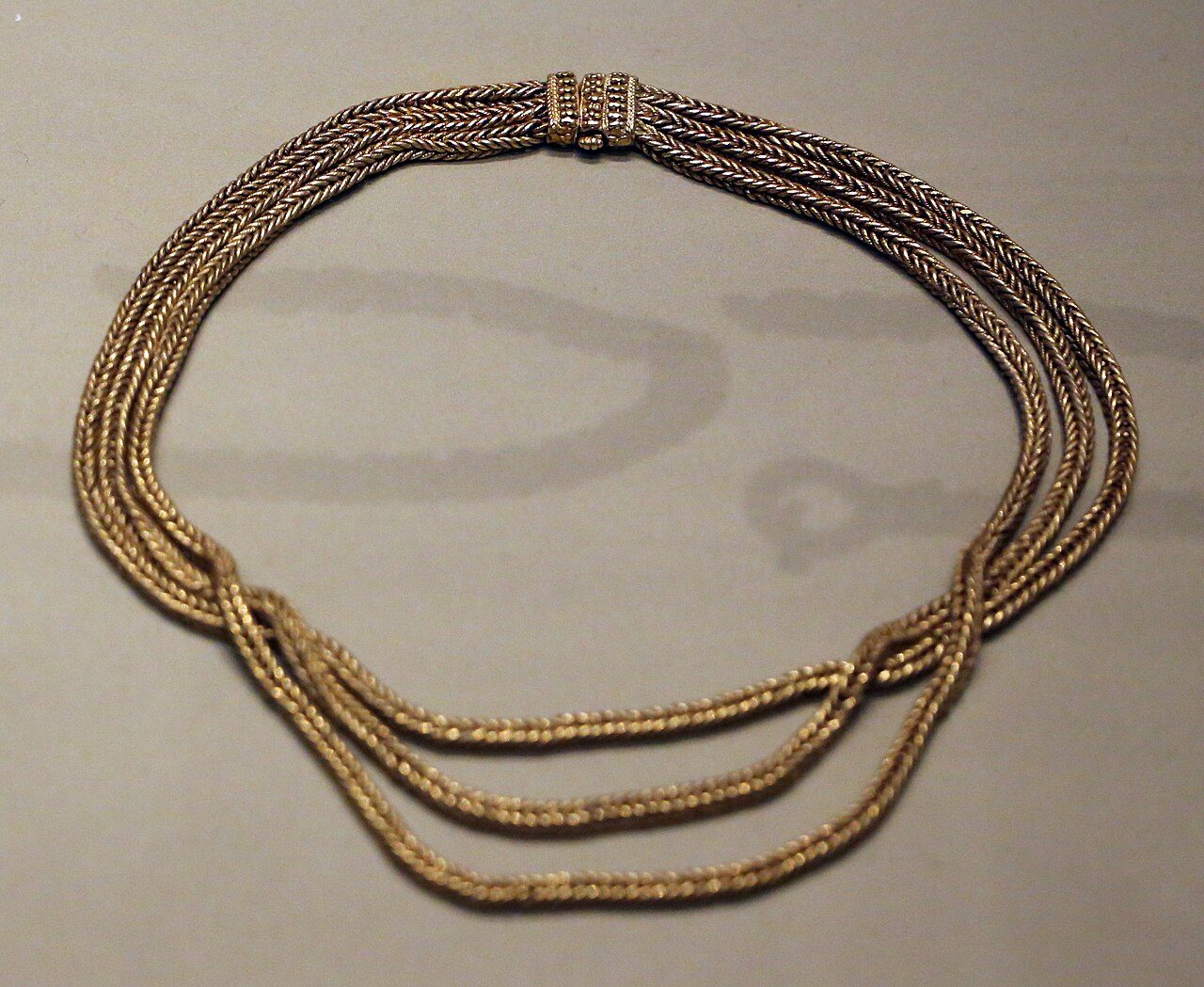
Photo: Sailko, CC BY 3.0, via Wikimedia Commons
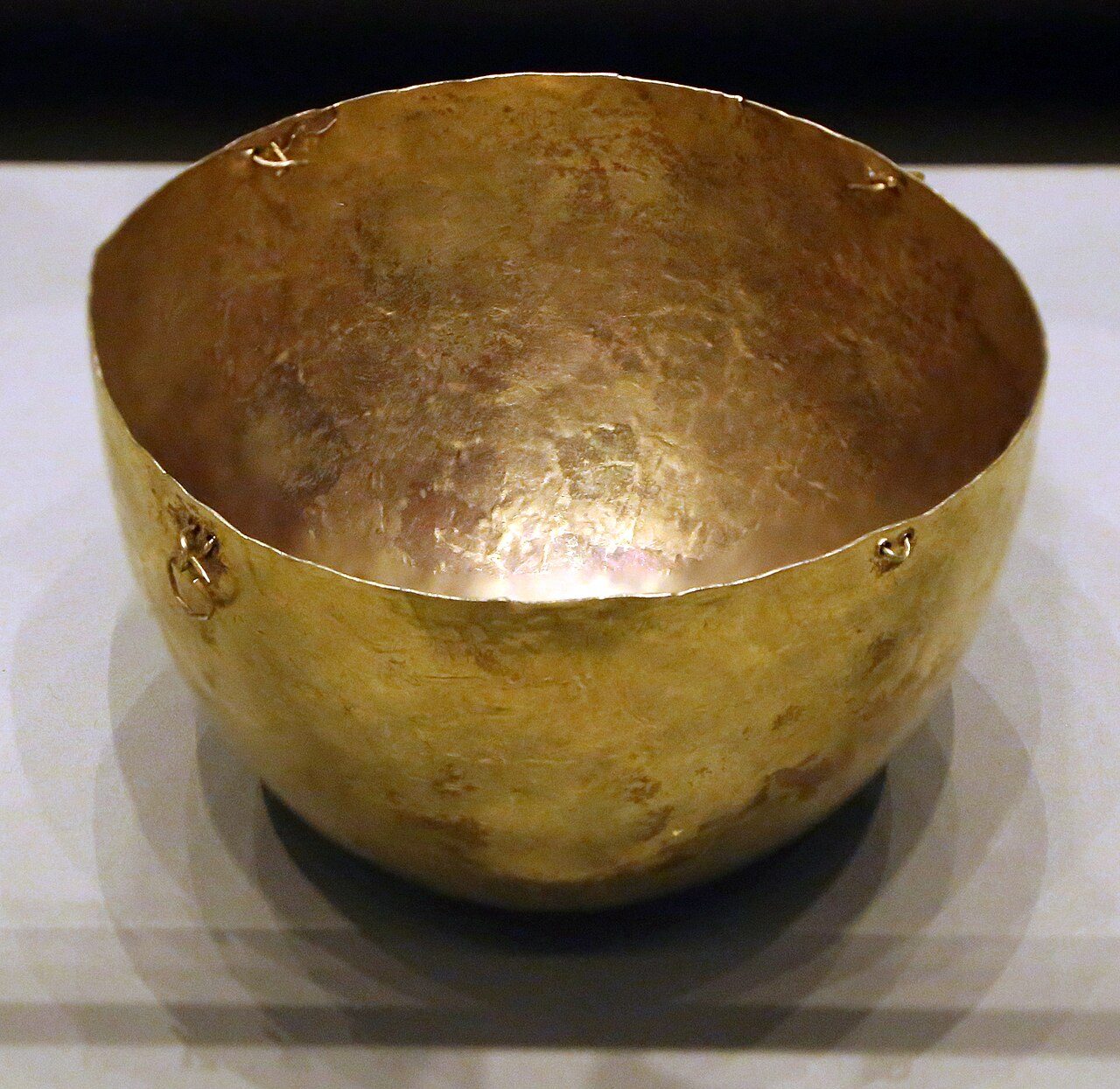
Photo: Sailko, CC BY 3.0, via Wikimedia Commons
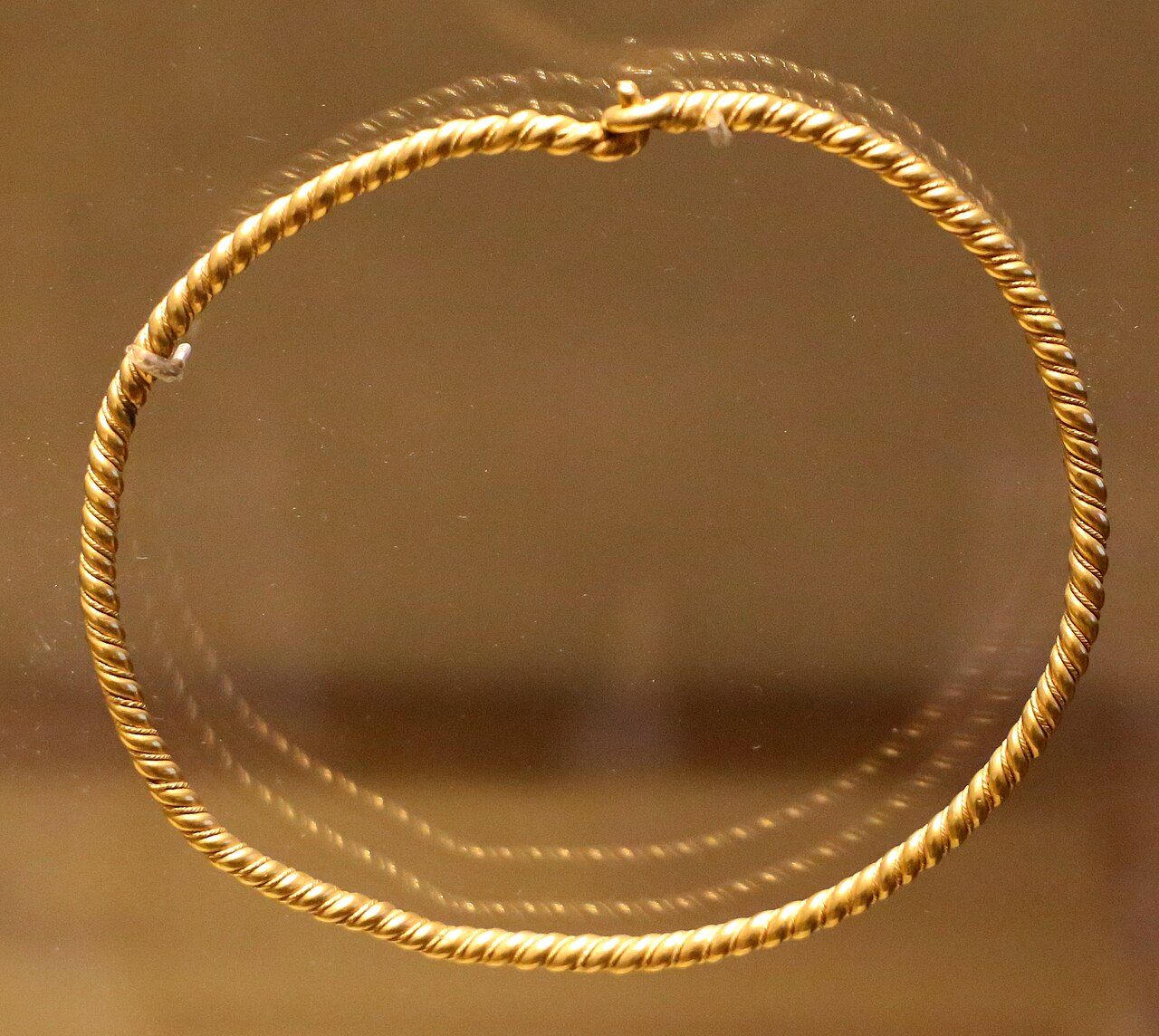
Photo: Sailko, CC BY 3.0, via Wikimedia Commons
How it is dated
There are no coins. The collar's ornament belongs to the later Irish La Tène style, and the chains and clasps match Roman types, together pointing to the 1st century BC.
What happened after the find
Sold to the British Museum in 1896, the hoard was claimed as treasure trove for the Crown; in 1903 a London court (Attorney-General v. Trustees of the British Museum) ruled it was treasure trove, and it was transferred to Dublin.
Where sources differ
- Whether the hoard was a votive offering or concealed valuables is unresolved; the 1903 court and the modern museum reached opposite conclusions.
- Where individual pieces were made (Ireland, Britain, the Roman Rhineland) is debated.
- Accounts of the boat's oar count vary: Wikipedia says two rows of nine oars; another account says two rows of 18.
- A missing thwart from the boat was reportedly sold separately to a Derry jeweller.
Questions
Where is the Broighter Gold now?
In the National Museum of Ireland – Archaeology on Kildare Street in Dublin. The Ulster Museum in Belfast has replicas.
Why is the Broighter Hoard in Dublin and not the British Museum?
The British Museum bought it in 1896, but in 1903 a court ruled it was treasure trove belonging to the Crown, and it was transferred to the national collection in Dublin.