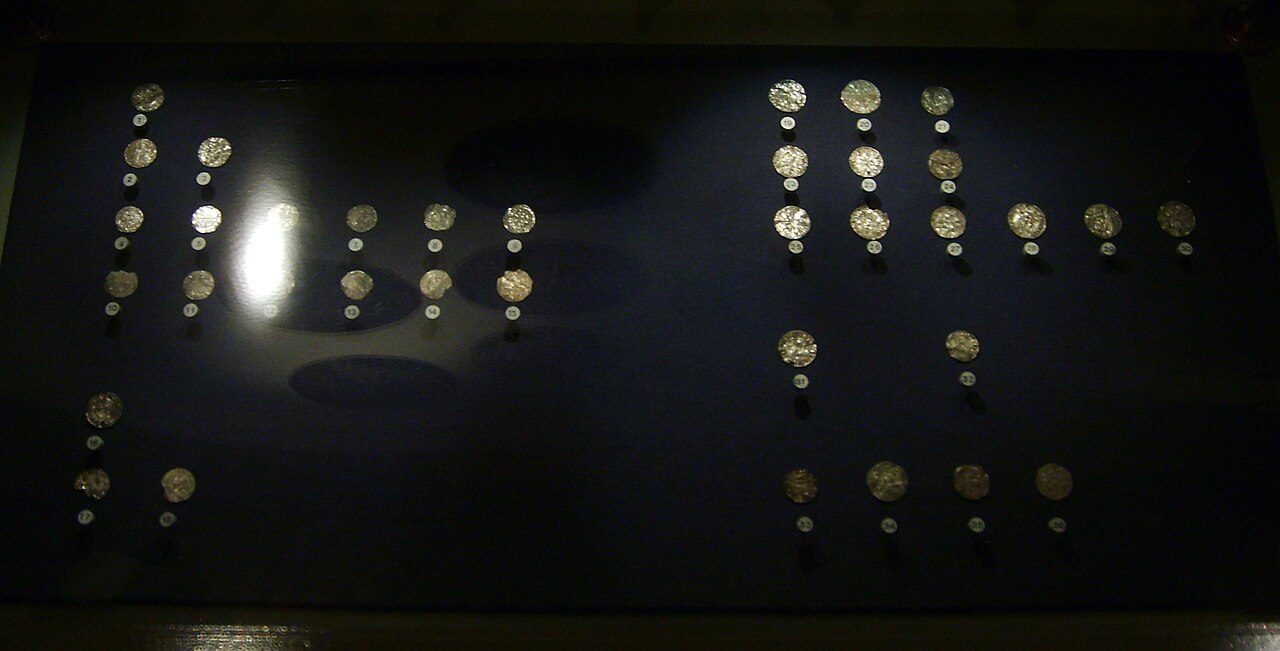
In 1863 a gravedigger working in the churchyard at Sandur, a village on the southern Faroese island of Sandoy, turned up a small heap of silver coins. There were 98 of them, and they remain the only coin hoard ever found in the Faroe Islands. Danish numismatists published them the same year, and they have been argued over ever since, because they fix a moment when this remote North Atlantic community was trading with half of Europe.
The coins span roughly the eleventh century. Half are German pennies, from imperial, ducal and bishops' mints along the Rhine, in Saxony and in the Low Countries. Twenty-four are English, from Æthelred II through Cnut and Harold I to Edward the Confessor, including a few contemporary imitations. Seventeen are Norwegian, struck under Magnus the Good and Harald Hardrada and their successors, and these Norwegian pieces have made the hoard a key reference for dating early Norwegian coinage. Five are Danish, one Hiberno-Norse from Dublin, and one Hungarian penny of King Stephen.
The mixture speaks of trade rather than plunder. Wool was the islands' main export, and the large German share hints that Faroese wool or cloth reached markets supplied with German silver, perhaps through middlemen in Norway. The Norwegian coins fit the islands' growing ties to the Norwegian crown in the later eleventh century.
The find spot matters. Sandur church has been rebuilt again and again: excavations beneath the present building, which dates from 1839, found five earlier churches, the oldest a small stave church of the eleventh century. In 1972 archaeologists examined the south-east corner of the old churchyard, where the hoard is said to have come from, and found a finely paved floor that the excavator read as part of a Viking-age longhouse. He suggested the coins had been buried under that floor. Later excavations just south of the churchyard uncovered an early burial ground, still undated when it was published in 1991.
An older account, repeated in encyclopaedias, places the hoard where the altar of the first church stood and suggests the church was a private chapel of a wealthy farm. Either way, the coins look like the savings of a well-off household at one of the islands' important early farms, hidden around 1070-1090 for reasons no one knows and never recovered.
The hoard is small next to the great Baltic finds, but it is the best evidence for coin use in the Faroes in the Viking and early medieval period, and it shows how far the islands' links ran: from Dublin to Hungary, through England, Germany, Denmark and Norway.
Highlights
Seventeen coins of Magnus the Good, Harald Hardrada and their successors, important for dating the earliest Norwegian royal coinage.
A coin of Hungary's first king (997-1038), one of the most far-travelled pieces in the hoard.
A single coin from Viking Dublin of about 1050, linking the Faroes to the Irish Sea world.
What is in it
Ninety-eight silver pennies from Germany, England, Norway, Denmark, Ireland and Hungary, struck between about 1000 and 1090. No jewellery or bullion is recorded.
Size: 98 coins.
| Item | Number | Notes |
|---|---|---|
| German | 50 | Imperial, ducal and episcopal issues from mints such as Goslar, Magdeburg, Speyer, Würzburg, Duisburg, Utrecht, Deventer and Tiel; 29 not closely identified |
| English | 24 | Æthelred II, Cnut, Harold I and Edward the Confessor, plus imitations |
| Norwegian | 17 | Magnus I and Harald III, Harald III alone, Magnus II and Olaf III, and Olaf III |
| Danish | 5 | Harthacnut and later issues, including two imitations |
| Irish (Hiberno-Norse) | 1 | About 1050 |
| Hungarian | 1 | Stephen I (997-1038) |
How it is dated
The youngest identifiable coins are Norwegian pennies of Olaf III, co-ruler from 1067 and sole king from 1069 to 1093, and a Danish coin of 1050-1095. English Wikipedia gives a burial date of 1070-1080; the 1991 excavation report in Fróðskaparrit puts the coins at about 1000-1080/90 and the burial around 1090.
What happened after the find
Found in 1863 when the Faroes were part of the Danish realm, the hoard was published in Copenhagen; it is now held by the National Museum of the Faroe Islands.
Where sources differ
- Find spot: 'where the altar of the first church stood' (English and Danish Wikipedia) versus the south-east corner of the churchyard, probably beneath a Viking-age house floor (Arge and Hartmann 1991, citing Krogh 1975).
- Burial date: 1070-1080 (Wikipedia) versus around 1090 (Arge and Hartmann 1991).
- Wikipedia says the grave was dug deep for two plague victims; I found no independent confirmation and left it out.
- Whether the hoard came back to the Faroes from Copenhagen and when: I did not find a source for its transfer; the museum display is confirmed by Wikipedia and visitor sources only.
Questions
Where can I see the Sandur coin hoard?
At the National Museum of the Faroe Islands in Tórshavn, where the coins are displayed together.
How many coins are in the Sandur Hoard?
Ninety-eight silver pennies: 50 German, 24 English, 17 Norwegian, 5 Danish, 1 Irish and 1 Hungarian.
Why is the Sandur Hoard important?
It is the only coin hoard found in the Faroes, so it is the main evidence for which countries the islanders were dealing with in the eleventh century, and its Norwegian coins help date early Norwegian coinage.