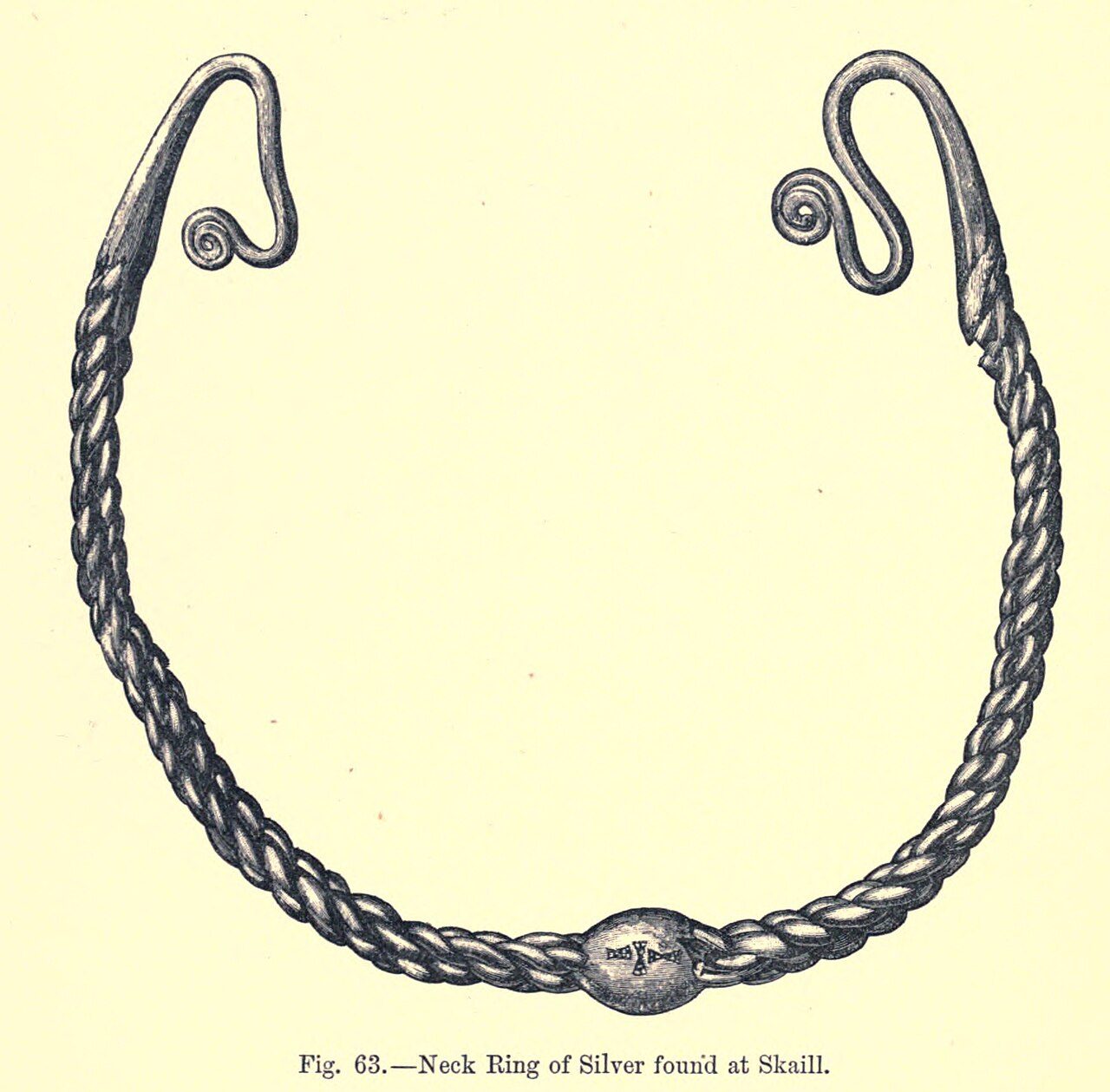
In March 1858 a boy digging at a rabbit hole near the parish church of Sandwick, above the Bay of Skaill on Orkney's west coast, turned up a few pieces of silver. Word spread. A few days later a group of local people waiting on the shore for seaweed went to look, one pushed a fork into the burrow and pulled out a parcel of brooches and neck-rings, and a free-for-all followed. Each person kept what he could grab.
It took the sheriff clerk of Orkney, George Petrie, to put the hoard back together. He went to Sandwick, explained the Crown's claim to treasure trove, advanced the finders £7 against a proper reward, and persuaded them to hand over what they admitted to holding; a fourth share had already been passed to a local landlord, who gave it up to the sheriff. Petrie recovered sixteen pounds of silver. Even so, not everything came in: eight further pieces from the hoard reached the national museum in the 20th century.
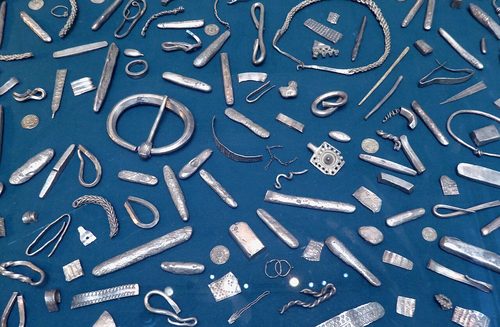
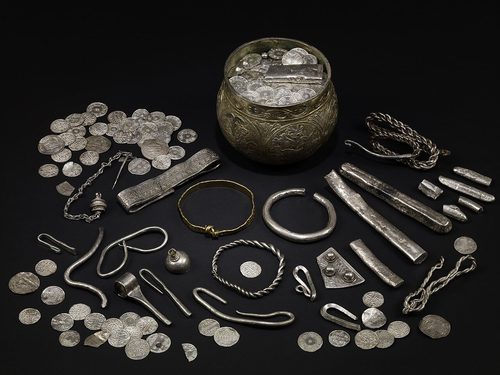
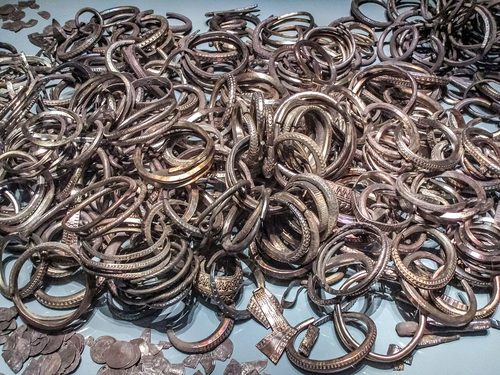
The archaeologist James Graham-Campbell estimated that the complete hoard weighed about eight kilograms, comparable to the largest Viking-age silver hoards from Scandinavia itself. It contains over a hundred items. Most are ornaments rather than coins: big penannular 'thistle' brooches, at least sixteen of them, Scandinavian neck-rings and arm-rings, pins, ingots, cut silver, and thirty-six plain penannular arm-rings of the kind sometimes called 'ring-money', a standardised form of bullion.
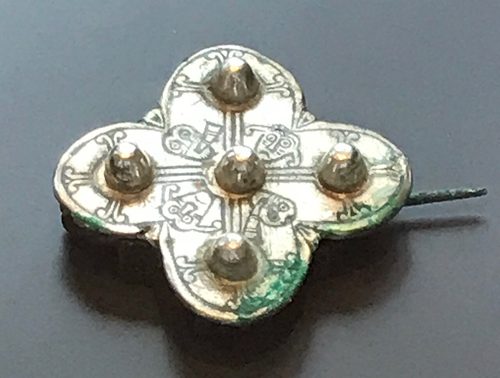
Two complete brooches and a loose terminal are decorated with beasts, birds and tendrils in a style between the Scandinavian Jellinge and Mammen styles. The ornament seems to come from the hand of one craftsman, probably trained in the Irish Sea world, where similar carving appears on Manx crosses. Many objects bear small testing nicks where their silver had been checked, a sign they had passed through several hands before ending up in Orkney.
Only 21 coins were found, less than half a per cent of the silver by weight. Nineteen are Islamic dirhams, the latest struck under the caliph al-Mustakfi in 944-6, and the absence of the common English coins of King Eadred, issued from 946, suggests the hoard went into the ground around 950. Why it was buried is unknown: it may have been hidden for safekeeping by someone who never returned. It remains, by a wide margin, the largest Viking silver hoard found in Scotland.
Highlights
Large silver penannular brooches with brambled 'thistle' terminals. Skaill has the largest concentration of them from any find.
Bulbous terminals and pin-heads carved with animals and a bird, heads thrown back amid tendrils, in a style on the cusp of Jellinge and Mammen.
Heavy Scandinavian neck-rings of plaited and twisted rods, some with hooked or scrolled ends.
Thirty-six plain penannular arm-rings, an early dated appearance in Scotland of this standardised form of bullion.
What is in it
Thistle brooches, Scandinavian neck-rings and arm-rings, plain 'ring-money' arm-rings, pins, ingots and hacksilver, with only 21 coins, 19 of them Islamic dirhams.
Size: over 100 items. Weight: about 8 kg.
| Item | Number | Notes |
|---|---|---|
| Penannular 'thistle' brooches | at least 16 (whole and fragments) | some decorated in the Jellinge/Mammen animal styles |
| Plain 'ring-money' arm-rings | 36 (whole and fragments) | |
| Neck-rings, arm-rings, pins, ingots and hacksilver | many | typical Scandinavian types |
| Coins | 21 | 19 Islamic dirhams and 2 Anglo-Saxon pennies, under 0.4% of the silver by weight |
Photographs
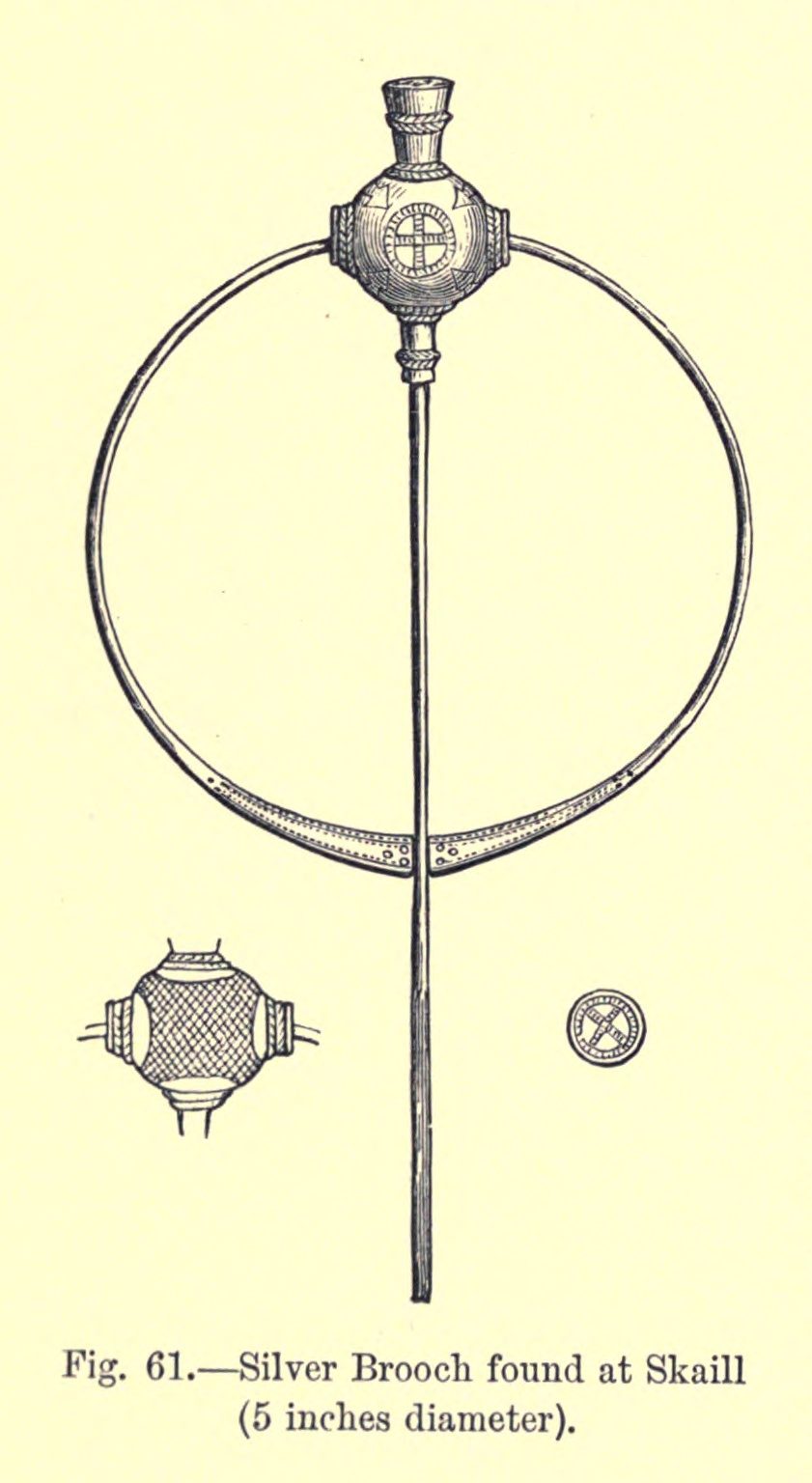
Photo: Anderson, Joseph, 1832-1916, Public domain, via Wikimedia Commons
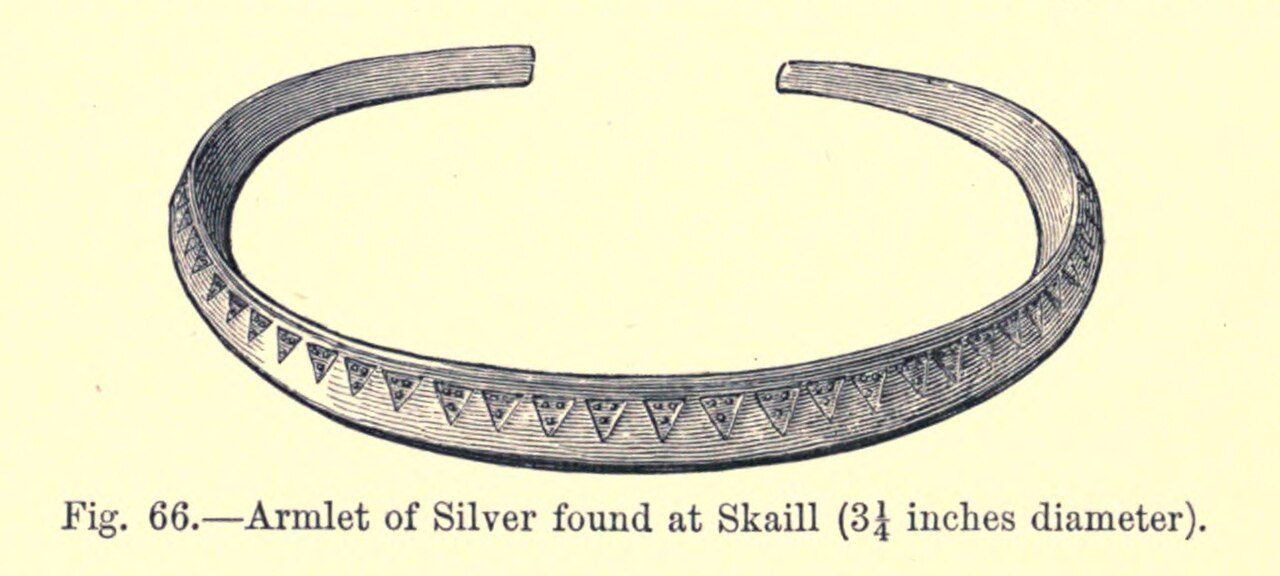
Photo: Anderson, Joseph, 1832-1916, Public domain, via Wikimedia Commons
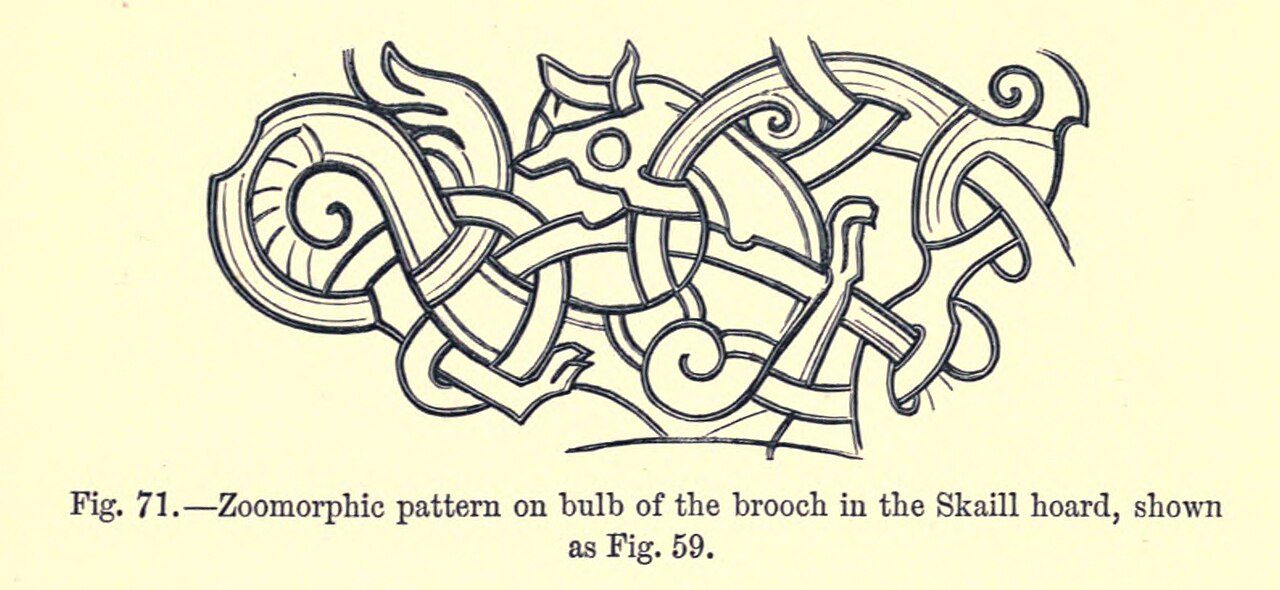
Photo: Anderson, Joseph, 1832-1916, Public domain, via Wikimedia Commons
How it is dated
Graham-Campbell dates the deposit to about 950: the latest of the 19 dirhams was struck for al-Mustakfi (944-946), and there are none of the plentiful English coins of Eadred (946-955) that would be expected later. Popular accounts give 950-970.
What happened after the find
Recovered for the Crown as treasure trove in 1858 through the sheriff clerk, George Petrie, who advanced the finders £7 pending a reward. The hoard was deposited in the national antiquities museum in Edinburgh.
Where sources differ
- Deposit date: Graham-Campbell (1976) gives c. 950; Orkneyjar and Wikipedia's hacksilver article give 950-970.
- Weight: Petrie recovered sixteen pounds (Graham-Campbell); Orkneyjar says 15 lb. Graham-Campbell estimates the original total at about 8 kg.
- First finder: Orkneyjar names a boy, David Linklater; the 1858 Orcadian report it quotes says 'a young man'. The page says 'a boy'.
- Orkneyjar gives a breakdown of 9 brooches, 14 necklets and 27 armlets; Graham-Campbell counts at least 16 brooches (with fragments) and 36 ring-money arm-rings. Counting methods differ.
- The other two coins: the 1858 newspaper mentions a coin of Athelstan; Graham-Campbell's paper does not list them individually.
Questions
Where is the Skaill Hoard?
It is in the collections of National Museums Scotland in Edinburgh, where it was deposited soon after its recovery in 1858.
Is the Skaill Hoard the largest Viking hoard in Scotland?
Yes, for Viking-age silver. At about 8 kg it is by far the largest Scandinavian-type silver hoard from Scotland. The Galloway Hoard is more varied but lighter, at over 5 kg.
How old is the Skaill Hoard?
It was buried around AD 950, judging by its latest coins, though some popular accounts allow a date up to about 970.