In 1892 a farmhand harrowing a field at Hornelund, near the village of Horne about 12 km north of Varde in west Jutland, picked out three gold objects from the soil: two round brooches and an arm-ring. He gave them to the farmer, who took them to the district office in Varde but then decided to deliver the gold himself. The state paid 525 kroner as danefæ compensation, plus 20 for travel, and the money was split between the two men, 295 kroner to the farmhand and 250 to the farmer.
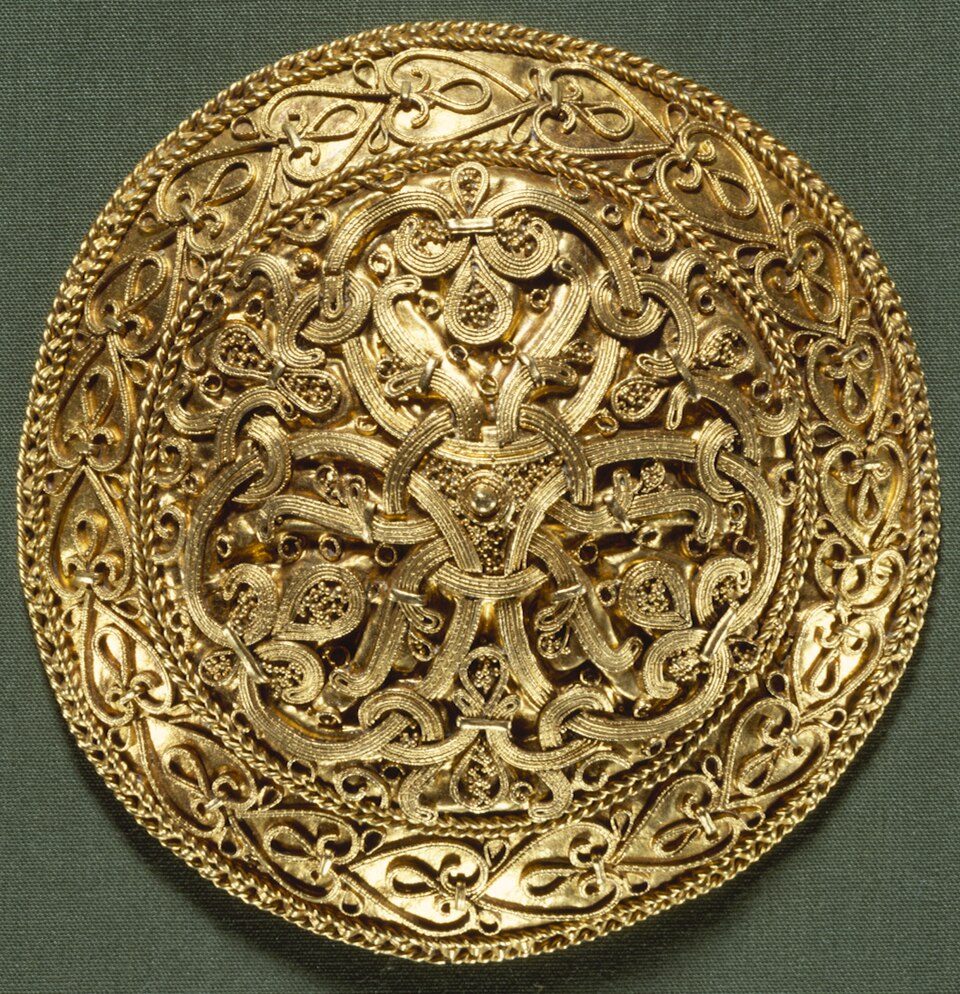
The hoard is small, 216 grams of gold, but the two brooches are counted among the finest pieces of goldsmith's work from Viking-age Denmark. Each is about 8.5 cm across, the pair weighing 75 and 62 grams. The goldsmith first hammered thin gold sheet over a die to raise a relief, then covered it with filigree wire and tiny grains of gold. The design is built from leafy scrolls and vine ornament, motifs that ultimately come from European, Christian art. Around the centre of one brooch, though, sit four animal heads in purely Scandinavian style, which show that a Danish goldsmith made them.
That blend of a continental plant style with Nordic animal heads is what makes Hornelund important. It shows Danish craftsmen at the top of their trade absorbing the art of the Christian kingdoms to the south in the decades around the year 1000, when the Danish kings themselves had converted. Gold was rare in Viking Scandinavia, where silver was the everyday medium of wealth, and brooches like these would have marked someone of the highest standing, probably a woman, since round brooches of this kind fastened women's dress.
Nobody examined the find spot in 1892. Varde Museum investigated it only in 1993. Then in April 2014 a metal detectorist found 24 silver coins and a gold arm-ring at the same place and reported them at once to the museum. A follow-up search by archaeologists with the finder turned up roughly another 130-140 silver coins. The new arm-ring is thought to belong to the 1892 hoard, while the coins, also of the eleventh century, may be a separate deposit. Both were declared danefæ.
Who buried the gold, and why so close to other silver, is unknown. West Jutland in this period lay within the kingdom of the Jelling dynasty, and the quality of the brooches points to a household with connections to the royal court or the highest aristocracy.
Highlights
A gold disc brooch with vine scrolls in filigree and granulation, and four small Nordic animal heads around its centre that mark it as Danish work.
The second, slightly lighter brooch, made by the same technique of die-stamped relief overlaid with gold wire and granules.
The third piece of the 1892 find, joined in 2014 by a second gold arm-ring detected at the same spot.
What is in it
Two round gold dress brooches with filigree and granulation, and a gold arm-ring; together about 216 g of gold.
Size: 3 objects (1892 find). Weight: 216 g of gold.
| Item | Number | Notes |
|---|---|---|
| Round brooches | 2 | About 8.5 cm across, weighing 75 g and 62 g; relief hammered over a die, then filigree and granulation |
| Arm-ring | 1 | Gold |
How it is dated
There are no coins in the 1892 find, so the date comes from ornament. The National Museum dates the brooches to the beginning of the eleventh century on the strength of their animal heads and plant ornament; older summaries place them in the second half of the tenth century. Coins found nearby in 2014 are of the eleventh century.
What happened after the find
Declared danefæ (treasure belonging to the Crown). In 1892 the state paid 525 kroner compensation plus 20 kroner travel, shared between the farmhand and the farmer. The 2014 finds were reported immediately and also declared danefæ.
Where sources differ
- Date of the brooches: 'beginning of the 1000s' (National Museum, Danish page) versus 'second half of the 900s' (Danish Wikipedia).
- Whether the 2014 coins belong to the same deposit: DR reported that the arm-ring is thought to be part of the old hoard while the coins may be a different hoard.
- The number of extra coins found in the 2014 follow-up search is given as '130-40' by DR, read here as 130-140.
- Whether round brooches like these were worn only by women is my inference, not stated by the sources.
Questions
Where can I see the Hornelund brooches?
At the National Museum of Denmark in Copenhagen, in its Viking-age displays.
Why are the Hornelund brooches famous?
They are among the finest gold work from Viking-age Denmark, combining European vine-scroll ornament with Scandinavian animal heads in delicate filigree and granulation.