On the afternoon of 9 September 1993 an excavator digging out a new car park beside a hospital in Trier's Feldstraße bit into the cellar of a Roman town house and ripped apart a bronze cauldron. Gold coins spilled into the spoil. Archaeologists from the state museum had been recording walls on the site, but it was coin collectors watching the work who first spotted the aurei glinting in the dirt.
What followed was a small gold rush. Lorry-loads of spoil had already gone to be dumped as fill for a hotel car park elsewhere in Trier, and the rumour travelled with them: by evening builders, drivers and hotel guests were sifting the earth and recovering more than 400 coins, along with the upper half of the cauldron. Back at the Feldstraße, an amateur with a metal detector returned that night and found a clotted heap of about 1,400 aurei and the bottom of the pot, still holding several hundred more. He took them home in a bucket and a plastic bag and handed them in to the museum the next morning.
In the end nineteen people delivered 2,518 coins, and it is thought that a few rare pieces were quietly kept back. The original hoard is reckoned at about 2,650 aurei, some 18.5 kg of almost pure gold: 2,650 aurei were worth 265,000 sesterces, more than a year's salary for the senior imperial finance officer based in Trier.
The coins span more than a century, from Nero's reforms of AD 64 to the reign of Septimius Severus. Nearly all were struck at Rome, the rest at Lyon, and Nero and Vespasian dominate because their lighter aurei stayed in circulation long after heavier issues were melted down. The series stops abruptly in 167/168, and only six coins of 193-196 were added much later. One reading is that the pot was first buried in the panic of the Antonine Plague, dug up and topped up decades later, and finally abandoned during the civil war of 196, when the army of Clodius Albinus besieged Trier. Whether it was private wealth or a public or military chest, perhaps connected with a nearby temple of Asclepius, is unknown.
For numismatists the hoard is a reference collection in itself. It contains about 80 previously unknown types and variants and roughly a tenth of all known aurei of its period, and the full publication by Karl-Josef Gilles appeared in 2013.
The hoard became a target in its own right. In the early hours of 8 October 2019 thieves broke into the Landesmuseum and tried to smash the armoured glass of its case. They failed and fled; one man was later extradited from the Netherlands and sentenced in 2021 to three years in prison, while his accomplices were not found.
Highlights
A bulbous lidded pot about 25 cm high in which the coins were stored in leather bags and rolls; the excavator tore it in two.
Over 1,600 coins of these two emperors, evidence of how long their lighter gold coinage stayed in use.
Aurei of 193-196, added long after the rest, which tie the final burial to the civil war between Septimius Severus and Clodius Albinus.
What is in it
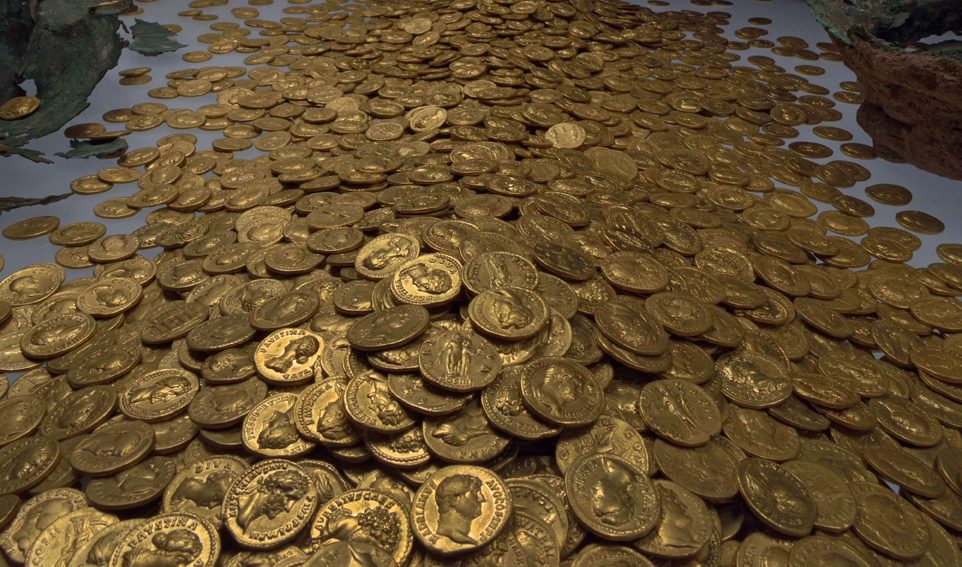
Roman gold aurei from Nero to Septimius Severus, packed in leather bags and rolls inside a lidded bronze cauldron.
Size: 2,518 coins recovered (about 2,650 originally). Weight: about 18.5 kg.
| Item | Number | Notes |
|---|---|---|
| Aurei struck AD 63 to 167/168 | over 99% | Nero (866) and Vespasian (819) are the commonest rulers |
| Aurei struck 193-196 | 6 | Added after a long gap; the latest coins of the hoard |
| Bronze cauldron and lid | 1 | About 25 cm high, torn apart by the excavator |
Photographs
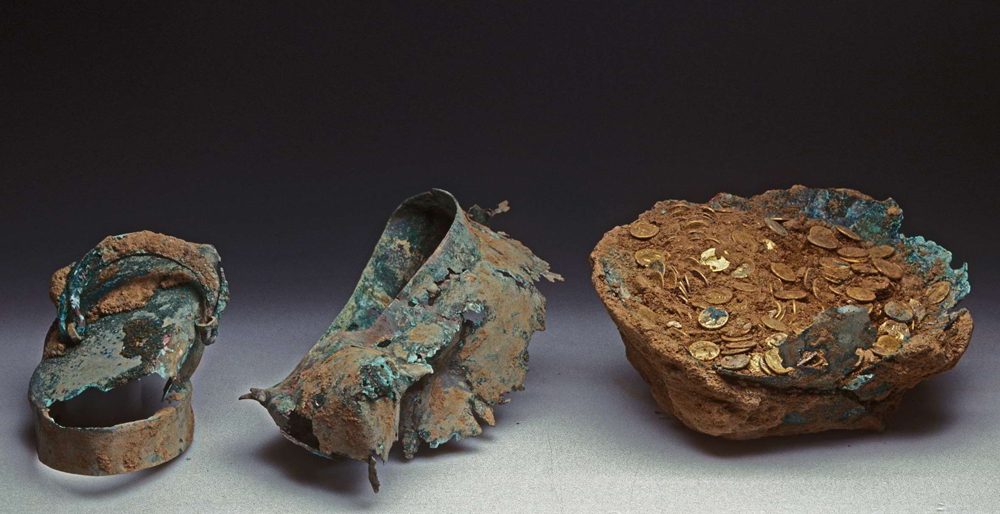
Photo: Th. Zühmer, CC BY-SA 3.0, via Wikimedia Commons
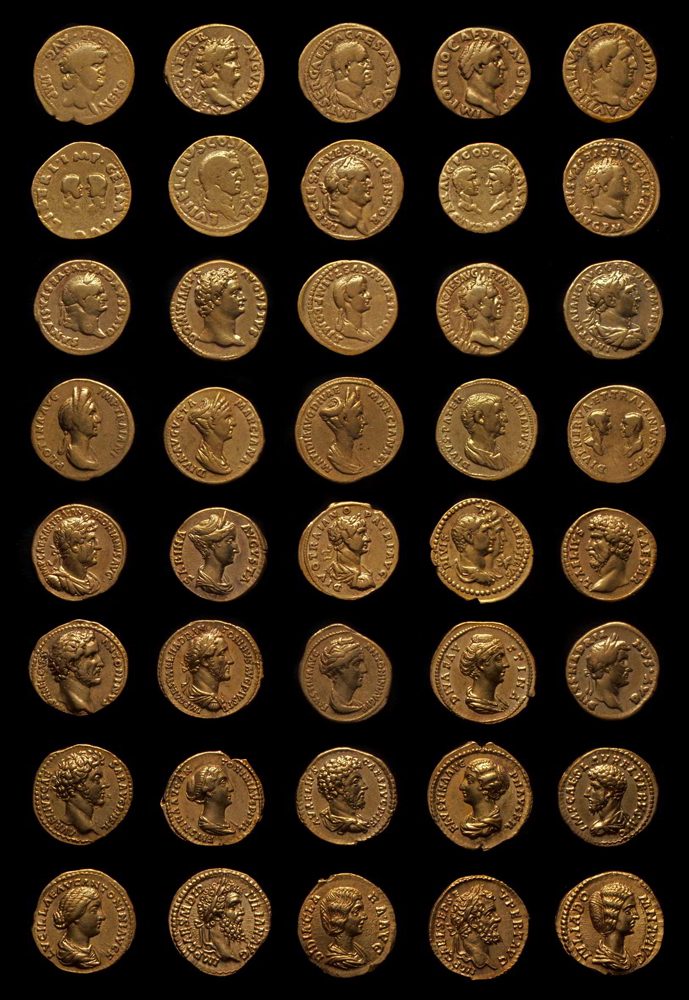
Photo: Th. Zühmer, CC BY-SA 3.0, via Wikimedia Commons
How it is dated
The bulk of the coins ends in 167/168, but six later aurei of 193-196 show the pot was reopened and finally buried around 196, probably during the siege of Trier by Clodius Albinus' troops. The gap suggests two episodes of concealment.
What happened after the find
The finder who recovered the main mass handed it in the next day and is reported to have received a reward of about 20,000 Deutschmarks, a small fraction of its value; the hoard passed to the Rhineland-Palatinate state museum in Trier.
Where sources differ
- Coin count: Die Welt (2013) gives 2,516; English Wikipedia gives 2,516 or 2,518; German Wikipedia says 19 people handed in 2,518. The original total is estimated at 2,650.
- Rulers depicted: English Wikipedia says 40 emperors and relatives, German Wikipedia 29.
- The detectorist's find: English Wikipedia says 560 coins in the pot plus a lump of 1,500; German Wikipedia says 561 and 1,389.
- The reward of about 20,000 DM is from a 2014 newspaper report cited by Wikipedia.
- The current display and the reopening date of the coin cabinet after 2019 were not confirmed on the museum's site.
Questions
How much gold is in the Trier hoard?
About 18.5 kg: 2,518 recovered aurei, each weighing roughly 6 to 7.5 grams, with the original deposit estimated at about 2,650 coins.
Where can I see the Trier Gold Hoard?
At the Rheinisches Landesmuseum Trier, the state archaeological museum, which displays it in its coin cabinet.
Was the Trier Gold Hoard stolen?
No. Thieves tried to break the armoured display case in October 2019 but failed and fled. One was later caught and convicted.