In November 1992 a tenant farmer at Hoxne in north Suffolk lost a hammer and asked a friend with a metal detector to look for it. Instead the detector found silver spoons, gold jewellery and coins. The two men lifted a few pieces, then stopped and told the landowner, Suffolk County Council, and the police. Archaeologists from the Suffolk Archaeological Unit dug out the rest the next day, lifting some of it in solid blocks for the laboratory. The hammer turned up too, and later went to the British Museum along with the treasure.
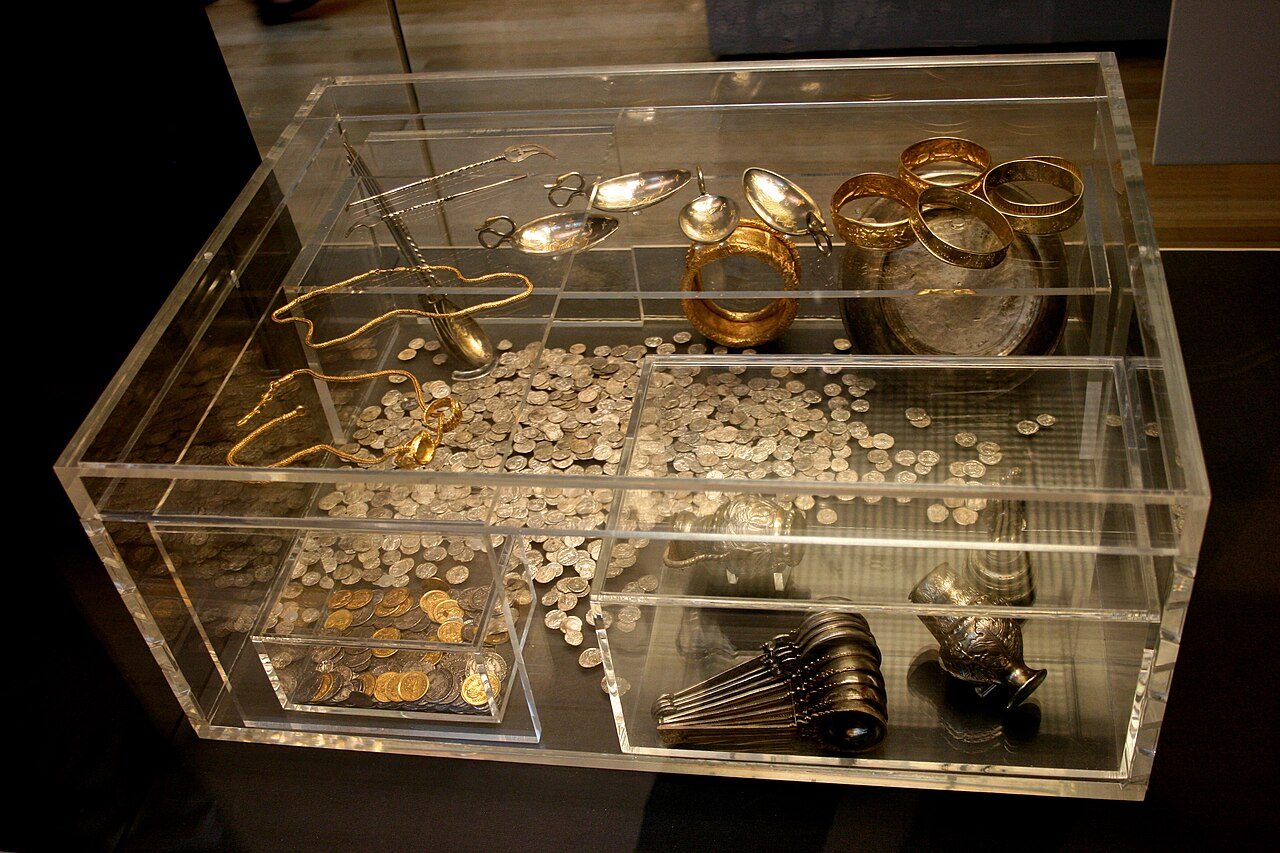
That restraint is why the hoard is so valuable to historians. The wood had rotted almost entirely, but because nothing had been pulled out at random, the excavators could see that the objects had been packed into an oak chest about 60 by 45 cm. Ladles and bowls were nested inside each other, smaller boxes of yew and cherry held some groups, and hay or woollen cloth padded the rest. Iron hinges, nails and two small silver padlocks survived from the containers.
No other find of late Roman gold and silver from Britain comes close in size. The chest held 569 gold solidi, more than 14,000 silver coins and two dozen bronze ones, struck at fourteen mints from Trier and Lyon to Antioch. Almost every silver siliqua has had its edge clipped, a habit peculiar to Britain in these decades; the sheer number of clipped coins lets numismatists study how and when the practice spread. The gold coins weigh almost exactly eight Roman pounds, which suggests they were counted out by weight.
The objects belong to a very rich household. Nineteen gold bracelets include three sets of four and one pierced with the words VTERE FELIX DOMINA IVLIANE, 'use this happily, Lady Juliane'. A gold body-chain, worn crossing over the chest and back, carries an amethyst and garnets at the front and an older gold coin of Gratian at the back. Among nearly a hundred spoons, many carry Christian monograms and the names of eight different people, the most frequent being Aurelius Ursicinus. Four silver pepper pots add a note of luxury: one is a bust of a richly dressed woman holding a scroll.
There are notable gaps. The chest held no large silver platters or jugs and none of the gem-set jewellery fashionable at the time, so it was probably only part of the family's wealth. Who buried it, and why, is unknown. The obvious context is the collapse of Roman rule after 407, when Constantine III took troops from Britain to Gaul. Some scholars prefer other explanations, such as a store of gifts that lost its purpose once the province left the Empire, or the proceeds of a theft. A single post-hole at one corner of the pit may have marked the spot for someone who never came back.
The find also changed the law. The prompt report and careful excavation were widely praised, and the case fed into the debate that produced the Treasure Act 1996, under which landowners as well as finders share in rewards.
Highlights
A hollow silver-gilt bust of a fashionably dressed woman holding a scroll. A turning disc in the base opened holes for shaking out pepper or other spices.
Four loop-in-loop chains ending in lion heads, joined at the front by a mount set with an amethyst and garnets and at the back by a reused solidus of Gratian. Four empty cells probably held pearls.
A solid silver statuette, 15.9 cm long, of a leaping tigress with niello-inlaid stripes. It was made as the handle of a larger vessel that was not in the hoard.
A gold openwork bracelet whose leafy pattern spells out a good-luck wish to 'Lady Juliane'. It is the only inscribed gold piece in the hoard.
What is in it
Late Roman gold and silver coins with a much smaller number of bronze ones, gold jewellery, and silver and silver-gilt table and toilet implements, packed by type inside a wooden chest.
Size: about 15,000 items, including 14,865 coins and roughly 200 other objects. Weight: about 27 kg of precious metal (3.5 kg gold, 23.75 kg silver) (gold and silver).
| Item | Number | Notes |
|---|---|---|
| Gold solidi | 569 | Valentinian I to Honorius; together they weigh almost exactly 8 Roman pounds |
| Silver coins | 14,272 | 14,212 siliquae and 60 miliarenses, nearly all siliquae clipped; 428 are good-quality local imitations |
| Bronze nummi | 24 | |
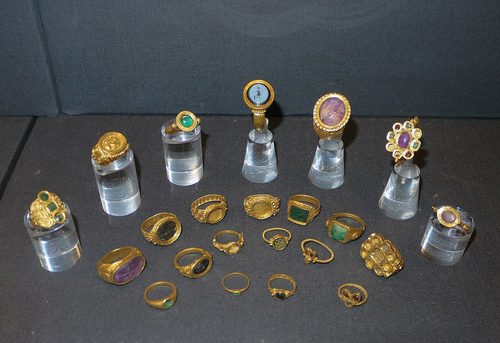
| Gold jewellery | 29 | a body-chain, six necklaces, three rings and nineteen bracelets, about 1 kg in all |
| Spoons and ladles | 98 | silver, some gilded; many with Chi-Rho monograms or owners' names |
| Other silver | about 15 | four pepper pots, a tigress handle, a beaker, a juglet, four bowls, a small dish, toothpicks and two padlocks |
Photographs
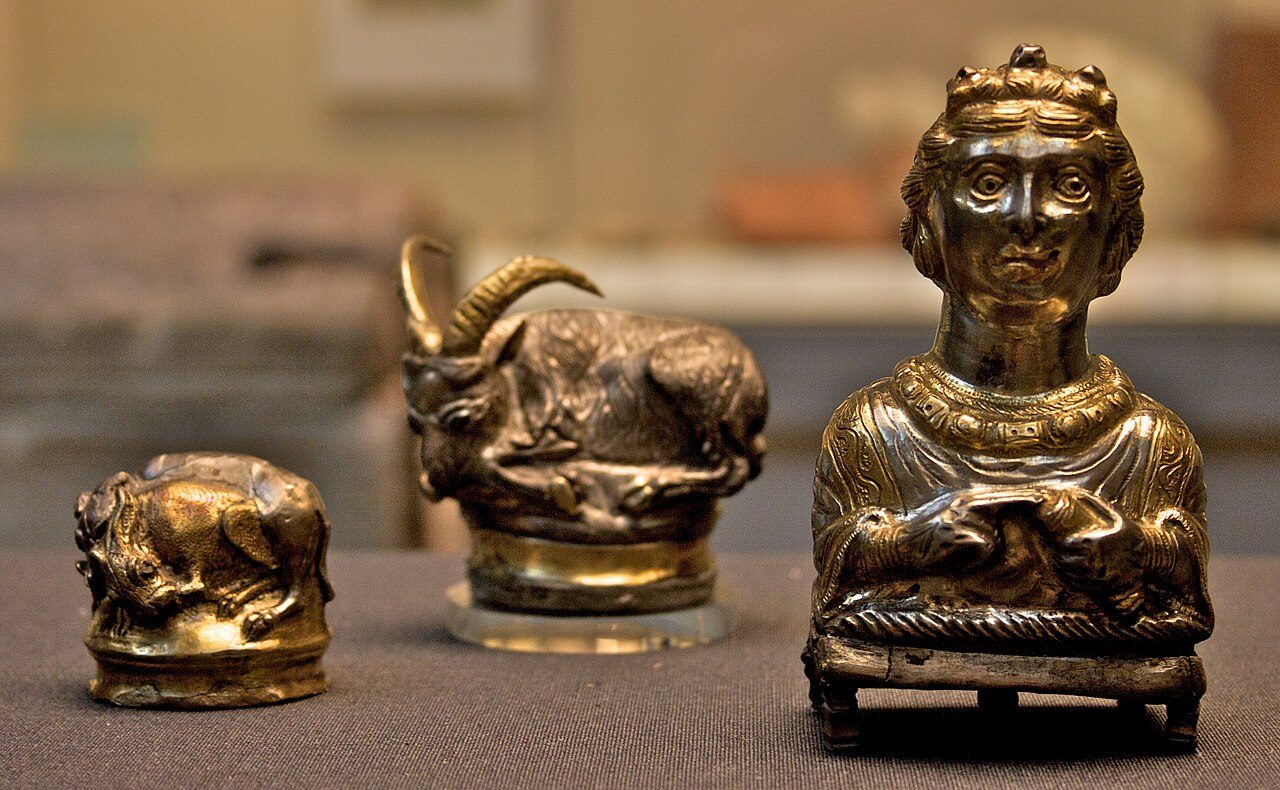
Photo: Mike Peel ( www.mikepeel.net )., CC BY-SA 4.0, via Wikimedia Commons
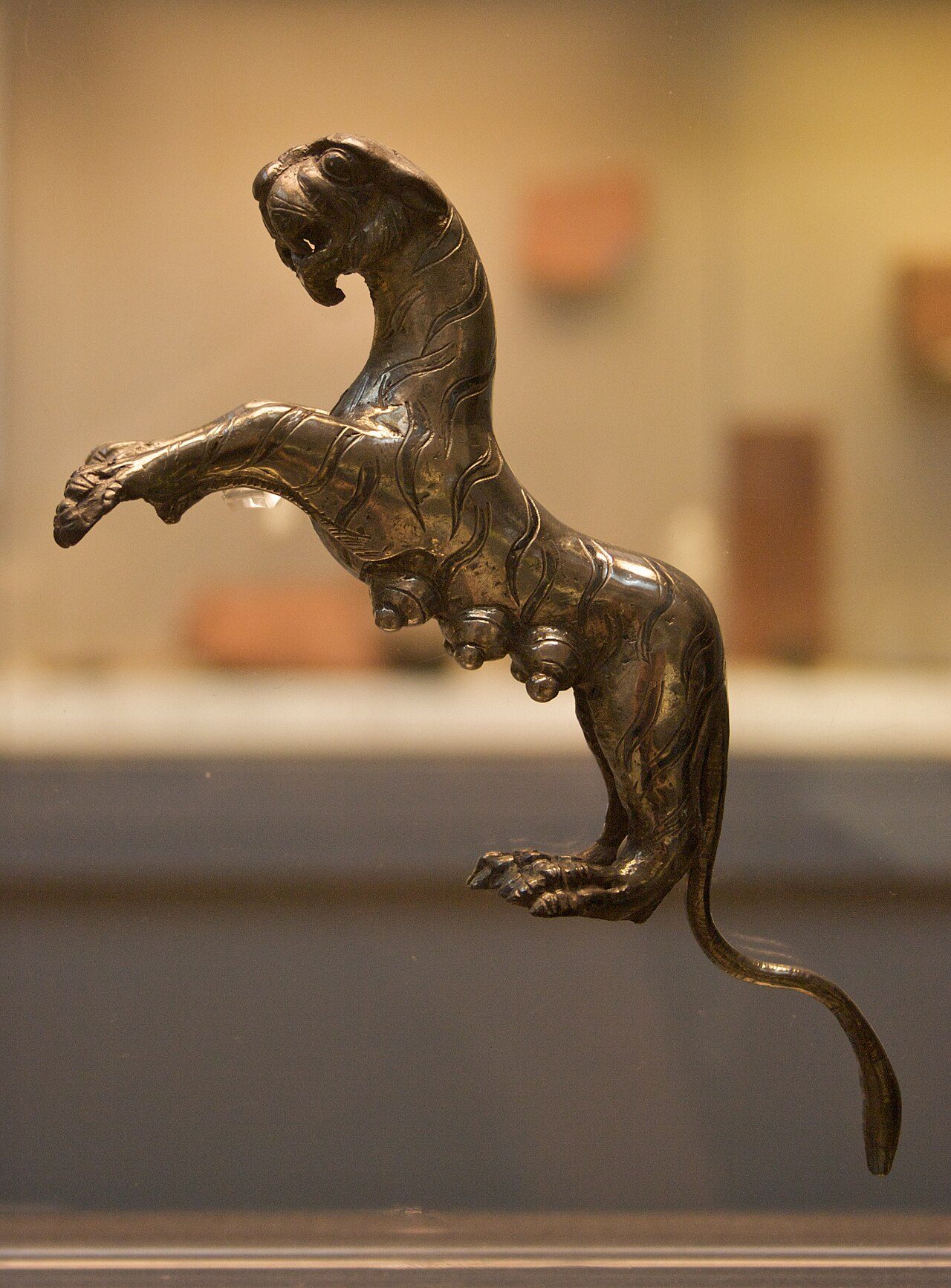
Photo: Mike Peel ( www.mikepeel.net )., CC BY-SA 4.0, via Wikimedia Commons
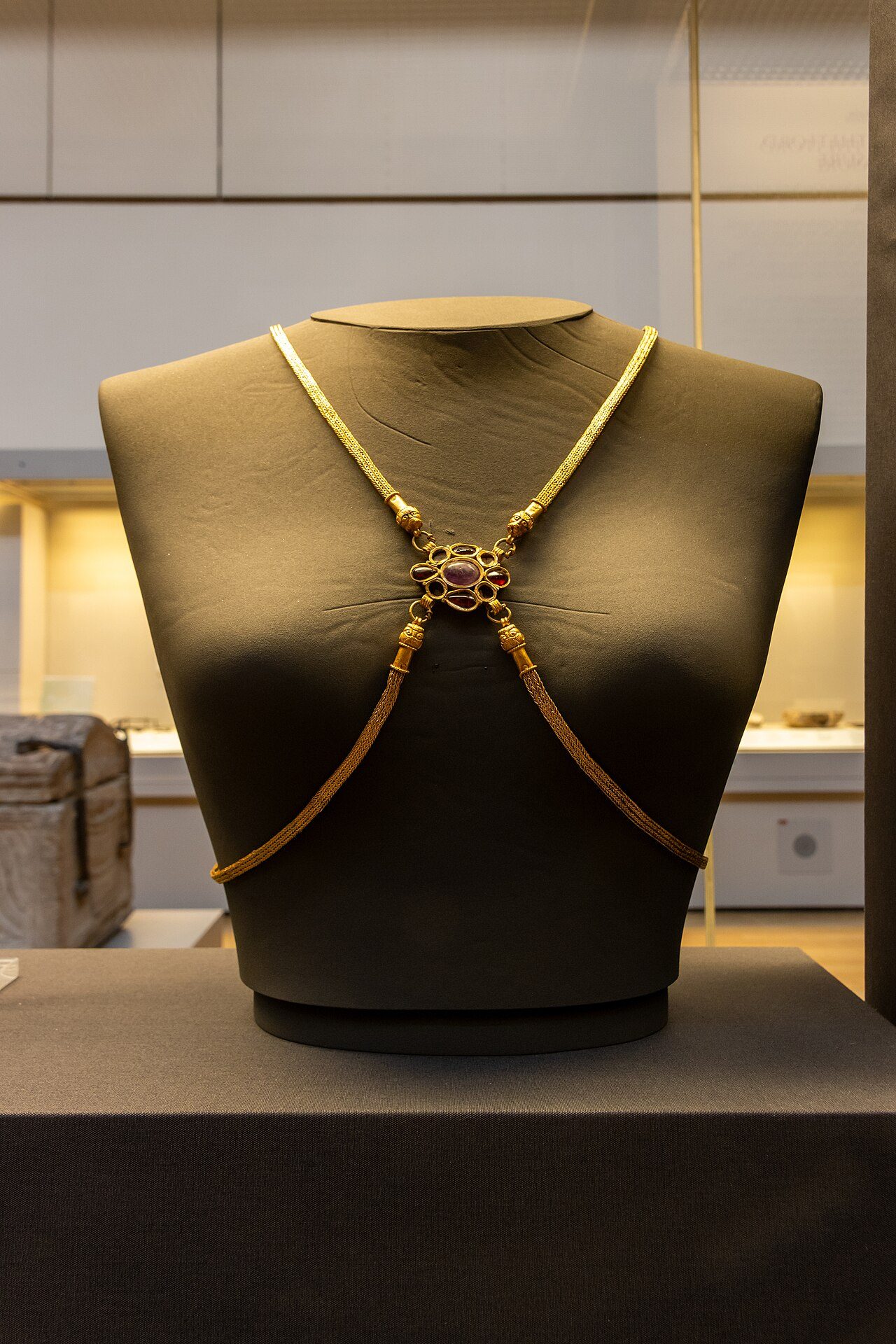
Photo: Mike Peel ( www.mikepeel.net )., CC BY-SA 4.0, via Wikimedia Commons
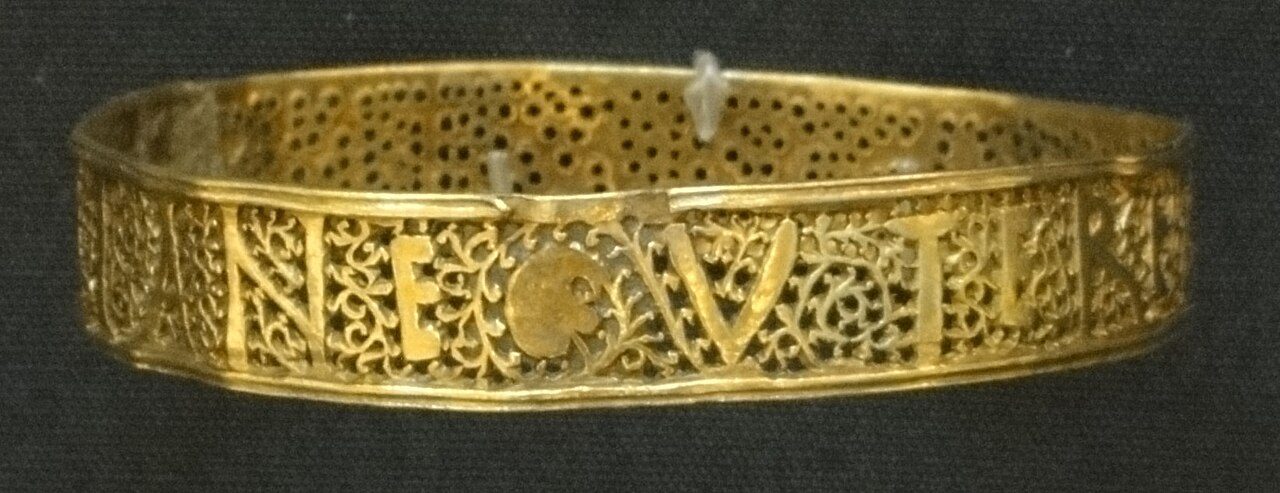
Photo: Unknown, CC BY-SA 3.0, via Wikimedia Commons
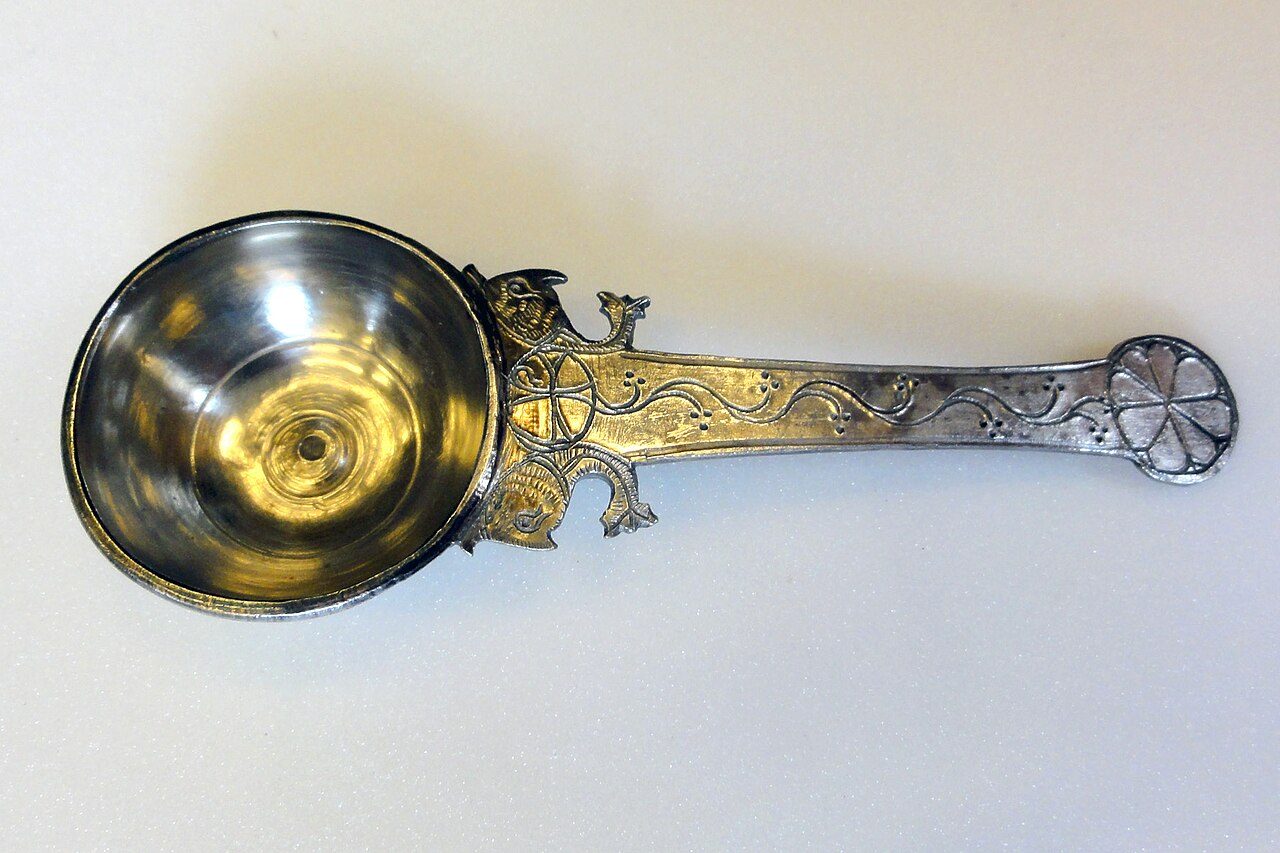
Photo: Unknown, CC BY-SA 3.0, via Wikimedia Commons
How it is dated
Coins give the date. The latest are siliquae of Honorius and Constantine III of types issued while Arcadius was still alive, so the chest cannot have been closed before 407/8. How long after that it went into the ground is unknown; the heavy clipping of the silver points to a period of continued use in a Britain cut off from new coin supplies.
What happened after the find
A coroner's inquest at Lowestoft declared the hoard treasure trove in September 1993, and the Treasure Trove Reviewing Committee valued it at £1.75 million, paid as a reward to the finder, who shared it with the farmer. The British Museum bought it in 1994 with grants from the National Heritage Memorial Fund, the Art Fund, the J. Paul Getty Trust and others.
Where sources differ
- Coin totals differ by source: Wikipedia (from the British Museum catalogues) gives 569 solidi and 14,272 silver coins; the Suffolk Historic Environment Record gives 565 solidi and 14,191 silver coins. Later fieldwalking and the 1994 excavation added more scattered coins.
- The number of non-coin objects is given only approximately (about 200; about 100 silver items) because some fragments cannot be matched.
- Why the hoard was buried, and by whom, is unknown; safekeeping during the end of Roman rule, a redundant store of gift-exchange wealth, and stolen goods have all been proposed.
Questions
Where is the Hoxne Hoard now?
The whole hoard belongs to the British Museum in London. The best pieces, and a reconstruction of the chest showing how the objects were packed, are on show in the Roman Britain gallery, Room 49.
How much was the Hoxne Hoard worth?
In 1993 the government's valuation committee put it at £1.75 million. That sum was paid as the finder's reward, and the British Museum raised it with help from national funds and charities.
Why was the Hoxne Hoard buried?
Nobody knows. It was closed after 407/8, as Roman rule in Britain was breaking down, and many think a wealthy family hid it for safety. Other suggestions include a store of gift wealth that had lost its purpose, or loot.