On 27 April 2016 workmen digging a trench with a mechanical excavator in the Olivar del Zaudín park at Tomares, a suburb across the Guadalquivir from Seville, hit a row of pottery jars packed with green, corroded coins. The machine had already smashed several of them before work stopped. Archaeologists were called in at once, and the find went to the Seville Archaeological Museum the next day. At a press conference its director called it a unique collection with very few parallels anywhere.
The numbers are staggering. Nineteen amphorae held about 600 kg of bronze coins: some 53,000 according to later figures, including 105 more recovered when archaeologists excavated the trench properly. They are nummi, often called folles, the large bronze coins introduced in Diocletian's reform of 294, carrying the portraits of the emperors of the Tetrarchy: Diocletian, Maximian, Constantius I and Galerius. Each weighs some 8 to 10 grams. The museum's director said some were probably given a silver wash when new.
That freshness is the most striking thing about them. The coins show almost no wear, so they had barely circulated, if at all, before being sealed in their jars. The museum's first suggestion was that this was official money, perhaps meant to pay soldiers or officials in the province of Baetica, rather than anyone's savings. The fact that the coins were stored in amphorae, jars made for oil and wine and not normally associated with coin, adds to the impression of a shipment or a bulk store.
The follow-up excavation found that the jars had stood in a Roman rural building used for storing and processing farm produce, with a residential part to the south. Unfortunately the exact setting of the pit was destroyed when the jars were pulled out, so how they were arranged and whether they were hidden or simply stored cannot now be known.
The early press reports spoke of coins of Maximian and Constantine, and some mention Constantine still. The later study concentrates on the first Tetrarchy, with coins running from 294 to about 310. A full publication of so large a mass is a long task; in 2023 a team published a detailed analysis of a sample of 102 coins from the excavation while the study of the rest continued.
Tomares is usually cited as one of the largest Roman coin hoards ever found. Its scale has made it a test case for how museums can clean, record and study tens of thousands of near-identical objects.
Highlights
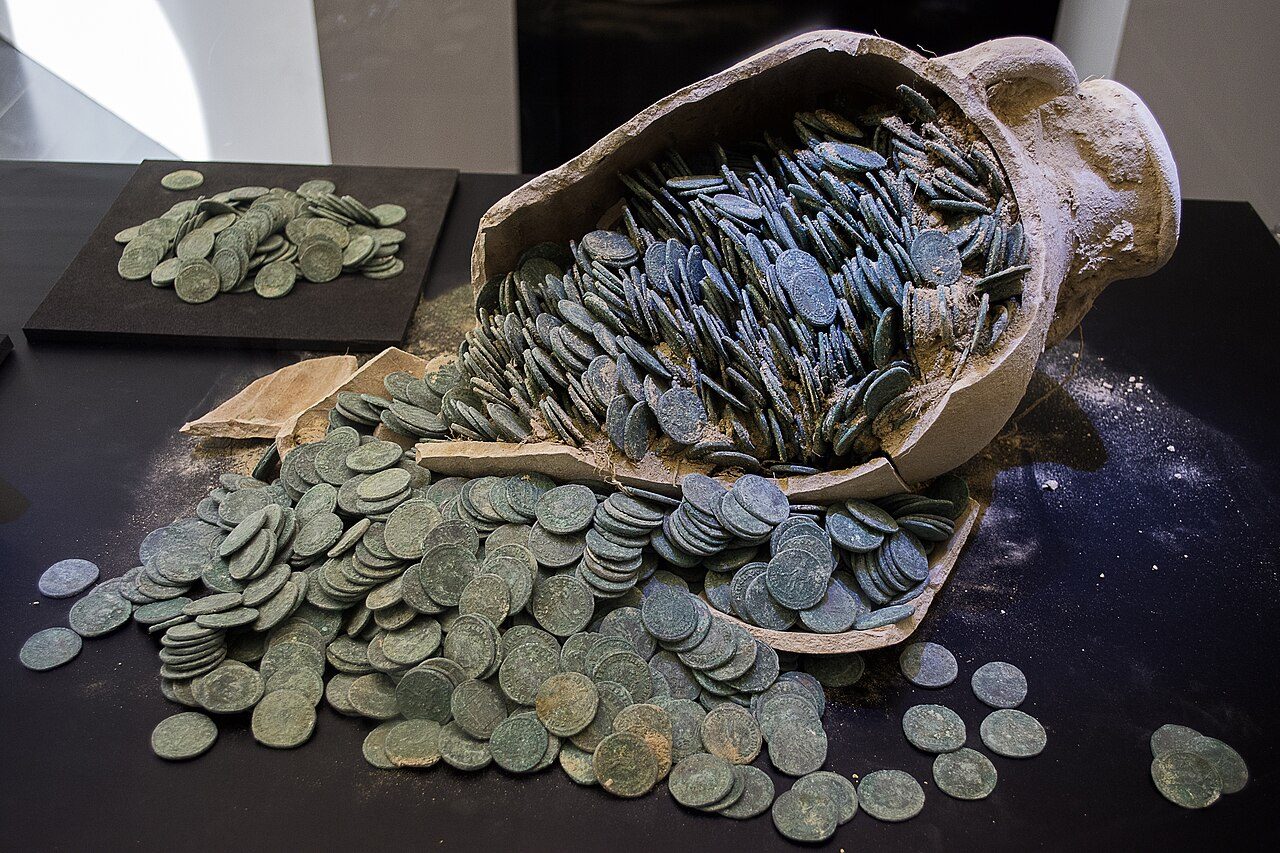
One of the jars, shown spilling its coins, conveys the sheer bulk of the deposit: each amphora held thousands of nummi.
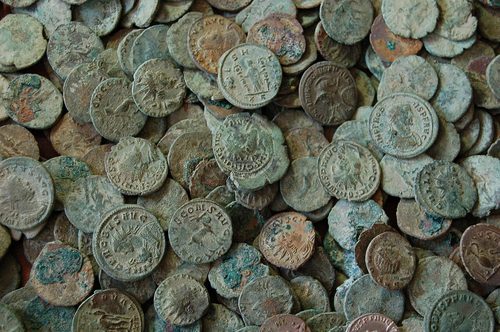
Bronze nummi of Diocletian, Maximian, Constantius I and Galerius, almost as crisp as when they left the mint.
What is in it
Tens of thousands of bronze nummi (folles) of the Tetrarchy with a small silver content, many apparently never circulated, stored in 19 pottery amphorae.
Size: about 53,000 coins. Weight: about 600 kg (copper alloy (bronze) with a little silver).
| Item | Number | Notes |
|---|---|---|
| Bronze nummi | 53,208 | Including 105 recovered in the follow-up excavation; struck about 294-310 for Diocletian, Maximian, Constantius I and Galerius |
| Amphorae | 19 | Nine recovered intact, the rest broken by the digger; some of a globular olive-oil type |
Photographs
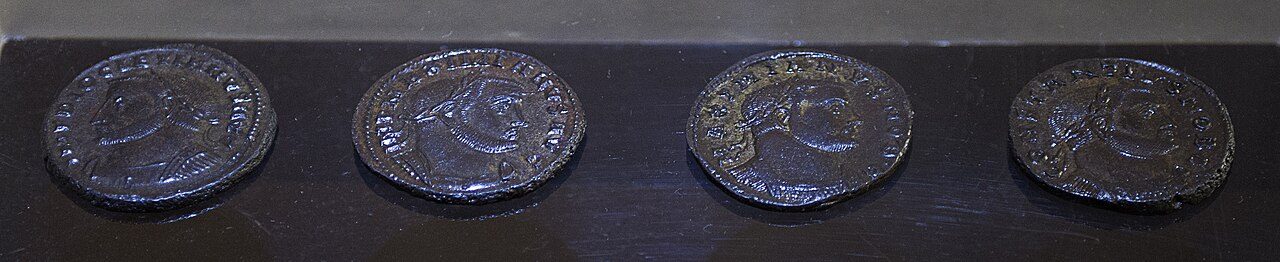
Photo: Anual, CC BY-SA 4.0, via Wikimedia Commons
How it is dated
The coins were struck between Diocletian's reform of 294 and about 310 and show very little wear, so they were put away soon after minting, probably around 310. No later coins are reported.
What happened after the find
Under Spanish heritage law archaeological finds are public property. The coins went straight to the Seville Archaeological Museum, which led a funded research project on them with university specialists.
Where sources differ
- Coin count: 53,208 (University Pablo de Olavide outreach article, 2020); Spanish Wikipedia says about 50,000; Francisca Chaves is reported as saying 40,000-50,000; German Wikipedia 53,000-55,000.
- Find date: 27 April 2016 per a 2026 University Pablo de Olavide article and AFP's 'Wednesday'; Spanish Wikipedia gives 28 April, the day the coins entered the museum.
- Rulers: initial press reports named Maximian and Constantine; later work names the four Tetrarchs.
- Number of intact amphorae: German Wikipedia says 9 intact and 10 broken; another account 9 intact, 2 partly broken and 8 broken.
- Whether the coins were official pay money is a hypothesis voiced at the 2016 press conference.
- Whether any of the hoard is on permanent display today could not be confirmed.
Questions
How many coins were in the Tomares hoard?
About 53,000 bronze coins, roughly 600 kg, stored in 19 amphorae. The figure of 53,208 includes 105 coins recovered in the follow-up excavation.
Are the Tomares coins silver?
No. They are bronze nummi with only a small silver content, though some were probably given a thin silver wash when new, according to the museum's director in 2016.
Where are the Tomares coins now?
They belong to the Seville Archaeological Museum, which has studied them since 2016. Selections have appeared in temporary exhibitions in Seville and Madrid.
Sources
- Tesoro de Tomares (Spanish Wikipedia)
- Massive 600kg haul of ancient Roman coins unearthed in Spain (The Guardian / AFP, 2016)
- El tesoro de Tomares (Universidad Pablo de Olavide, Patio Colorado, 2020)
- Un hallazgo inesperado: el Tesoro de Tomares y su impacto arqueológico (Universidad Pablo de Olavide, 2026)
- Wikidata Q23977973 (CC0)