On 28 December 1924 two brothers digging in their vineyard outside Valchitran, a village about 22 kilometres south-east of Pleven in northern Bulgaria, struck a cache of gold vessels. There were thirteen pieces and they weighed about 12.5 kilograms, and Bulgarian archaeologists still describe it as the largest Thracian gold treasure found in the country.
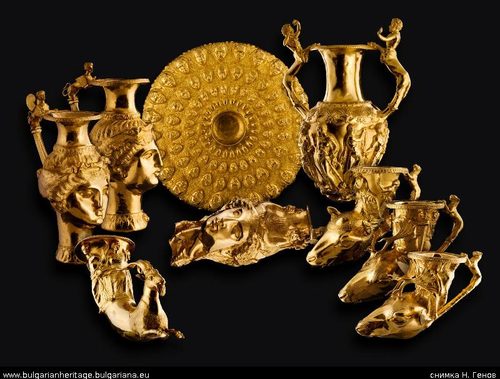
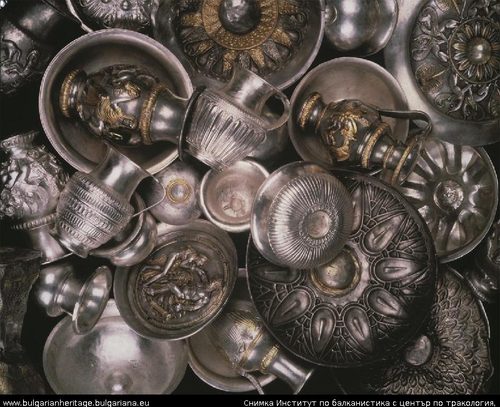
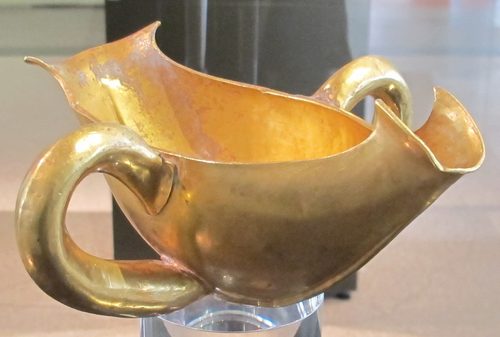
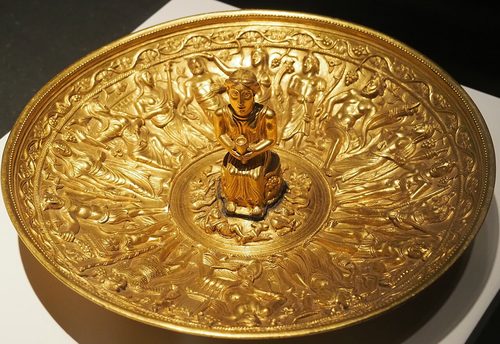
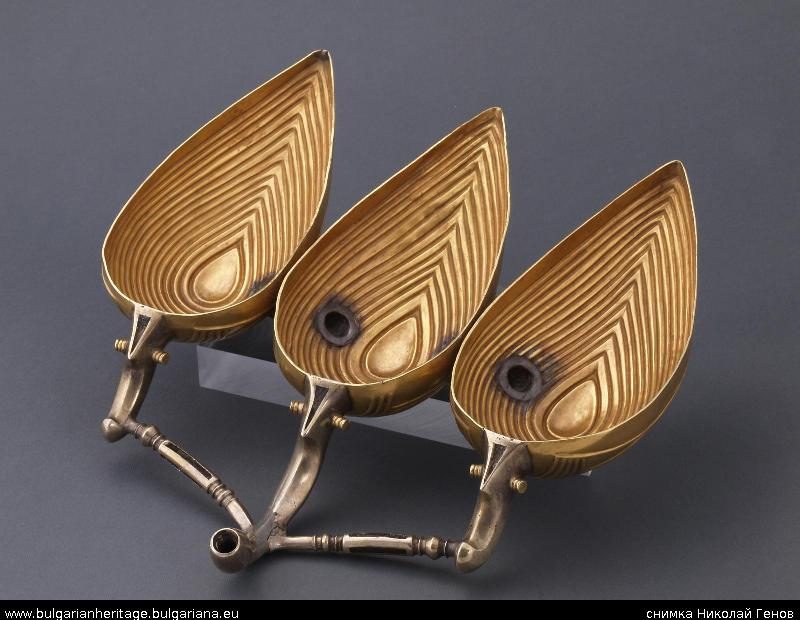
The gold is an alloy with roughly a tenth part silver, as it came from the ground, and the shapes are unlike anything from later Thracian treasures. The centrepiece is a large two-handled bowl, a kantharos, weighing about 4.5 kilograms on its own; its high loop handles rise well above the rim. There are several smaller cups with tall handles. The strangest object is a triple vessel: three almond-shaped bowls linked by hollow tubes and a branched handle, so that liquid poured into one would flow into the others. The remaining pieces are broad domed discs, some with long knobbed handles at the centre, which look like lids or like cymbals. Several are decorated with bands of inlaid silver, an early use of contrasting metals.
Archaeologists have long argued about what this set was for. The size of the bowl and the linked vessels suggest communal drinking or libations, and the discs may have been lids, offering plates or instruments. The most common view is that it was the ritual equipment of a ruler who was also a priest, used at feasts or ceremonies. Nothing was found with it to say who that was.
The vessel shapes point outward from Thrace. The British archaeologists Andrew Sherratt and Timothy Taylor compared the kantharos and cups with a silver kantharos from Shaft Grave IV in Grave Circle A at Mycenae and a gold one found at Thebes, and with hoards from Romania and Ukraine that also hold drinking cups. Valchitran therefore belongs to a world of Bronze Age elites stretching from the Aegean to the Carpathians who drank, and displayed status, in similar ways.
Dating such a find without context is difficult. English-language summaries often give around 1300 BC; Bulgarian sources allow anything from the 16th to the 12th century BC, and the Metropolitan Museum's 1977 exhibition catalogue placed it in the 13th to 12th centuries. What is not in doubt is that it is roughly a thousand years older than the famous Thracian treasures of Panagyurishte and Rogozen.
Highlights
A two-handled gold bowl weighing about 4.5 kg, its looped handles rising high above the rim.
Three leaf-shaped bowls joined by tubes and a branching handle into a single communicating vessel, without close parallel.
Wide, shallow gold domes with central knobbed handles, some decorated with inlaid silver bands; their purpose is still debated.
What is in it
Thirteen vessels and lid-like discs of almost pure gold: a large two-handled bowl, cups with high handles, a triple vessel of three linked leaf-shaped bowls, and several domed discs with central handles.
Size: 13 objects. Weight: about 12.5 kg.
| Item | Number | Notes |
|---|---|---|
| Two-handled bowl (kantharos) | 1 | About 4.5 kg on its own |
| Cups with handles | 3-4 | Lists differ on whether a jug is counted separately |
| Triple vessel | 1 | Three almond- or leaf-shaped bowls joined by tubes and a branched handle |
| Domed discs and platters | 7 | Lid- or cymbal-like pieces, some with long central handles, decorated with silver inlay in places |
Photographs
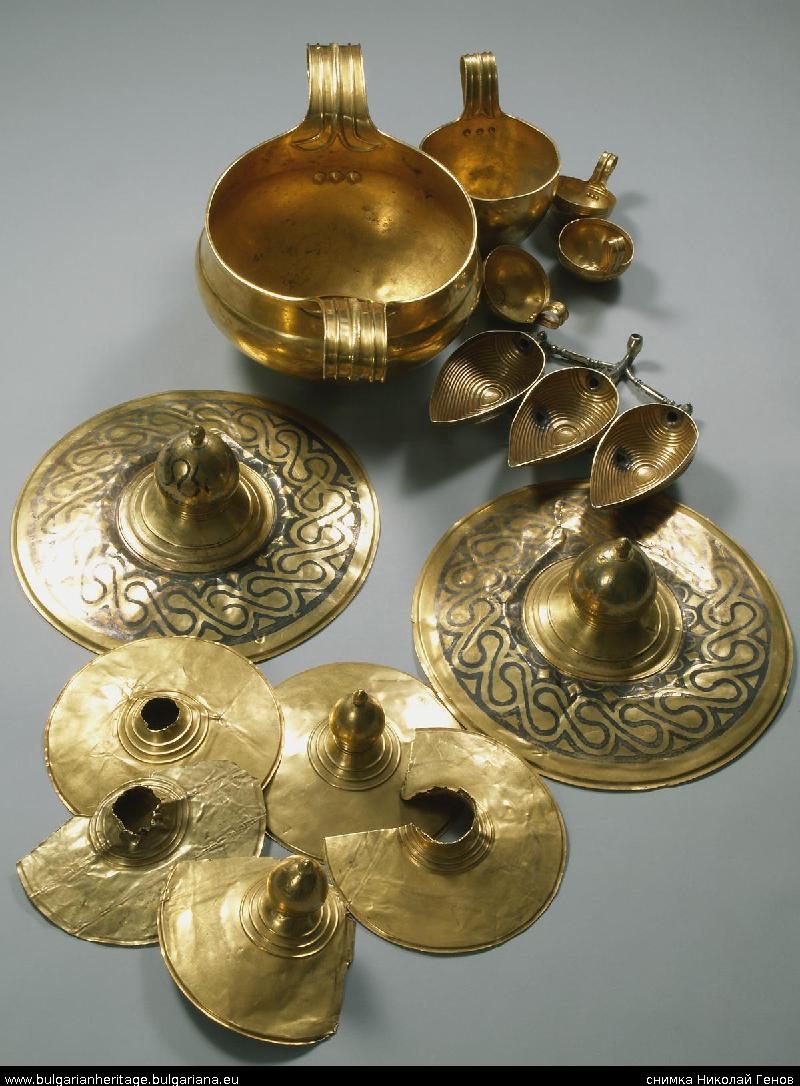
Photo: Николай Генов. Съкровище от Вълчитрън - Институт за балканистика с Център по тракология, Bulgaria - CC BY., CC BY 3.0, via Wikimedia Commons
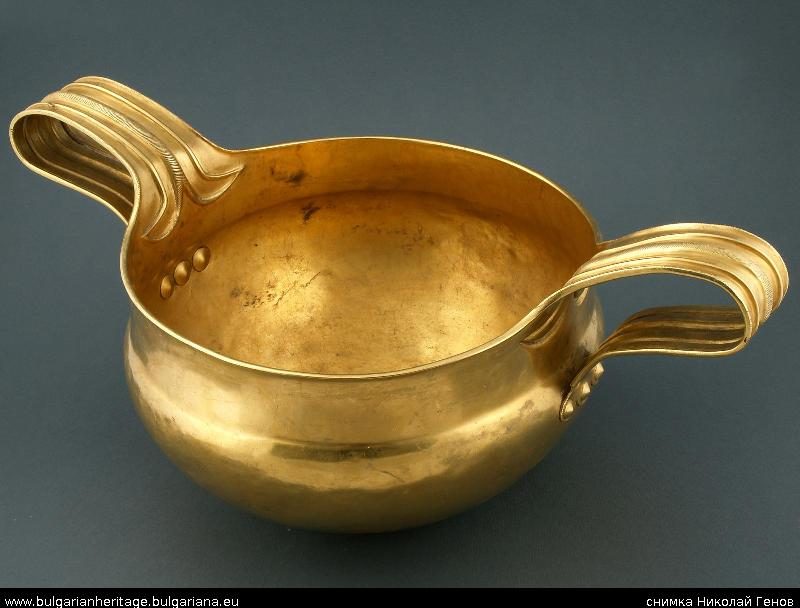
Photo: Николай Генов http://bulgarianheritage.bulgariana.eu/jspui/handle/pub/552, CC BY 3.0, via Wikimedia Commons
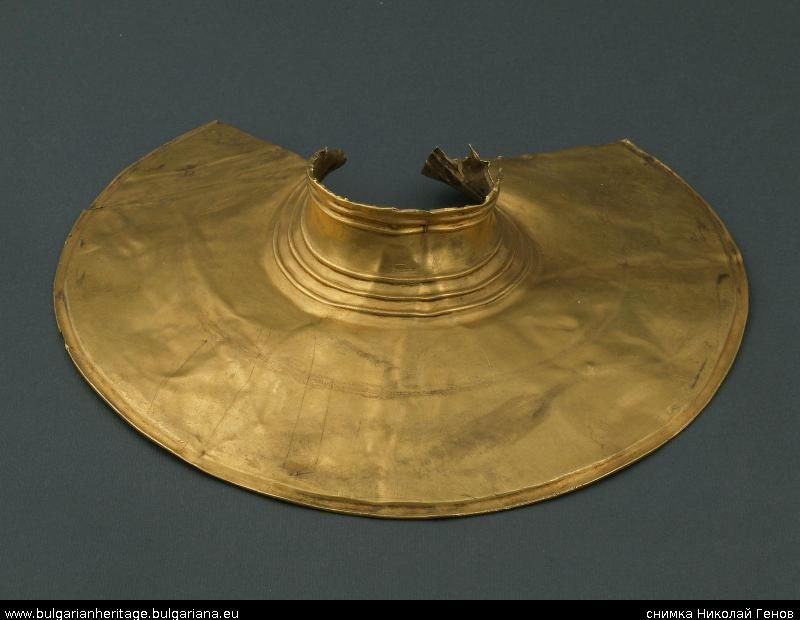
Photo: Николай Генов http://bulgarianheritage.bulgariana.eu/jspui/handle/pub/555, CC BY 3.0, via Wikimedia Commons
How it is dated
There is no excavated context, so the date depends on comparing the cup and bowl shapes with dated vessels from Mycenaean Greece and the Carpathian Bronze Age. That puts the hoard in the Late Bronze Age; published estimates range from the 16th to the 12th century BC, with about 1300 BC a common round figure.
Where sources differ
- Breakdown of the 13 objects differs: English Wikipedia lists two platters, five domed pieces, three cups, a jug, the triple vessel and the bowl; Bulgarian Wikipedia lists seven lid-like pieces, four cups, the kantharos and the triple vessel.
- Alloy: Bulgarian Wikipedia gives 88.15% gold, 9.7% silver, 1.74% copper, yet also calls the 12.5 kg 'pure gold'.
- Date: about 1300 BC (English Wikipedia), 16th to 12th century BC (Bulgarian Wikipedia), 13th to 12th century BC (Metropolitan Museum 1977 checklist).
- Bulgarian Wikipedia gives the kantharos as about 4 kg in one sentence and 4.5 kg in another.
- Silver inlay on the discs: visible in photographs; not stated in the text sources I used.
Questions
Where is the Valchitran Treasure?
The original gold vessels are held by the National Archaeological Institute with Museum in Sofia. A replica set is shown in the Regional Historical Museum in Pleven, near the find spot.
How old is the Valchitran Treasure?
It dates to the Late Bronze Age. Estimates range from the 16th to the 12th century BC, and around 1300 BC is often quoted.
What was the Valchitran Treasure used for?
Probably for ritual drinking or libations by a ruler with religious duties. The linked triple vessel and the lid-like discs suggest ceremonial use rather than everyday tableware.