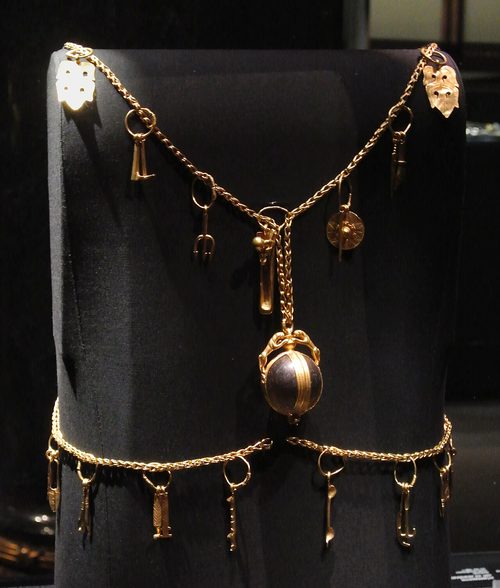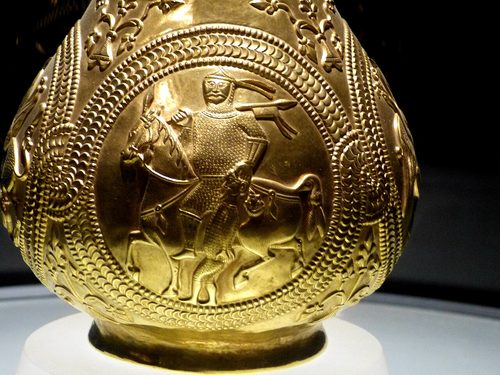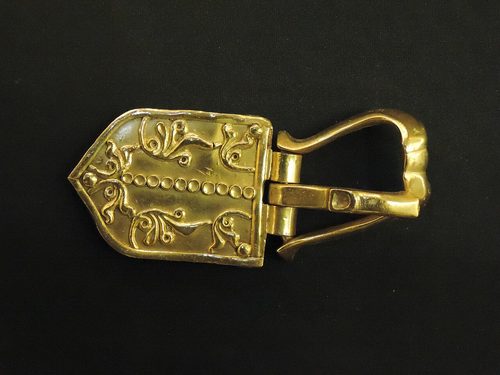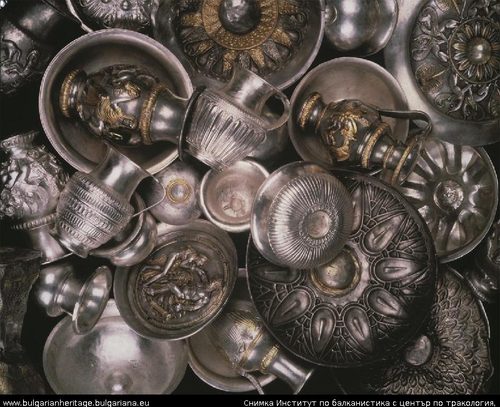
In the spring of 1837 two villagers cutting stone on Istrița hill, near Pietroasele in the foothills north-east of Bucharest, found a mass of gold vessels and jewellery stuck together. One of them later compared the arrangement to a hen sheltering her chicks, and Romanians still call the hoard Cloșca cu puii de aur, the hen with the golden chicks. Accounts speak of 22 objects weighing around 20 kilograms. Soon afterwards about ten of them had vanished, sold or broken up for their metal, and only twelve reached the authorities.
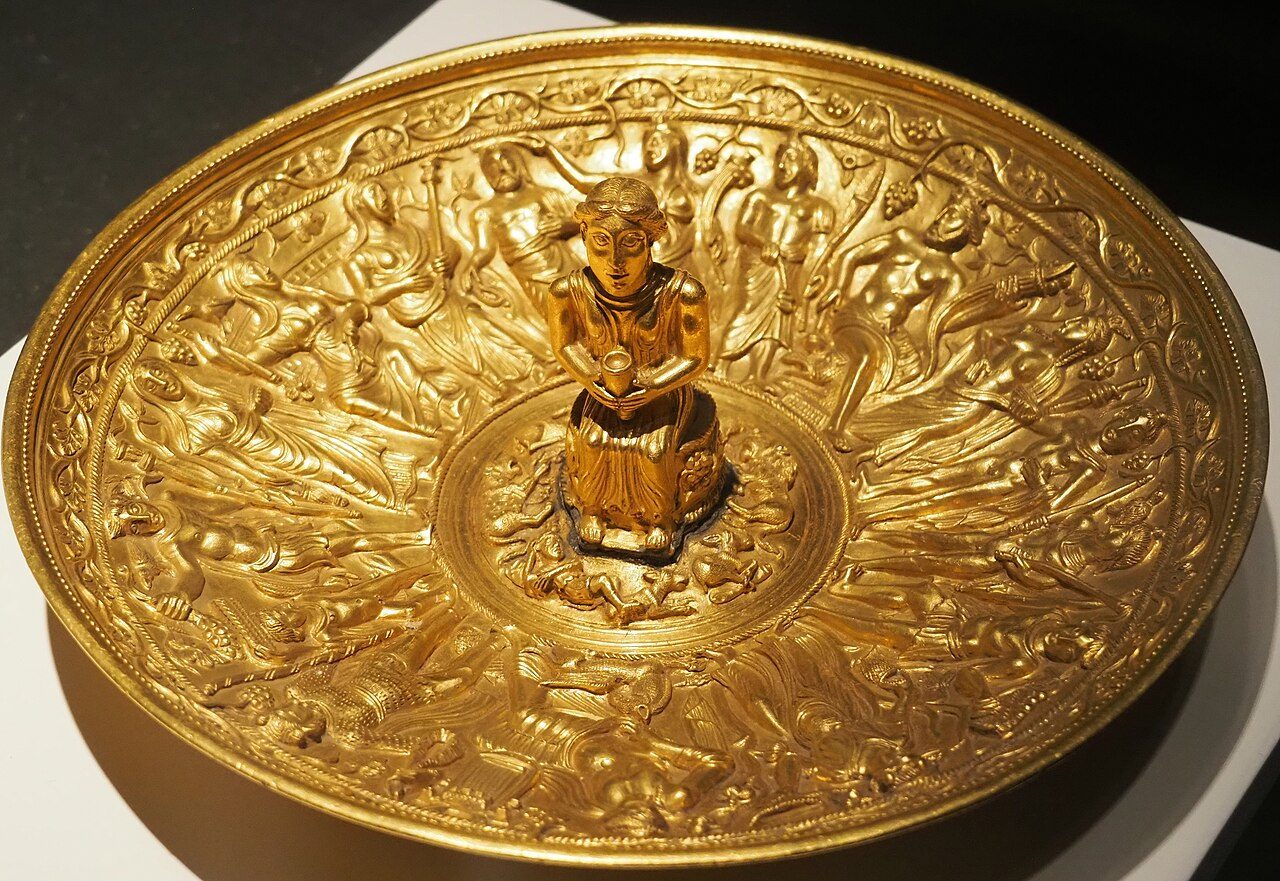
Those twelve are among the finest pieces of late antique goldwork to survive anywhere. The tableware is Roman in manner: a broad patera with a seated female figure modelled in the round at its centre and a crowd of deities in relief around her; a large plain tray; a ewer; and two polygonal cups with walls of openwork gold, once filled with coloured stones, and handles in the shape of animals. The jewellery is something else entirely. Four eagle-headed brooches, one of them enormous, are encrusted with garnets and other stones in the polychrome style that the Goths and their neighbours carried across Europe in the 4th and 5th centuries.
One of the neck-rings carries a short inscription in runes, usually read as naming the Goths and as a dedication of something holy. It is one of very few runic texts from the Gothic world, and it suffered for its fame. Soon after the find it was cut into pieces by a goldsmith, and one rune was damaged; drawings, a cast and an early photograph allow scholars to reconstruct it.
The treasure's later history is almost as dramatic as its burial. In November 1875 a young seminarian broke into the Bucharest antiquities museum through the ceiling and carried off the gold; he was caught within days, but several pieces had been flattened or broken and needed restoration. In 1884 the collection was rescued from a fire by being thrown out of a window. In December 1916, with German armies approaching Bucharest, the Romanian state treasury was evacuated to Moscow for safekeeping, and the hoard went with it. It did not come back until 1956.
Who buried it, and why, are open questions. The 19th-century scholar Alexandru Odobescu attributed the hoard to Athanaric, leader of the Thervingian Goths, who died in 381, and the idea still circulates. Modern archaeologists are more cautious. The mixture of Roman plate and Germanic jewellery fits the cosmopolitan elite of the Chernyakhov culture north of the Danube, and the hoard may equally belong to the early 5th century, when the region was under Hunnic domination. Analysis of the metal suggests the gold came from several different sources. The hoard was probably the treasury, or part of the cult equipment, of a Gothic ruling family, hidden at a moment of danger and never retrieved.
Highlights
A large brooch in the shape of a bird of prey, its body crusted with garnets and crystal and hung with pendants. Old photographs show that its head was reattached the wrong way round in a later restoration.
A gold dish with a seated goddess modelled in the round at the centre, surrounded by a frieze of figures in relief, a piece in the Roman tradition of display plate.
Two polygonal cups whose walls are gold lattices once filled with coloured stones, with handles shaped as animals.
A plain gold ring bearing an Elder Futhark inscription in the Gothic language, one of the earliest runic texts from south-east Europe.
What is in it
Gold tableware and jewellery: a figured patera, a large tray, a ewer, two openwork polygonal cups, four eagle-headed brooches set with stones, and neck-rings, one carrying a Gothic runic inscription.
Size: 12 surviving objects (of 22 reported at discovery). Weight: about 20 kg originally; the surviving pieces are usually given as about 19 kg.
| Item | Number | Notes |
|---|---|---|
| Tableware | 5 | Patera with a seated goddess, large tray, ewer and two openwork polygonal cups |
| Eagle-headed brooches | 4 | One very large and three smaller, set with garnets and other stones |
| Neck-rings and collar | 3 | Two neck-rings and a collar, including the ring with a runic inscription |
Photographs
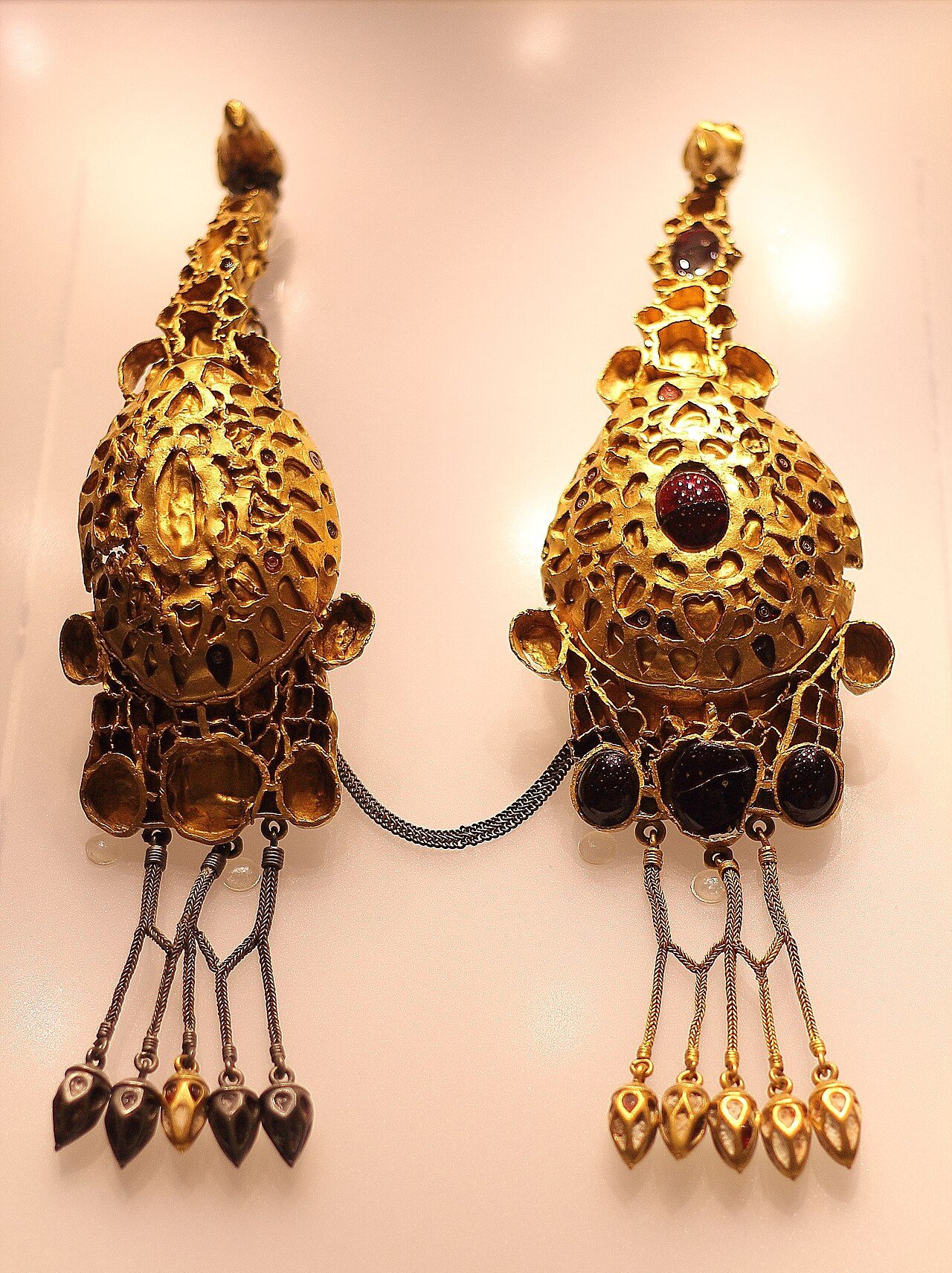
Photo: Cristian Chirita, CC BY-SA 3.0, via Wikimedia Commons
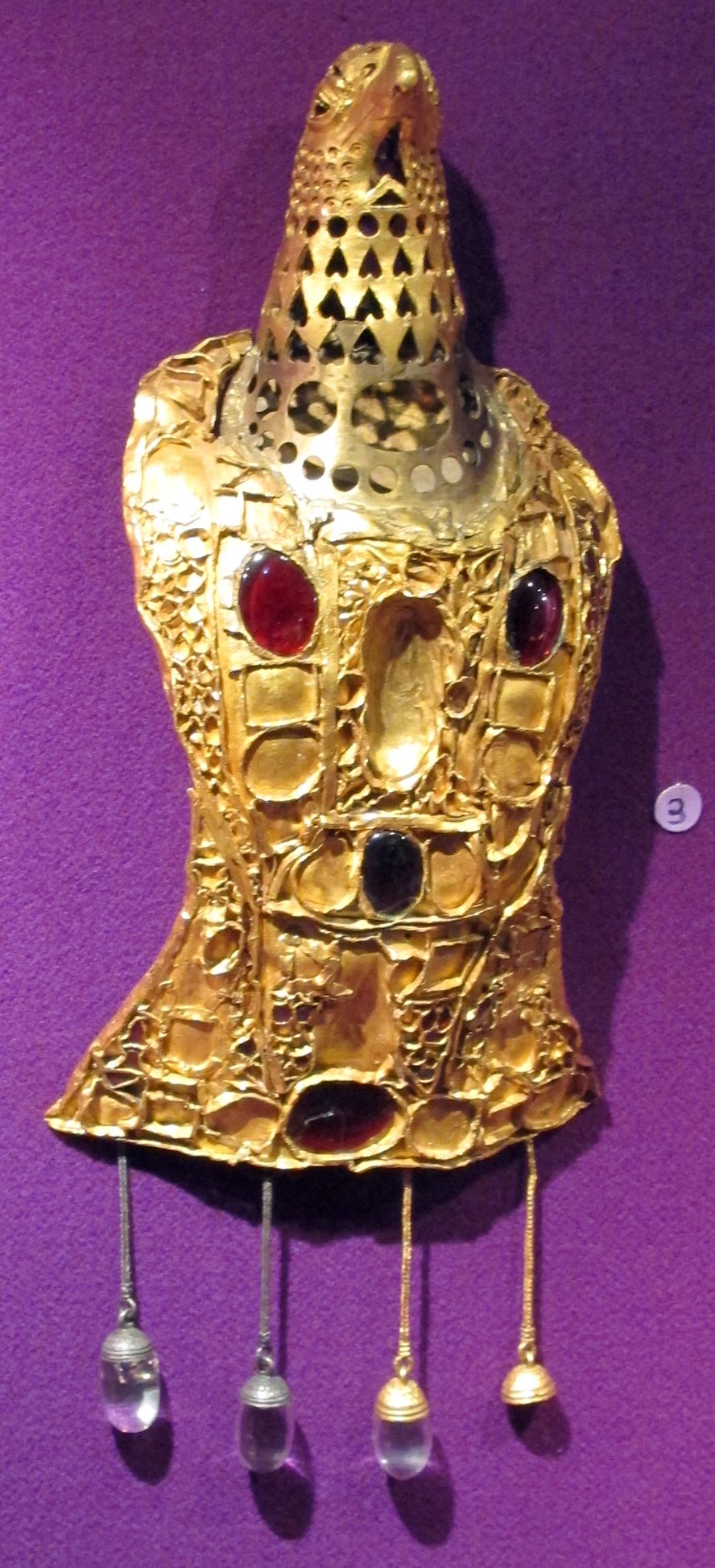
Photo: sailko, CC BY-SA 3.0, via Wikimedia Commons
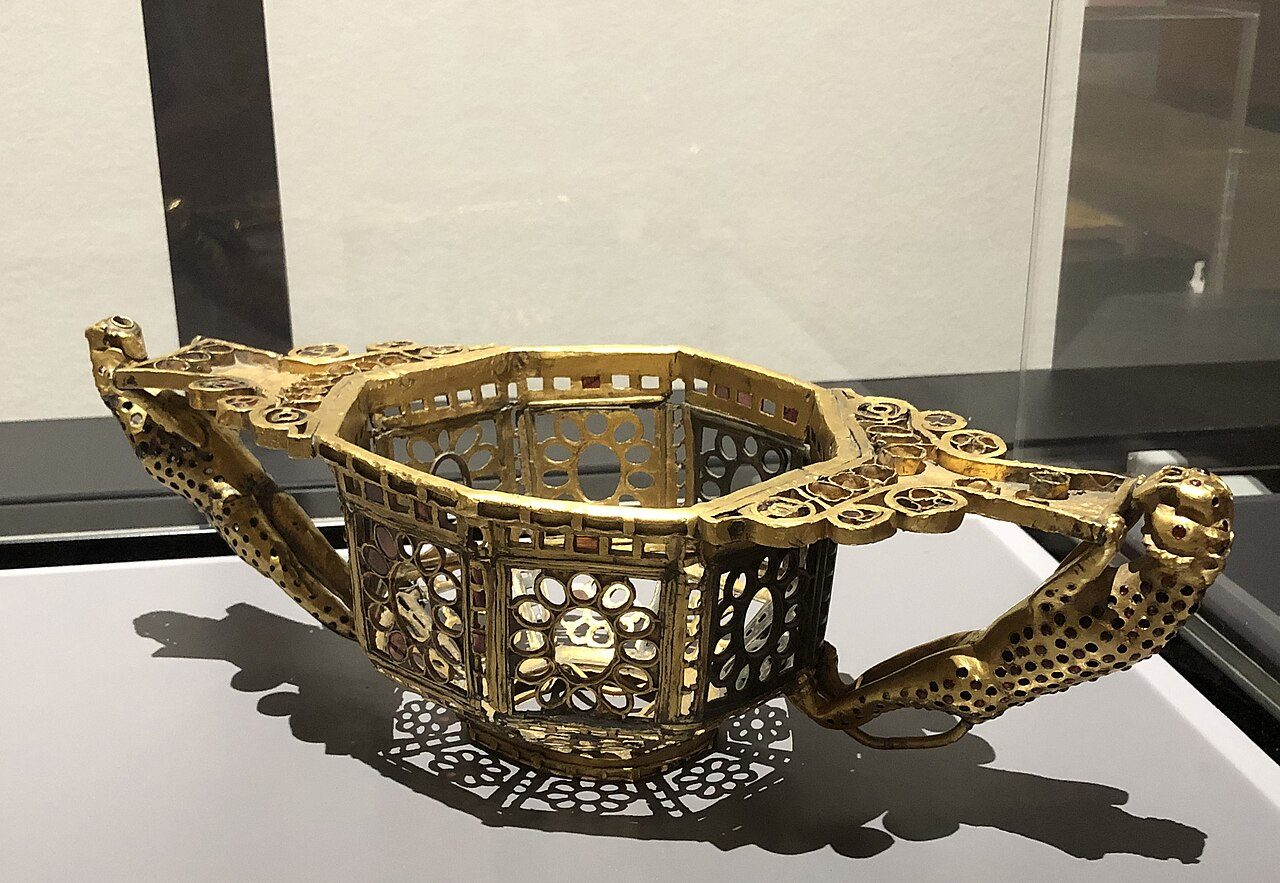
Photo: Christelle Molinié, CC BY-SA 4.0, via Wikimedia Commons
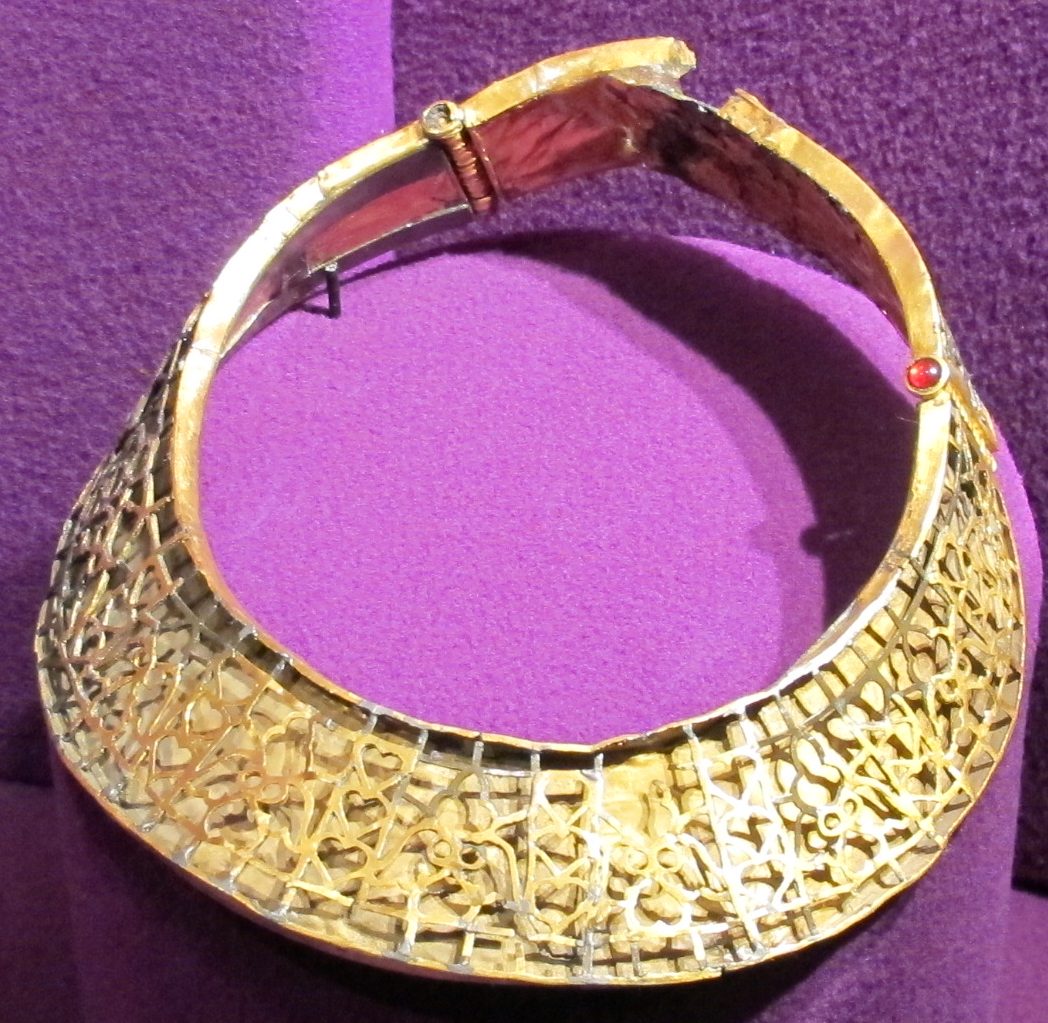
Photo: sailko, CC BY-SA 3.0, via Wikimedia Commons
How it is dated
There are no coins. The polychrome brooches belong to the late 4th and 5th centuries, and the Roman plate fits the same period, so most scholars place the deposit in the decades either side of AD 400. Supporters of the Athanaric link prefer the 370s to 380s; others argue for burial in the Hunnic period, before about 450.
Where sources differ
- Original count: most sources give 22 objects; some Romanian accounts say 22 or 26.
- Weight: Wikipedia gives about 20 kg for the original find; Romanian press figures for what survives range from about 19 kg to 19.76 kg, and it is not always clear which total is meant, so weight_g is left empty.
- Date of deposit: late 4th century (Athanaric hypothesis) versus first half of the 5th century (Hunnic period).
- Exact breakdown of the twelve surviving pieces varies between lists; Wikipedia calls one cup twelve-sided, while Commons captions call the two cups octagonal and ten-sided. The breakdown (5 vessels + 4 brooches + 3 rings) totals 12 but should be checked against the museum's list.
Questions
Where is the Pietroasele Treasure now?
All twelve surviving pieces are in the Historical Treasury of the National Museum of Romanian History in Bucharest. They have been displayed there since 1971.
Why is it called the hen with the golden chicks?
One of the finders compared the large eagle brooch and the smaller pieces around it to a hen with her chicks. The nickname, Cloșca cu puii de aur, stuck and is how most Romanians know the hoard.
Was the Pietroasele Treasure taken to Russia?
Yes. It was sent to Moscow with the Romanian state treasury in December 1916 for safekeeping during the First World War and was only returned in 1956.