Bronze Age hoards
to c. 800 BC · 7 hoards on this site
Most Bronze Age hoards are hoards of bronze. In 1959 two brothers digging at Isleham, near Ely in Cambridgeshire, turned up more than 6,500 pieces of worked and unworked metal: swords, spearheads, axes, knives, horse gear and a great deal of broken sheet bronze, all from around 1000 BC. It is still the largest Bronze Age hoard from England, and its make-up is typical of the period. People put tools and weapons into the ground, often bent or broken, alongside lumps of raw metal. Gold appears too, and Ireland is unusually rich in it, but for most of the second millennium BC the alloy itself was the valuable thing.
Why they did it is the oldest argument in hoard studies. One reading treats these deposits as stores: a smith's stock of scrap waiting for the furnace (the classic founder's hoard), or a trader's goods hidden along a route. The other reads them as gifts that were never meant to come back. Where a hoard lies often settles the case. The Dowris Hoard from County Offaly, more than 200 bronzes including 26 horns and dozens of spearheads and axes, came out of a bog that was a shallow lake in the Bronze Age, and current thinking sees it as a long series of offerings rather than a single hiding. At Mooghaun North in County Clare, railway workers in 1854 opened a stone-lined cavity holding over 150 gold objects, more than 5 kg in all; dealers melted most of it and only 29 pieces survive. Specialists still cannot say whether it was a treasury hidden in a crisis or a gift to the gods. The two readings need not exclude each other: a deposit can be deliberate, valuable and sacred all at once.
The most famous Bronze Age hoard shows how much is lost when the find-spot is lost. The Nebra sky disc, a bronze plate inlaid with a gold sun, moon and stars and made around 1800-1600 BC, was dug up illegally in 1999 with two swords, two axes, a chisel and fragments of spiral arm-rings, and then sold. It was recovered in 2002 in a police operation in Basel, and only after that did the finders lead archaeologists back to the hilltop where it had lain. It is now in the State Museum of Prehistory in Halle.
There were no coins, but there was something close to money. A Leiden study published in 2021 weighed more than 5,000 Early Bronze Age rings, ribs and axe blades from central Europe, made between about 2500 and 1700 BC, and found that some seventy per cent of the rings would feel identical in the hand to a ring of about 195 grams (Kuijpers and Popa, PLOS ONE). Objects made to a common weight and buried together by the hundred (one find held almost 750 rings, about 150 kg) look very like an early commodity currency. In the eastern Mediterranean copper moved as 'oxhide' ingots of 20-30 kg each: the Uluburun ship, wrecked off southern Turkey in the late 14th century BC, carried 354 of them, about ten tonnes of copper.
In Britain, Bronze Age hoards are found in large numbers, most of them bronze tools and weapons, with a smaller group of gold torcs and ornaments. Ireland's late Bronze Age goldwork, from finds like Mooghaun, ranks among the richest north of the Alps. Many of the best-known deposits come from wet places, bogs, rivers and former lakes, where getting them back out would have been hard, and that pattern is one of the strongest arguments for the offering side of the debate.
Bronze Age hoards
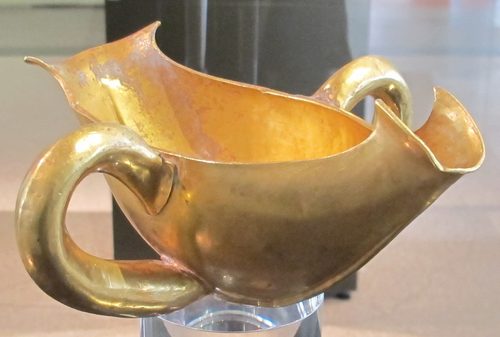
Priam's Treasure
Early Bronze Age gold and silver dug up by Schliemann at Troy in 1873 and named for King Priam; it is a thousand years too early, and now sits in Moscow.
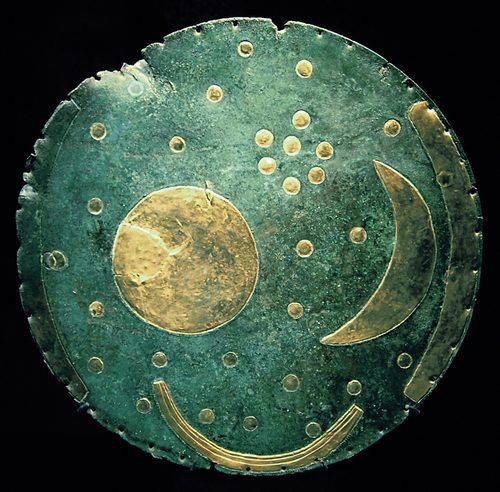
Nebra hoard (Nebra sky disc)
A bronze disc inlaid with a gold sun, moon and stars, buried c. 1600 BC with two swords, two axes, a chisel and arm spirals; looted 1999, recovered 2002.
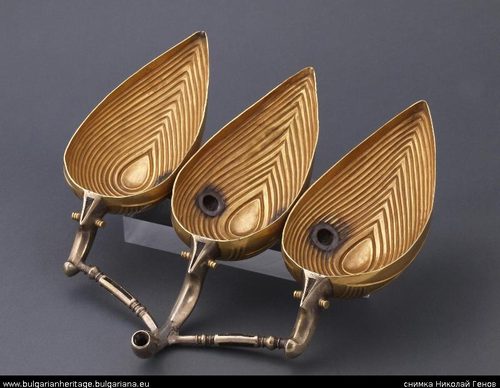
Valchitran Treasure
Thirteen Late Bronze Age gold vessels weighing about 12.5 kg, turned up by two brothers in their vineyard near Pleven, Bulgaria, in December 1924.
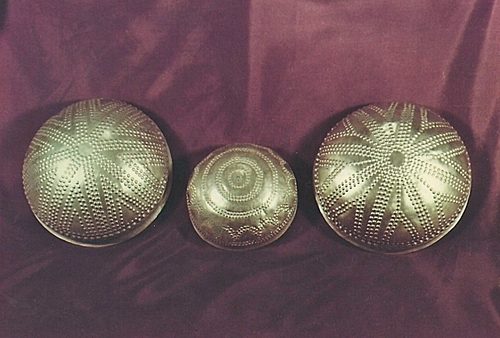
Treasure of Villena (Tesoro de Villena)
59 Bronze Age objects weighing nearly 10 kg, mostly gold bowls, bottles and bracelets, found near Villena in 1963. Most of the gold was stolen in 2026.
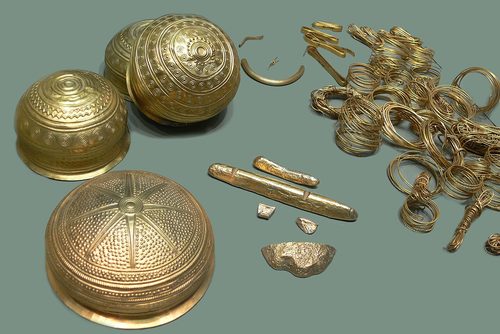
Eberswalde Hoard (Eberswalder Goldschatz)
81 gold objects weighing 2.59 kg, including eight decorated bowls, found in a lidded pot near Eberswalde in 1913; taken to Moscow in 1945 and still there.
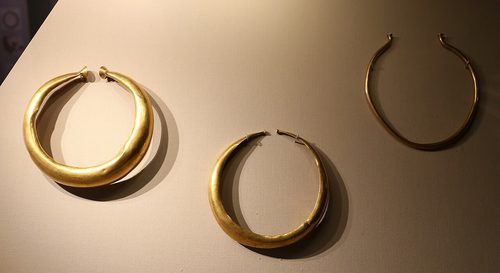
Mooghaun North Hoard (Great Clare Find)
Over 150 Late Bronze Age gold objects, more than 5 kg, found by railway workers in County Clare in 1854; all but 29 were melted down.
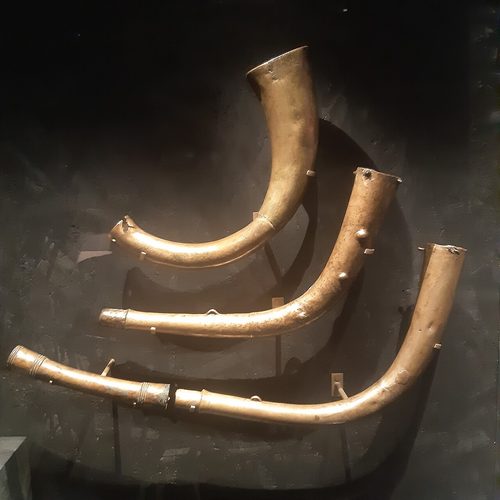
Dowris Hoard
More than 200 Late Bronze Age bronzes, including 26 horns, 48 rattle-like crotals, spears, axes and a cauldron, dug from a County Offaly bog in the 1820s.
Sources
- Isleham Hoard (Wikipedia)
- Dowris Hoard (Wikipedia)
- Mooghaun North Hoard (Wikipedia)
- Nebra sky disc (Wikipedia)
- Leiden archaeologists discover an early form of money from prehistoric Central Europe (Leiden University, 2021)
- Uluburun shipwreck (Wikipedia)
- Oxhide ingot (Wikipedia)
- List of hoards in Great Britain (Wikipedia)