In late May 1873, near the end of his third season digging the mound of Hisarlık in north-western Turkey, Heinrich Schliemann found a large copper vessel against a stone wall, and gold behind it. His published account is vivid: he called a sudden break so his workmen would not see, cut the treasure out with a knife under a wall that threatened to collapse, and passed the pieces to his wife Sophia, who carried them away in her shawl. Schliemann later admitted she was not there; she was in Athens, mourning her father.
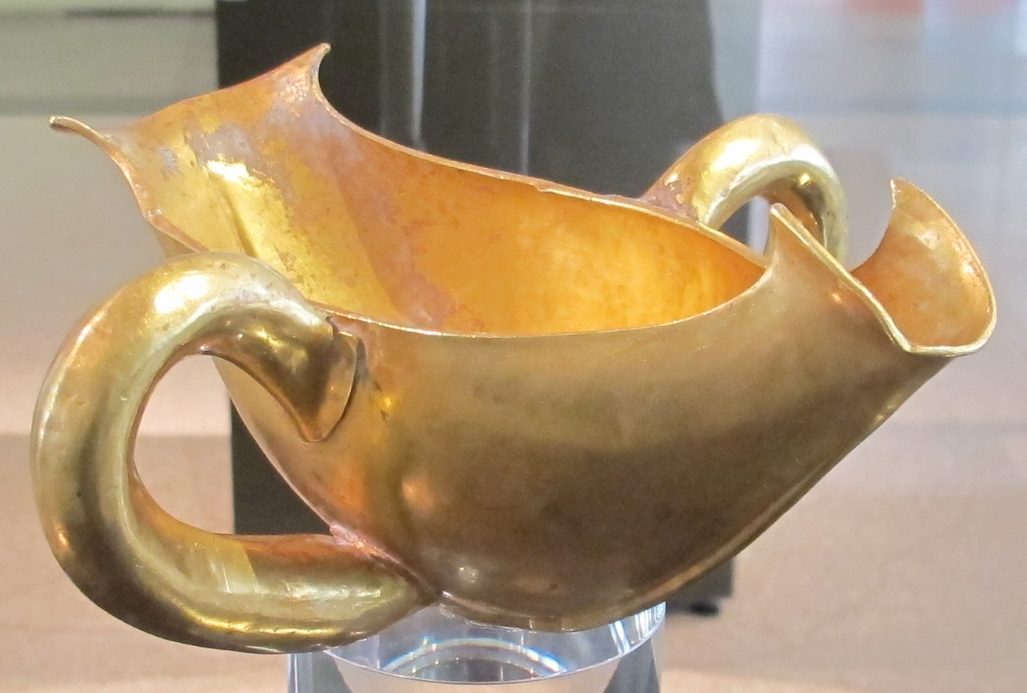
What he recovered was spectacular. Inside the largest silver vase lay two gold diadems, the larger made of 90 fine chains hung with leaf-shaped pendants, the smaller of 64. There were earrings, bracelets, dozens of hair rings, a long gold band and around 8,750 tiny gold beads and elements. Alongside were a gold bottle and cups, including a two-handled boat-shaped cup, silver vessels, and copper weapons and vessels. Schliemann, convinced he had found Homer's Troy, called it the treasure of King Priam, and a famous photograph shows Sophia wearing the great diadem as the jewels of Helen.
The name was wrong. Later work at Troy, especially by Carl Blegen and Manfred Korfmann, showed that the layer Schliemann was digging belongs to Troy II, a prosperous Early Bronze Age town of about 2550 to 2250 BC. The Troy of the Trojan War, if it existed, would be Troy VI or VIIa, more than a thousand years later. Many scholars also doubt the treasure was a single find: Schliemann probably grouped objects found in different places into one dramatic discovery.
Schliemann did not report the find to the Ottoman authorities as his permit required. He smuggled it to Athens. The Ottoman government sued him in a Greek court; he was ordered to pay 10,000 gold francs and in the end paid 50,000 to the Imperial Museum in Constantinople, with some lesser finds. The Ottoman official assigned to watch his excavation was jailed. After failing to sell the treasure to the Louvre or the Hermitage, and showing it in London from 1877 to 1880, Schliemann gave it in 1881 to the German people for display in Berlin.
It stayed there until the Second World War. Packed into three crates, it was stored in the flak tower at Berlin Zoo. When the Red Army took the city in 1945, the director of the prehistory museum, Wilhelm Unverzagt, stayed with the crates and handed them to Soviet officers. On 30 June 1945 the treasure was flown to Moscow and taken to the Pushkin Museum, where its presence was kept secret. For decades it was thought lost. Researchers found documents in Soviet archives in 1987, and in 1994 the Pushkin Museum confirmed it had the gold, putting it on show in 1996.
Russia regards the treasure, along with other art taken from Germany, as compensation for wartime losses, and a 1998 Russian law blocks its return. Germany considers it the property of the Berlin museums, and Turkey has also asked for it to come home to Troy. For now the gold remains in Moscow, the replicas in Berlin, and the site itself in Turkey.
Highlights
A headdress of 90 gold chains hung with tiny leaf-shaped plates, falling to the shoulders; the piece Sophia Schliemann was photographed wearing.
A boat-shaped gold cup with two handles and spouts at both ends, a characteristic Early Bronze Age Anatolian form.
A round-bodied gold flask with a narrow neck, hammered from sheet gold.
Silver vessels, one of which held the jewellery when found; some were returned to Germany and are shown in Berlin.
What is in it
Gold diadems, earrings, hair rings, bracelets and thousands of tiny gold beads, gold and silver vessels, and copper weapons and vessels.
Size: around 8,000 items, most of them tiny gold beads.
| Item | Number | Notes |
|---|---|---|
| Diadems | 2 | The large diadem with 90 chains of leaf-shaped pendants; the small one with 64 chains |
| Other gold jewellery | about 70 | A gold band about 46 cm long, 4 earrings with pendants, 56 hair rings, 6 bracelets |
| Gold beads and small elements | about 8,750 | Later strung into necklaces |
| Gold vessels | 4 | A bottle, a cup and two small cups including the two-handled 'sauceboat' |
| Silver vessels | several | A cup and three vases; the jewellery was found inside the largest silver vase |
| Copper objects | several | A shield, a cauldron, daggers and spearheads |
Photographs
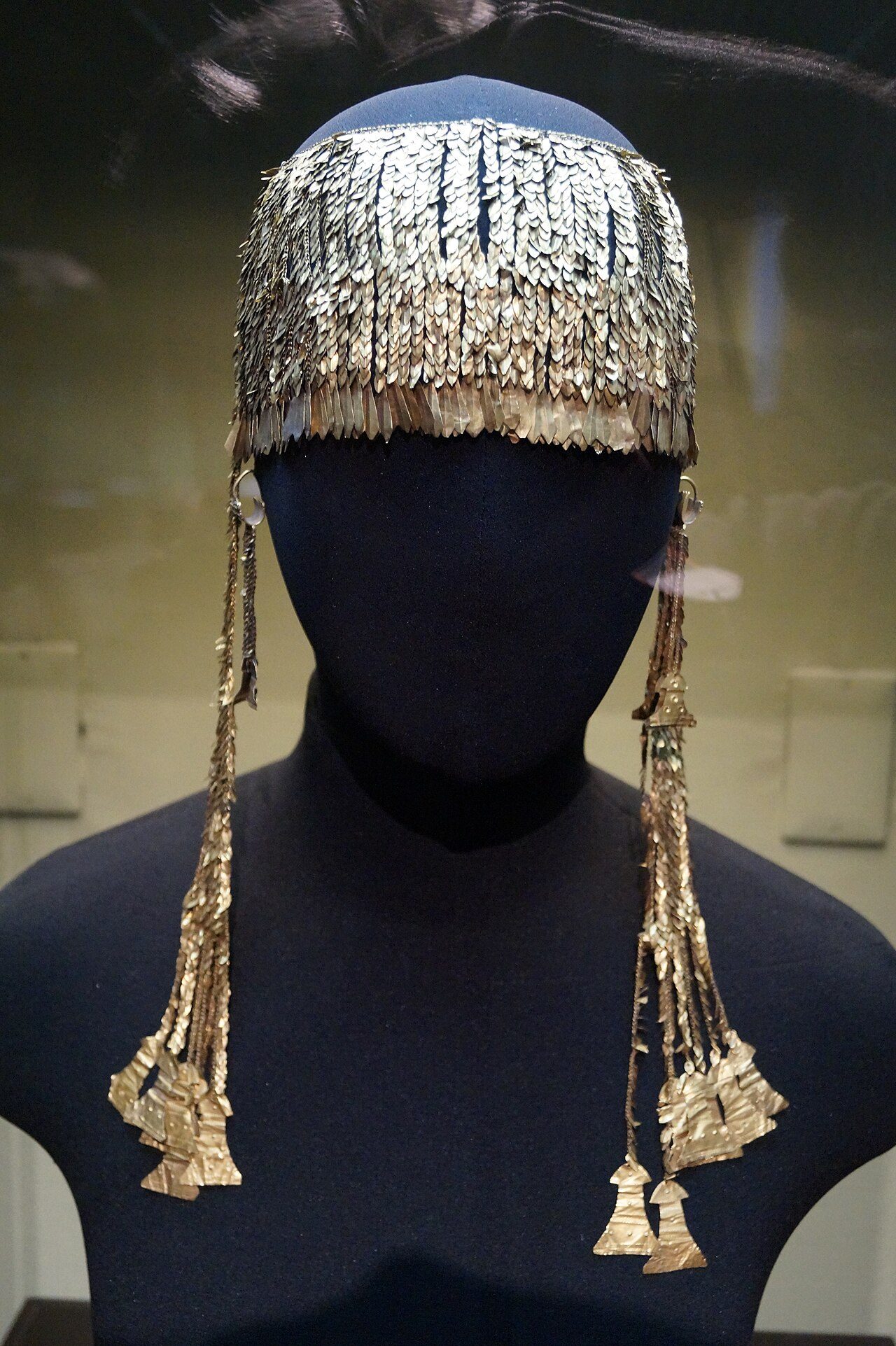
Photo: NearEMPTiness, CC BY-SA 4.0, via Wikimedia Commons
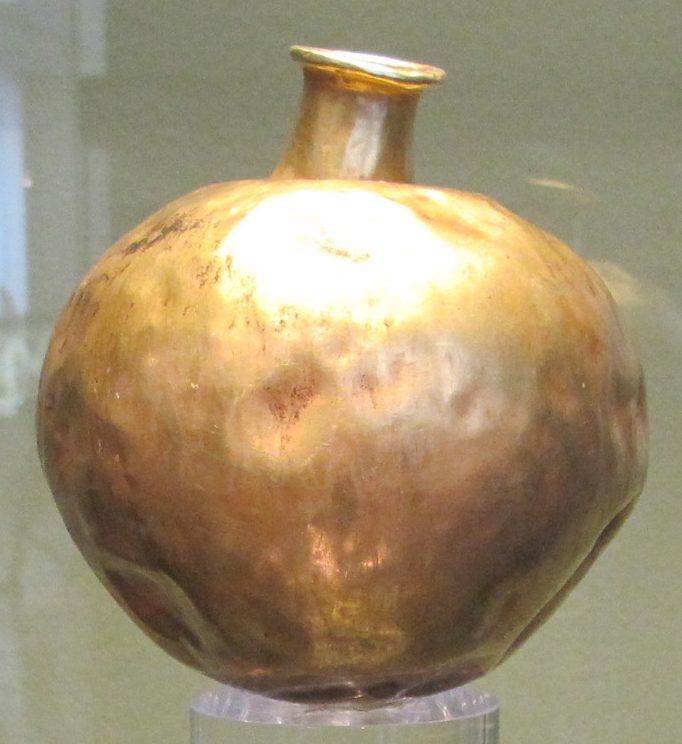
Photo: sailko, CC BY-SA 3.0, via Wikimedia Commons
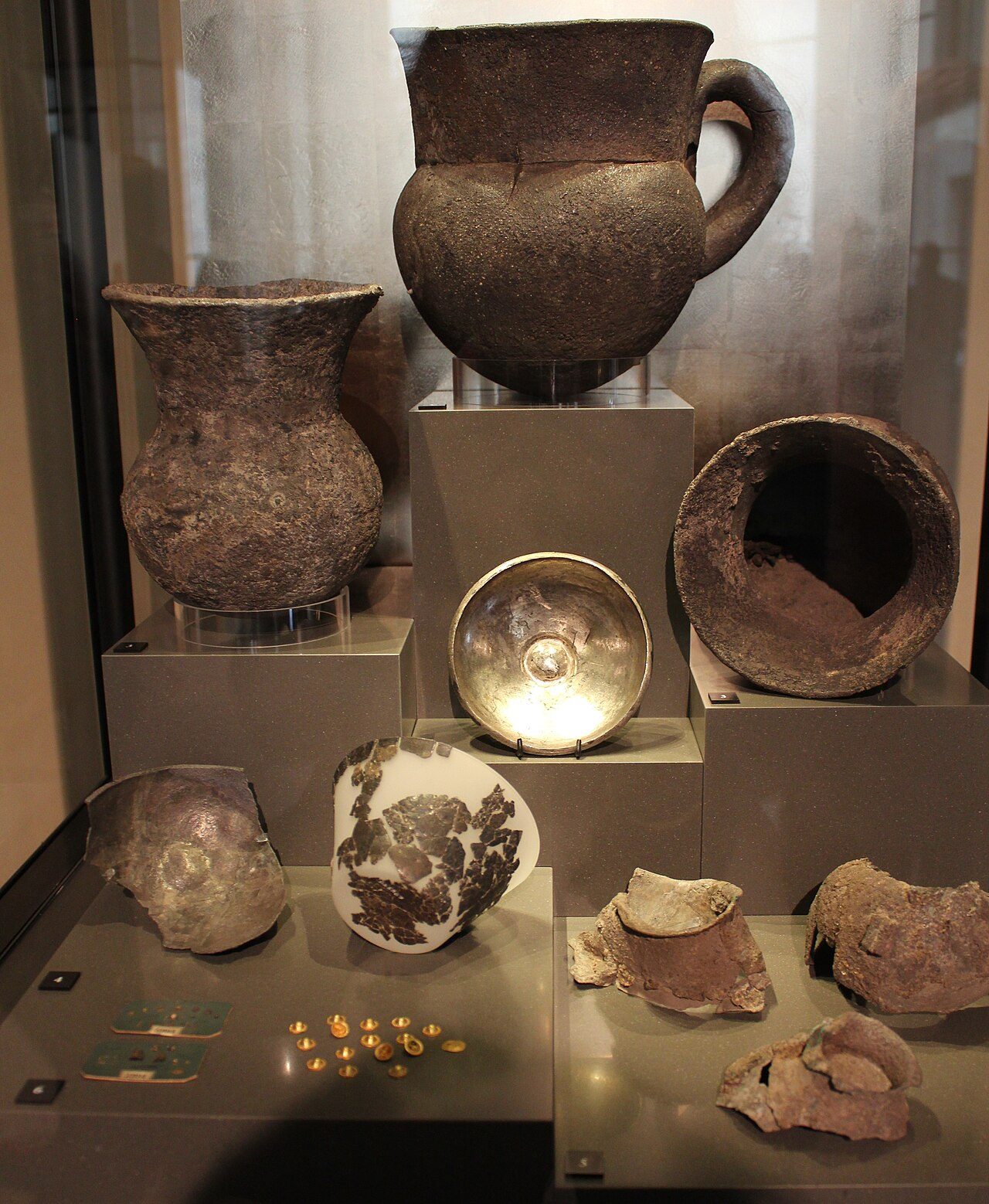
Photo: Matysik, Public domain, via Wikimedia Commons
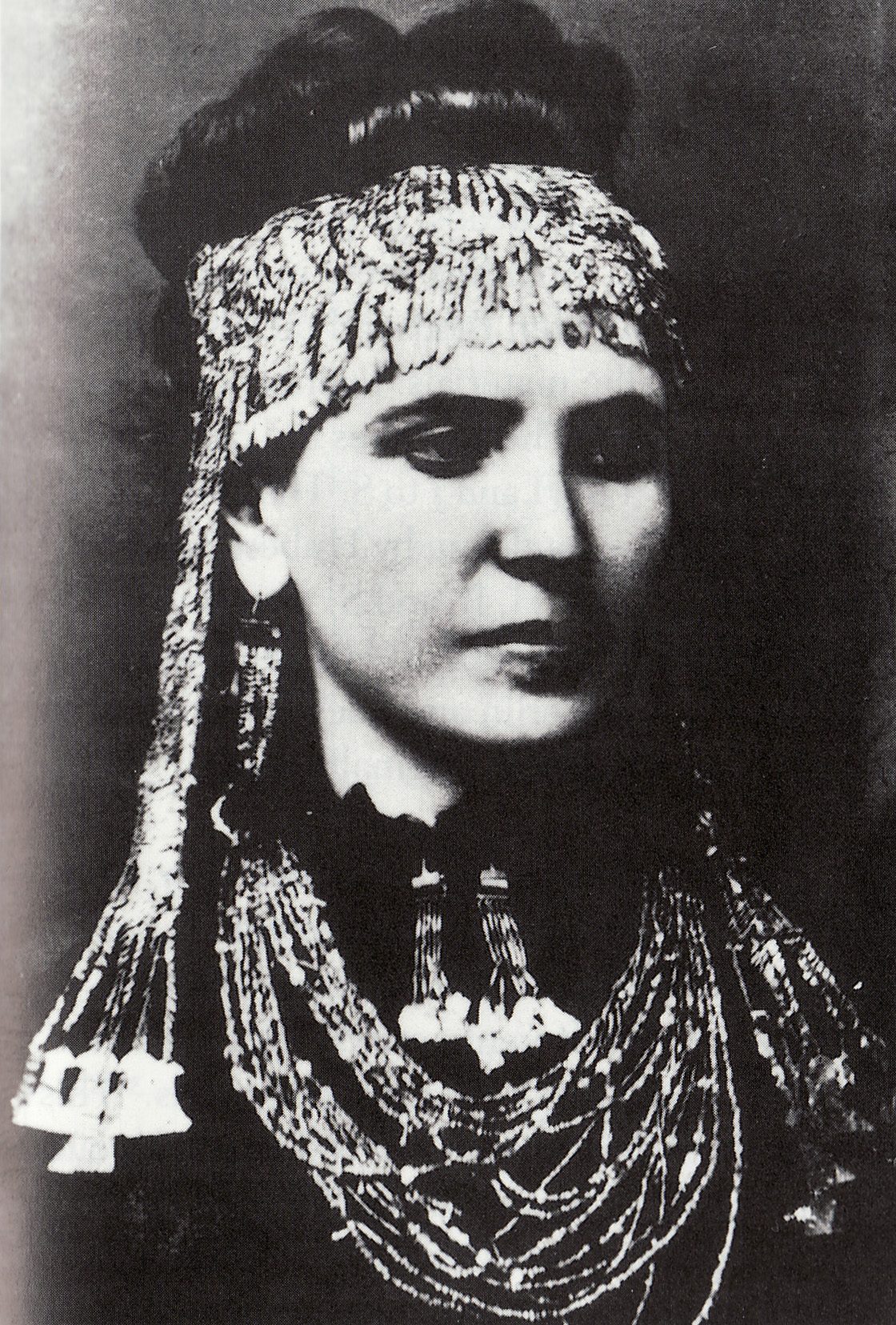
Photo: Elizabeth Simpson, Public domain, via Wikimedia Commons
How it is dated
Schliemann's records place the find in the burnt level he took for Priam's city, now identified as Troy II. Manfred Korfmann dated the objects to around 2500 BC or slightly earlier, within Troy I to II (about 2920 to 2250 BC). That is roughly a thousand years before Troy VI and VIIa, the candidates for Homer's Troy.
What happened after the find
Schliemann concealed the find from the Ottoman authorities, contrary to his permit, and smuggled it to Athens; a Greek court ordered him to pay compensation. Taken from Berlin to Moscow in 1945, it is held under a 1998 Russian law that bars restitution; Germany and Turkey both seek its return.
Where sources differ
- Find date: English Wikipedia says on or about 27 May 1873; German Wikipedia says 31 May 1873.
- Whether it was a single deposit: many scholars think Schliemann combined separate finds into 'Treasure A'.
- Item count: 'around 8,000' (German Wikipedia) includes about 8,750 tiny beads in its own breakdown, so the totals are not consistent; treat as 'thousands'.
- German Wikipedia gives weights of 193 g and 85 g for the two diadems in one reading of its text; not used here.
- Exact division between Moscow, Berlin and Istanbul holdings is not given in the sources used.
Questions
Where is Priam's Treasure now?
Most of it is in the Pushkin State Museum of Fine Arts in Moscow, where it was taken from Berlin in 1945. Berlin's Neues Museum shows replicas and a few returned originals, and some of Schliemann's Troy finds are in Istanbul.
Did Priam's Treasure belong to King Priam?
No. It comes from the Troy II level, dated to around 2500 BC, about a thousand years before the period of the Trojan War. Schliemann named it after Priam because he believed he had found Homer's city.
Why doesn't Russia return Priam's Treasure?
Russia treats art removed from Germany at the end of the Second World War as compensation for Nazi destruction and looting, and a 1998 law prevents its return. Germany disputes this, and Turkey has also asked for the treasure.