In 1828 Charles Lefroy, eighteen years old, was out shooting with his gamekeeper on his family's land at Crondall in north-east Hampshire when he noticed a scatter of small metal objects where turf had been cut. They were gold coins, together with two jewelled ornaments and some fine chains. Lefroy thought the chains might have belonged to a purse that once held the coins.
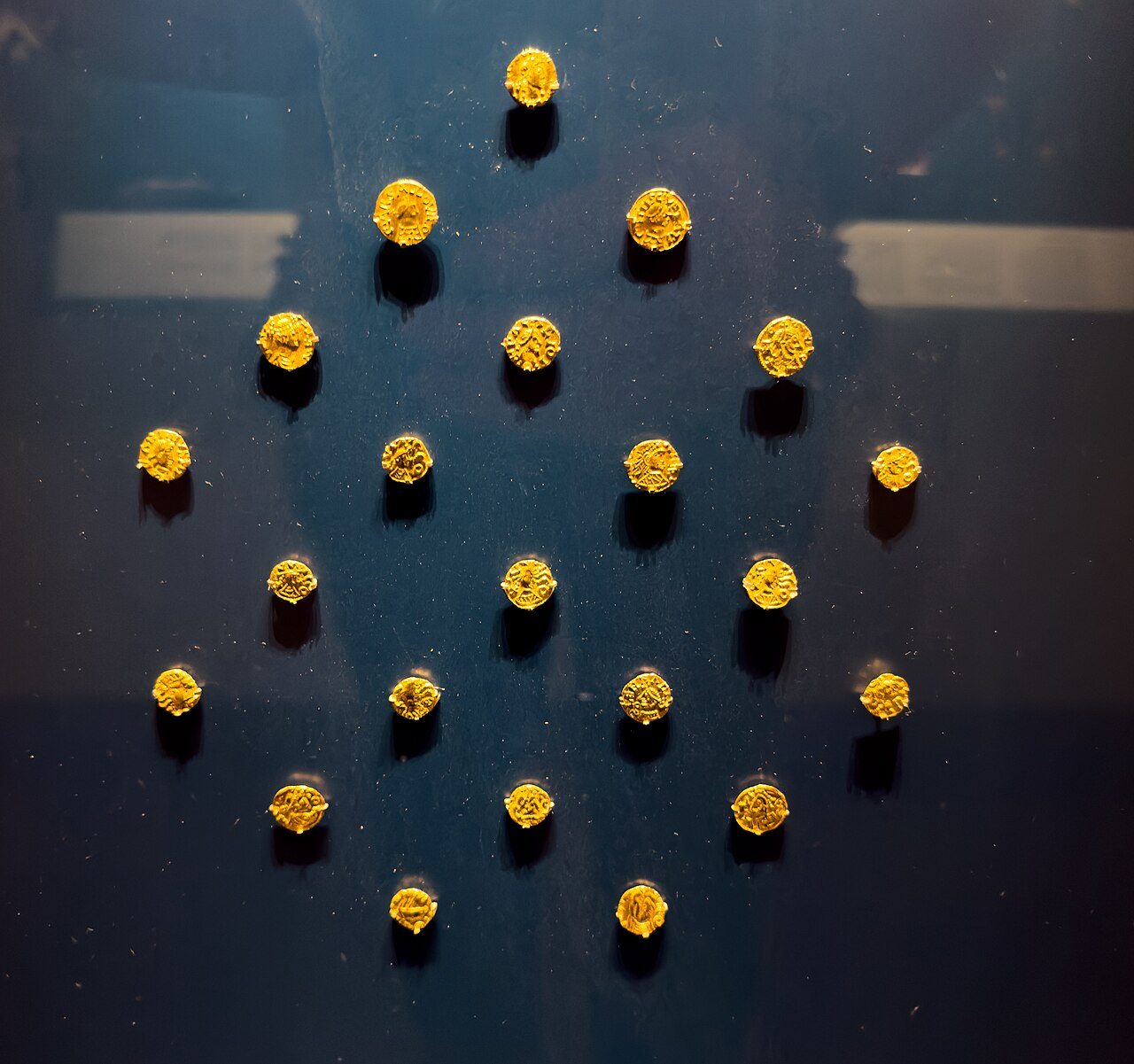
As recorded, the find comprised about a hundred pieces. Seventy-three were Anglo-Saxon gold coins, today called thrymsas or gold shillings, struck in the first half of the 7th century. Most of the rest were small Frankish gold coins (tremisses) of the Merovingian kingdoms, with a few from further afield. Three were unstruck gold blanks, and one was a gold-plated fake. These were the first coins made in England since Roman coinage stopped arriving two centuries earlier.
That is what makes Crondall so important. It is the only large hoard of thrymsas ever found, and for nearly two hundred years it has been the main evidence for how English coinage began. The coins follow Frankish models but also look back to Rome, and their designs vary remarkably, from symbols of royal and church power to a simple facing head drawn like the bishops and saints of manuscript painting; some remain a mystery. According to the Ashmolean, most of the English coins were struck in London and Kent, by kings and probably by bishops.
Why it was buried, or lost, is uncertain. The numismatist Philip Grierson noticed that coins and blanks together came to about a hundred, and that in Kentish law the wergild, the compensation due for killing a free man, was a hundred shillings. He wondered whether the purse was a blood-price. It is an attractive idea, but Crondall lay in the kingdom of Wessex, where the tariffs were different, and nobody can be sure that Lefroy recovered every piece.
The coins stayed with the Lefroy family until 1895, when they were sold to the 5th Lord Grantley. After his death in 1943 the dealers A. H. Baldwin & Sons bought them and passed them at cost to the Ashmolean Museum, which acquired them in 1944 in memory of the archaeologist Sir Arthur Evans. The blanks, the forgery and the jewellery had already vanished by then, and nobody knows where they went.
Highlights
Seventy-three small gold coins, the earliest English coinage after Rome. Their varied designs mix Frankish, Roman and Christian imagery.
Frankish gold coins from Continental mints, showing how closely early English money was tied to Gaul.
Two jewelled ornaments and chains, perhaps fittings from a purse, were recorded in 1828 but disappeared before the coins reached the museum.
What is in it
Small gold shillings (thrymsas) of Anglo-Saxon England with Merovingian Frankish tremisses, three unstruck blanks and a forgery, found with two jewelled ornaments and fine chains.
Size: about 100 coins and blanks, plus jewellery.
| Item | Number | Notes |
|---|---|---|
| Anglo-Saxon gold shillings (thrymsas) | 73 | Mostly struck in London and Kent for kings and probably bishops |
| Continental gold coins | about 24 | Merovingian Frankish tremisses, with some from Italy and the Low Countries |
| Blanks and forgery | 4 | Three unstruck gold blanks and one gold-plated forgery; now lost |
| Jewellery | 2 ornaments and chains | Two jewelled ornaments and small chains, perhaps from a purse; now lost |
Photographs
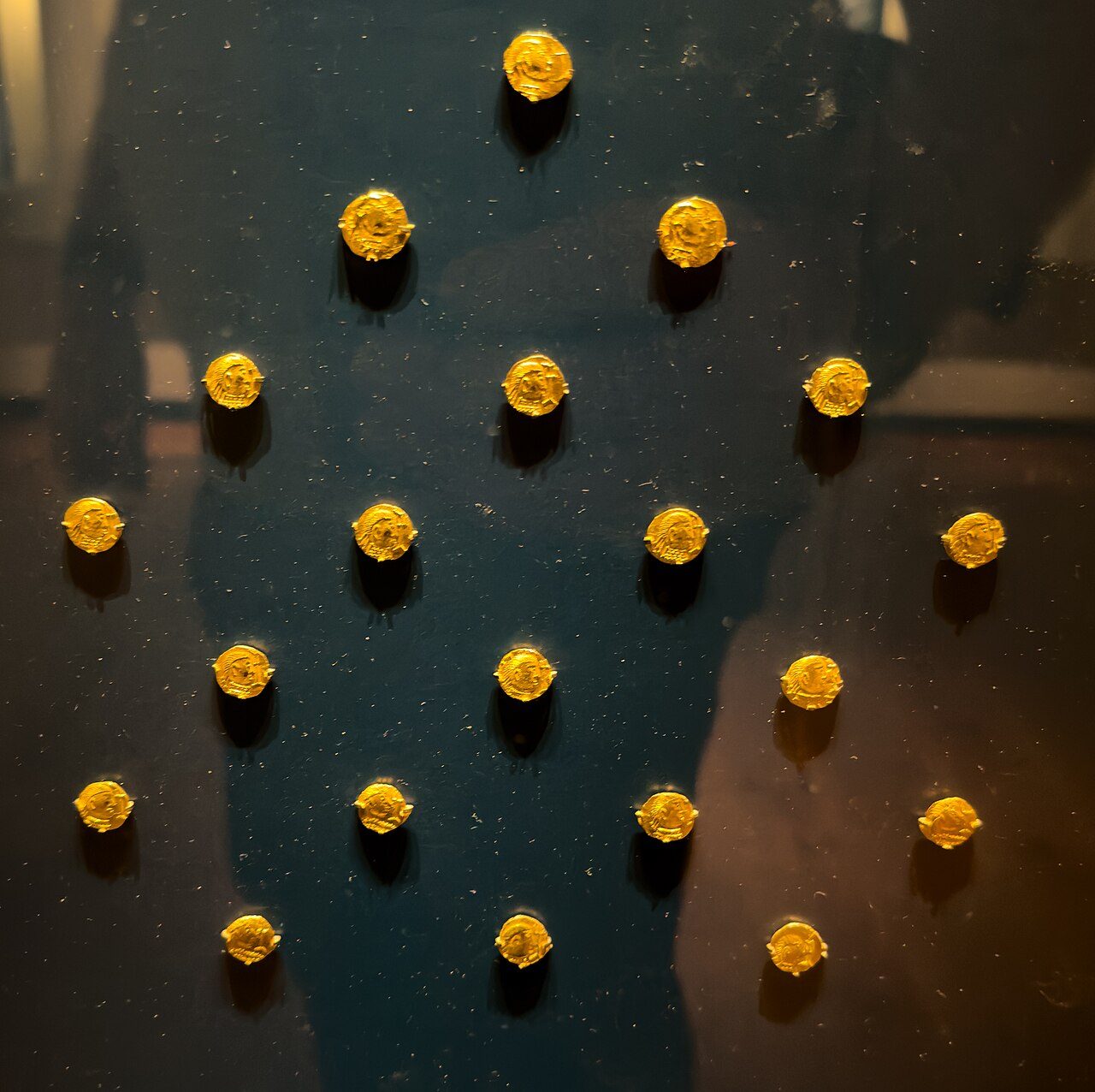
Photo: Mike Peel ( www.mikepeel.net )., CC BY-SA 4.0, via Wikimedia Commons
How it is dated
The hoard is dated by its coins. The latest types of both the Anglo-Saxon and the Frankish pieces point to burial in about 635-650; the Ashmolean puts it simply as 'before AD 650'.
What happened after the find
Found in 1828 and kept as private property by the Lefroy family and then Lord Grantley; no treasure trove inquest is recorded in the sources consulted. The coins were acquired by the Ashmolean in 1944 through A. H. Baldwin & Sons.
Where sources differ
- Coin count: Wikipedia gives 97 coins (73 Anglo-Saxon, 24 Merovingian) plus 3 blanks and 1 forgery; the Ashmolean says 98 gold coins, of which 73 are English and three are 'unofficial issues', and that the hoard 'contained over 100 pieces'.
- Grierson's wergild interpretation is a hypothesis.
- Fate of the blanks, forgery and jewellery is unknown.
Questions
Where is the Crondall Hoard?
The coins are in the Ashmolean Museum in Oxford, which acquired them in 1944. The jewellery and blanks found with them have been lost.
Why is the Crondall Hoard important?
It is the only large hoard of early Anglo-Saxon gold shillings (thrymsas), the first coins struck in England after the Roman period, and much of what is known about them comes from it.
How old is the Crondall Hoard?
It was buried around 635-650, in the first half of the 7th century.