On 4 July 1958 a local schoolboy who had just joined a University of Aberdeen dig on St Ninian's Isle, a tied island off the west coast of Shetland, noticed a broken sandstone slab with a faint cross scratched on it. It lay close to the foundations of the chancel arch of a buried medieval chapel. Beneath it, in the decayed remains of a larch-wood box, was a tangle of silver. The excavation director, Professor Andrew O'Dell, later wrote that the bowls lay upside down with the brooches knotted together among them, as if the box had been carried in a hurry and buried top down.
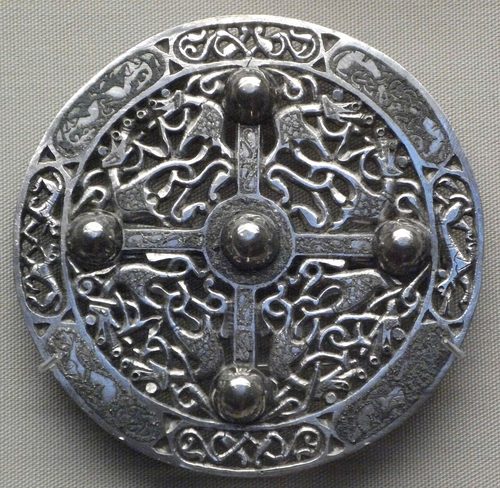
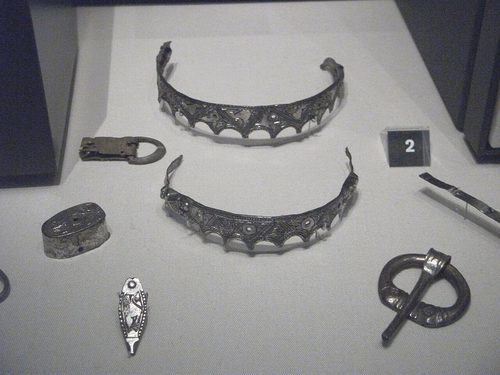
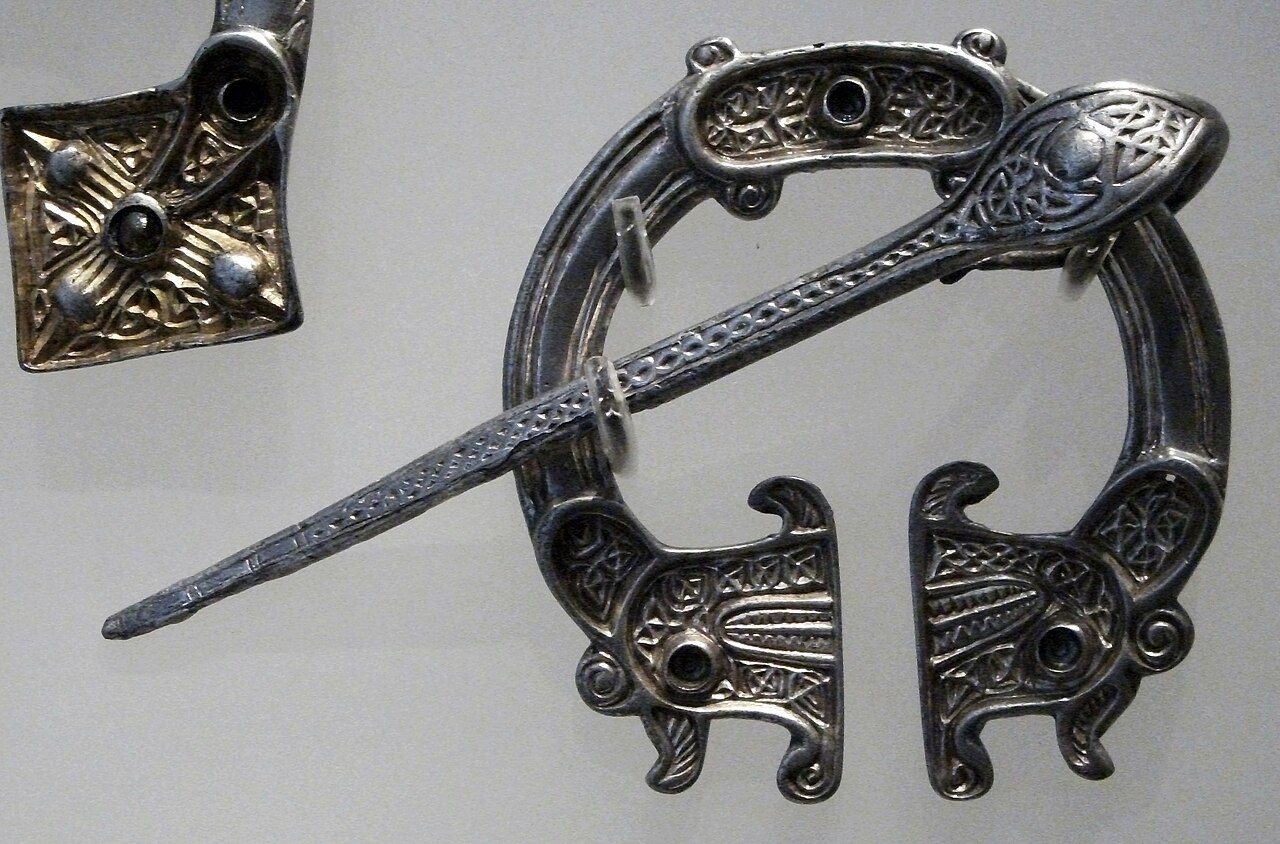
The hoard contains 28 objects of silver and silver-gilt, the finest group of early medieval silver from Scotland. Twelve are penannular brooches, the large ring brooches worn by the Pictish elite, with terminals shaped as animal heads or as lobed and geometric panels. Eight are bowls, decorated with punched and engraved patterns; one is a hanging bowl, a type normally made in bronze. There is a small spoon, a knife or prong, three little silver cones, two scabbard chapes and a sword pommel. Packed in with them was part of a porpoise's jawbone.
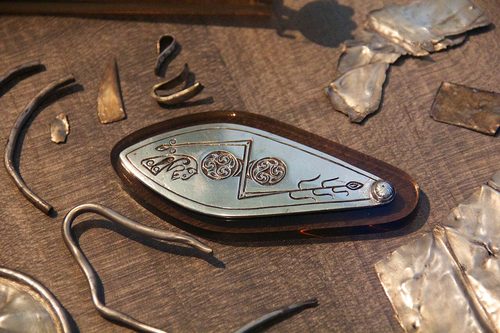
Not everything is Pictish. The two chapes and the pommel look Anglo-Saxon and were probably made in Mercia in the late 8th century; one chape carries a short inscription in Old English. Weapons and weapon fittings travelled widely as gifts between rulers, and these pieces show Shetland linked to the courts of southern Britain.
The mix of objects has puzzled scholars. The brooches and sword fittings belong to the secular world of an aristocratic household, while the bowls, the spoon and the setting beneath a church floor suggest something ecclesiastical. One reading is that local people entrusted family valuables to the church for safekeeping; another is that the bowls served in the church's own rituals. The porpoise jaw has been explained as a relic, though nobody can say whose.
The objects were made in the later 8th century, and the burial is usually placed around 800. That is exactly when Norse raiders began to strike the Northern Isles, and the hurried packing fits a moment of danger. Shetland was soon fully Scandinavian, and whoever hid the box never returned.
Because the treasure came out of a controlled excavation, archaeologists know exactly where and how it lay, which is rare for hoards of this date. Its ownership was then settled in the courts: in Lord Advocate v. University of Aberdeen, heard in the Court of Session, the Crown's claim to it as treasure trove prevailed, and the hoard was allocated to the National Museum of Antiquities of Scotland in 1965-66. A 2023 petition asked for it to return to Shetland permanently; the originals have returned twice on loan, in 1966 and in 2008 for the fiftieth anniversary of the find.
Highlights
Twelve silver brooches in a range of Pictish forms, from bold animal-head terminals to lobed panels with settings. Together they are the best surviving set of Pictish brooches.
A hanging bowl, usually a bronze vessel, here made in silver. It is one of only two silver examples known.
Two gilded silver chapes ending in animal heads, probably made in Anglo-Saxon Mercia. One carries an Old English inscription.
A gilded silver pommel decorated with animal interlace, another piece of southern English work.
What is in it
Twenty-eight silver and silver-gilt objects: brooches, bowls and a spoon, sword fittings and small cone-shaped mounts, with a fragment of a porpoise jawbone.
Size: 28 silver objects, plus a porpoise jawbone.
| Item | Number | Notes |
|---|---|---|
| Penannular brooches | 12 | Pictish types with animal-head and lobed terminals |
| Bowls | 8 | Including a hanging bowl, one of only two known in silver |
| Spoon and knife | 2 | A small spoon (sometimes called a communion spoon) and a knife or prong |
| Sword fittings | 3 | Two scabbard chapes and a pommel, probably Anglo-Saxon work; one chape carries an Old English inscription |
| Cone-shaped mounts | 3 | Purpose uncertain, perhaps from a sword harness |
| Porpoise jawbone | 1 | The only non-metal item |
Photographs
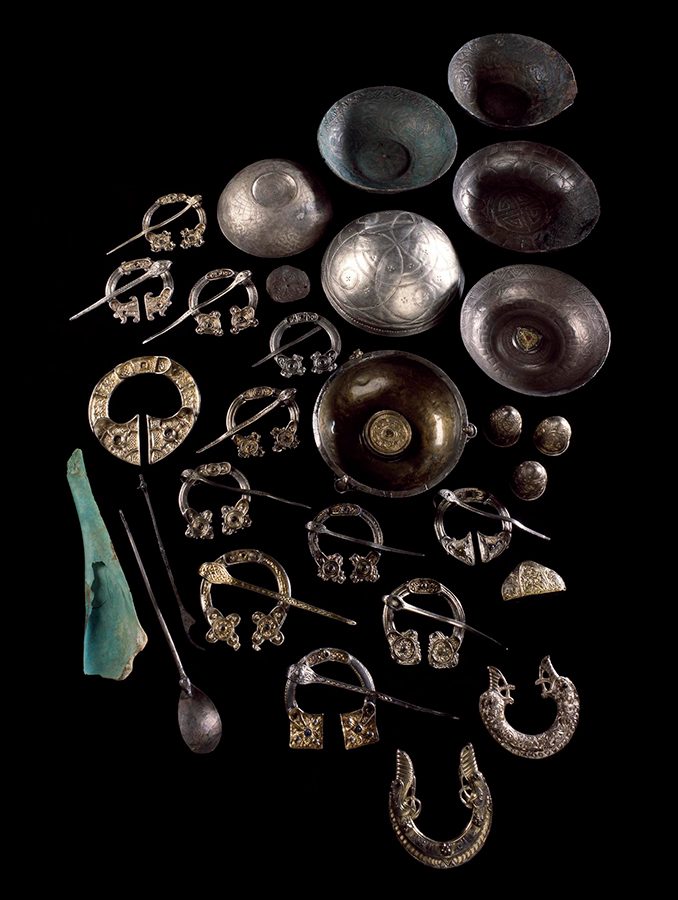
Photo: National Museums Scotland, CC BY-SA 4.0, via Wikimedia Commons
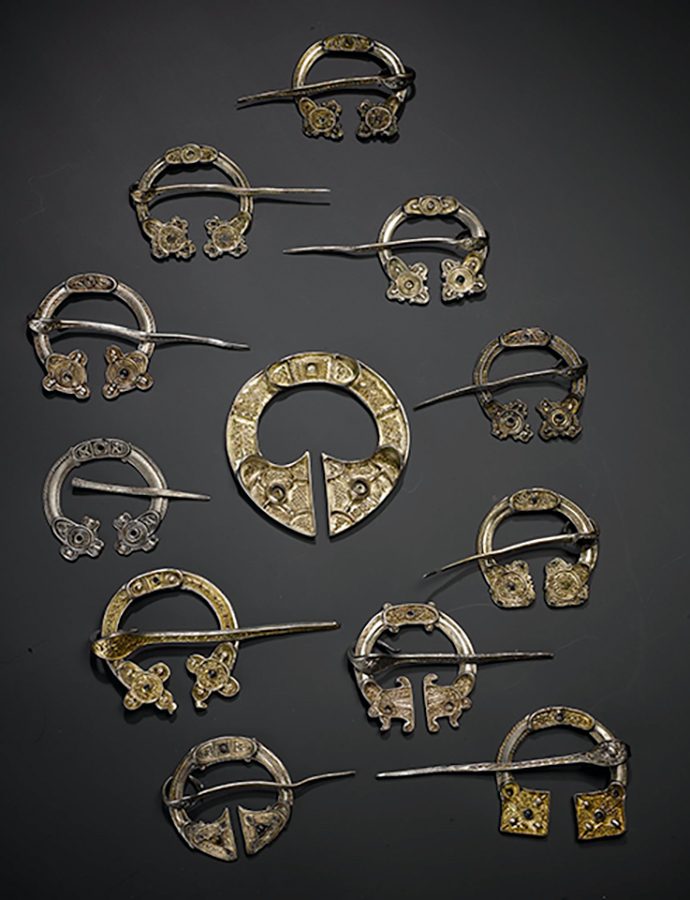
Photo: National Museums Scotland, CC BY-SA 4.0, via Wikimedia Commons
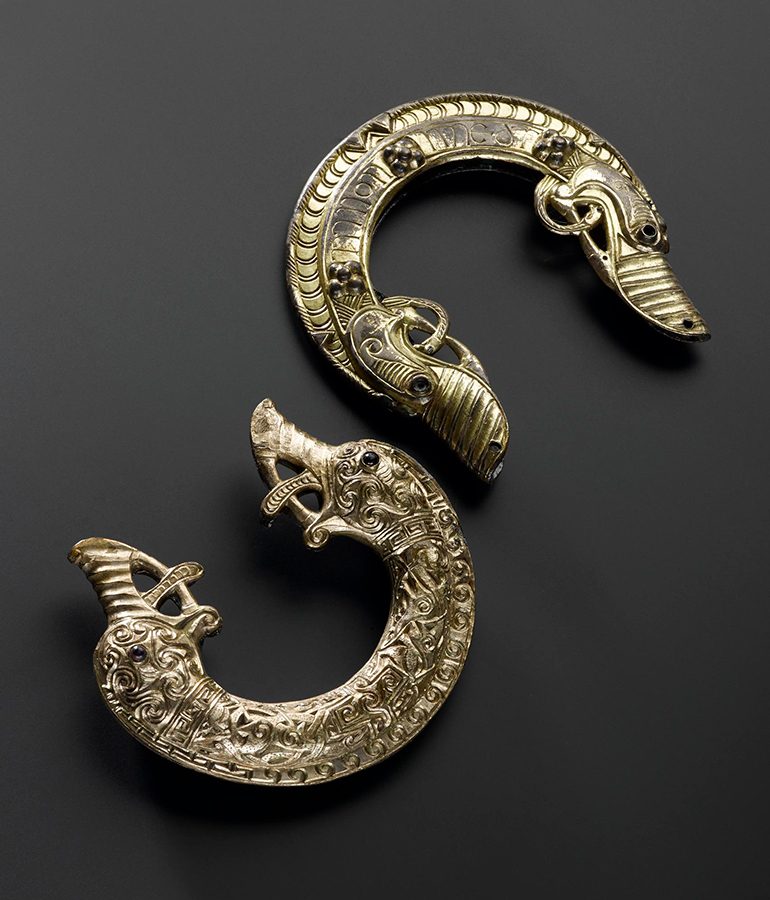
Photo: National Museums Scotland, CC BY-SA 4.0, via Wikimedia Commons
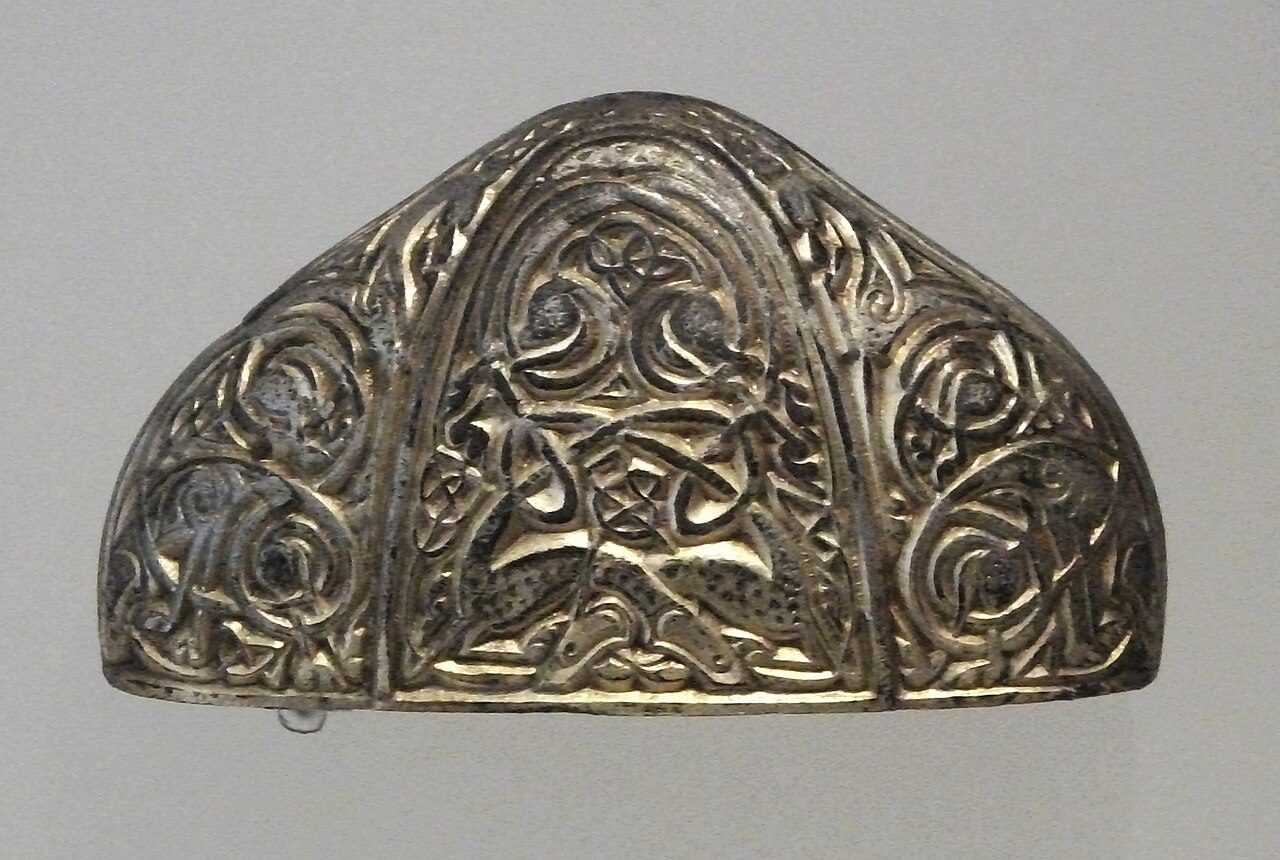
Photo: Johnbod, CC BY-SA 3.0, via Wikimedia Commons
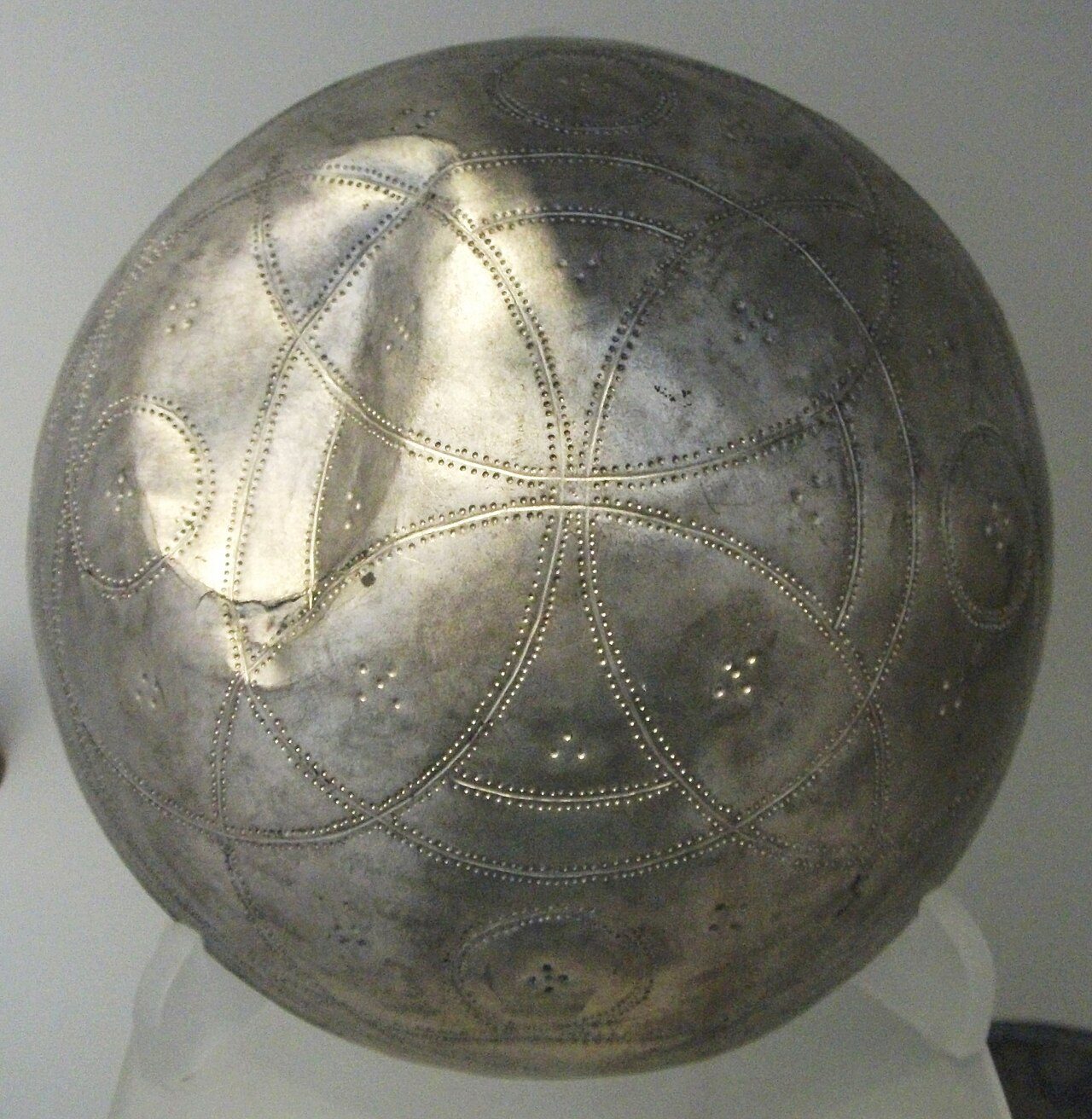
Photo: Johnbod, CC BY-SA 3.0, via Wikimedia Commons
How it is dated
There are no coins, so the date comes from art history. The brooch types, the bowl ornament and the Anglo-Saxon chapes and pommel all belong to the second half of the 8th century, with some pieces possibly into the early 9th. A burial around AD 800 is the usual estimate, before Norse settlement transformed Shetland.
What happened after the find
The treasure was claimed by the Crown as treasure trove. After the Court of Session case Lord Advocate v. University of Aberdeen, it was allocated to the National Museum of Antiquities of Scotland in 1965-66.
Where sources differ
- Exact gallery at the National Museum of Scotland not verified (a search summary said 'Early People', unconfirmed).
- Breakdown of the small objects differs between sources: Wikipedia lists a spoon and a knife; the Shetland Museum fact sheet describes 'a spoon and fork type object' and gives 7 bowls plus a hanging bowl (total 8 either way).
- Date of the Court of Session judgment not checked; Wikipedia gives only the case name and the 1965-66 allocation.
- Whether the porpoise jawbone was a relic is speculative.
Questions
Where is the St Ninian's Isle Treasure kept?
The original silver is in the National Museum of Scotland in Edinburgh. Shetland Museum and Archives in Lerwick displays replicas, and the originals have visited Shetland on loan in 1966 and 2008.
Who found the St Ninian's Isle Treasure?
A local schoolboy helping on a University of Aberdeen excavation found it on 4 July 1958, beneath a cross-marked slab in the ruins of a medieval chapel. The dig was directed by Professor Andrew O'Dell.
Was the St Ninian's Isle Treasure hidden from the Vikings?
Possibly. It was buried in haste around AD 800, when Norse raids on the Northern Isles were beginning, but there is no direct evidence of why it was hidden.