Beeston Tor is a limestone crag above the River Manifold in the Staffordshire Peak, and in its face is a cave known as St Bertram's Cave. In 1924 the Reverend George H. Wilson of Chorlton-cum-Hardy, a keen explorer of the caves of the Peak, was digging in its deposits when he came on a scatter of silver coins and jewellery.
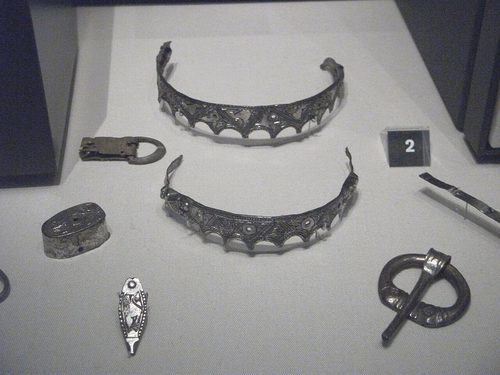
There were 49 Anglo-Saxon silver pennies: twenty of Burgred, king of Mercia, twenty of Alfred of Wessex, seven of Alfred's elder brother Æthelred I, and single coins of Archbishop Ceolnoth of Canterbury and of King Æthelwulf. With them lay two silver brooches, three finger-rings, one of gold and two of copper-alloy wire, a copper-alloy binding strip and a few other fragments. Wilson noticed traces of skin or leather around the objects and suggested that coins and jewellery had been carried in a single bag or purse.
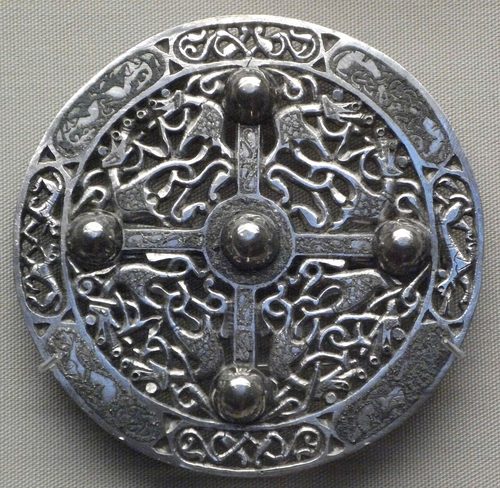
The two brooches are good examples of the 9th-century Trewhiddle style. The smaller is an openwork disc with a beaded rim and an expanded cross carrying five bosses, its panels filled with beaked animals, interlace and ivy scrolls against a black niello ground. The larger is a flat silver disc laid out with four intersecting circles and nine small bosses, one now missing, decorated more simply with interlace, plant and geometric motifs. Between them they show the two main families of Trewhiddle-style disc brooch.
The coins date the hoard closely. Burgred's reign ended in 874, when the Danish Great Army drove him from Mercia, and Alfred came to the West Saxon throne in 871. A purse containing their coins in equal numbers was most likely hidden around 875. In the winter of 873-874 the Great Army had camped at Repton in the Trent valley, and from there it took over Mercia. Writing in 1925, the antiquary Reginald Smith saw the Beeston Tor find, alongside other coin hoards of the same years, as evidence of the insecurity caused by the Danish menace.
Whoever hid the purse chose a cave on a cliff above a river, a place that could be found again. They did not return. The hoard is small, but because its coins are so tightly dated it gives a fixed point for the Trewhiddle-style jewellery buried with them, a point Smith made at the time. Wilson described his discoveries in a book on the caves and crags of the Peak District published in 1926, and the finds went to the British Museum.
Highlights
A small silver brooch with a beaded rim, an expanded cross and five bosses, filled with beaked animals and ivy scrolls on a niello ground.
A larger silver disc with four intersecting circles and nine small bosses, one missing, in a plainer version of the Trewhiddle style.
Forty-nine pennies split almost evenly between Mercia and Wessex, including twenty early coins of Alfred the Great.
What is in it
A purse-sized hoard: 49 Anglo-Saxon silver pennies, two silver disc brooches in the Trewhiddle style, three finger-rings and a few small fittings, found loose among traces of skin or leather.
Size: 49 coins, 2 brooches, 3 rings and fragments.
| Item | Number | Notes |
|---|---|---|
| Pennies of Burgred of Mercia | 20 | Reigned 853-874 |
| Pennies of Alfred of Wessex | 20 | Early in his reign, which began in 871 |
| Pennies of Æthelred I of Wessex | 7 | Reigned 865-871 |
| Other pennies | 2 | One of Archbishop Ceolnoth of Canterbury, one of Æthelwulf of Wessex |
| Brooches | 2 | A small openwork niello brooch and a larger flat disc brooch |
| Finger-rings | 3 | One gold, two of copper-alloy wire (one broken) |
| Fittings | a few | A copper-alloy binding with beaded edge and other fragments |
How it is dated
The latest coins are pennies of Burgred of Mercia, whose reign ended in 874, and early issues of Alfred, king of Wessex from 871. The hoard is therefore dated to about 875, the time of the Danish Great Army's occupation of Mercia.
What happened after the find
Found in 1924 during private cave exploration and acquired by the British Museum; no details of a treasure trove inquest were found in the sources consulted.
Where sources differ
- Rings: the Beeston Tor Hoard article says 'three gold rings' in one place and one gold plus two copper-alloy rings in another (citing Webster and Backhouse 1992); the latter is used here.
- Whether the coins as well as the jewellery are in the British Museum was not confirmed (BM pages could not be opened; registration numbers 1925,0114 appear in search results).
- Wikipedia's coordinates for the find-spot (53.08, -1.84) come from Wikimapia and are approximate.
Questions
What was found at Beeston Tor?
In 1924 a hoard of 49 Anglo-Saxon silver pennies, two silver brooches, three finger-rings and a few small fittings was found in St Bertram's Cave on Beeston Tor, Staffordshire.
Why was the Beeston Tor Hoard hidden?
Its coins date it to about 875, just after the Danish Great Army wintered at Repton and took over Mercia, so it was probably hidden for safety during that upheaval.
Where is the Beeston Tor Hoard now?
The finds are in the British Museum in London.