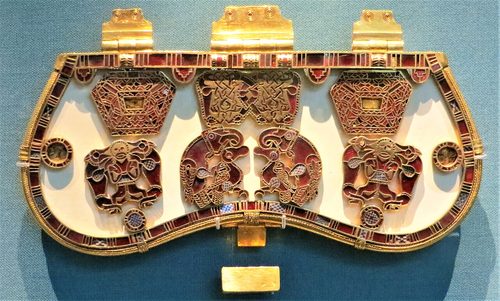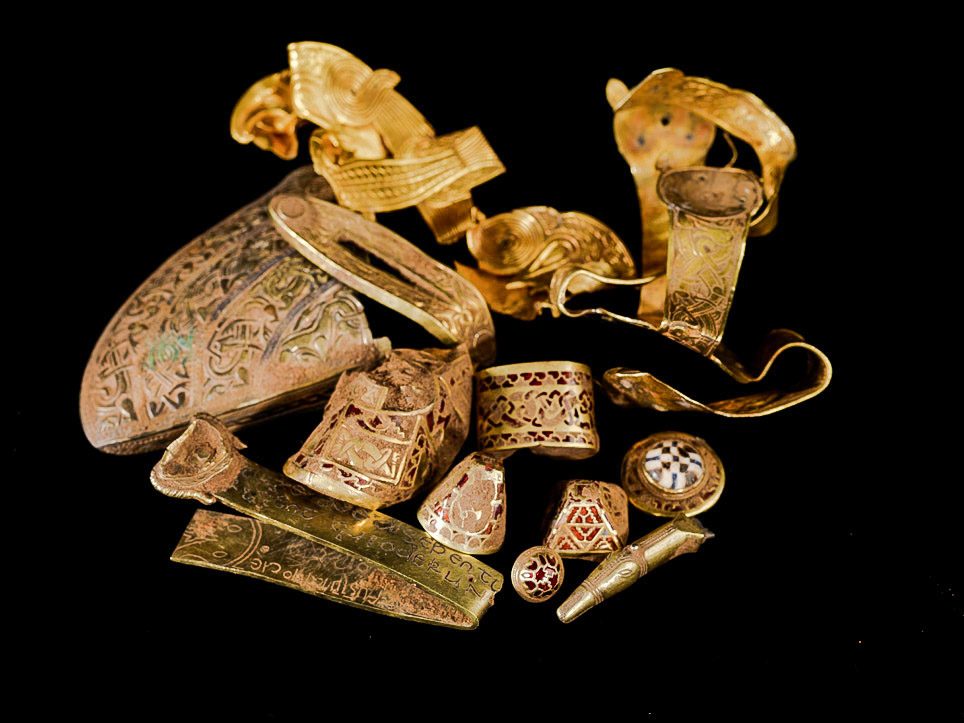
On 5 July 2009 a metal detectorist walking a freshly ploughed field near Hammerwich, a few miles from Lichfield, began to pull gold out of the soil. Over five days he recovered 244 gold objects before calling the local Finds Liaison Officer of the Portable Antiquities Scheme. With the farmer's agreement, archaeologists funded by English Heritage excavated the spot that summer. Ploughing had already scattered the metal through the topsoil, so they opened an area about 9 by 13 metres, lifted soil blocks for X-ray, and eventually recovered several thousand pieces. A return visit in 2012, after another ploughing, produced 91 more items, 81 of which were judged to belong to the hoard.
The total is almost 4,600 items and fragments, with about 5.1 kg of gold and 1.4 kg of silver. Nothing else from Anglo-Saxon England comes close in quantity: the gold from the Sutton Hoo ship burial weighs well under half as much. What makes the hoard strange is its narrow range. There are no dress pins of the kind women wore, no coins and no tableware. Almost everything comes from weapons and armour: gold hilt collars, garnet-set hilt plates, pommel caps of many types, and the silver-gilt panels, crest and cheek-pieces of one magnificent helmet, which accounts for roughly a third of all the fragments.
The pieces were not lost by accident. Most had been prised or torn from the objects they once decorated; the iron blades, the wooden grips and the helmet's iron cap were left behind. Several pieces, among them the inscribed strip and the largest gold cross, had been folded before burial. The workmanship is consistently superb, from cloisonné cells holding thousands of tiny cut garnets to filigree as fine as anything known from early medieval Europe. Scientific work at the British Museum suggests that some of the gold came from melted Byzantine coins and that many garnets were cut from stones that travelled from South Asia.
Among the few explicitly Christian objects is a slim gold strip inscribed, on both faces, with a Latin verse from Numbers 10:35: "Rise up, Lord, and may your enemies be scattered, and those who hate you be driven from your face." The lettering is usually dated to the late 7th or 8th century. It may have come from a cross or a piece of war-gear; either way, it is a battle prayer.
The hoard was buried, most likely in the third quarter of the 7th century, on rising ground just south of the Roman road later called Watling Street, in the heartland of the kingdom of Mercia. This was the age of Penda and his sons, when Mercian kings fought almost continually against Northumbria, East Anglia and the Welsh. Who buried it, and why, is unknown. Ideas include battlefield trophies stripped from defeated enemies, a royal store of war-gear handed over as death duties by noblemen, a votive offering, or a stash of metal awaiting recycling. None can be proved.
Because the find was reported promptly and excavated properly, archaeologists could show that it was a single buried deposit rather than a grave, and could map how ploughing had spread it. A six-year research project commissioned by Historic England then cleaned, joined and catalogued the fragments, recognising around 600 significant objects among them, and published the results in 2019. The hoard has changed how specialists date Anglo-Saxon metalwork and how they picture the aristocratic warrior culture celebrated in poems such as Beowulf.
Highlights
Roughly a third of all the fragments, silver-gilt sheet, crest and cheek-pieces, came from a single helmet, comparable in status to the Sutton Hoo helmet. Two replicas made from the research are displayed in Birmingham and Stoke.
A strip of gold about 18 cm long when unfolded, engraved on both sides with the verse from Numbers 10:35. One side appears to carry an abandoned first attempt at the text.
Gold hilt collars and plates set with cloisonné garnets in interlocking animal and geometric patterns, showing Anglo-Saxon goldsmiths working at the highest European level.
The largest cross in the hoard, a gold processional or altar cross, was folded before it was buried. Whether this was done to make it fit, out of disregard or as a deliberate act of de-consecration is debated.
What is in it
Thousands of small gold and silver fittings deliberately torn from weapons, above all sword hilts and pommels, together with the fragments of a lavish helmet and a handful of Christian objects, including a folded gold cross and a strip inscribed with a verse from the Book of Numbers.
Size: almost 4,600 items and fragments. Weight: about 6.5 kg (about 5.1 kg of gold and 1.4 kg of silver) (gold and silver).
| Item | Number | Notes |
|---|---|---|
| Sword fittings | hundreds | Hilt collars, hilt plates and pommels, many with garnet cloisonné; at least 74 pommel caps in the final study |
| Helmet fragments | roughly a third of all fragments | Silver-gilt sheet, crest and cheek-pieces from a single high-status helmet, since reconstructed in replica |
| Christian objects | a few | A large folded gold cross, smaller crosses and the inscribed gold strip |
| Garnets | about 3,500 | Cut garnets set in cloisonné cells, some probably from India and Sri Lanka |
Photographs
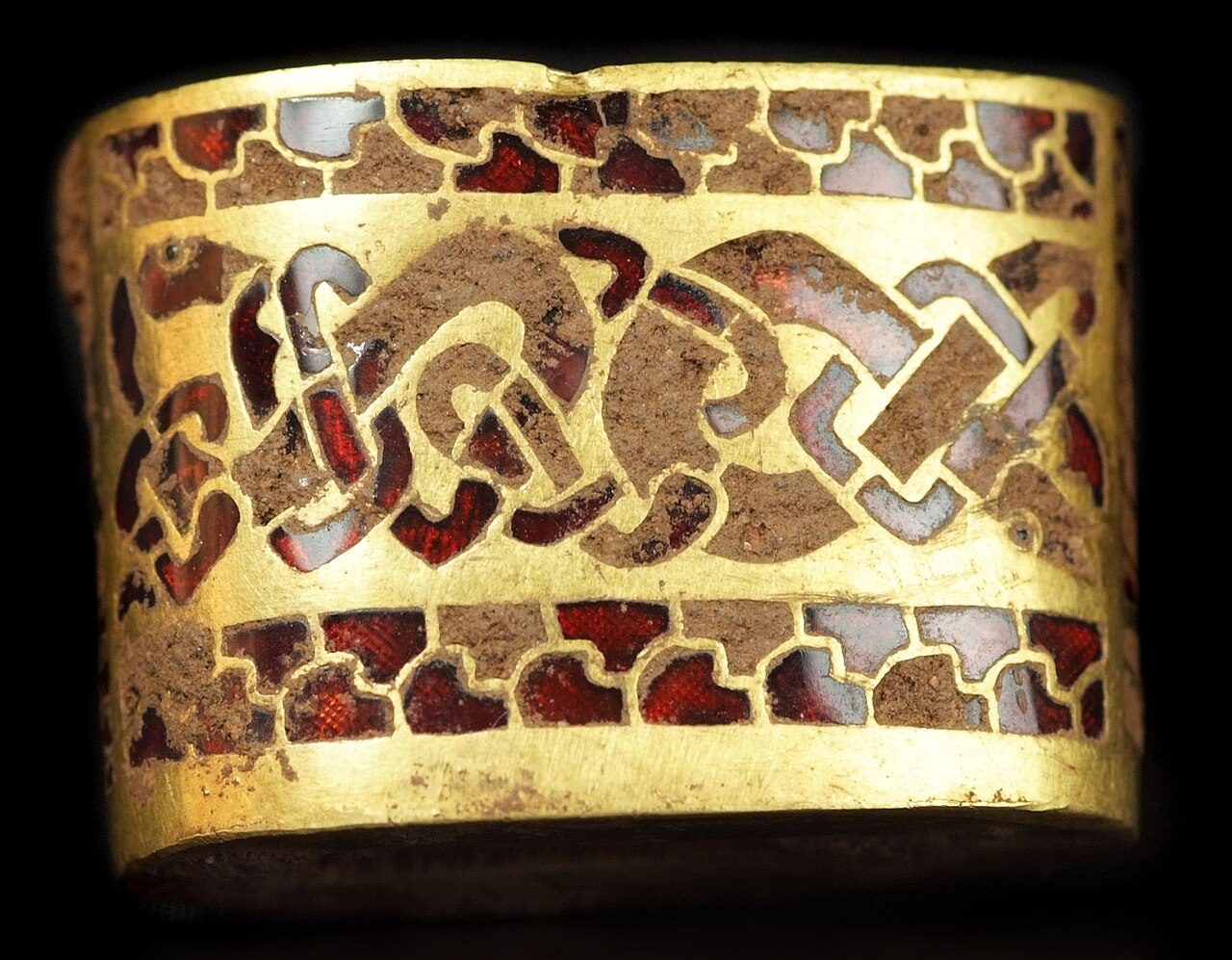
Photo: portableantiquities, CC BY 2.0, via Wikimedia Commons
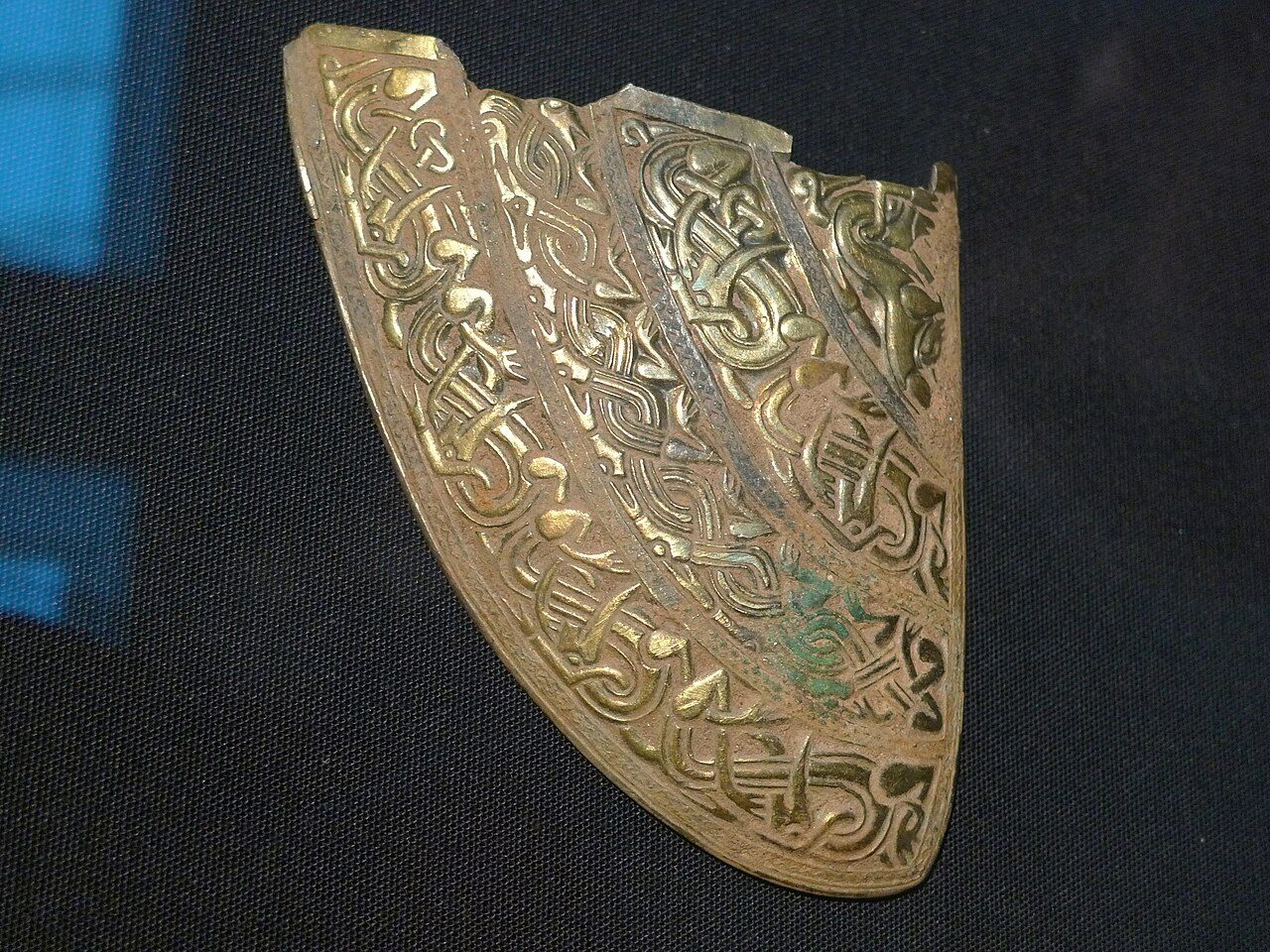
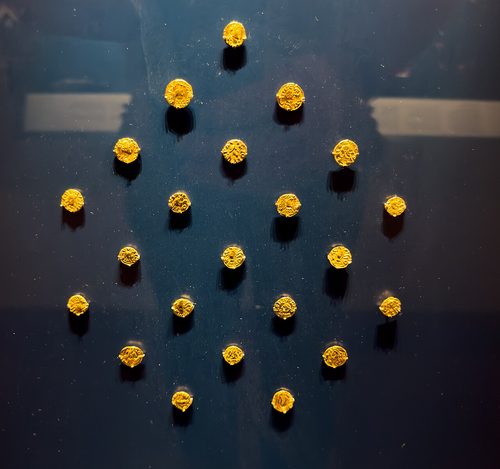
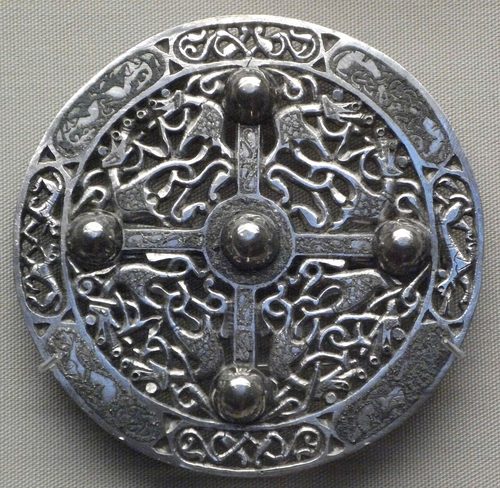
Photo: Jon Callas from San Jose, USA, CC BY 2.0, via Wikimedia Commons
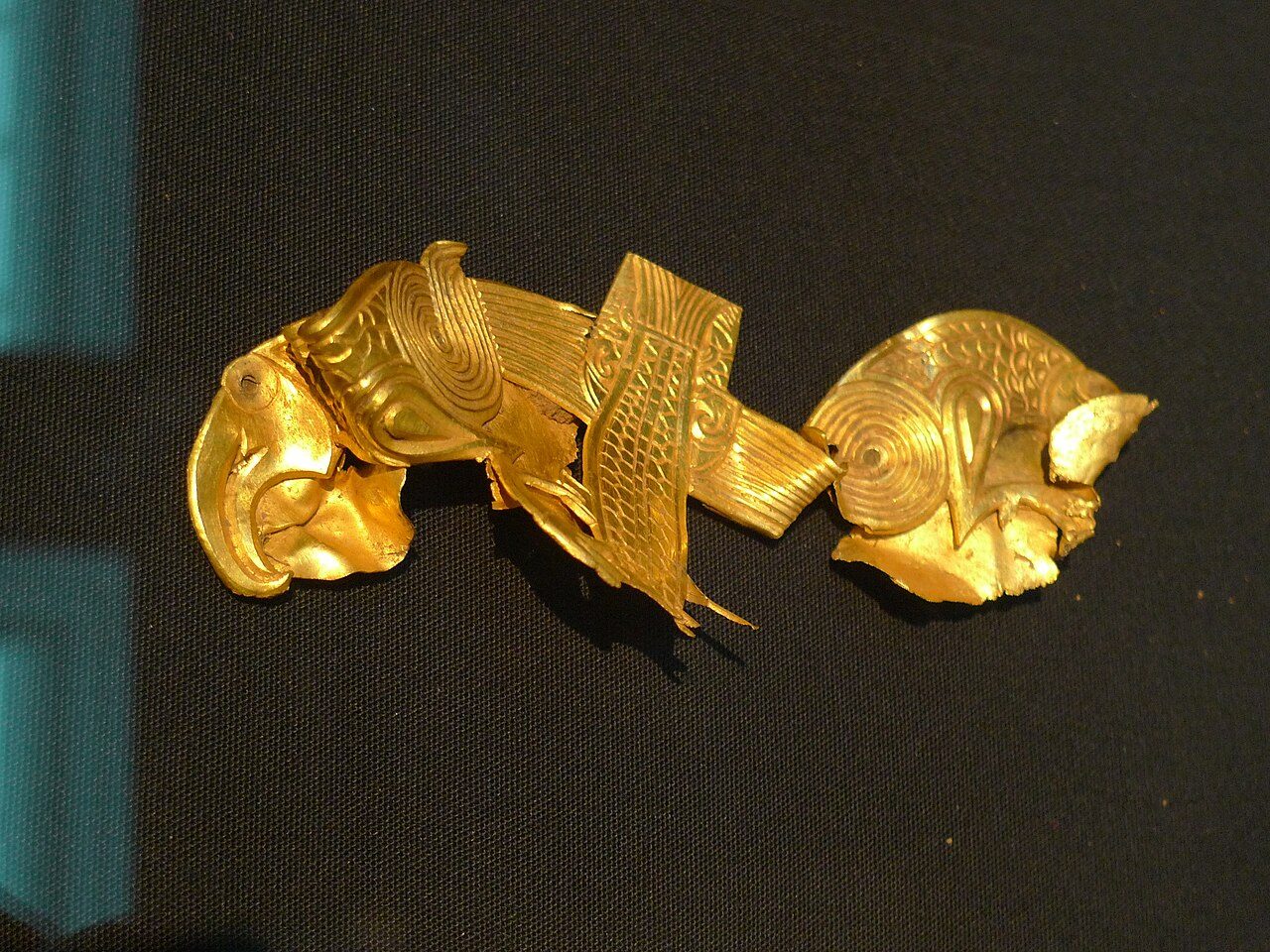
Photo: Jon Callas from San Jose, USA, CC BY 2.0, via Wikimedia Commons
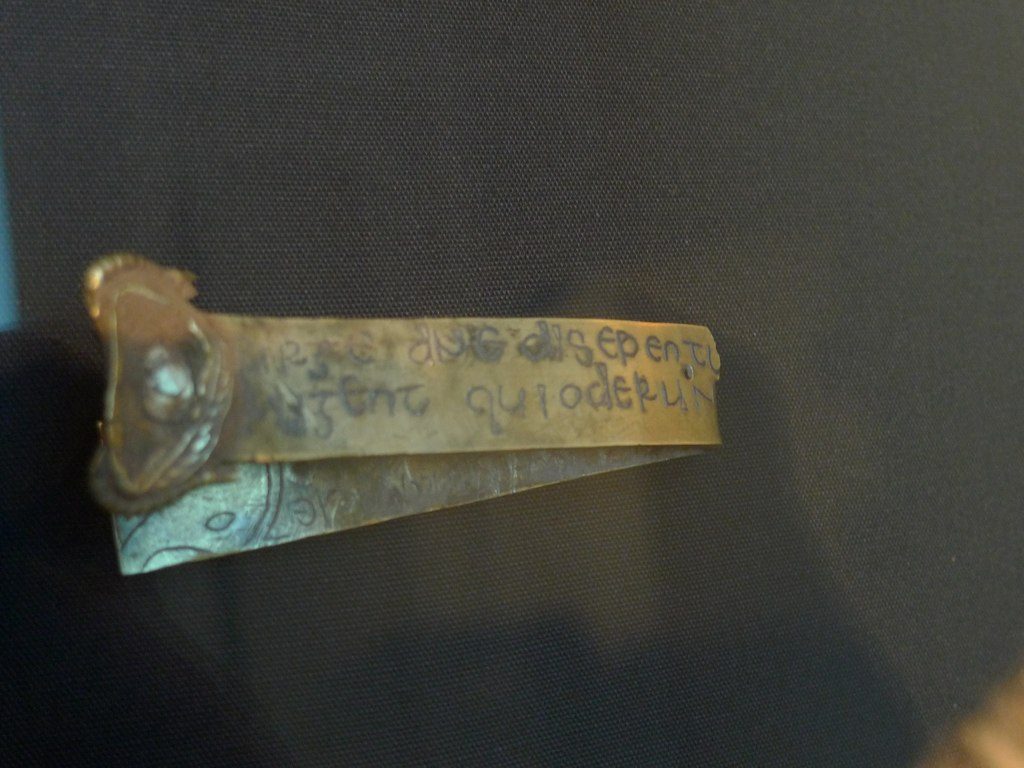
Photo: Jon Callas from San Jose, USA, CC BY 2.0, via Wikimedia Commons
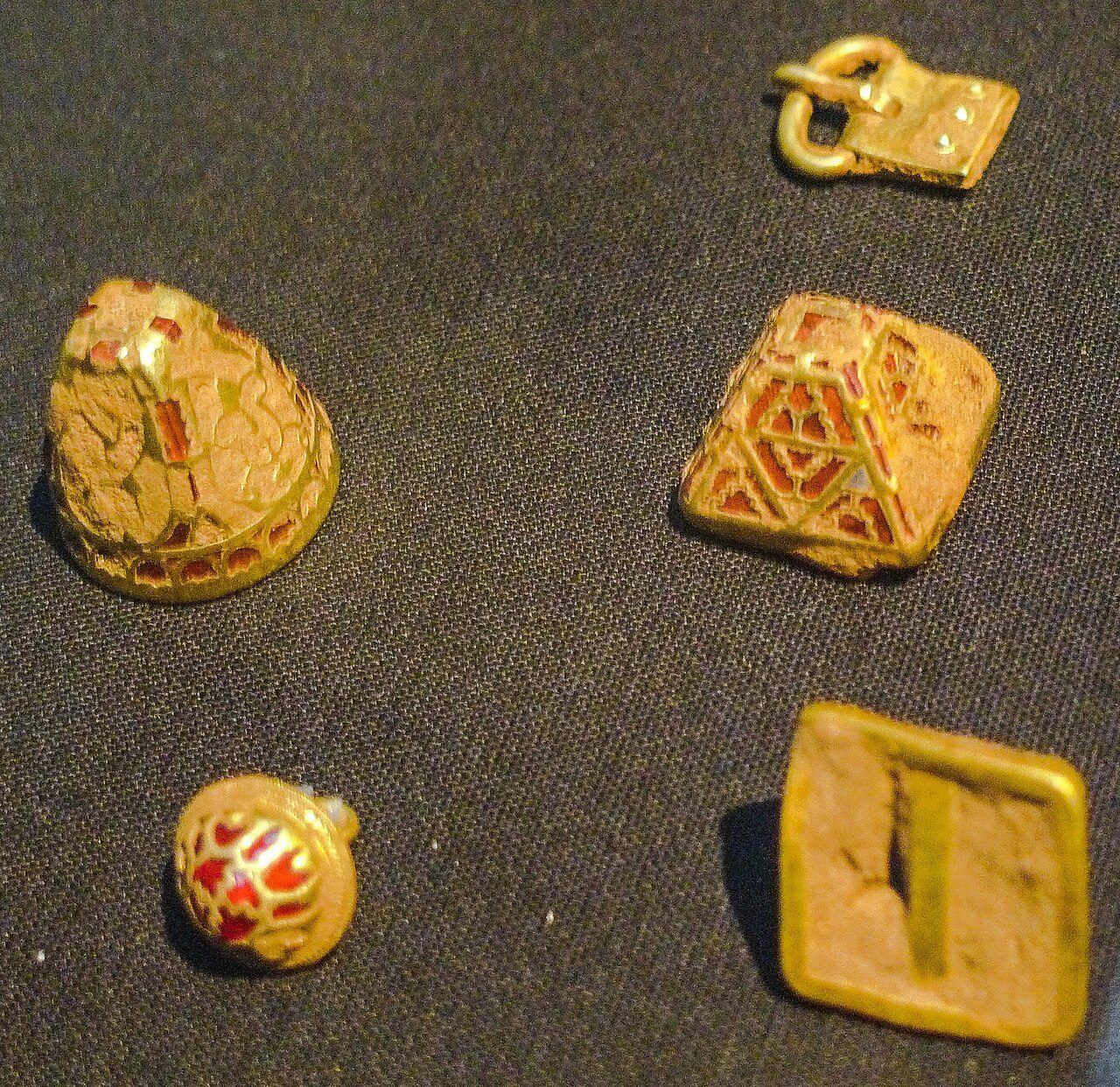
Photo: Jon Callas from San Jose, USA, CC BY 2.0, via Wikimedia Commons
How it is dated
No coins were found, so the date rests on the style and manufacture of the objects. Most were made in the 6th and 7th centuries; the 2019 study arranges them in overlapping phases ending around 660, which points to burial in about 650-675. The inscription has been dated on letter forms to the late 7th or 8th century, which has led some writers to argue for a later burial.
What happened after the find
A coroner declared the hoard treasure in September 2009. The Treasure Valuation Committee valued it at £3.285 million, which Birmingham Museums and the Potteries Museum raised through a public appeal and a National Heritage Memorial Fund grant; the reward was split between the finder and the landowner.
Where sources differ
- Total weight: the gold and silver figures (5.094 kg and 1.442 kg) come from the press statement cited by Wikipedia; the 2009 official website said about 5 kg of gold and 1.3 kg of silver; a Current Archaeology review of the 2019 monograph prints 5,636 g in total. The sum of the commonly quoted figures is about 6.5 kg.
- Deposition date: 650-675 is the usual estimate; some writers (including Sharp 2016) argue for a much later burial on the basis of the inscription.
- Pommel counts differ: 86 pommels in the preliminary 2009 catalogue, at least 74 pommel caps after full study.
- The share of fragments from the helmet ('approximately a third') is from Birmingham Museums; exact counts vary by source.
Questions
Where can I see the Staffordshire Hoard?
The hoard is jointly owned by Birmingham Museum and Art Gallery and the Potteries Museum & Art Gallery in Stoke-on-Trent. Birmingham has a permanent gallery with hundreds of pieces and a replica of the helmet; Stoke has its own display, and items are lent to Tamworth Castle and Lichfield Cathedral.
How much was the Staffordshire Hoard worth?
It was valued at £3.285 million in 2009 under the Treasure Act. The two museums raised that sum by public appeal and grants in 2010, and it was shared between the finder and the landowner.
Why was the Staffordshire Hoard buried?
Nobody knows. Because it consists almost entirely of fittings stripped from weapons, suggestions include war trophies, a royal store of war-gear, a religious offering or scrap awaiting reuse.
Sources
- Staffordshire Hoard (Wikipedia)
- Staffordshire Hoard gallery, Birmingham Museums
- Review: The Staffordshire Hoard, an Anglo-Saxon treasure (Current Archaeology)
- Fern, Dickinson and Webster (eds), The Staffordshire Hoard: An Anglo-Saxon Treasure (2019, open access)
- Staffordshire Hoard (Wikidata)
- Wikidata Q1135210 (CC0)