On a winter afternoon in January 1942 a ploughman at West Row, on the edge of the Fens near Mildenhall, struck a large metal dish. He fetched his employer, Sydney Ford, an agricultural engineer who collected local antiquities, and as snow fell the two men dug out dishes, bowls and spoons, 34 pieces in all. Blackened with age, they looked like pewter. Ford took them home, had a few bent pieces straightened, cleaned them and kept them in his house; the family is said to have used the great dish on special occasions.
The silver stayed there for four years. In 1946 a visitor recognised what it was and the authorities were told. At an inquest that summer the find was declared treasure trove and passed to the British Museum. Because the find had not been reported, Gordon Butcher, the ploughman, and Ford received £1,000 each rather than the full market value. Neither the archaeologists who attended the inquest nor later researchers could pin down exactly where and how the objects had been found, and Roald Dahl later turned the episode into a short story.
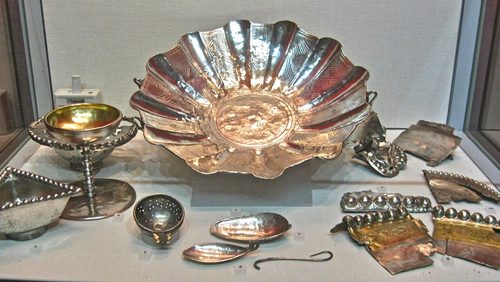
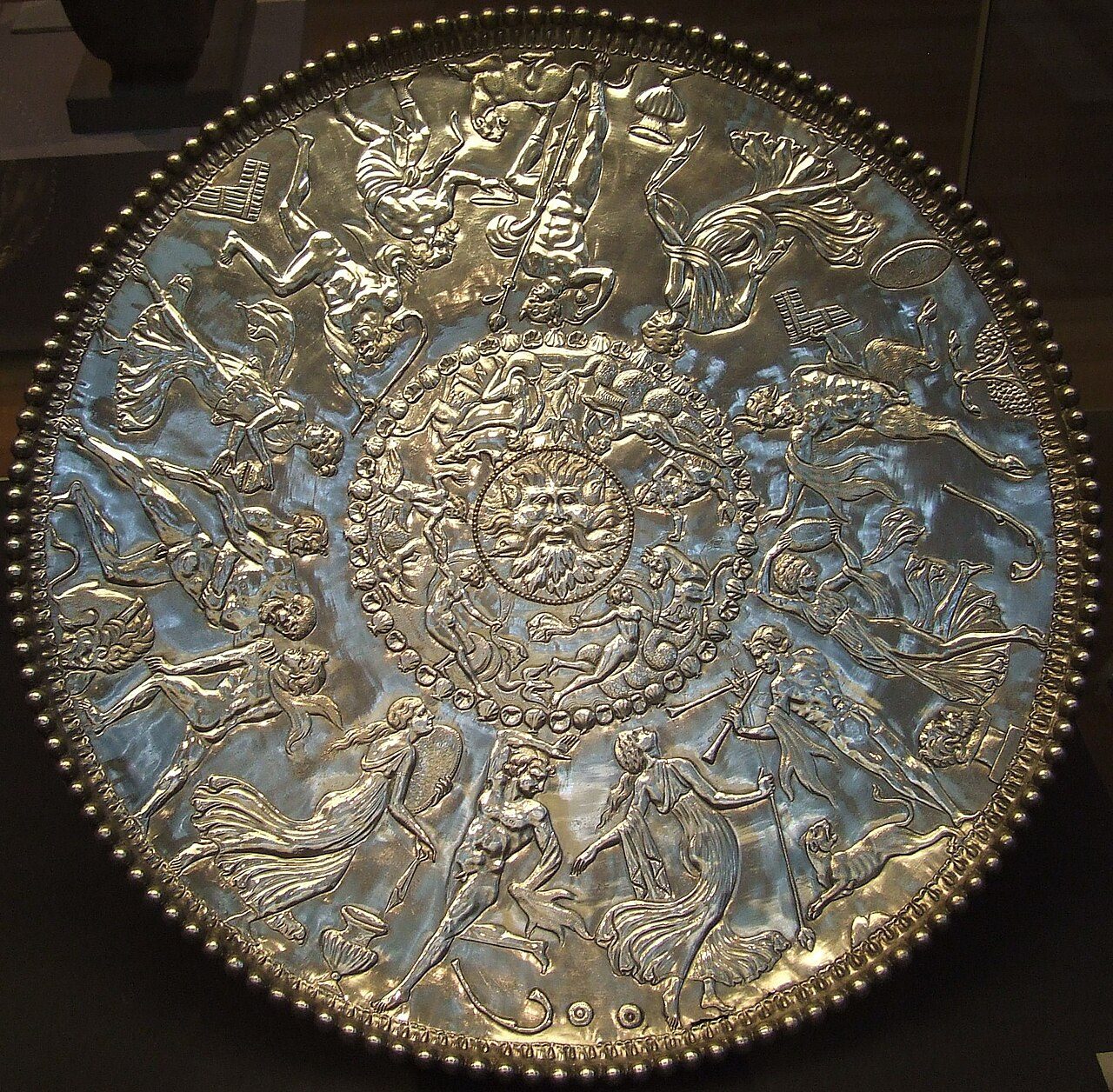
The centrepiece is the Great Dish, more than 60 cm across and weighing over 8 kg. In the middle is the head of a sea god, usually identified as Oceanus, with a beard of seaweed and dolphins in his hair. A ring of nereids and sea creatures surrounds him, and the broad outer band shows Bacchus with his panther, a drunken Hercules held up by satyrs, Pan with his pipes and dancing maenads. The relief was chased from the front with great skill.
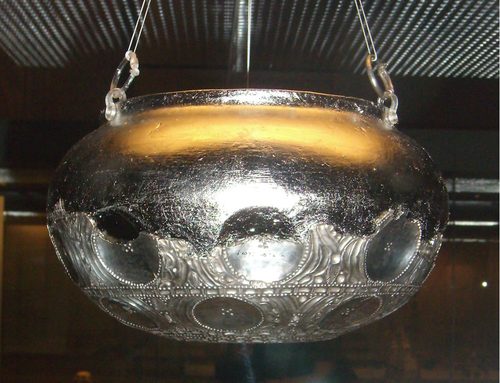
The rest of the service is almost as fine. Two small plates repeat the Bacchic theme and are scratched underneath with the Greek name Eutherios, presumably an owner. A covered bowl made in Gaul in the 3rd century is the oldest piece; its later lid is topped by a little gilt triton blowing a conch. There are flanged bowls with beaded rims and pastoral friezes, a fluted bowl, a pair of pedestalled dishes and a set of spoons. Three of the spoons carry Chi-Rho monograms and two wish long life to Pascentia and Papittedo, so the household that owned this pagan imagery was probably Christian.
For years some scholars doubted that such silver could have been used in Roman Britain at all, and rumours circulated that it had been brought from abroad and reburied. Later finds, above all the Hoxne Hoard, showed that wealthy households in late Roman Britain did own silver of this class. The objects themselves are now generally accepted as a 4th-century assemblage. Where they were made is unknown, though somewhere in the Mediterranean world is likely for the Great Dish.
Weight marks scratched on some pieces are a reminder that silver plate was stored wealth as well as display. Why it was buried is unknown; the late 4th century saw raids on the province, and East Anglia has produced several hoards of that period.
Highlights
A silver platter 60.5 cm across and weighing 8.256 kg, with Oceanus at the centre and the triumph of Bacchus over Hercules round the rim. It is the most celebrated piece of Roman silver found in Britain.
Two small plates, one with Pan and a maenad playing pipes and the other with a satyr and maenad dancing. Each has 'of Eutherios' scratched in Greek underneath.
A Gaulish flanged bowl of the 3rd century, given a domed lid with centaurs hunting animals and a small gilt triton as its knob.
Long-handled spoons engraved with Chi-Rho monograms, and two inscribed PASCENTIA VIVAS and PAPITTEDO VIVAS.
What is in it
A partial dining service of high-quality Roman silver: great platters, decorated plates and bowls, a covered bowl, pedestalled dishes, ladles and spoons.
Size: 34 catalogued pieces.
| Item | Number | Notes |
|---|---|---|
| Great Dish | 1 | 60.5 cm across, 8.256 kg, with Oceanus at the centre and a Bacchic revel round the rim |
| Other platters and plates | 3 | a second large platter with niello geometric ornament, and two small Bacchic plates scratched with the name Eutherios in Greek |
| Bowls | about 8 | a fluted bowl, a covered flanged bowl made in Gaul, a set of four large beaded flanged bowls and a matching pair of small ones |
| Pedestalled dishes | 2 | once thought to be goblets |
| Ladles and spoons | 13 | five ladles with dolphin handles and eight long-handled spoons, some with Chi-Rho monograms or 'vivas' inscriptions |
Photographs
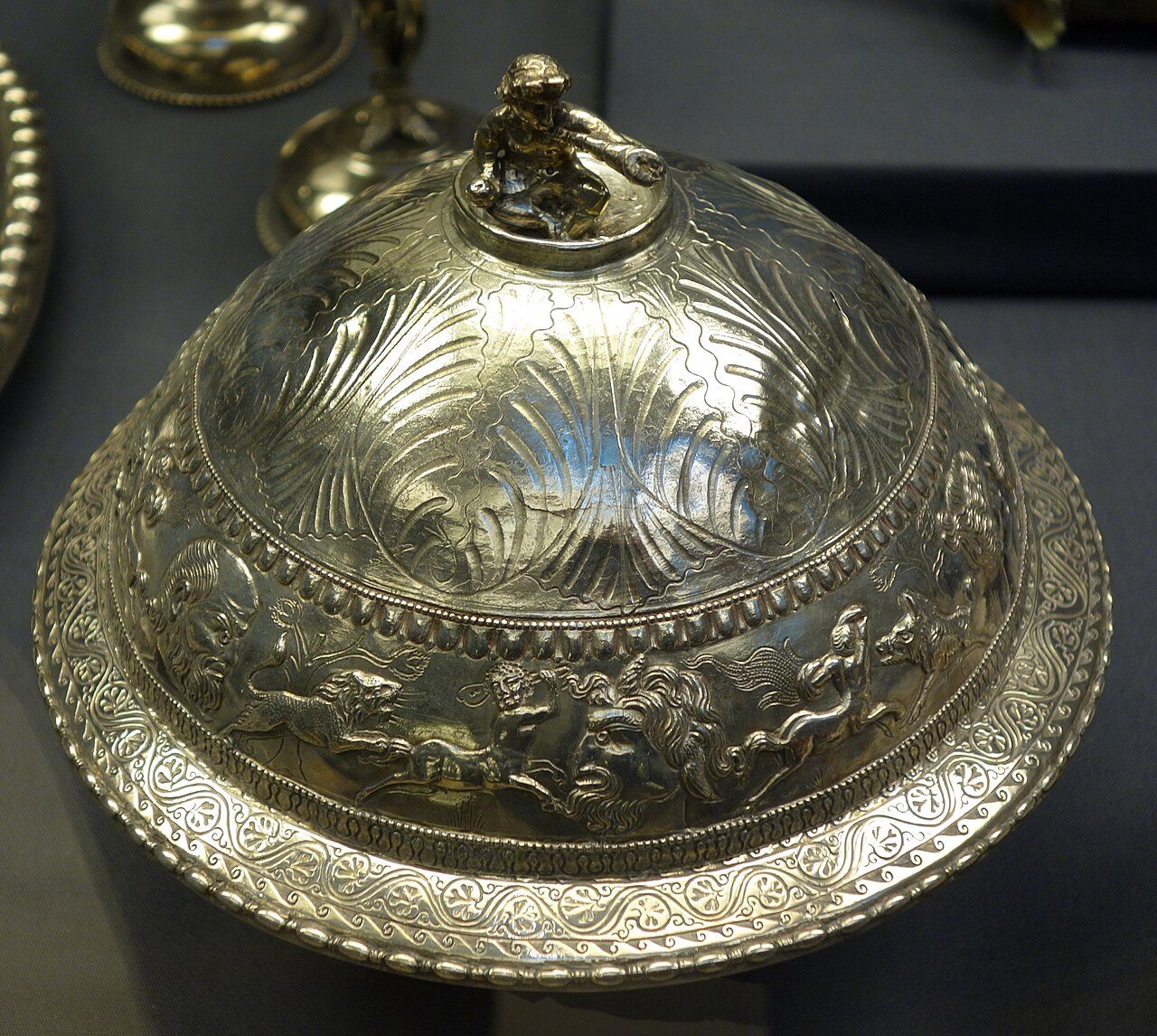
Photo: Daderot, CC0, via Wikimedia Commons
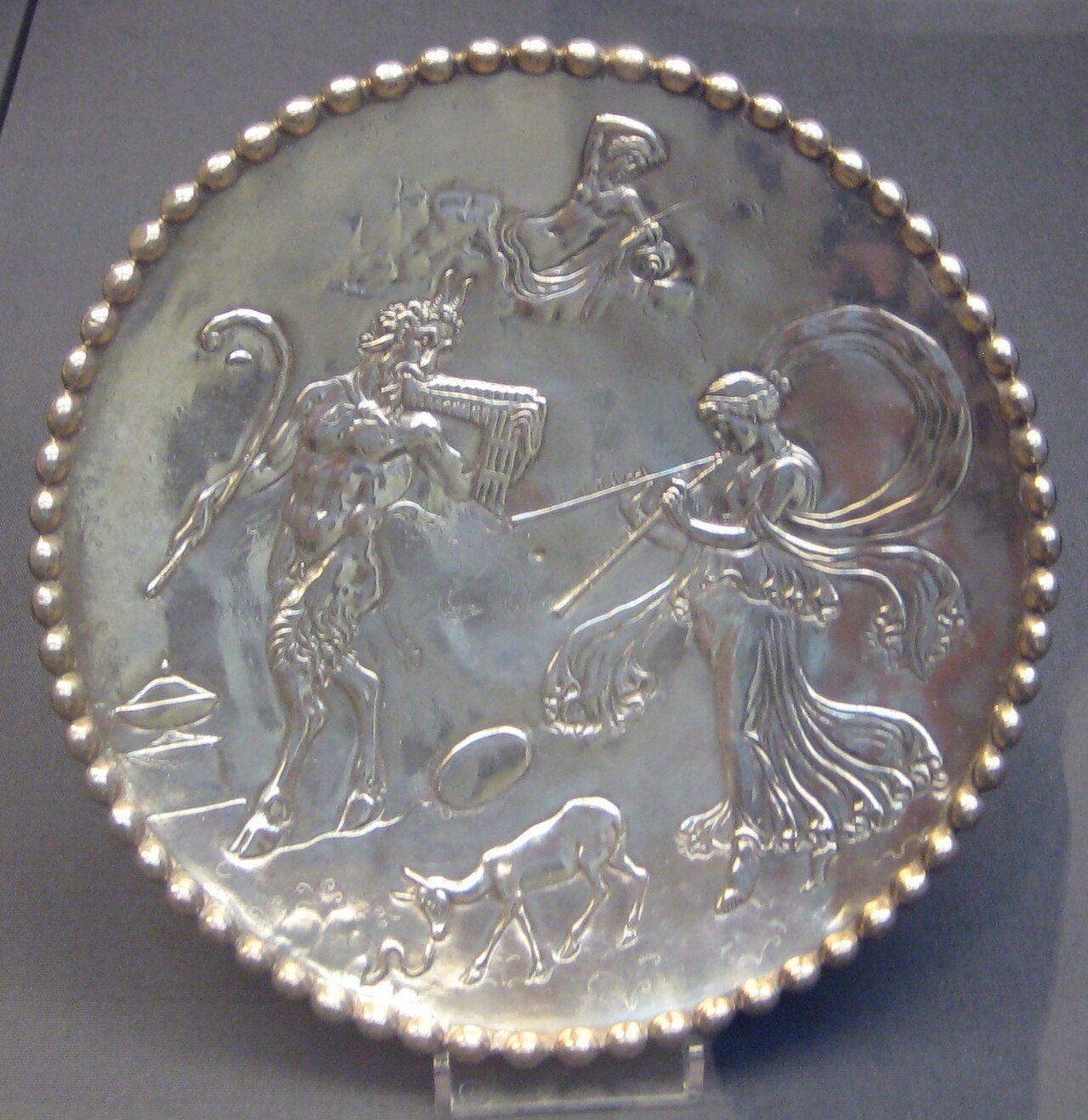
Photo: Unknown, CC0, via Wikimedia Commons
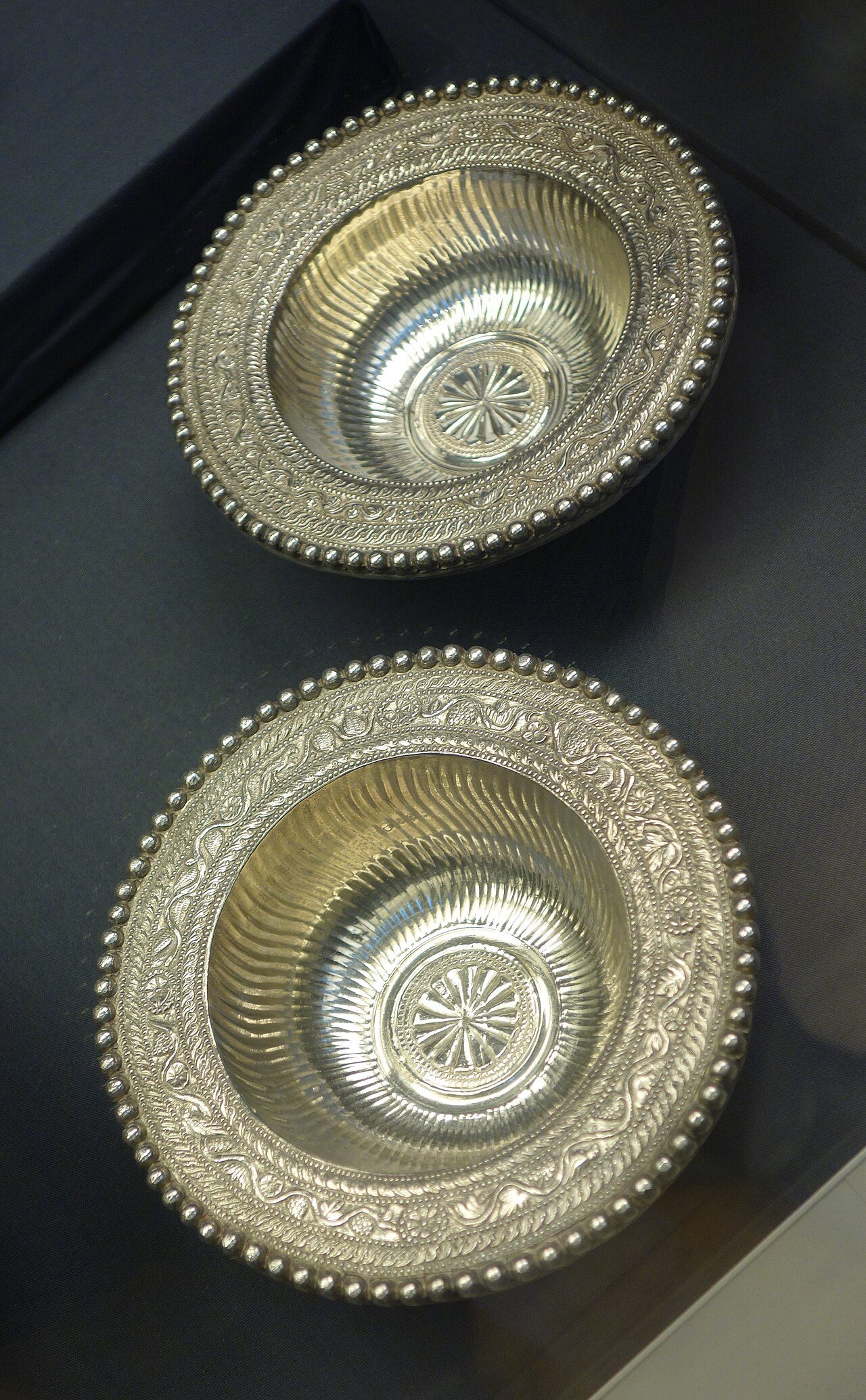
Photo: Daderot, CC0, via Wikimedia Commons
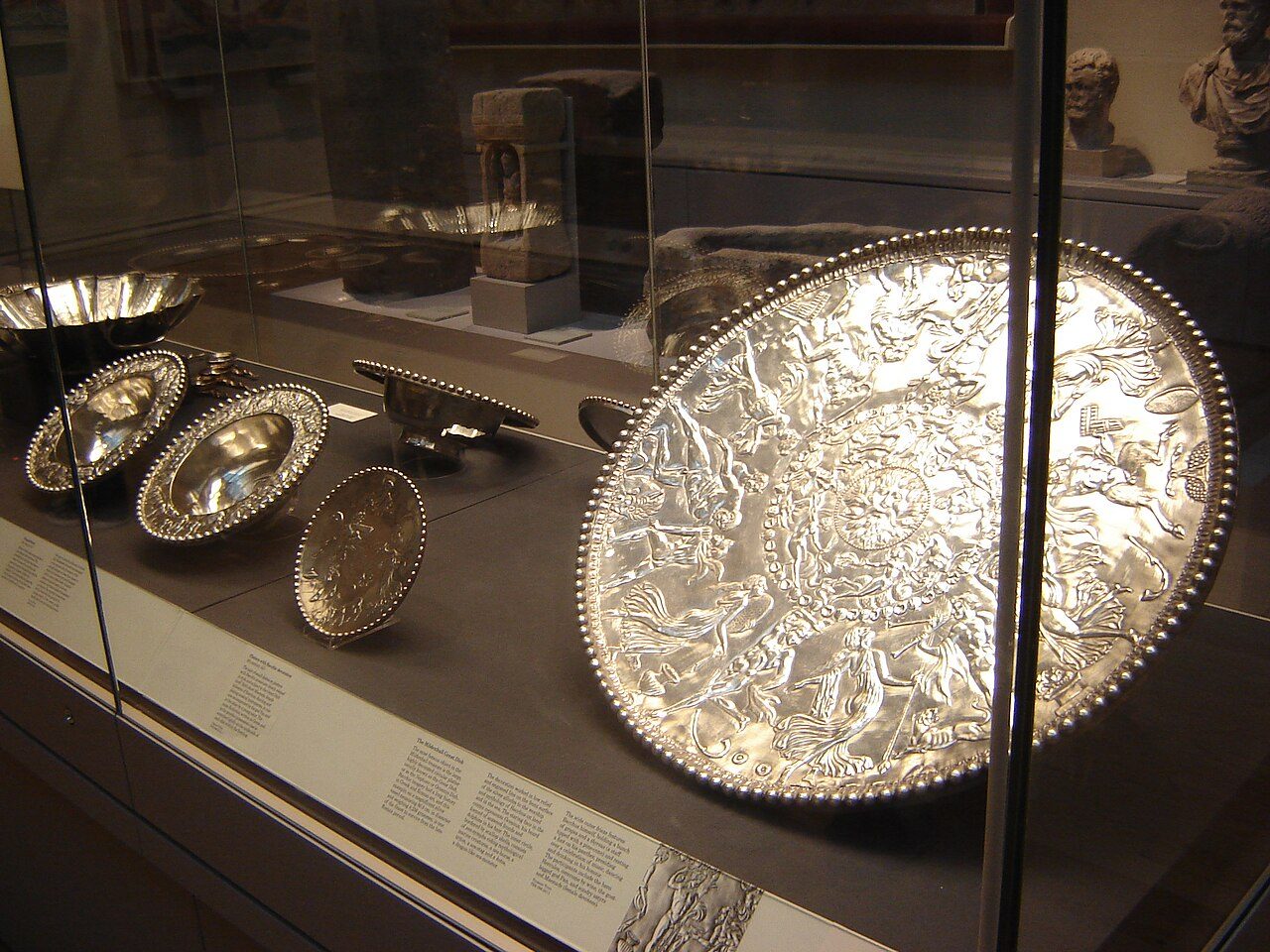
Photo: Unknown, CC BY-SA 3.0, via Wikimedia Commons
How it is dated
There are no coins. The shapes and decoration of the vessels fit the 4th century, and the Chi-Rho spoons suggest Christian owners in the decades after Constantine. The Gaulish covered bowl was already old when the group was assembled. Because the findspot was never properly recorded, the burial date cannot be refined from archaeology.
What happened after the find
Declared treasure trove at an inquest in 1946, four years after discovery, and acquired by the British Museum. Because the find was reported late, the ploughman and his employer received £1,000 each rather than the full value.
Where sources differ
- The exact findspot and circumstances of discovery were never established; the finders' account was doubted at the time.
- Sources describe the hoard as '34 pieces' (British Museum registration numbers and Mildenhall Museum) or 'over thirty items'; counts depend on whether lids and detached handles are counted separately.
- No total weight for the whole treasure was found in the sources consulted.
- The date of burial within the 4th century is uncertain; suggestions linking the silver to the general Lupicinus (in Britain in 360) are speculation.
Questions
Where can I see the Mildenhall Treasure?
The original silver is in the British Museum's Roman Britain gallery, Room 49. Replicas are on show at Mildenhall Museum in Suffolk.
Who found the Mildenhall Treasure?
A ploughman, Gordon Butcher, turned it up in January 1942 while working for Sydney Ford, who kept the silver at home until 1946. It was then declared treasure trove and went to the British Museum.
What is the Great Dish?
A silver platter about 60 cm across and over 8 kg in weight, decorated with a sea god's face and a Bacchic revel. It is one of the finest pieces of Roman silver from Britain.