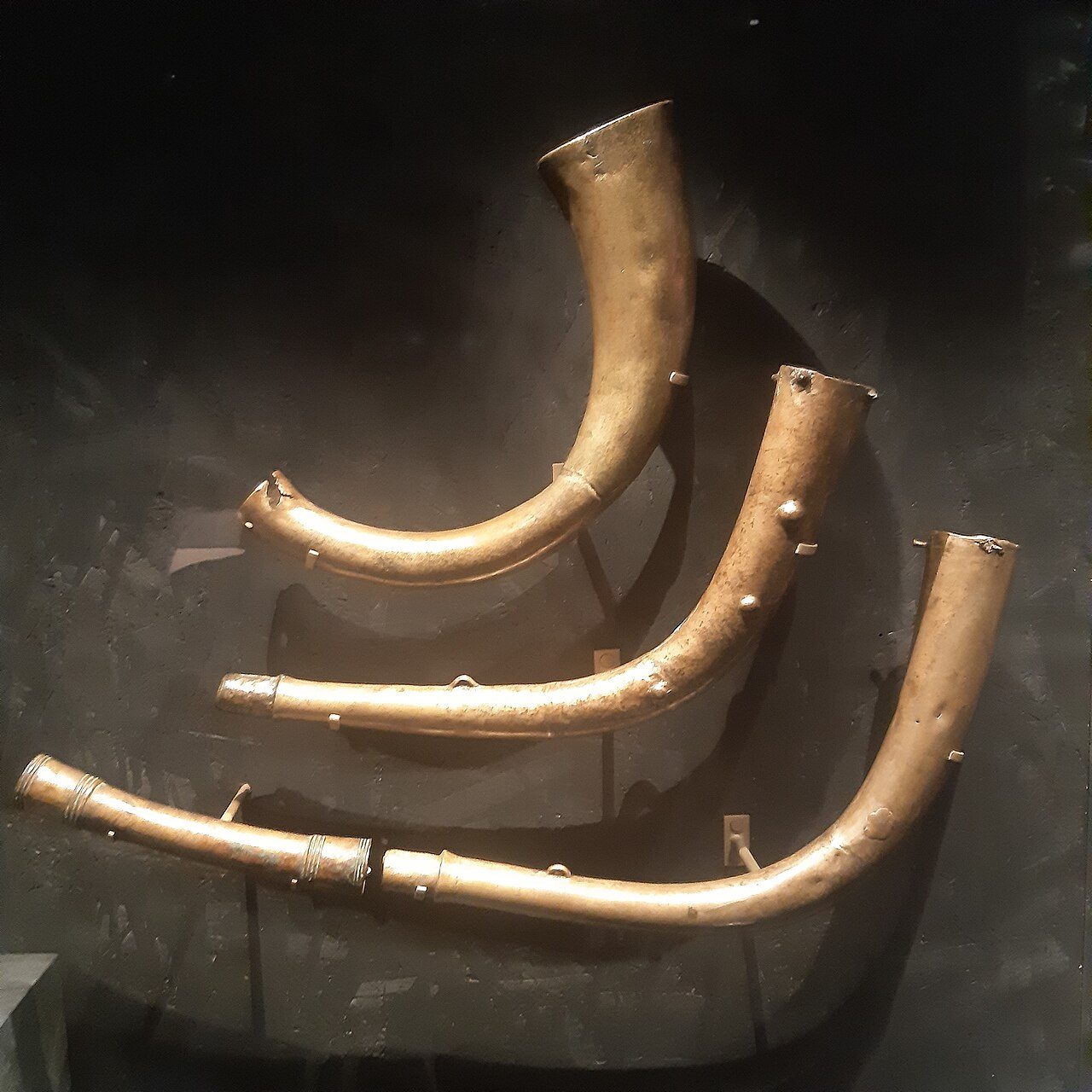
Twenty-six bronze horns make the Dowris Hoard sound different from any other. Irish smiths of the Late Bronze Age cast these curved instruments, some blown from the end and some through a hole in the side, and they were found together with forty-eight crotals: hollow bronze pendants with a loose pellet inside that rattle when shaken. Whatever happened at Dowris, it was not silent.
The objects came out of a peat bog near the shore of Lough Coura, north-east of Birr in County Offaly, in the 1820s. Two men digging potato trenches struck the first pieces. During the Bronze Age the spot was a shallow lake, which only silted up in the later Middle Ages. The find was split almost at once: part went to the 3rd Earl of Rosse at nearby Birr Castle, part to a collector named Cooke, who sold his Irish antiquities to the British Museum in 1854.
With more than 200 objects, Dowris is one of the largest Bronze Age groups found in Ireland. Besides the horns and crotals there are 44 spearheads, 43 socketed axes, five swords, a riveted sheet-bronze cauldron, three buckets of a continental type, and a range of chisels, knives and other tools. The swords may have been made in southern England; the buckets belong to a type known on the continent. Today 111 pieces are in Dublin and 79 in London.
The records of the discovery are too thin to say whether this was one deposit or many. Most archaeologists now think it built up over a long time, as people at the lake edge returned to cast weapons, tools and instruments into the water. That would make Dowris less a hidden store than a sacred place, comparable to watery deposits elsewhere in Bronze Age Europe.
The find gave its name to the last stage of the Irish Late Bronze Age, the Dowris Phase, roughly 900 to 600 BC. In those centuries Irish bronzesmiths were masters of casting and sheet-metal work, and goldsmiths produced superb jewellery, while ironworking spread through Britain and the continent but had not yet reached Ireland. The hoard is one of the fullest pictures of that world's equipment, from axes for daily work to instruments for ceremony.
Highlights
Twenty-six cast bronze horns, end-blown and side-blown, among the earliest surviving musical instruments from Ireland.
Forty-eight hollow bronze pendants in two sizes, each containing a loose pellet that rattles when shaken.
A large cauldron built from bronze sheets joined with rivets, a feasting vessel of the Dowris Phase.
Three sheet-bronze buckets, or situlae, a continental type.
What is in it
Mostly bronze: spearheads, socketed axes, horns, crotals (hollow rattle pendants), swords, a riveted cauldron, buckets and many smaller tools such as chisels and knives.
Size: more than 200 objects (about 190 traced today).
| Item | Number | Notes |
|---|---|---|
| Crotals | 48 | hollow bronze rattle pendants in two sizes |
| Spearheads | 44 | |
| Socketed axes | 43 | |
| Horns or trumpets | 26 | cast bronze, end-blown and side-blown |
| Swords | 5 | about 48 cm long, perhaps from southern England |
| Vessels | 4 | a riveted sheet-bronze cauldron and three buckets (situlae) |
| Tools | many | chisels, knives and others |
Photographs
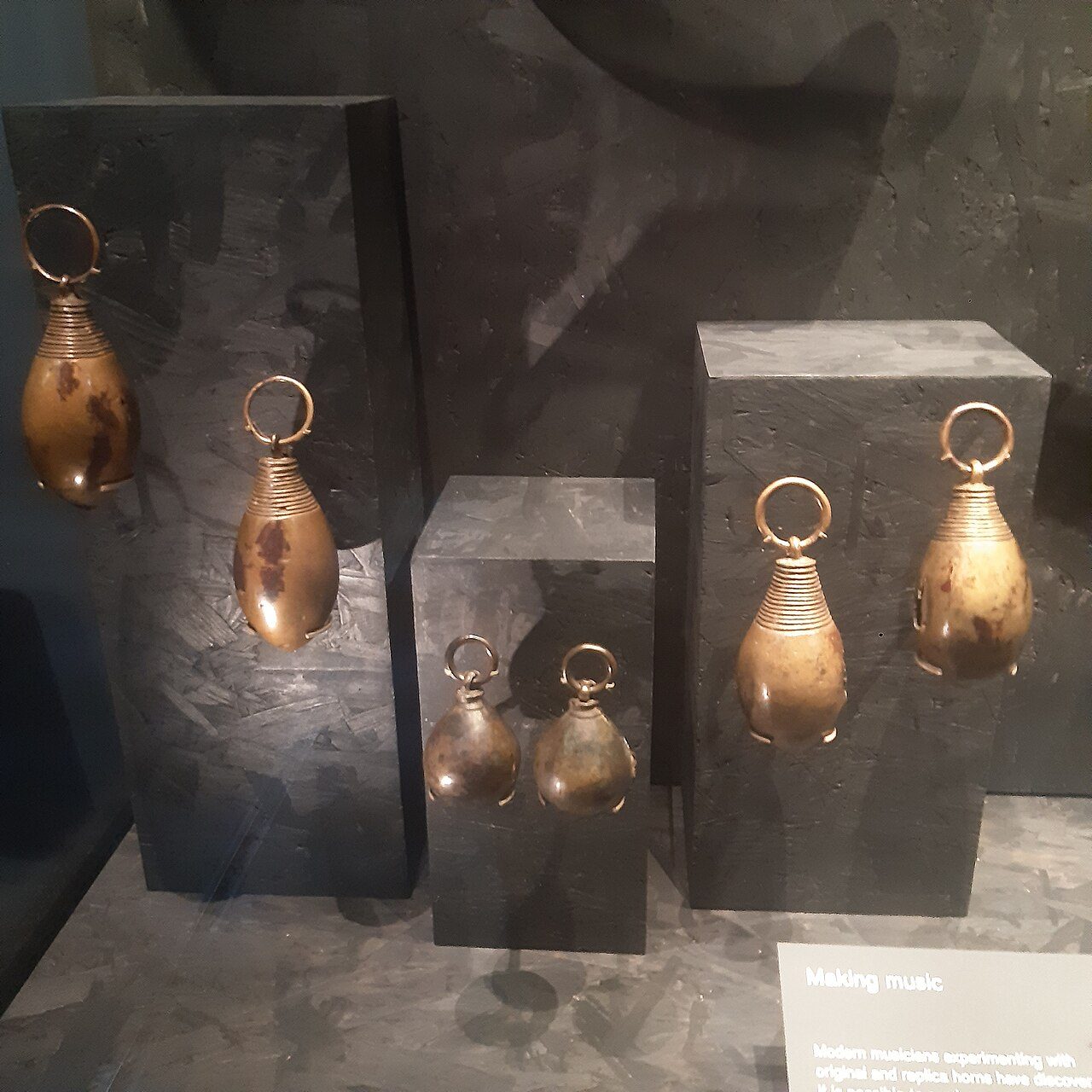
Photo: Jononmac46, CC BY-SA 4.0, via Wikimedia Commons
How it is dated
There is no scientific date. The hoard is dated by the types of its objects, especially the swords, horns and buckets, which belong to the final phase of the Irish Late Bronze Age, about 900-600 BC. If the deposit built up over time, it may span much of that period.
What happened after the find
Found long before modern heritage laws, the hoard was divided between local collectors; the British Museum bought its share with the Cooke collection in 1854, and other pieces later reached what is now the National Museum of Ireland.
Where sources differ
- The exact year of discovery is not recorded; Wikidata gives 1820, Wikipedia 'the 1820s'.
- Whether the hoard is a single deposit or a series built up over time is unknown.
- The British Museum's share is attributed to a collector Wikipedia calls 'TD Cooke'; the initials could not be checked.
- Item counts are from Wikipedia (citing Eogan 1983); not checked against museum catalogues.
Questions
What is a crotal?
A hollow, roughly pear-shaped bronze pendant with a loose pellet inside, so that it rattles when shaken. The Dowris Hoard contains 48, in two sizes.
Where is the Dowris Hoard?
It is split between the National Museum of Ireland – Archaeology in Dublin, which holds 111 objects, and the British Museum in London, which holds 79.