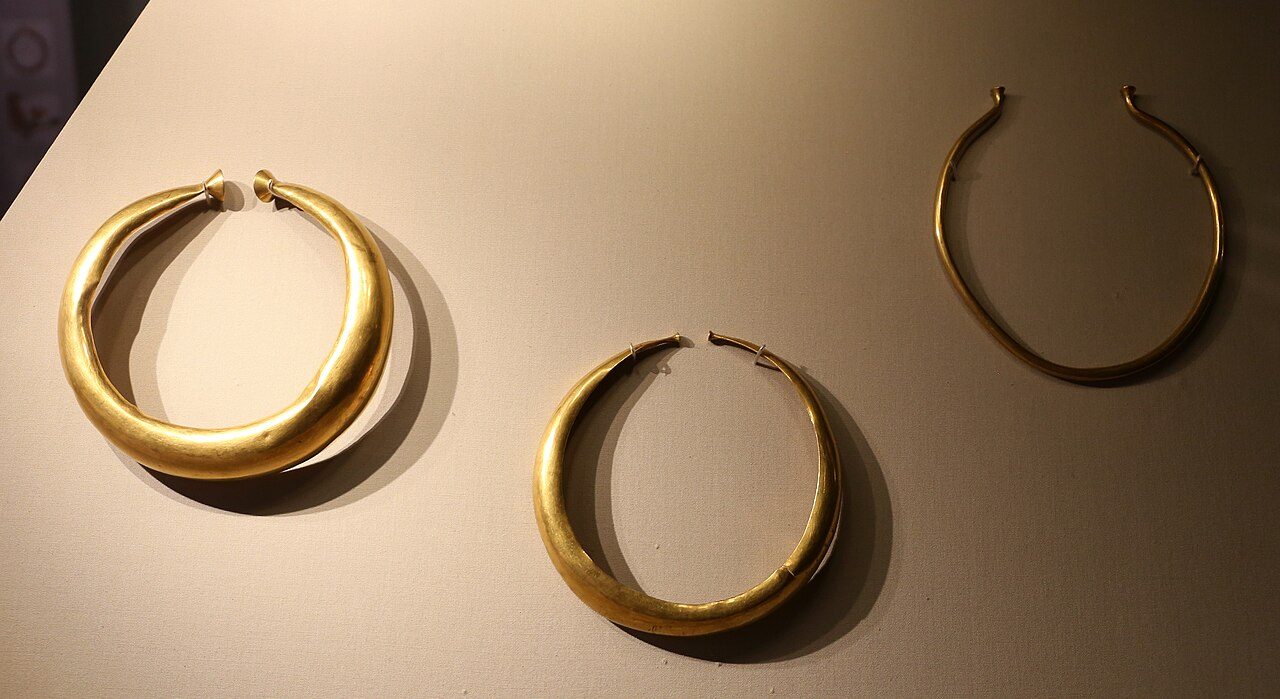
Most of the Great Clare Find no longer exists. In March 1854 labourers building the railway near Newmarket-on-Fergus in County Clare were realigning a ditch beside Mooghaun Lake when they shifted a stone and found a cavity packed with gold: bracelets, neck collars, torcs and ingots, more than 150 objects in all and over five kilograms of metal. It was one of the largest Bronze Age gold finds ever made north of the Alps.
The find never reached a coroner or a museum intact. The workmen sold the gold to local dealers and jewellers, who melted almost all of it for bullion. Only 29 objects are known to survive. Fortunately some pieces were copied before they went into the crucible, and the National Museum of Ireland displays casts of the lost bracelets beside the originals, a long row that shows how much was destroyed.
The survivors are mainly penannular bracelets of solid gold, with expanded ends, and six crescent-shaped neck collars of gold. They belong to the Late Bronze Age, when Irish goldsmiths produced some of the most ambitious goldwork in Europe. Research has suggested that much of the gold came from the Mourne Mountains in County Down rather than from the west of Ireland.
The hoard lay below Mooghaun hillfort, one of the largest hillforts in Ireland, with three concentric stone ramparts enclosing about twelve hectares. Excavations in the 1990s dated activity beneath its outer rampart to around 1260-930 BC and found little sign of everyday settlement, suggesting a place of gathering and ceremony as much as defence. The hoard's quantity of gold fits a landscape dominated by a wealthy elite.
Why so much gold was put in a stone chamber in wet ground is not known. It could have been hidden during a local crisis and never recovered, or deposited near the lake as an offering. There is no direct evidence either way.
The surviving pieces are split between Dublin, which holds fifteen, and the British Museum, which bought most of its fourteen in 1857 from the collection of the 3rd Earl of Enniskillen. The hoard features in the series A History of Ireland in 100 Objects.
Highlights
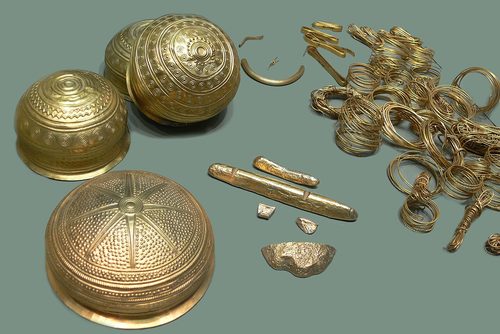
Six crescent-shaped neck collars of heavy gold sheet, all of which survive; they are among the finest objects from the find.
Solid gold bracelets with flared ends, the commonest object in the hoard; 138 were recorded and only 23 survive.
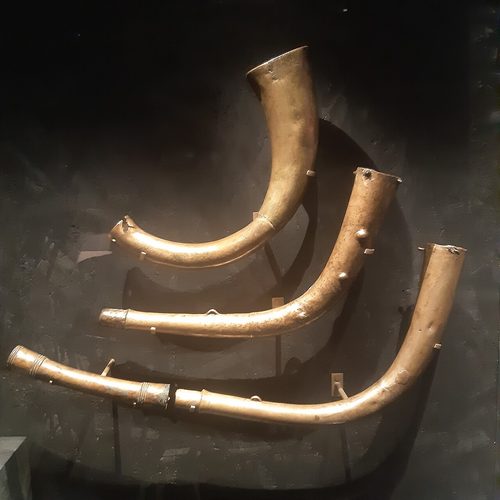
Casts of the melted-down bracelets, shown in Dublin, give a sense of the hoard's original size.
What is in it
Mostly penannular gold bracelets, with gold neck collars, a few torcs and ingots, packed into a stone-lined cavity. Fewer than a fifth of the objects survive.
Size: over 150 objects (29 survive). Weight: over 5 kg originally.
| Item | Number | Notes |
|---|---|---|
| Bracelets | 138 recorded | 23 survive; the rest were melted down |
| Collars | 6 | crescent-shaped neck collars, all surviving |
| Torcs | 2 | |
| Other | several | including ingots |
| Surviving today | 29 | 15 in the National Museum of Ireland, 14 in the British Museum |
Photographs
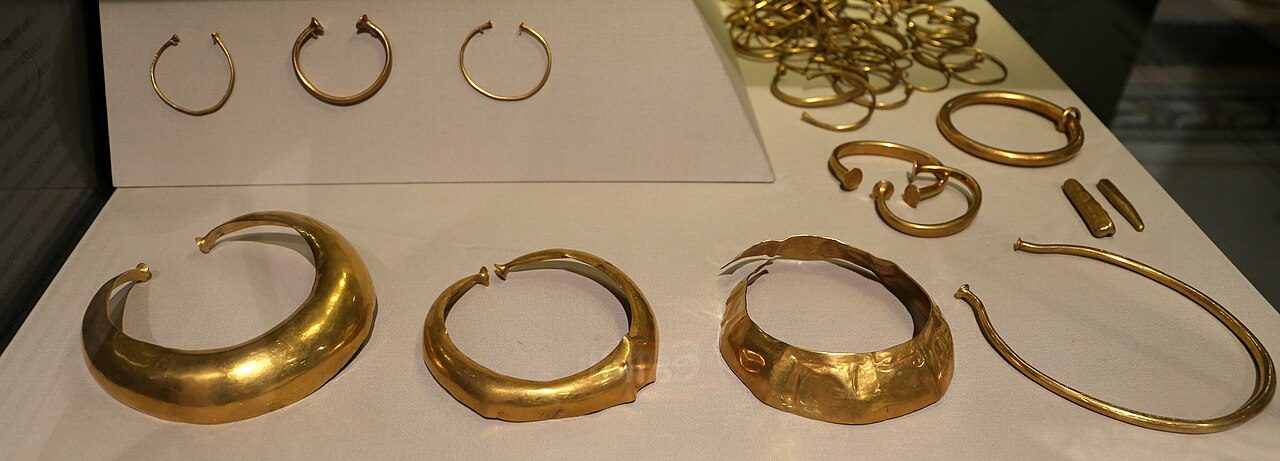
Photo: Sailko, CC BY 3.0, via Wikimedia Commons
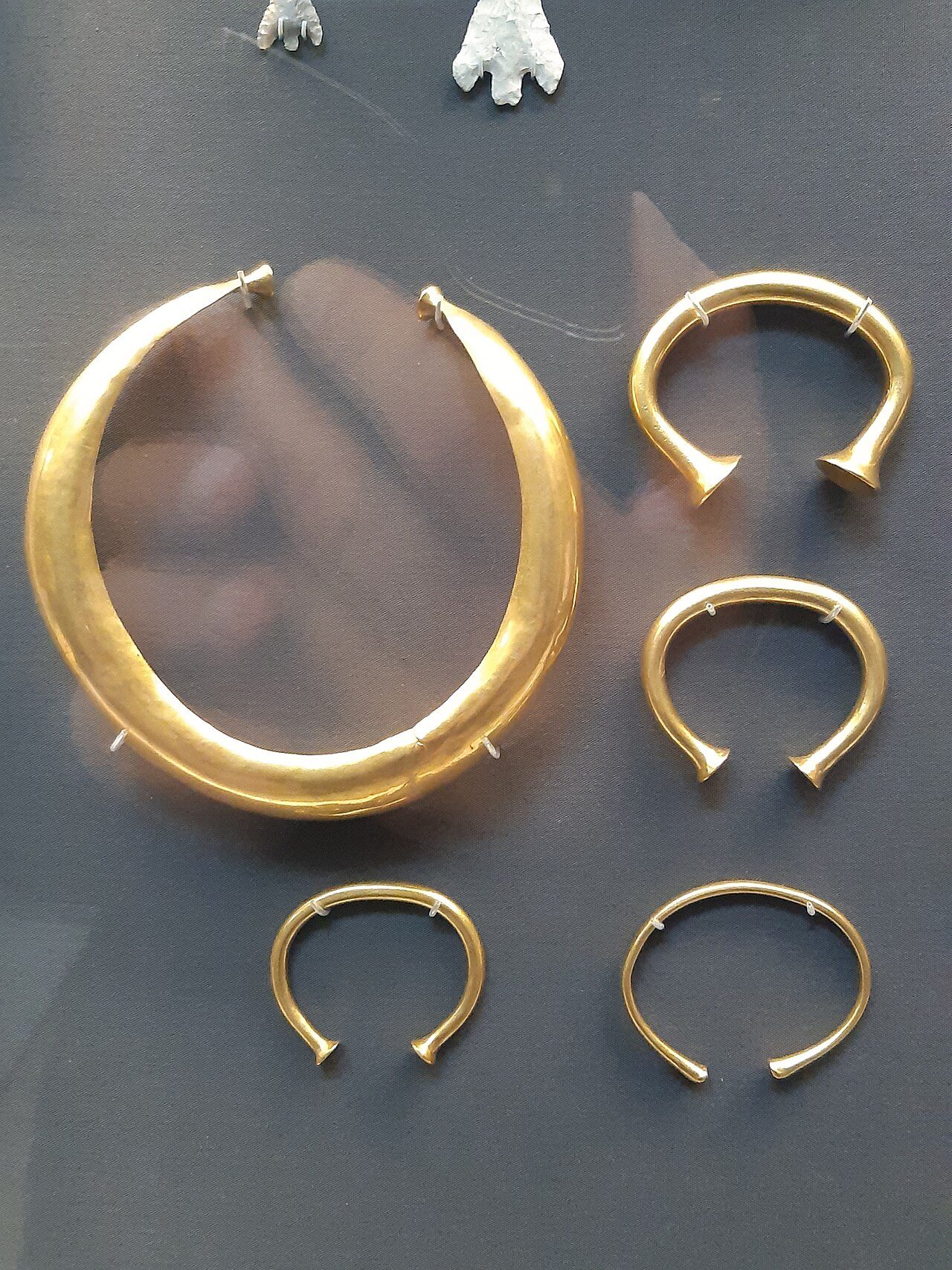
Photo: Jononmac46, CC BY-SA 4.0, via Wikimedia Commons
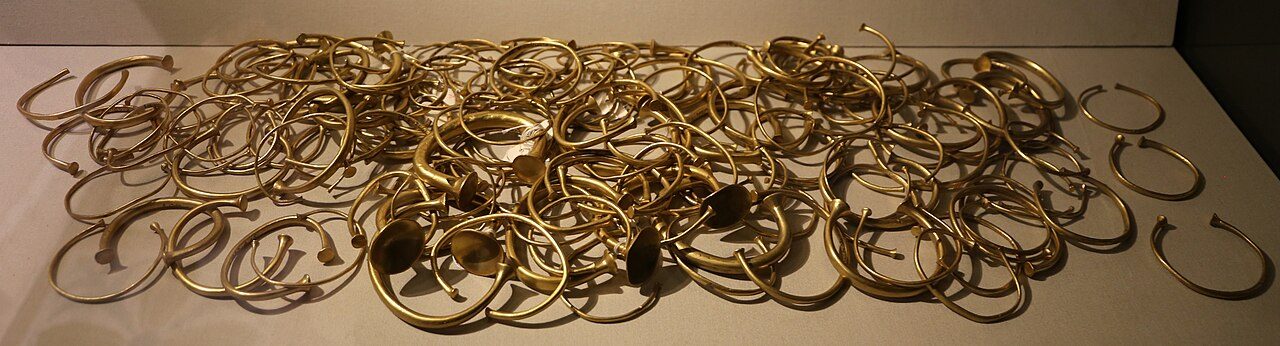
Photo: Sailko, CC BY 3.0, via Wikimedia Commons
How it is dated
The hoard has no datable organic material. Its bracelets and collars belong to the Irish Late Bronze Age; the British Museum dates its pieces to about 1150-750 BC, and other displays give about 800-700 BC. Radiocarbon dating beneath the rampart of the nearby hillfort, around 1260-930 BC, places the monument in the same broad period.
What happened after the find
The find was not declared as treasure trove: the workmen sold the gold to dealers, who melted most of it. The 29 surviving pieces are now divided between the National Museum of Ireland and the British Museum.
Where sources differ
- The original count and weight are estimates from 19th-century accounts; 'over 150 objects' and 'over 5 kg' are the usual figures.
- Date range varies: 1150-750 BC (British Museum, via Wikipedia), about 800-700 BC (National Museum of Ireland label as photographed on Commons).
- The Mourne Mountains source for the gold is reported by Wikipedia from O'Toole's 'A History of Ireland in 100 Objects'; not checked against the scientific study.
- How the surviving pieces reached the Royal Irish Academy is not documented in the sources used.
Questions
What happened to the Mooghaun gold?
Most of it was sold by the workmen who found it in 1854 and melted down by dealers for its metal. Only 29 of more than 150 objects survive.
Where can I see the Mooghaun hoard?
Fifteen pieces are in the National Museum of Ireland – Archaeology in Dublin, with replicas of lost bracelets; fourteen are in the British Museum in London.