Axes, swords, spearheads and scrap buried by the hundred in Bronze Age Europe: how to tell a flat axe from a palstave, and why so much went underground.
More Bronze Age metal has come out of hoards than out of graves or settlements. The largest in England, found at Isleham in Cambridgeshire in 1959, held more than 6,500 pieces of bronze: swords, spearheads, axes, knives, horse gear and a great deal of broken sheet metal, all of about 1000 BC. Hoards like this are the backbone of Bronze Age chronology, because objects buried together were in use at the same time, and archaeologists name whole phases after them; the last stage of the Irish Bronze Age, about 900 to 600 BC, is called the Dowris phase after a deposit from a former lake in County Offaly.
The axe is the type fossil. The earliest copper and bronze axes, in Britain from around 2500 to 2000 BC, are flat axes cast in an open one-piece mould, shaped much like the stone axes they replaced. Smiths then hammered up the edges into flanged axes so the head would sit firmly in a split haft. The palstave, typical of the Middle Bronze Age, was cast in a two-piece mould with high flanges and a stop-ridge to stop the haft splitting. In the Late Bronze Age the socketed axe took over: a hollow head cast round a clay core, with the handle pushed into the socket and lashed through a small side loop. Swords followed a similar path, from short dirks and rapiers to the leaf-shaped slashing swords of the Late Bronze Age, with rivet holes where a wooden or bone grip was fixed.
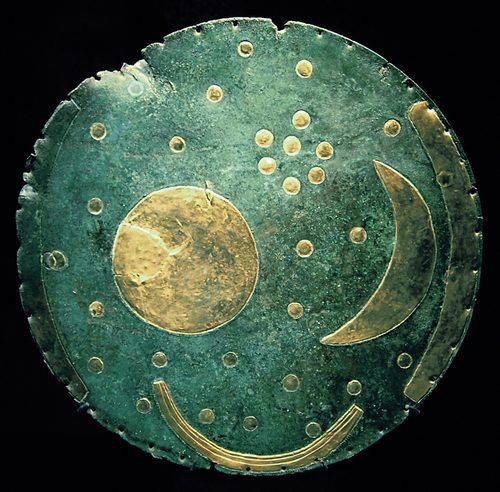
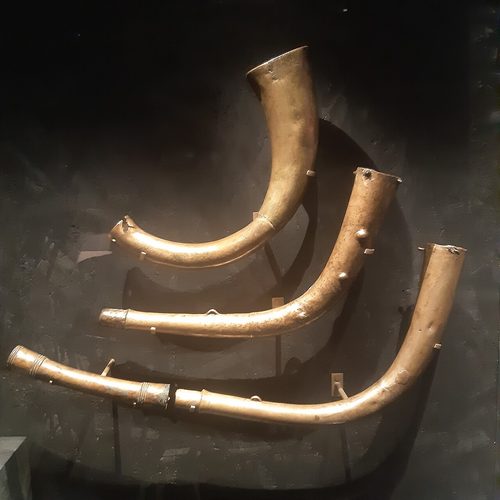
Archaeologists sort hoards by what they contain. A founder's hoard holds broken tools, miscast pieces, casting jets and lumps of raw metal: a smith's stock of scrap for remelting, or so it seems. A merchant's hoard has sets of new, unused objects of the same kind. Others look like offerings, especially when they were placed in rivers, bogs and lakes, as at Dowris, where the 200 or more objects included 43 socketed axes, 44 spearheads, 26 horns and dozens of bronze rattles called crotals. The Nebra hoard in Saxony-Anhalt paired the famous sky disc with two swords, two axes, a chisel and spiral arm-rings; birch bark from the sword hilts gives a radiocarbon date of about 1600 to 1560 BC for its burial.
The boundary between a tool and a token is not always sharp. In Brittany and Normandy, hoards of Armorican socketed axes can run to hundreds of pieces. Many are of a soft, heavily leaded bronze, left as they came from the mould, and some scholars read them as a form of early money. Their date is argued: they were long put at the very end of the Bronze Age, but recent work places many in the early Iron Age.
A bronze axe or blade is usually green or brown with corrosion, but the shape is diagnostic: look for flanges, a stop-ridge, a socket and loop, or the seam line left by a two-piece mould. In England and Wales, two or more prehistoric base-metal objects found together count as Treasure and must be reported.
Examples
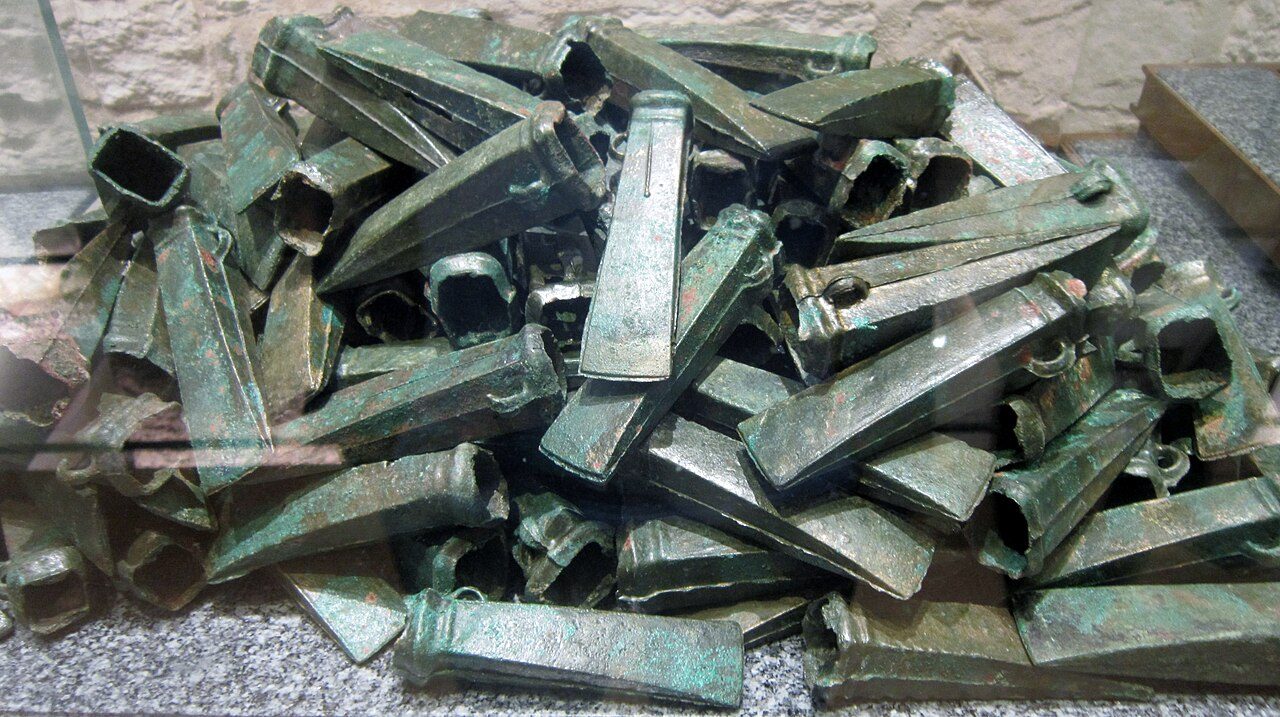
Photo: Moreau.henri, CC BY-SA 4.0, via Wikimedia Commons
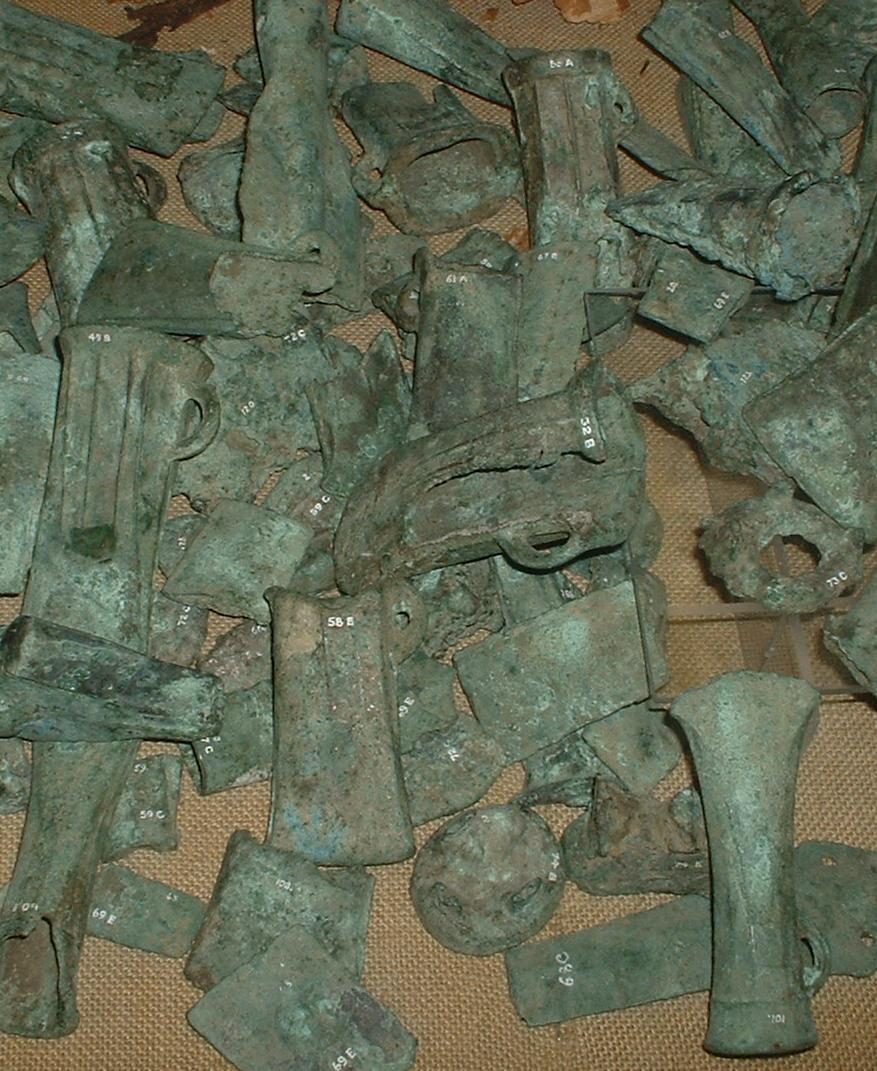
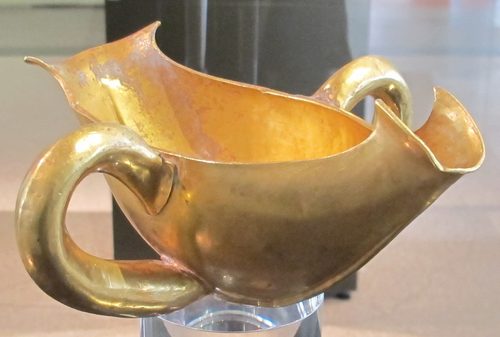
Photo: No machine-readable author provided. Gaius Cornelius assumed (based on copyright claims)., Public domain, via Wikimedia Commons
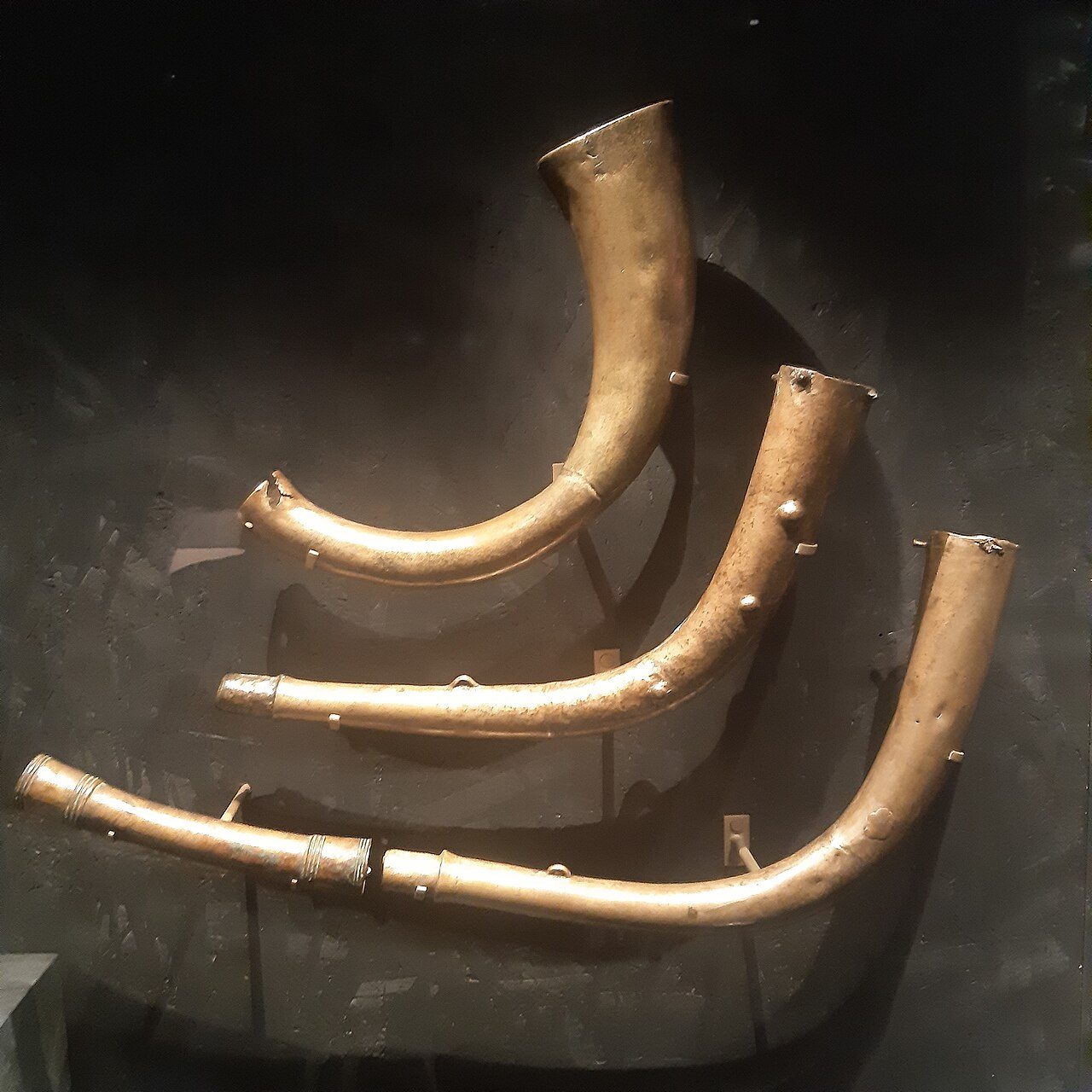
Photo: Jononmac46, CC BY-SA 4.0, via Wikimedia Commons
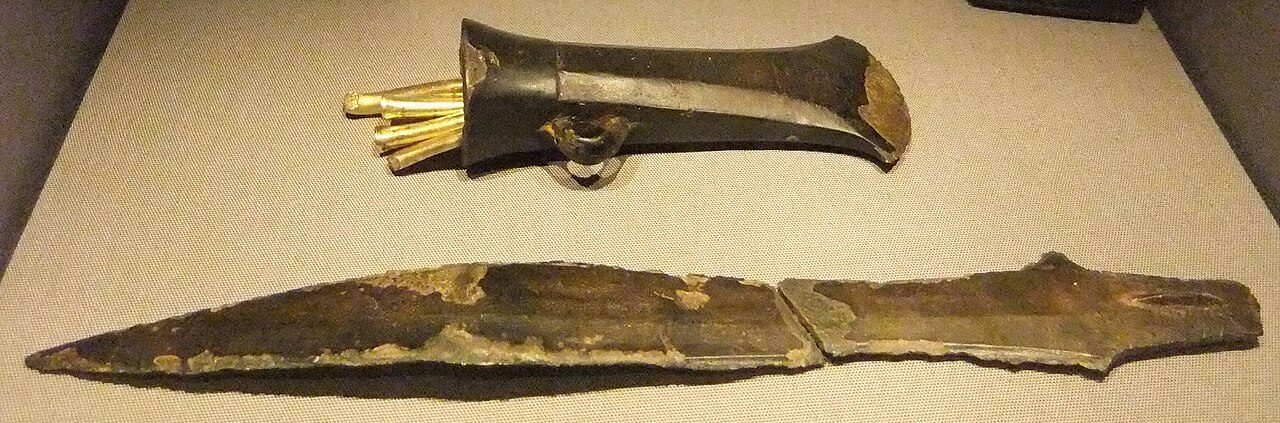
Photo: Rept0n1x, CC BY-SA 3.0, via Wikimedia Commons