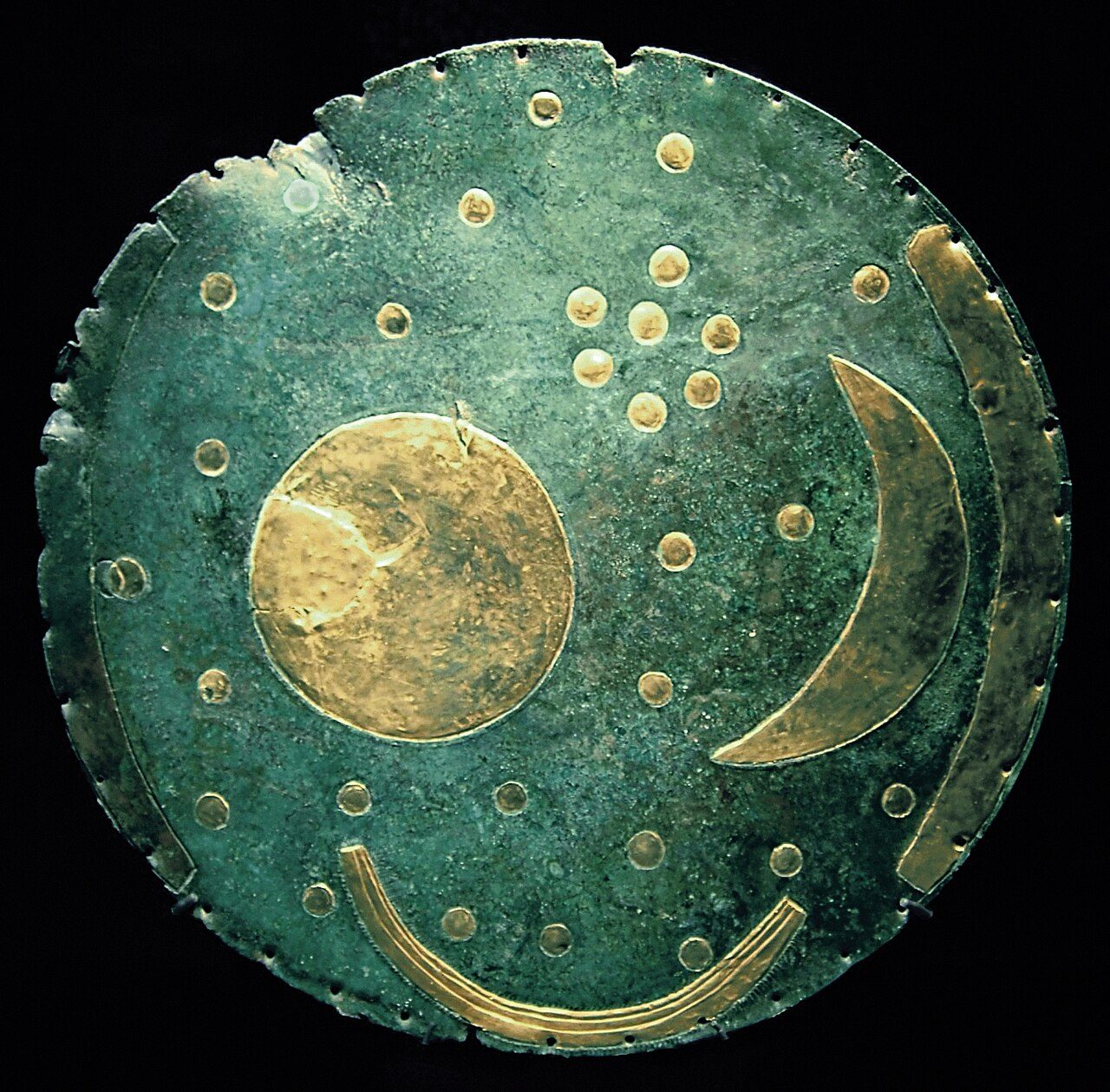
The oldest known concrete picture of the night sky came out of the ground on the end of a spade. In 1999 two men detecting without a licence on the Mittelberg, a wooded hill near Nebra in Saxony-Anhalt, dug up a bronze disc together with swords, axes and bracelets. They knew the digging was illegal: in Saxony-Anhalt archaeological finds belong to the state. They damaged the disc as they lifted it, disturbed the site, and sold the whole group the next day to a dealer in Cologne.
For more than two years the hoard moved through the hands of dealers, offered at prices rising towards a million marks. In February 2002 the state archaeologist of Saxony-Anhalt, working with Swiss and German police, was put forward as a buyer in a sting operation in Basel, and the hoard was seized. The original diggers were traced and convicted, and as part of the case they showed investigators where they had dug. Excavation there found traces of bronze in a pit inside an enclosure on the hilltop, and soil from the pit matched the soil still clinging to the objects.
The disc itself is about 30 cm across and weighs some 2.2 kg. Its green patina is set with sheet gold: a large circle for the sun or full moon, a crescent, and 32 small stars, seven of them grouped in a tight cluster usually read as the Pleiades. Analysis shows that it was altered several times. Two gold arcs were added at the edges, spanning about 82 degrees, the angle between the midsummer and midwinter sunsets on the horizon at Nebra's latitude; one has since been lost. Later a curved gold band with fine strokes was added at the bottom, often read as a boat carrying the sun. Last of all, a ring of small holes was punched around the rim.
The companion pieces matter as much as the disc, because they date it. The two swords and two axes belong to well-known Early Bronze Age types, and a scrap of birch bark from a sword hilt gave a radiocarbon date of about 1600-1560 BC. That is when the hoard went into the ground; the disc may already have been several generations old. The objects come in pairs, two swords, two axes, two arm rings, which some archaeologists connect with the divine twins of later European myth.
The region was the heartland of the Únětice culture, whose rulers were buried in huge mounds nearby. Some archaeologists argue that the disc was a tool of such rulers, recording solar and lunar cycles that mattered for farming and for keeping a calendar. Metal analysis found that copper came from the eastern Alps and that some of the gold and the tin came from Cornwall, a reminder of how far metal travelled in this period.
The disc has had its challengers. One scholar claimed in 2005 that it was a forgery, and in 2020 two archaeologists argued that the find story was unreliable and that the disc might be Iron Age. Specialists who have examined the disc, its corrosion and the find spot rejected both claims, and the Early Bronze Age date is the accepted one. In 2013 UNESCO added the disc to its Memory of the World register.
Highlights
Bronze with gold inlays of a sun or full moon, a crescent and 32 stars, later given horizon arcs and a boat; about 30 cm across and 2.2 kg.
Two gold arcs spanning about 82 degrees, matching the swing of sunset points between midsummer and midwinter as seen from the Mittelberg; one arc is missing.
Two bronze swords with gold-decorated hilts; birch bark from one hilt supplied the radiocarbon date for the hoard.
Fragments of two spiral bracelets of bronze wire, part of the pairs that run through the deposit.
What is in it
The sky disc, a bronze plate about 30 cm across inlaid with gold, buried with two bronze swords, two flanged axes, a chisel and fragments of two spiral arm rings.
Size: the disc and seven other bronzes (some fragmentary). Weight: the disc alone weighs about 2.2 kg.
| Item | Number | Notes |
|---|---|---|
| Sky disc | 1 | bronze, about 30 cm across, with gold inlays of a sun or full moon, a crescent, 32 stars, two horizon arcs (one lost) and a boat |
| Swords | 2 | bronze, with gold-decorated hilts; one blade has a copper-inlaid wavy line |
| Axes and chisel | 3 | two flanged axes and a chisel |
| Spiral arm rings | 2 | fragmentary |
Photographs
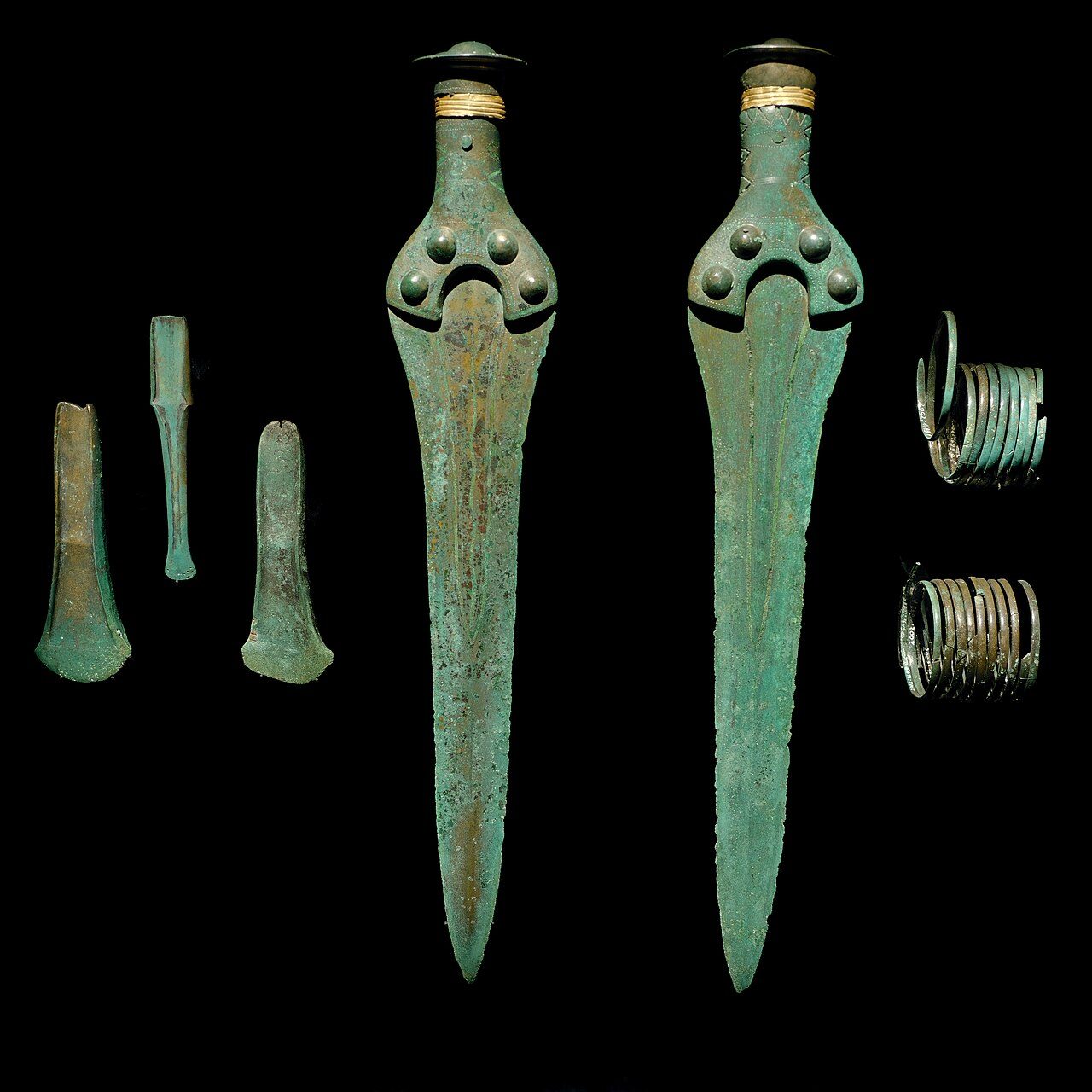
Photo: WFS.Berlin, CC0, via Wikimedia Commons
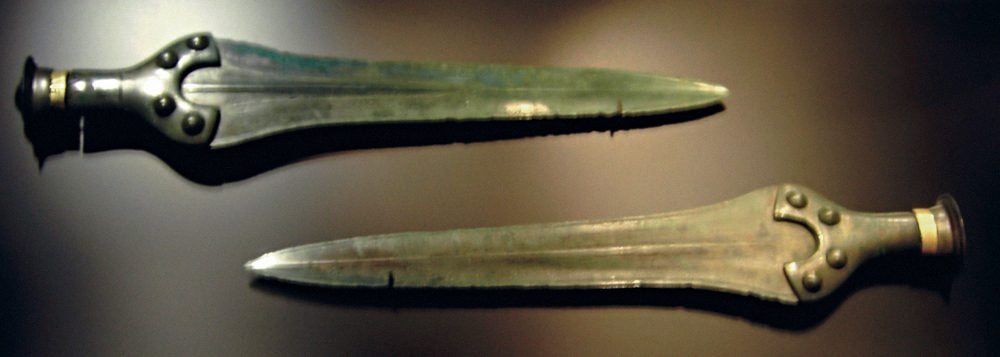
Photo: Unknown, CC BY-SA 3.0, via Wikimedia Commons
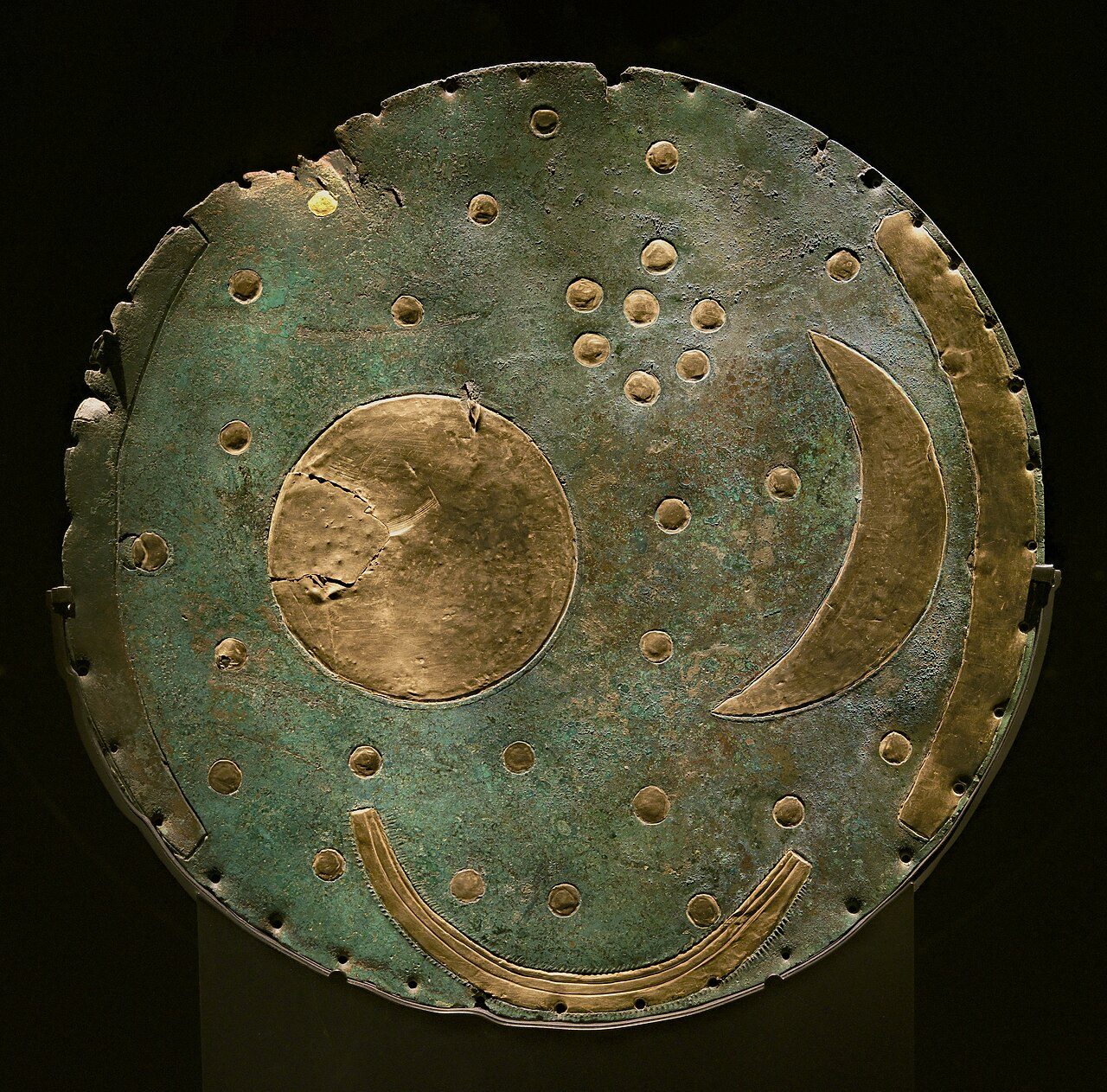
Photo: Shonagon, CC0, via Wikimedia Commons
How it is dated
The swords and axes are Early Bronze Age types placed around 1600 BC, and birch bark from a sword hilt was radiocarbon dated to roughly 1600-1560 BC, which dates the burial. The disc was made earlier, perhaps 1800-1600 BC, and modified over time. A 2020 proposal for an Iron Age date was rebutted by the original research team the same year.
What happened after the find
In Saxony-Anhalt archaeological finds belong to the state. The hoard was looted, sold illegally, and recovered in a police operation in Basel in February 2002; the two diggers were convicted by a court in Naumburg in 2003, and their sentences were increased on appeal.
Where sources differ
- The exact find date in 1999 (the museum says summer 1999).
- Whether the disc was made c. 1800-1600 BC or later is debated; a 2020 paper by Gebhard and Krause proposed an Iron Age date, rejected by Pernicka and colleagues.
- The precise number of objects depends on how the arm-ring fragments are counted.
- The interpretation of the lower arc (boat, rainbow, sickle) and the calendar readings are scholarly hypotheses.
- The Wikidata item Q157094 is the sky disc itself; no separate item for the hoard was found.
Questions
Where is the Nebra sky disc now?
In the permanent exhibition of the State Museum of Prehistory (Landesmuseum für Vorgeschichte) in Halle, Saxony-Anhalt, with the swords, axes and arm rings found with it.
How old is the Nebra sky disc?
It was buried around 1600 BC, a date given by radiocarbon from birch bark on one of the swords found with it. The disc itself is older, perhaps by several generations.
Is the Nebra sky disc genuine?
Yes. Forgery claims were made in 2005 and an Iron Age date was proposed in 2020, but analyses of the disc's corrosion, its metal and the find spot support an Early Bronze Age origin.