On 17 October 1868 soldiers of a Prussian infantry regiment were cutting a rifle range into the western slope of the Galgenberg, a low hill south-east of Hildesheim, when their spades hit decorated sheet metal. What came out of the pit, much of it crushed and blackened, turned out to be a Roman silver dinner service of the finest quality, buried about two metres down. The soldiers wheeled most of it back to barracks in a cart to be cleaned, and a local silversmith's workshop helped with the first treatment.
The recovery was not tidy. Townspeople at the site pocketed fragments; some were handed back and some apparently stayed in Hildesheim homes, so the find is almost certainly incomplete. The local newspaper first guessed it was Renaissance plate from a princely household. Within days the antiquary Colonel August von Cohausen, who knew the Roman camps of the Rhineland, questioned the soldiers about how the pieces had lain, and in 1869 he dug a small area around the findspot. Because the land belonged to the Prussian state, the silver went to Berlin within weeks of its discovery.
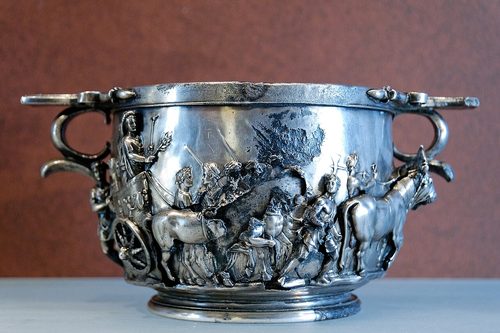
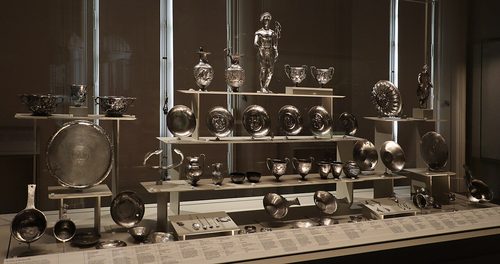
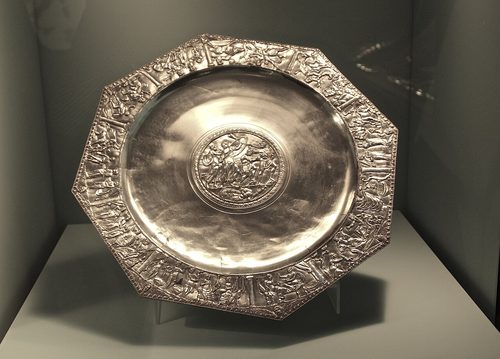
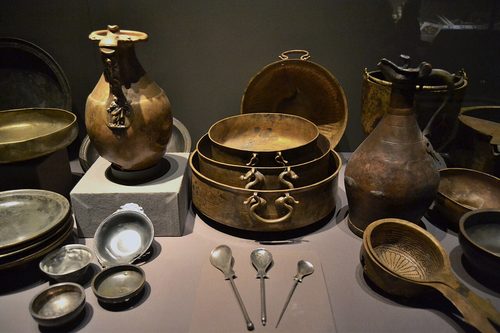
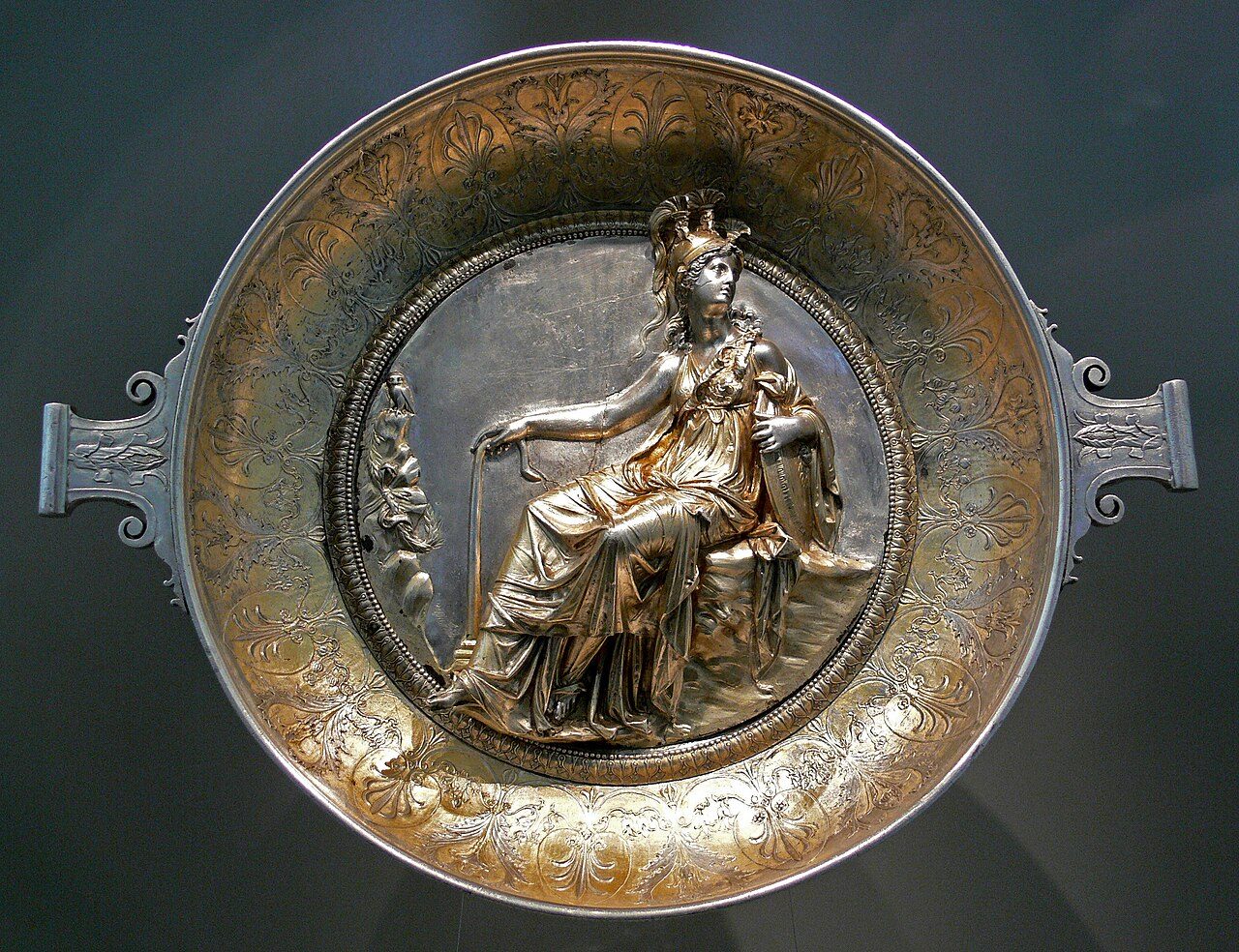
The hoard is all tableware: cups, bowls, plates, trays, ladles, an egg dish, a bucket and big mixing vessels, together with a folding tripod table and a candelabrum. The finest pieces are relief bowls whose centres carry figures beaten up almost into the round, among them Athena (Minerva) enthroned and the infant Hercules throttling the serpents. Dionysiac vines, masks and cupids wind around the drinking cups. Much of it is Augustan, from the decades either side of the birth of Christ, and some pieces are older.
The service was assembled, not commissioned in one go. Owners' names scratched on different pieces show it passed through several hands, and some vessels are heavily worn. Ancient numbers and weights punched on the silver suggest that what lay in the pit was only half of a set: for several types exactly half the recorded number was found, which has led some scholars to think the ensemble had been deliberately divided.
Who buried it is the great open question. Hildesheim enthusiasts long linked it to Publius Quinctilius Varus and his army's destruction in AD 9, but finds since 1987 place that battle at Kalkriese near Osnabrück, and the mixed, worn service hardly suits a nobleman of the imperial family. Other suggestions are booty from a Roman camp, the property of an officer in Augustan Germany, or an offering by a Germanic leader. The orderly way the vessels were packed, with smaller vessels apparently set inside a bucket, a krater and a kantharos, points to deliberate concealment or a ritual deposit rather than panic.
The silver was restored between 1895 and 1901, when Erich Pernice and Franz Winter published the standard monograph. One large krater decorated with cupids among vine tendrils went missing in 1945 and is now known from a copy. Electrotype and silver replicas made in the nineteenth century spread the treasure's fame to museums from London to Moscow, and its designs were copied for modern table silver.
Highlights
A two-handled gilt bowl about 25 cm across, with the seated goddess, helmeted, with her owl and shield, rising in high relief from the centre. It weighs almost 2.4 kg.
An emblem dish whose centre shows the infant hero gripping two snakes, one of a set of three bust bowls with Cybele and Attis or Men.
A collapsible silver table stand, rare evidence for the portable furniture a Roman officer or official might take on campaign.
Drinking cups covered with masks, vines and animals in crisp repoussé, among the best Augustan relief silver to survive.
What is in it
A Roman dining and drinking service in solid silver, some of it gilded: emblem bowls, cups, plates, serving trays, ladles, a krater, a bucket, a folding tripod table and a candelabrum.
Size: over 70 pieces (published counts range from about 70 to 77).
| Item | Number | Notes |
|---|---|---|
| Drinking cups and bowls | many | Including relief cups with Dionysiac scenes and three emblem bowls with busts in high relief |
| Plates, trays and serving vessels | many | Fluted dishes, a large rectangular tray, a bucket (situla), a bell krater and a volute krater |
| Furniture and lighting | 2+ | A folding three-legged table and a candelabrum |
Photographs
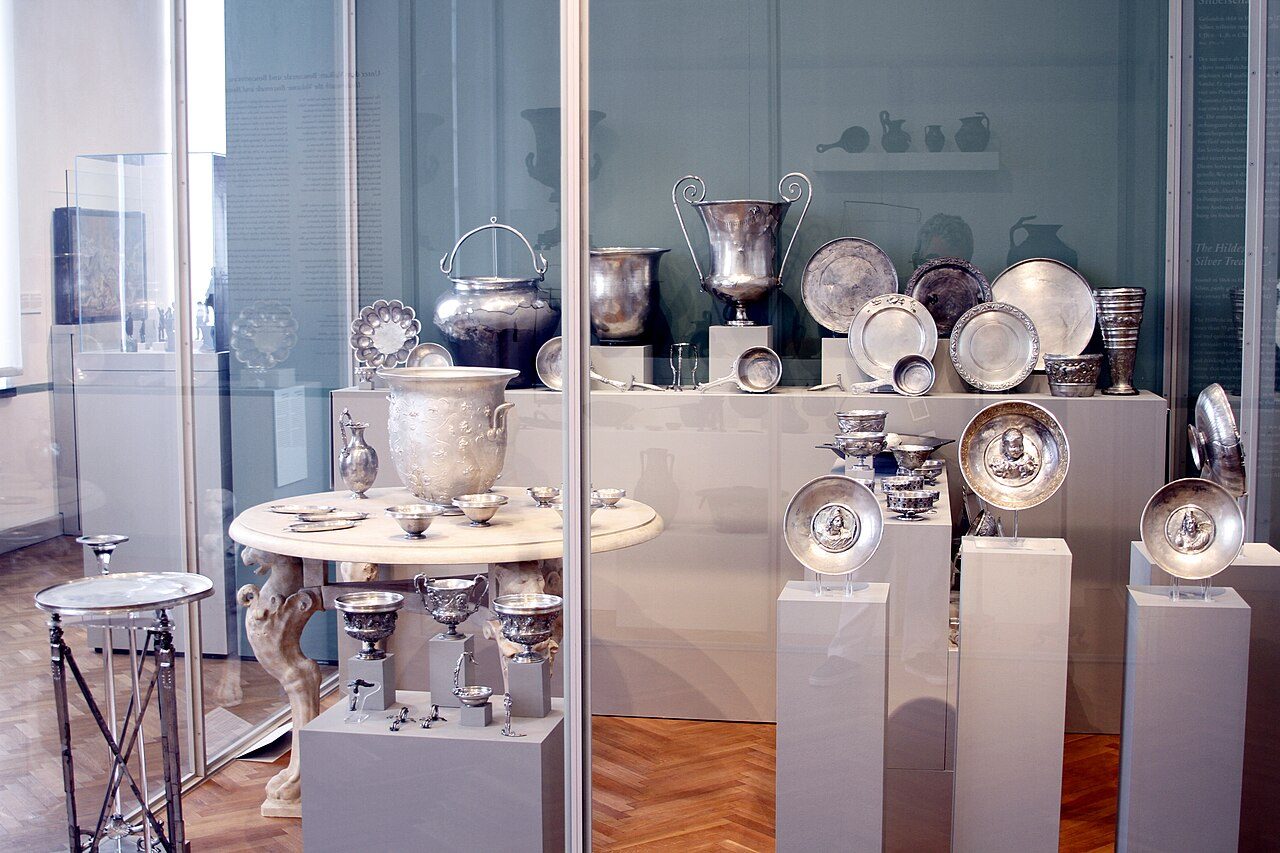
Photo: José Luiz, CC BY-SA 4.0, via Wikimedia Commons
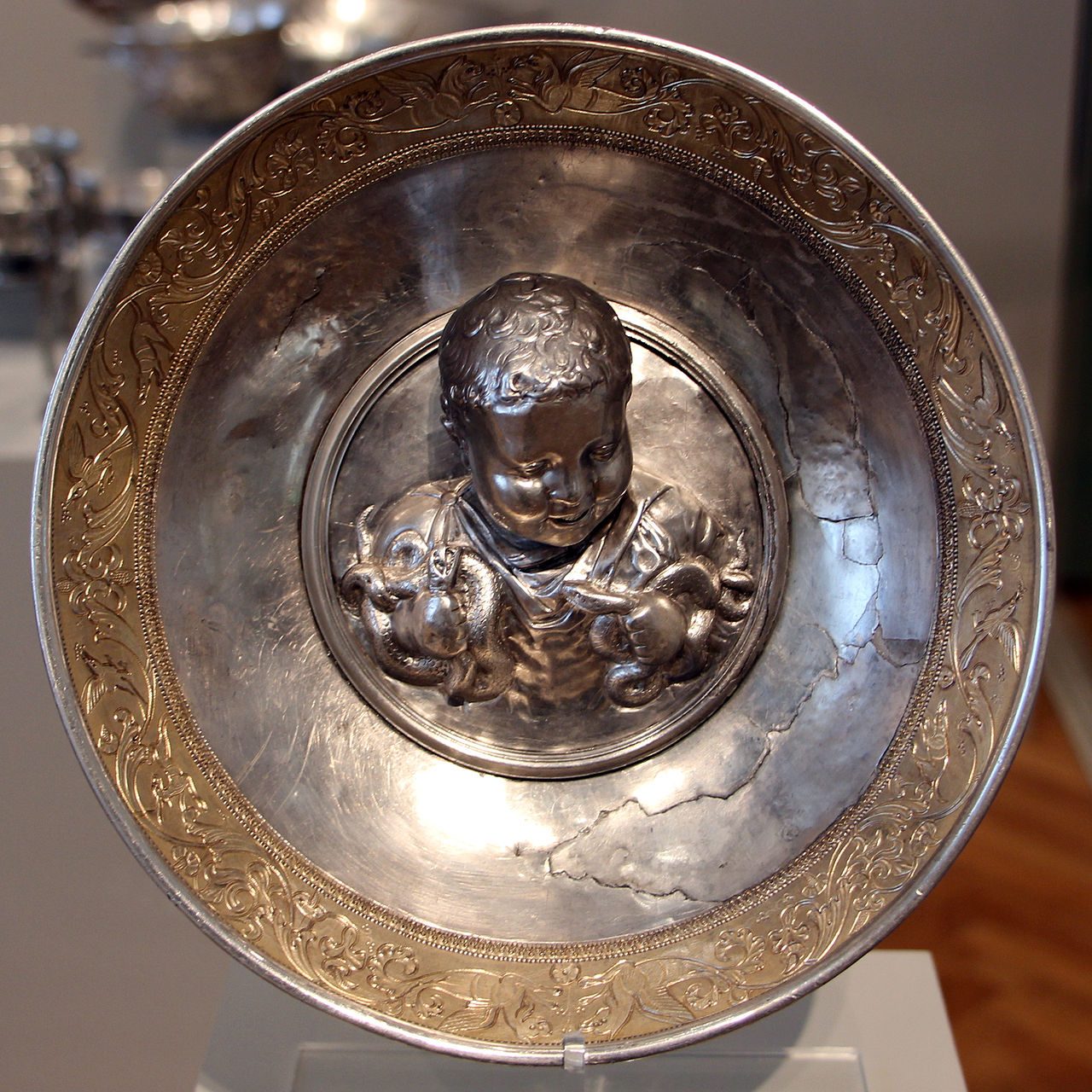
Photo: Sailko, CC BY 3.0, via Wikimedia Commons
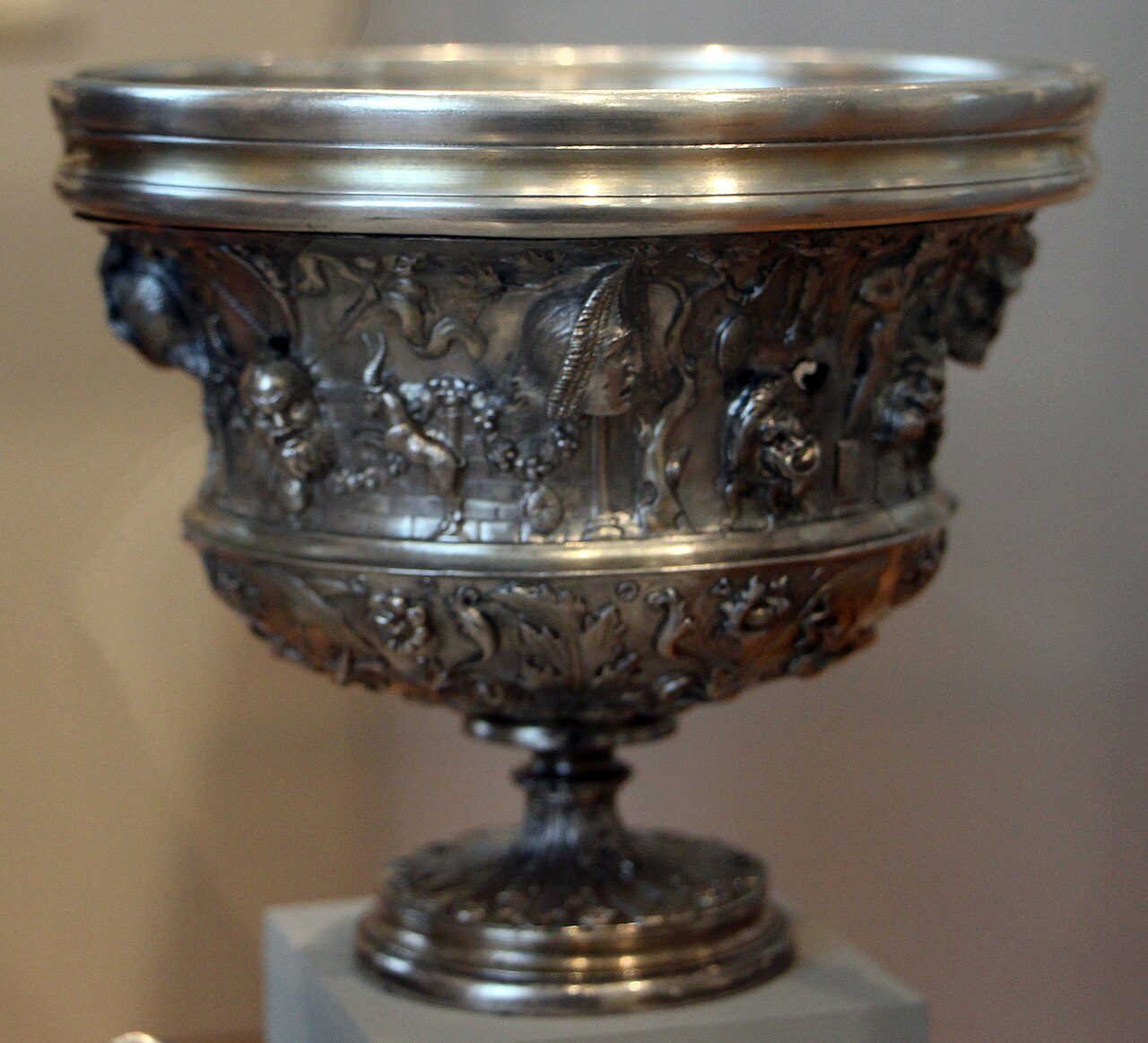
Photo: Sailko, CC BY 3.0, via Wikimedia Commons
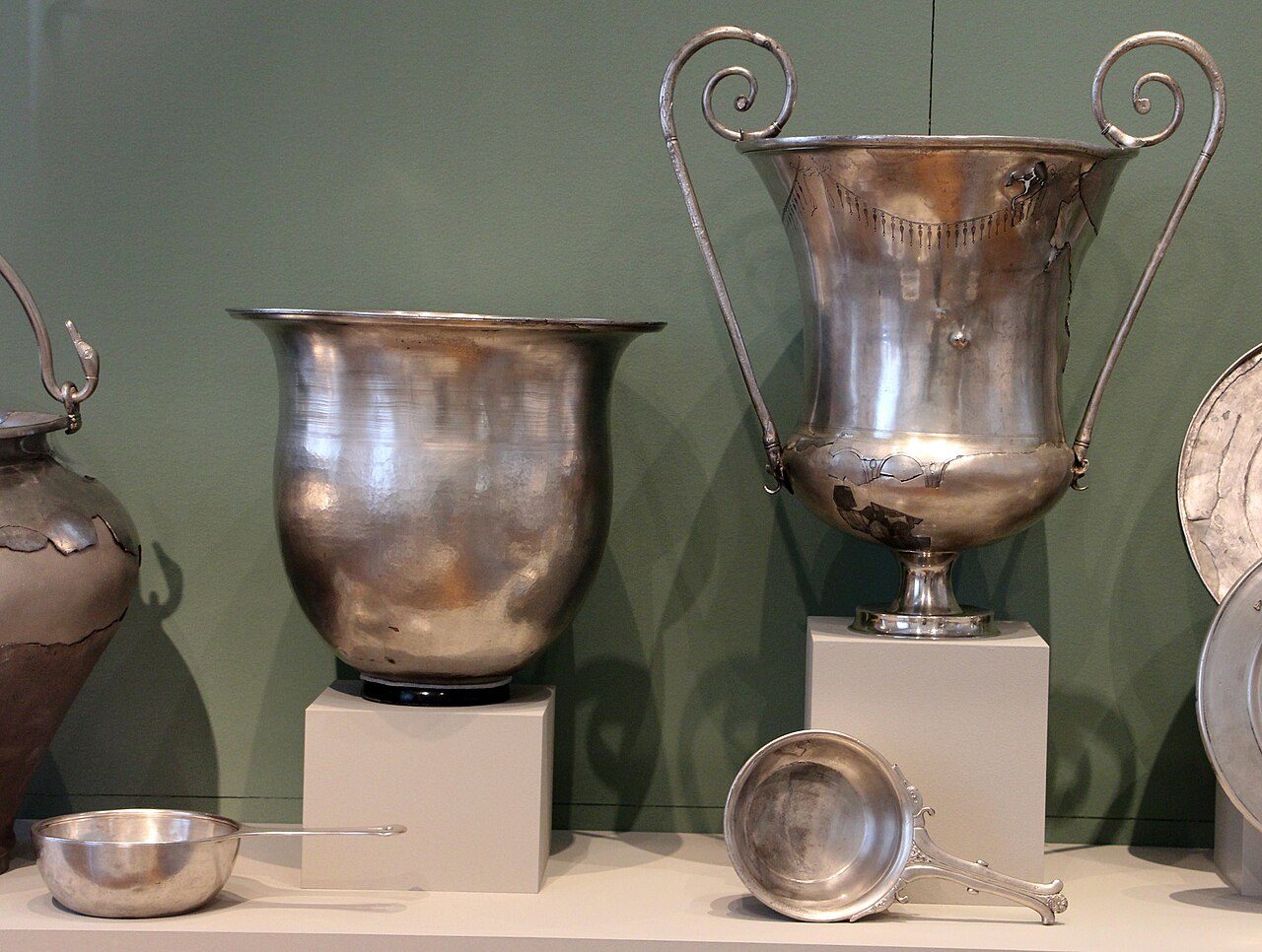
Photo: Sailko, CC BY 3.0, via Wikimedia Commons
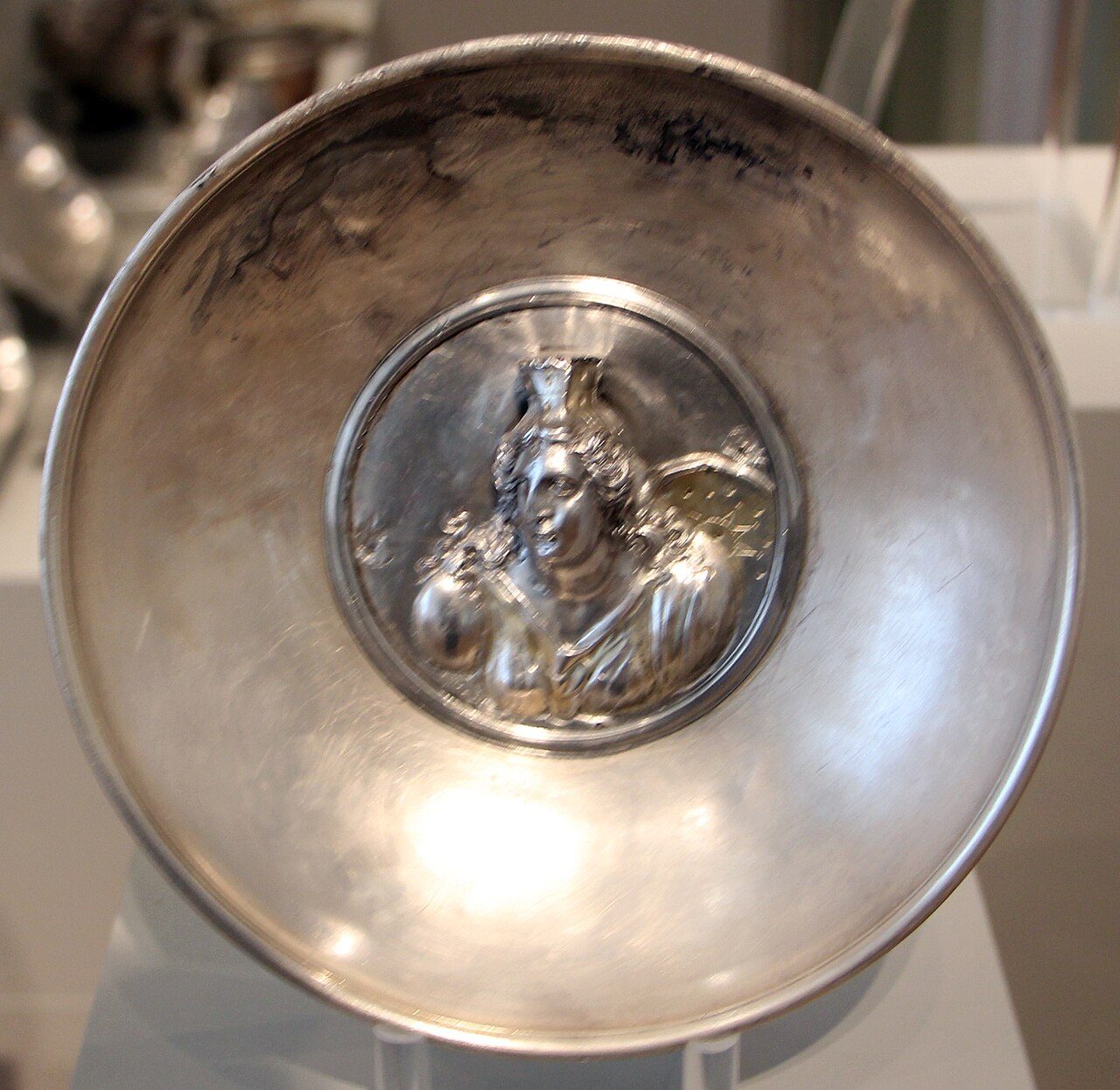
Photo: Sailko, CC BY 3.0, via Wikimedia Commons
How it is dated
No coins were found with the silver, so the deposit date rests on style and on the history of Roman Germany. Most of the vessels are Augustan, with some older Hellenistic-style pieces; a burial in the first century AD is usual, but whether during Augustus' German campaigns, after the Varus disaster of AD 9 or later is disputed.
What happened after the find
Because it was found on land belonging to the Prussian state, the silver was sent to Berlin within weeks and passed to the Royal Museums there. Hildesheim later received a full set of copies.
Where sources differ
- The number of pieces: English Wikipedia says about 70, German Wikipedia 73, and reports of the 2018 anniversary exhibition 77 (perhaps counting fragments separately).
- Total weight: a 2018 review of Barbara Niemeyer's anniversary volume is reported to give about 54 kg, but I could not open the review to confirm it, so no weight is given.
- The burial date and the owner are unknown; the Varus connection is now generally rejected.
- German Wikipedia names the bust on the third emblem bowl as Men, English Wikipedia as Attis.
Questions
Where is the Hildesheim Treasure now?
In the Antikensammlung of the Staatliche Museen zu Berlin, displayed in the Altes Museum on Museum Island. It went to Berlin a few weeks after it was found in 1868, and Hildesheim received copies.
Did the Hildesheim silver belong to Varus?
Probably not. The idea was popular in the nineteenth century, but the Varus battle is now located at Kalkriese near Osnabrück, and the worn, mixed service, with several owners' names, looks more like an officer's or official's set than the plate of an imperial relative.
How old is the Hildesheim Treasure?
Most pieces were made in the time of Augustus, roughly 30 BC to AD 14, with a few older ones. When it was buried is uncertain, probably sometime in the first century AD.