In April 1895 workmen digging out a Roman farmhouse at Boscoreale, on the lower slopes of Vesuvius north of Pompeii, broke into a vaulted pit in the room where the villa's wine had been pressed. Inside lay more than a hundred pieces of silver plate, gold jewellery and a leather bag holding about a thousand gold coins. The villa, known as the Villa della Pisanella, had been buried by the eruption of AD 79, and whoever stowed the valuables there never came back for them.
The excavation was a private one on private land, and the finds went straight to the market. The Naples museum was offered the treasure and judged the price too high; most of it left Italy and was bought by Baron Edmond de Rothschild, who gave it to the Louvre in 1896. Other collectors and dealers supplied the remaining pieces, and a few went to the British Museum. Whether the export was legal is still argued over: Italy's first strong export law came only in 1902, but the treasure's route to Paris was murky at the time. The coins were sold off without anyone recording them properly.
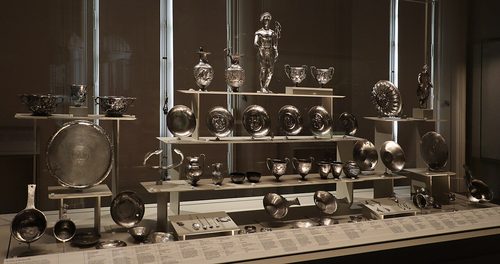
What survived as a group is the most complete Roman silver service known. It covers every part of elegant dining: cups and jugs for wine, serving dishes and platters, mirrors and toilet vessels. Several pieces carry the name Maxima scratched or punched on them, probably the last owner of the set. Some vessels were already antiques when the eruption came, heirlooms made generations earlier.
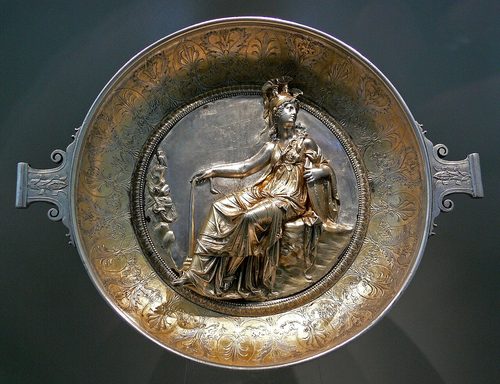
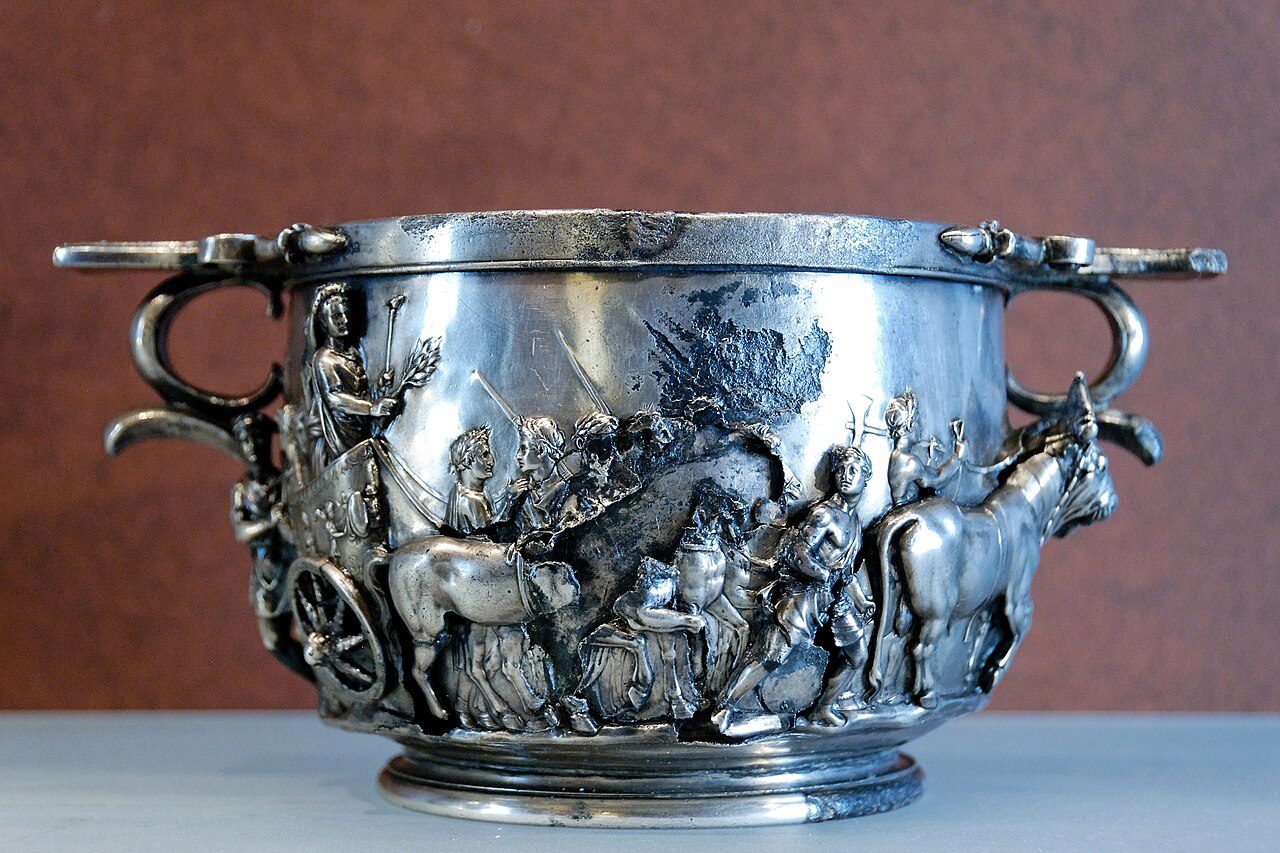
Its fame rests on a handful of extraordinary pieces. Two skyphoi carry state propaganda in miniature: on one, Augustus sits enthroned while defeated barbarians submit; on the other, Tiberius rides in a triumphal chariot and sacrifices before a temple. A dish shows a woman in an elephant-skin headdress surrounded by symbols of Africa, read by some scholars as Cleopatra Selene, daughter of Cleopatra and Queen of Mauretania. A pair of cups carry skeletons of Greek poets and philosophers under garlands, a joke about death to be enjoyed with a full glass.
The hoard is often compared with the Hildesheim silver found in Germany and with the plate found in Pompeii's House of the Menander. Together they show what a rich household of the early Empire set on its table. Boscoreale adds a sense of the moment of loss: the silver was packed away carefully in a cistern-like store, probably in the hope of rescuing it later, while its owners fled or died.
Excavations at the villa recovered a woman's body nearby, and it is tempting to connect her with Maxima. There is no evidence that the two are the same, and the identity of the owners of the villa remains a matter of educated guesswork.
Highlights
A two-handled silver cup on which the emperor, seated among his lictors, receives the submission of defeated barbarians; the other side shows him among the gods.
Its pair shows the future emperor riding in triumph through Rome and, on the reverse, a bull sacrificed before a temple.
A partly gilded dish with a woman's bust in high relief, wearing an elephant scalp and surrounded by symbols of plenty; possibly a posthumous portrait of Cleopatra Selene.
Two cups decorated with skeletons of famous Greek poets and philosophers, urging drinkers to enjoy life while they can.
A polished silver hand mirror whose back shows Leda and Jupiter in the form of a swan.
What is in it
A complete household set of silver plate for dining, drinking and the toilet, with gold jewellery and a bag of about a thousand gold aurei.
Size: 109 pieces of silver in the Louvre, plus jewellery and coins. Weight: over 30 kg of silver.
| Item | Number | Notes |
|---|---|---|
| Silver plate | 109 in the Louvre | Cups, skyphoi, kantharoi, jugs, dishes, mirrors and toilet vessels, a few more in the British Museum |
| Gold jewellery | about 9 | Chain, bracelets and earrings |
| Gold coins | about 1,000 | Aurei of the late Republic and early Empire, dispersed on the market without being recorded |
Photographs
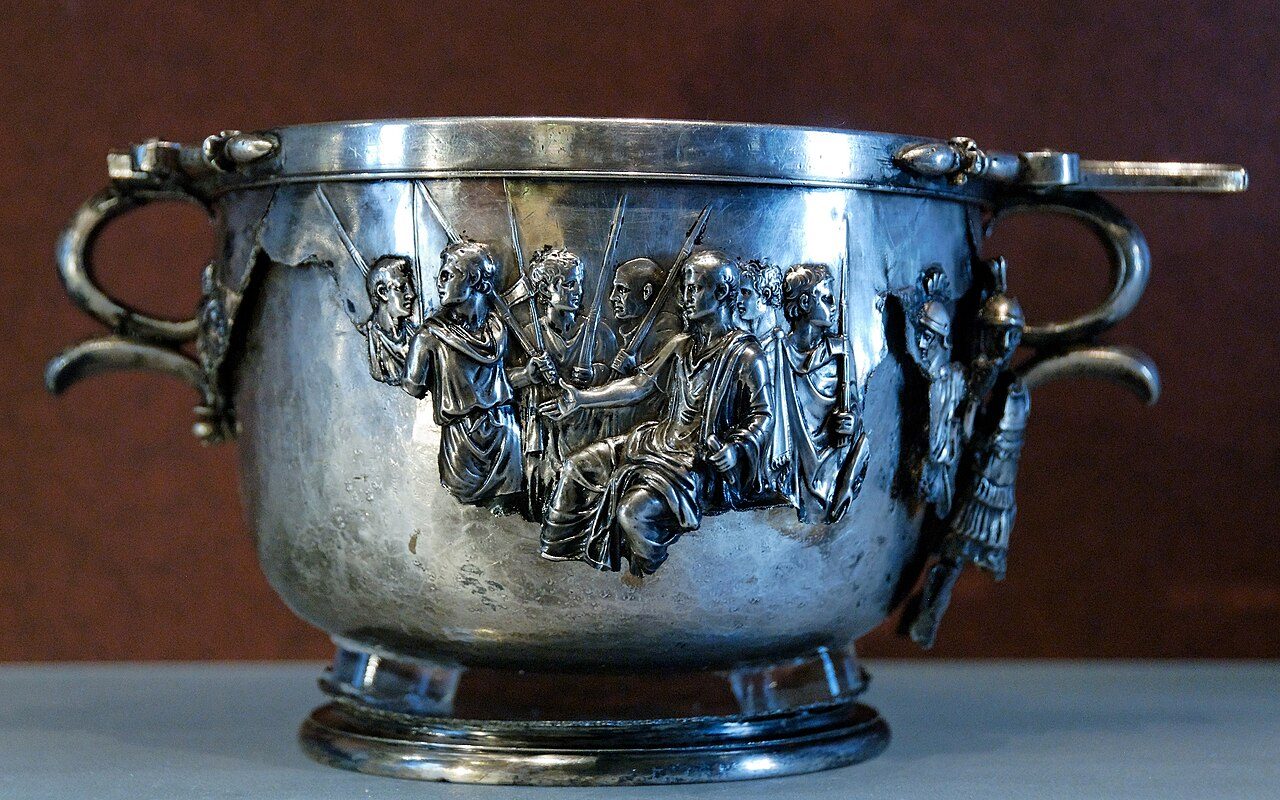
Photo: Unknown, CC BY 2.5, via Wikimedia Commons
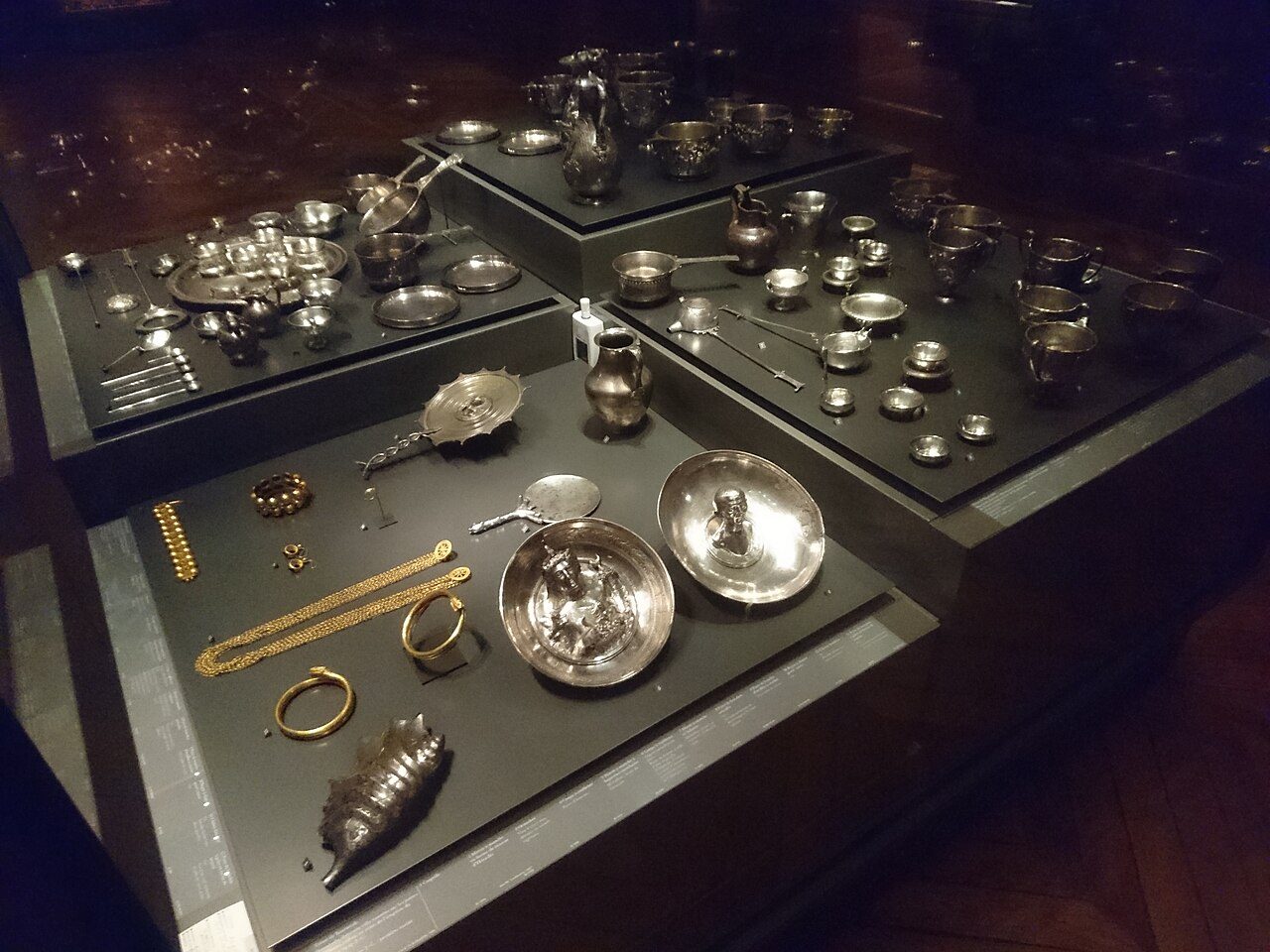
Photo: Shonagon, CC0, via Wikimedia Commons
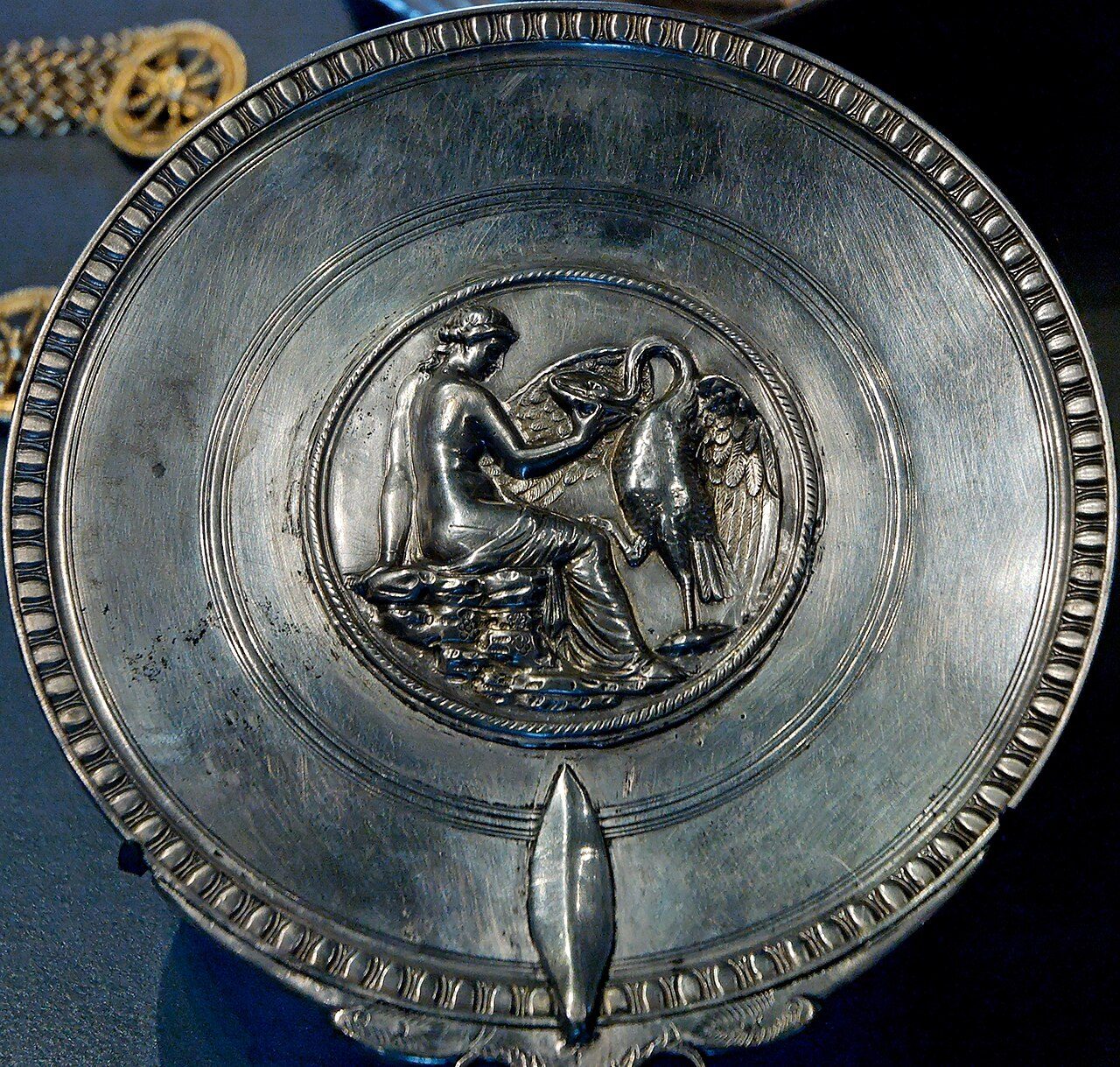
Photo: Unknown artist, Public domain, via Wikimedia Commons
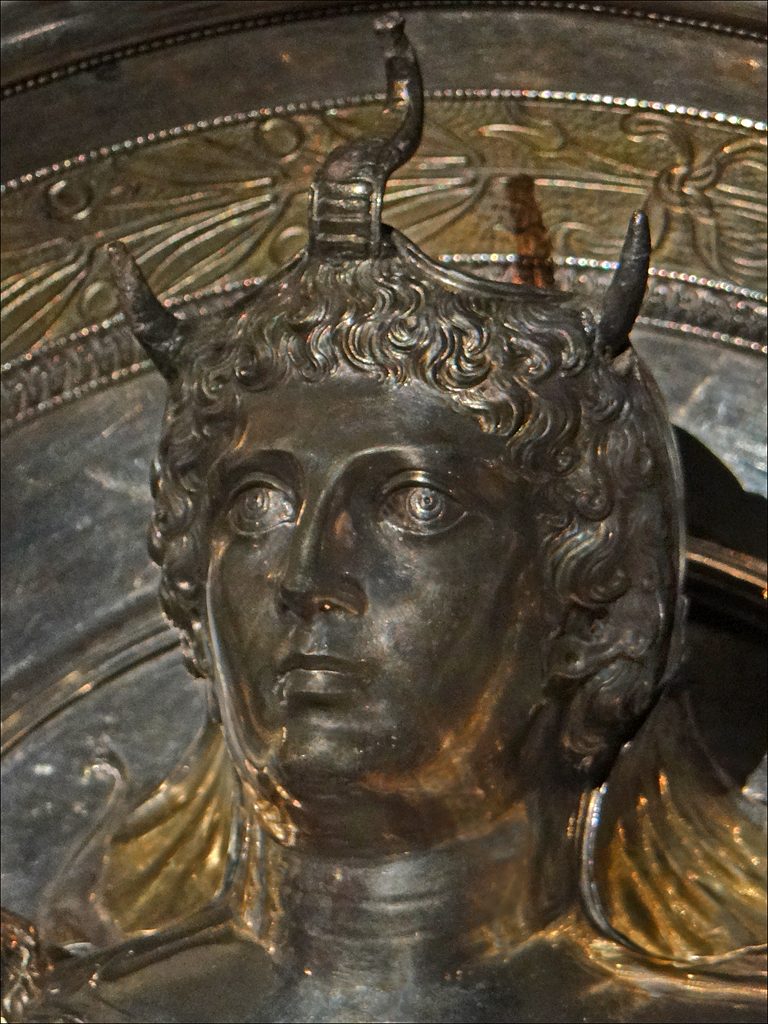
Photo: Jean-Pierre Dalbéra from Paris, France, Public domain, via Wikimedia Commons
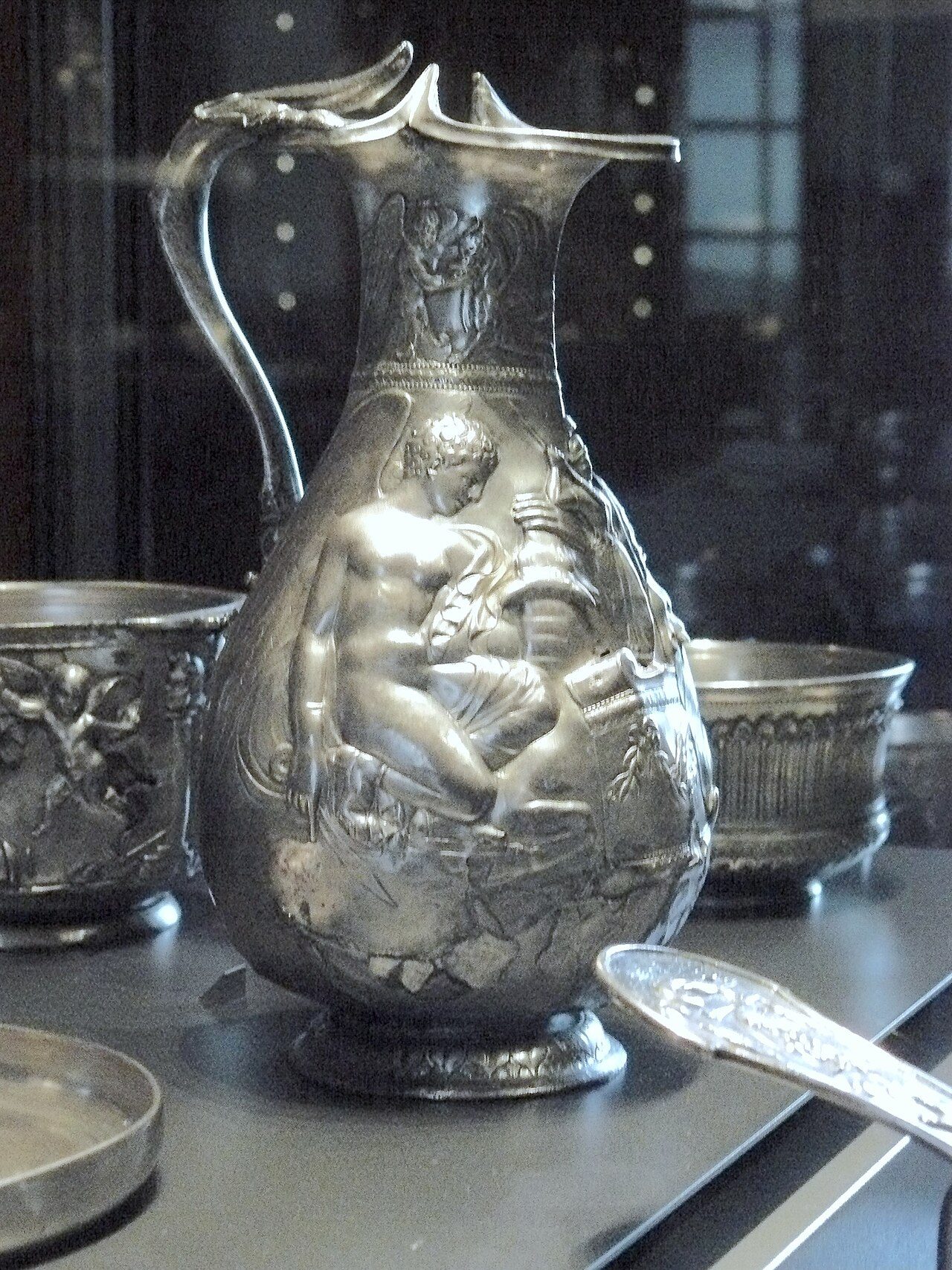
Photo: Siren-Com, CC BY-SA 3.0, via Wikimedia Commons
How it is dated
The deposit is dated by the eruption of Vesuvius in AD 79, which buried the villa, and the coins reportedly ran up to that year. The silver itself ranges in date from Hellenistic heirlooms to pieces of the first century AD.
What happened after the find
Found during a private excavation in 1895 and sold on the open market, as Italian law then allowed; Edmond de Rothschild bought most of it and gave it to the Louvre in 1896. French sources describe the export as irregular, English ones as legal, and the point remains disputed.
Where sources differ
- Object count: the Louvre holds 109 pieces, but a 2015 Louvre statement quoted in the press gave 102 items found with the coins; some Louvre pieces may come from outside the original find.
- The coins: often given as 'about 1,000 aurei', sometimes as coins 'to the value of' 1,000 aurei; they were never properly recorded and a list published in 1909 may mix in other finds.
- Legality of the export to France: English Wikipedia says the sale was legal under the law of the day, French Wikipedia that the export was illegal.
- Identification of the Africa bust as Cleopatra Selene is a scholarly proposal, not a certainty.
- One report gives the find date as 6 April 1895 rather than 13 April.
Questions
Where is the Boscoreale Treasure now?
Almost all of it is in the Louvre in Paris, given by Baron Edmond de Rothschild in 1896 and by other donors. A few pieces are in the British Museum, and the gold coins were scattered among collectors.
Who owned the Boscoreale Treasure?
The name Maxima appears on many vessels and she was probably the last owner of the set. The owner of the villa itself is not known for certain.
What are the Boscoreale skeleton cups?
A pair of silver cups decorated with skeletons of Greek poets and philosophers, a Roman reminder to enjoy wine and life before death. They are among the best-known pieces of the treasure.