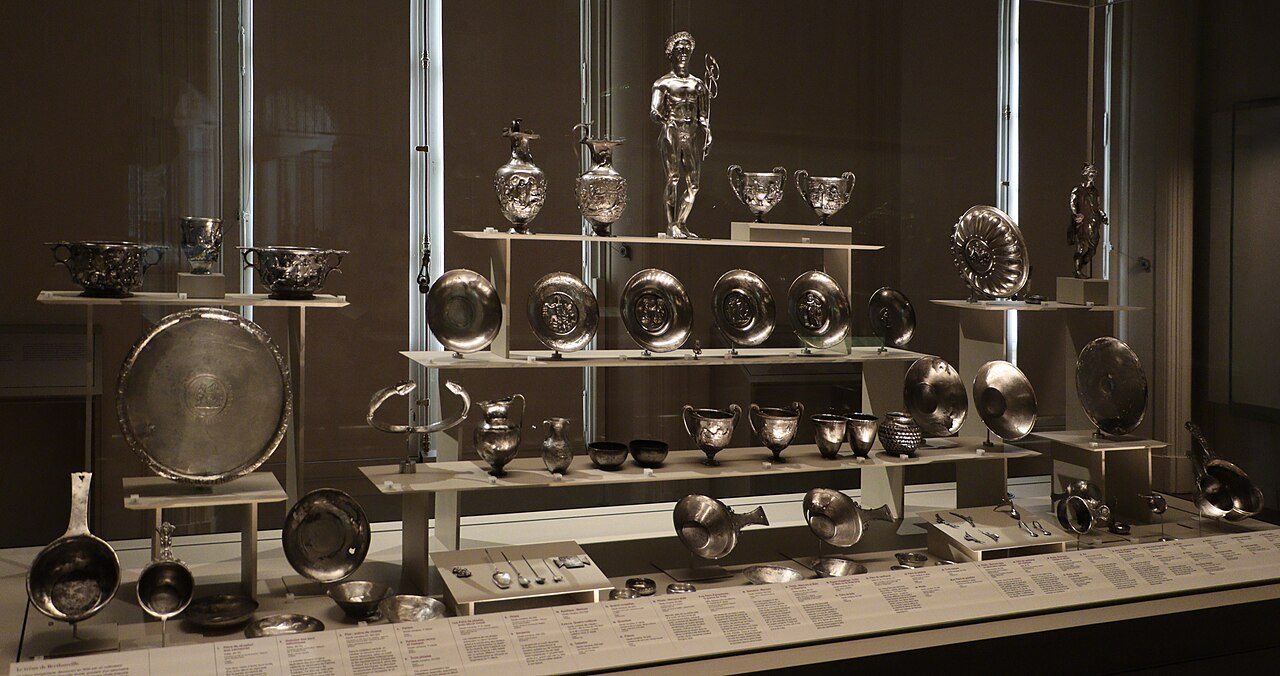
On 21 March 1830 a ploughman working a field near Berthouville in Normandy felt his share jar against a Roman roof tile. Lifting it, he found a mass of tarnished silver lying barely 20 cm below the surface. The farmer showed it to a local notable, word reached antiquaries, and the Cabinet des médailles of the Royal Library in Paris bought the lot for 15,000 francs after it had also been examined on behalf of the Louvre. That quick sale is why it was not melted down, the fate of most silver found in the nineteenth century.
The hoard turned out to be the treasury of a rural sanctuary. Later digs nearby uncovered a walled Gallo-Roman precinct with two temples and a theatre, and many of the vessels carry dedications to Mercury Canetonensis, Mercury of a place called Canetonum, in the territory of the Lexovii. Caesar had named Mercury as the chief god of the Gauls, and here he is shown in his Roman form but worshipped under a local name. The silver had been stowed in a built cache within the sanctuary.
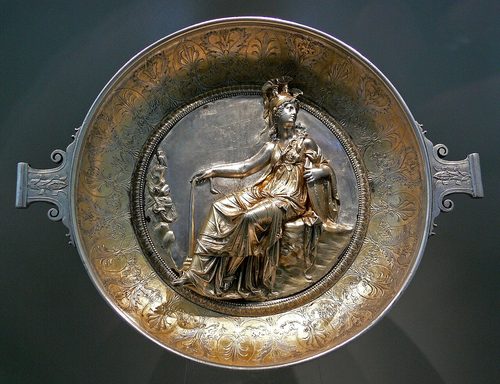
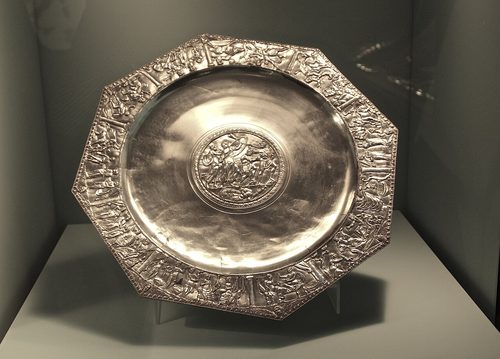
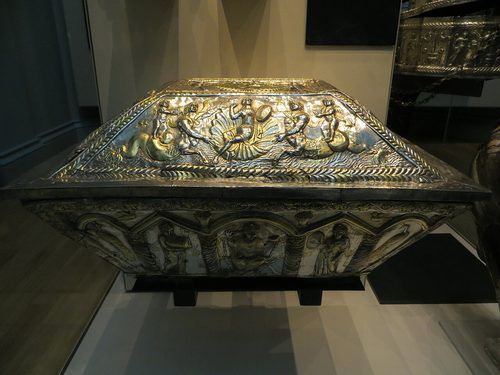
About ninety objects survive, together some 25 kg of silver. Two statuettes show Mercury nude with his purse and caduceus; the larger stands about 60 cm high. A bust of a goddess, probably his mother Maia, comes from a similar group. The rest are vessels for libation and feasting: shallow phialai with medallions, handled paterae, ladles, cups and jugs, many pricked with the letters VSLM, the standard formula for a vow fulfilled.
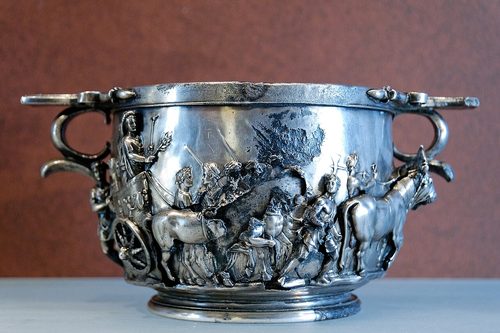
The finest pieces were not made for a country shrine at all. A Roman citizen named Quintus Domitius Tutus gave a group of about nine luxury vessels, made in Italy in the first century AD, which had probably graced a wealthy dining room before he dedicated them. Among them are a pair of jugs with scenes from the Trojan War, including Achilles mourning Patroclus, and a pair of skyphoi with centaurs and cupids in such high relief that the figures almost leave the surface. Other pieces are plainer provincial work, scratched with the names of local donors, some Gaulish, some Latin.
Why the treasure was hidden is uncertain. It used to be blamed on invasion and panic in the later 2nd or 3rd century, but the careful packing has led some scholars to see an orderly storage or safekeeping rather than an emergency burial.
Between 2010 and 2014 the whole treasure was studied and conserved at the Getty Villa in Malibu, its first journey outside France. Removing old restorations and grime revealed gilding, inlays and fine engraving that had been invisible for generations. After a tour of American museums the silver returned to Paris, where it is now a centrepiece of the renovated BnF museum.
Highlights
A pair of Italian drinking cups of the mid-1st century AD with centaurs and centauresses carrying cupids, the bodies raised so high they are almost free-standing sculpture.
Two silver jugs from the gift of Quintus Domitius Tutus, decorated with episodes from the Iliad, among them Achilles grieving over Patroclus.
About 60 cm tall, the god nude with caduceus, one of the largest silver statuettes surviving from the Roman world.
A libation bowl whose central medallion shows the god and a goddess side by side, with a dedication to Mercury.
What is in it
The silver plate of a Gallo-Roman sanctuary of Mercury: two statuettes of the god, a bust of a goddess, and about sixty bowls, cups, jugs, ladles and dishes, many inscribed as gifts, plus handles, appliqués and fragments.
Size: about 90 objects (counts range from about 90 to 100). Weight: about 25 kg.
| Item | Number | Notes |
|---|---|---|
| Statuettes and busts | 3 | Two silver statuettes of Mercury, the larger about 60 cm tall, and a bust of a goddess, probably Maia |
| Vessels | about 60 | Phialai, paterae, cups, skyphoi, kantharoi, jugs, ladles and dishes, many with votive inscriptions |
| Components and fragments | dozens | Detached handles, appliqués and other pieces |
Photographs
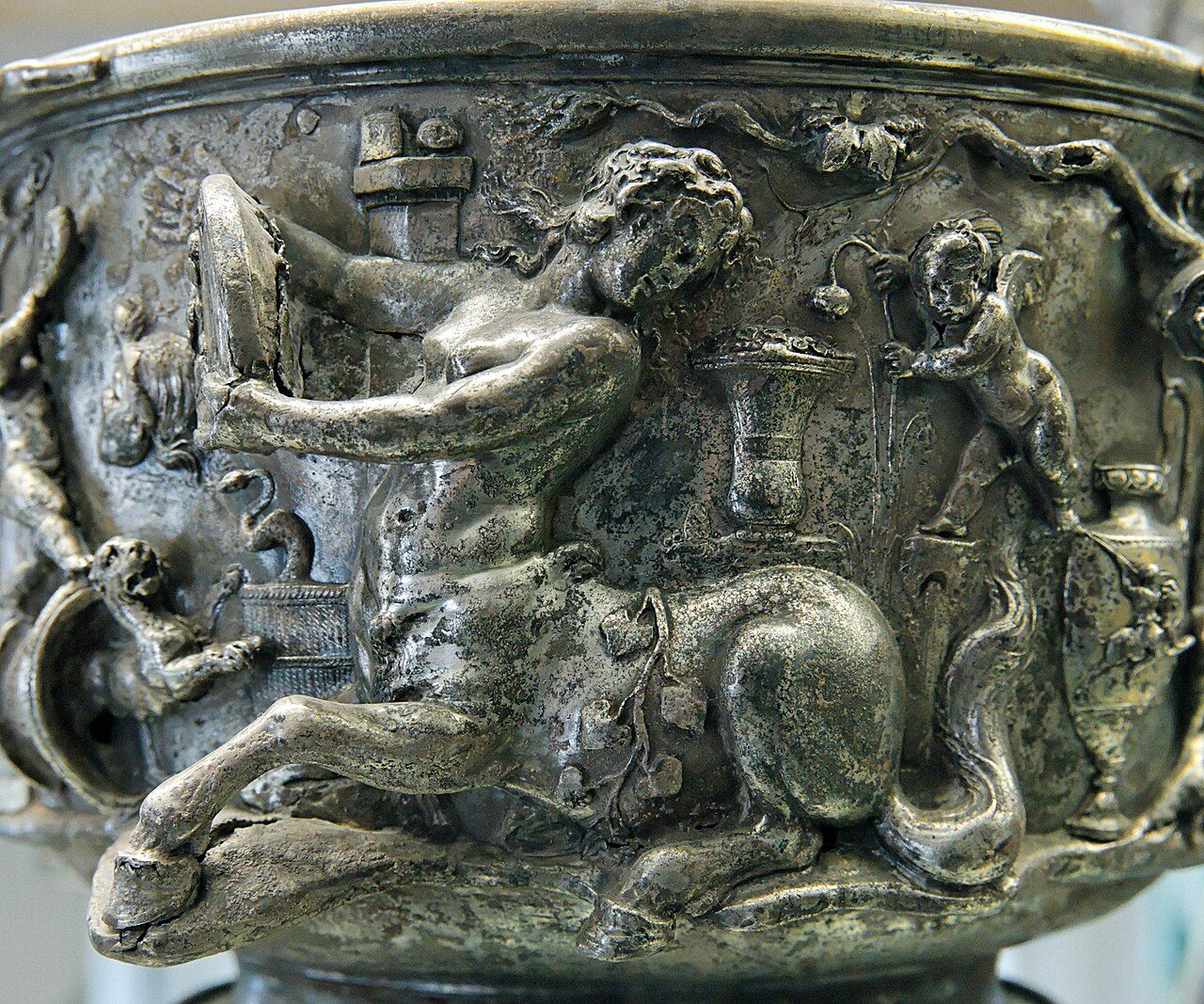
Photo: Unknown, CC BY 2.5, via Wikimedia Commons
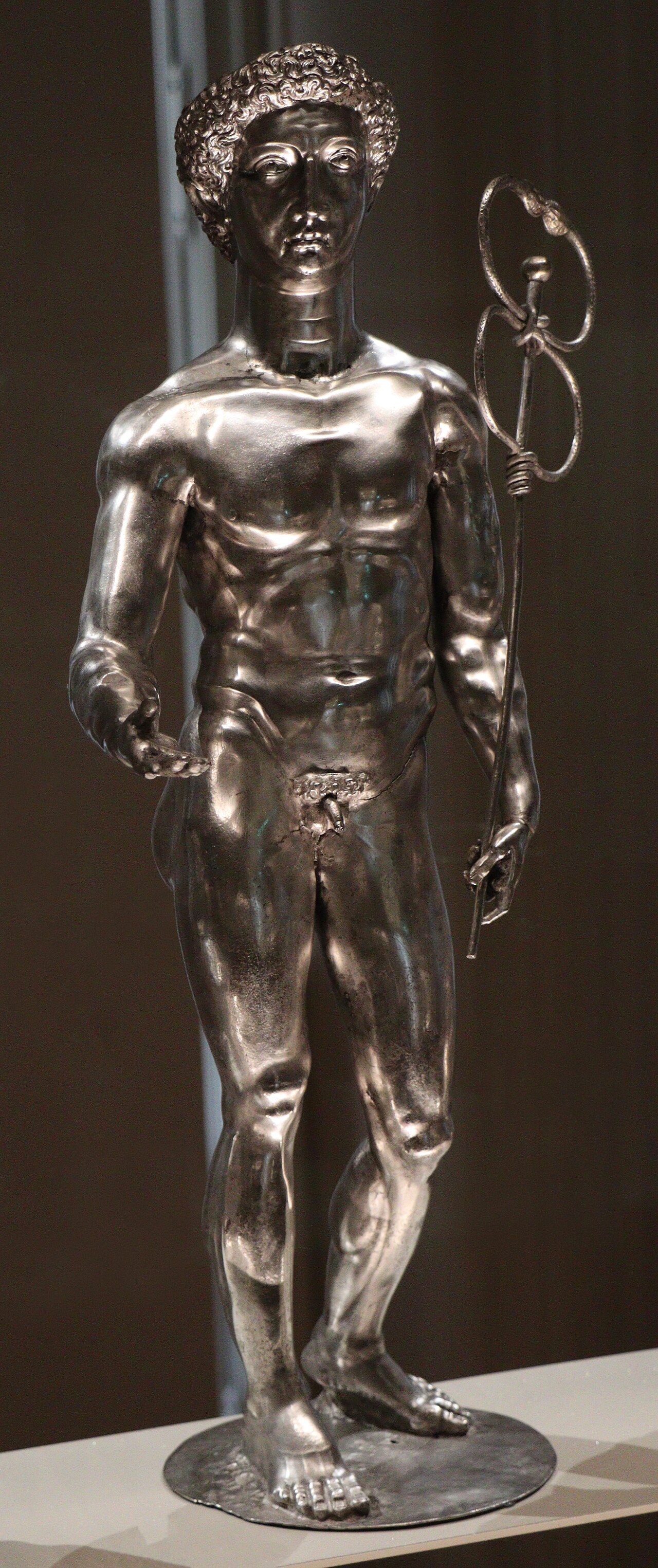
Photo: Francesco Bini, CC BY-SA 4.0, via Wikimedia Commons
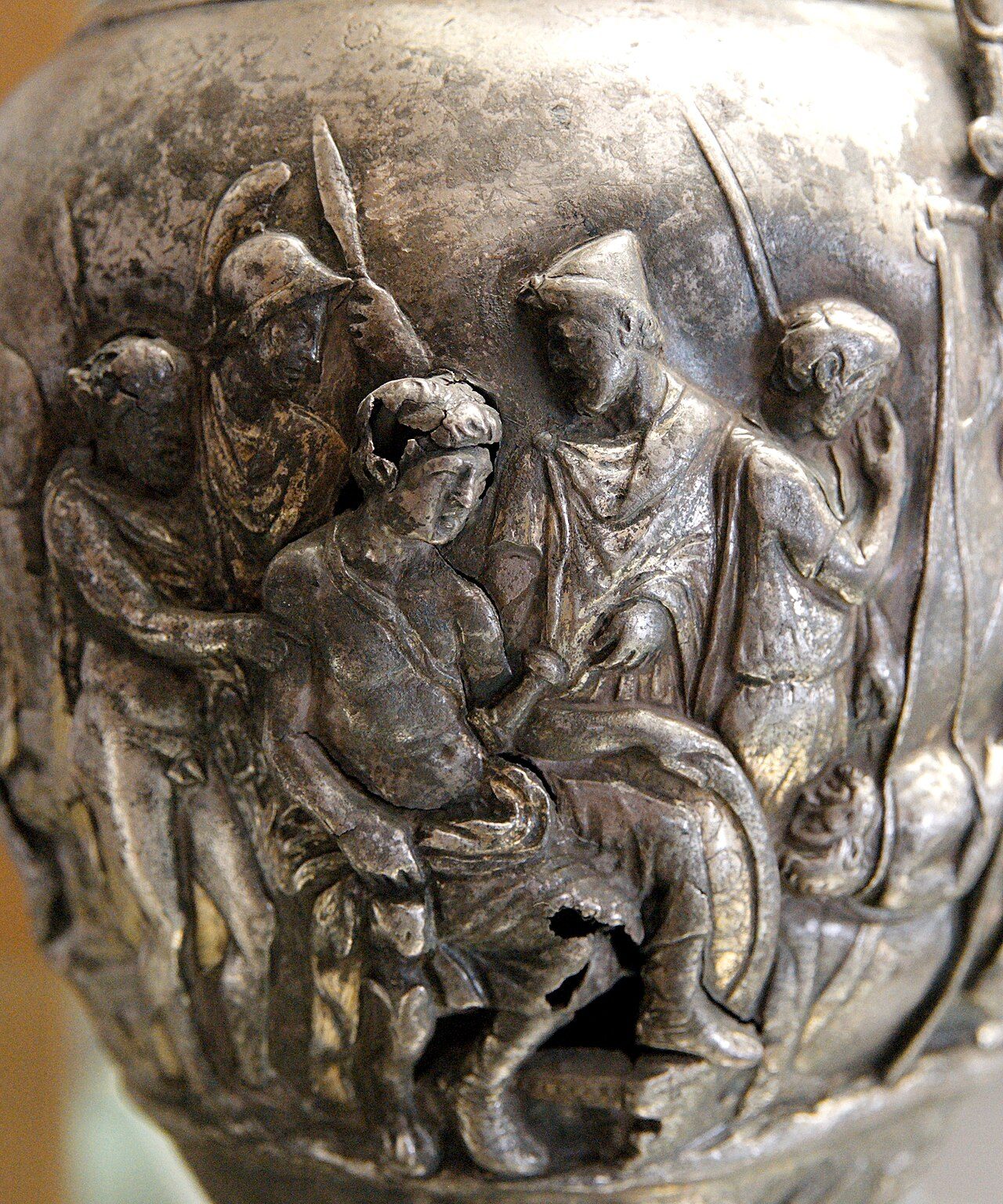
Photo: Unknown, CC BY 2.5, via Wikimedia Commons
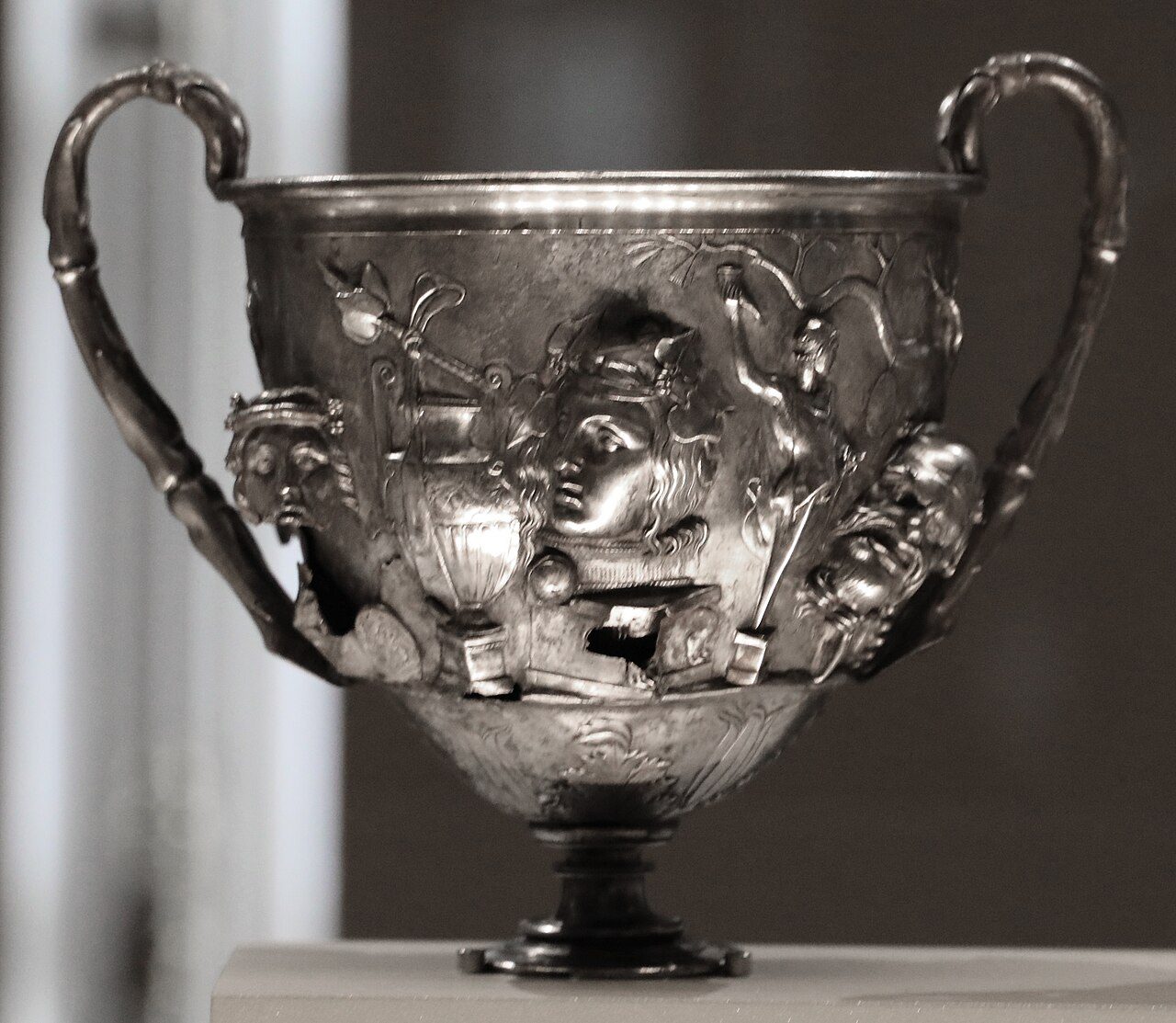
Photo: Francesco Bini, CC BY-SA 4.0, via Wikimedia Commons
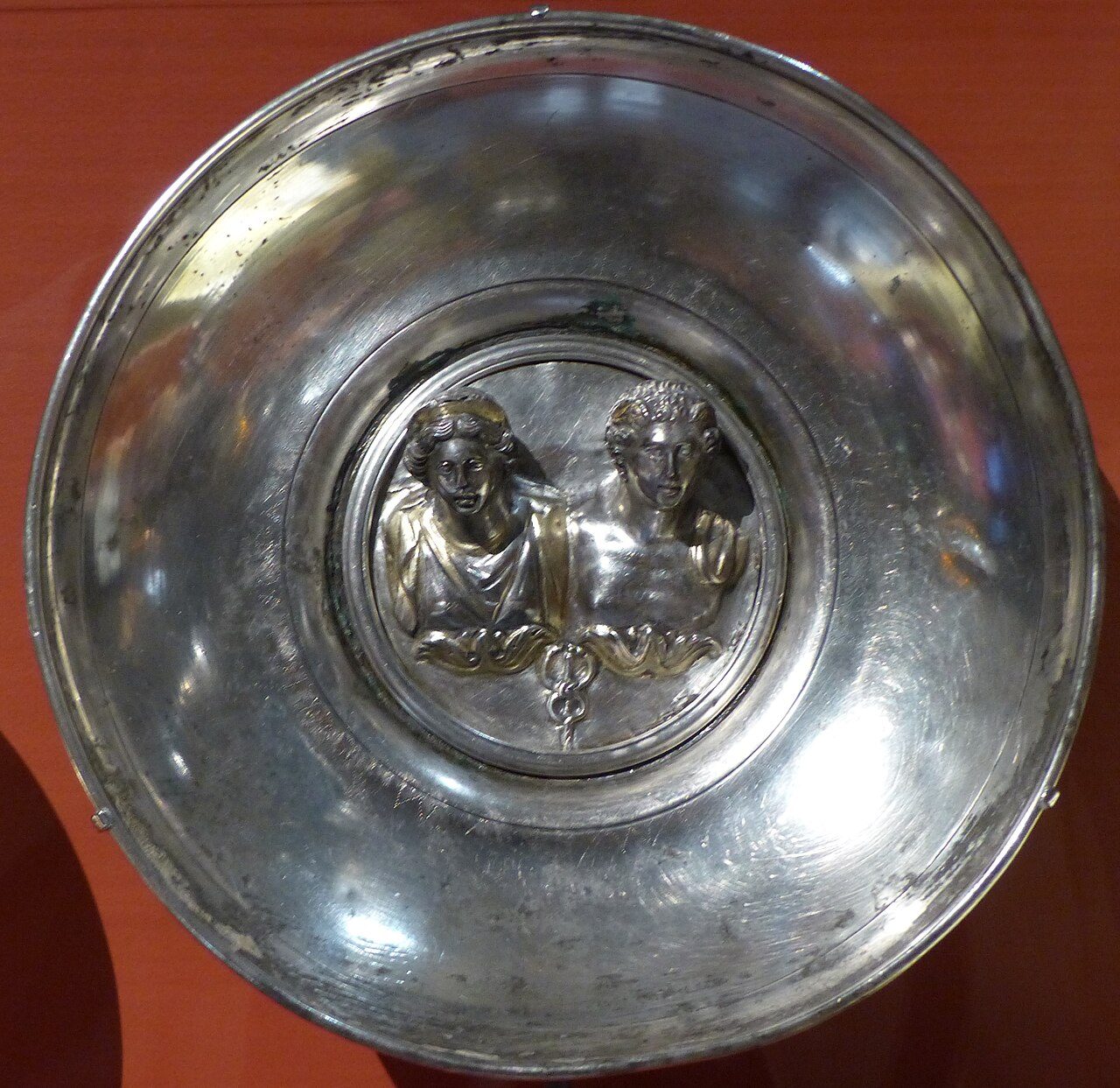
Photo: Finoskov, CC BY-SA 4.0, via Wikimedia Commons
How it is dated
There are no coins. The vessels range from 1st-century Italian work to 2nd-century provincial pieces, so the treasure must have been hidden after the later 2nd century; dates proposed run from the end of the 2nd into the 3rd century.
What happened after the find
Bought in 1830 from the finder for 15,000 francs by the Cabinet des médailles of the Bibliothèque royale (now the BnF's Département des Monnaies, médailles et antiques).
Where sources differ
- Object count: English Wikipedia gives 93, the Getty about 90, French Wikipedia about 100, and the ISAW catalogue about sixty vessels plus two statuettes and dozens of components and fragments.
- Dates of the later excavations: English Wikipedia says 1861-62 and 1986, the Getty 1861 and 1896, French Wikipedia 1897-98.
- The goddess bust is usually identified as Maia, but the identification (Maia or Rosmerta) is not certain.
- Whether the cache was an emergency burial or orderly storage is debated.
Questions
Where can I see the Berthouville Treasure?
In the museum of the Bibliothèque nationale de France at its Richelieu site in central Paris, in the central case of the room devoted to precious metalwork. Copies of the main pieces are in the municipal museum at Bernay, near the findspot.
Who was Mercury Canetonensis?
The god Mercury as worshipped at Canetonum, a sanctuary in Roman Gaul near modern Berthouville. Gauls often gave Roman gods local epithets, and many of the silver vessels carry dedications using this name.
How much is the Berthouville Treasure worth?
It has no market value because it belongs to the French national collections. It was bought in 1830 for 15,000 francs.
Sources
- Berthouville Treasure (Wikipedia)
- Trésor de Berthouville (French Wikipedia)
- Magnificent Ancient Roman Silver Treasure on View Following Four-Year Conservation Project (J. Paul Getty Museum)
- The Berthouville Silver Treasure and Roman Luxury (ISAW, NYU)
- Le parcours du musée de la BnF (Bibliothèque nationale de France)
- Wikidata Q1547010 (CC0)