In November 2004, during an organised metal detecting rally on farmland at Huxley, south-east of Chester, a detectorist found pieces of lead sheet about 30 cm below the turf. Under them lay a bundle of flattened silver bands. Their stamped decoration marked them as Viking straight away, and a local archaeologist who happened to be in the area excavated the spot. Apart from 39 scraps of lead, nothing else was found with them.
The hoard is a single, compact parcel: 21 silver arm-rings and one small cast ingot, about 1.5 kg of silver in all. Twenty of the rings are penannular bands, broad strips of silver bent round the arm with a gap; the twenty-first was found twisted into a bar and is stamped with a zig-zag. Before burial the rings had been folded or hammered flat, probably to pack them tightly.
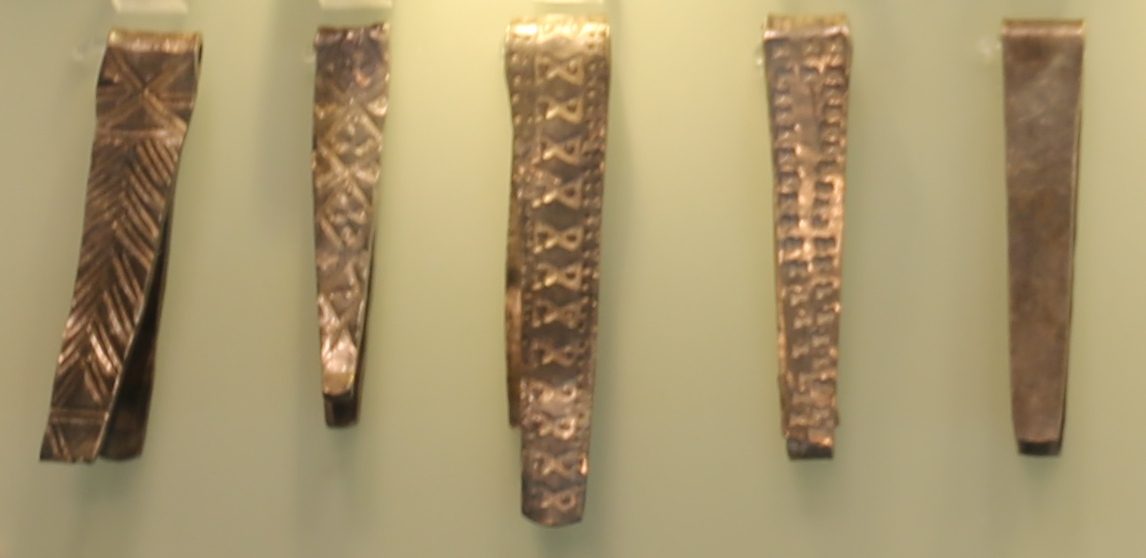
The decoration is what makes Huxley distinctive. Sixteen of the bands are covered with punched patterns, many built around a saltire, the diagonal cross: six have a cross stamped at the centre, six more have crosses at the centre and both ends, and others carry lattice, hourglass and chevron designs. Four are plain. One ring looks as if its decoration was never finished, or was done by a less practised hand. Four are incomplete, perhaps cut for their metal.
Rings of this broad-band type were made by Norse settlers in Dublin in the late 9th and early 10th centuries, and the same type fills much of the Cuerdale Hoard, buried about 905-910. Huxley is thought to date from the same years. One view is that it belonged to Norse incomers from Ireland who settled in Cheshire and the Wirral after the Vikings were driven out of Dublin in 902; another sees it as the takings of raiders who meant to come back. Either way, it is silver as currency, kept in a form that could be worn, weighed or cut.
Huxley is one of a cluster of Viking-age hoards found in and around Chester. After study at the British Museum it was declared Treasure and bought jointly by the Grosvenor Museum in Chester, Cheshire Museums Service and National Museums Liverpool, helped by a £45,000 Heritage Lottery Fund grant.
Highlights
Broad silver bands punched with rows of saltire crosses and triangles, the hallmark of Hiberno-Norse ring-making around 900.
One band carries only partial, rougher decoration, as if unfinished or made by a learner.
A ring found twisted into a bar and stamped with a zig-zag pattern, unlike the flat bands.
Thirty-nine fragments of lead show the silver was wrapped in sheet lead or packed in a lead-lined wooden box.
What is in it
Twenty-one silver arm-rings, folded or flattened for storage, most stamped with saltire crosses and other punched patterns, with one small cast ingot and 39 fragments of the lead that wrapped them.
Size: 22 silver items (plus 39 lead fragments). Weight: about 1.5 kg.
| Item | Number | Notes |
|---|---|---|
| Penannular arm-rings | 20 | flattened; 16 with stamped decoration, many with saltire crosses; 4 plain; 4 incomplete |
| Twisted arm-ring | 1 | found as a twisted bar with zig-zag stamping |
| Ingot | 1 | small, cast |
| Lead fragments | 39 | from a lead wrapping or the lining of a wooden box |
Photographs
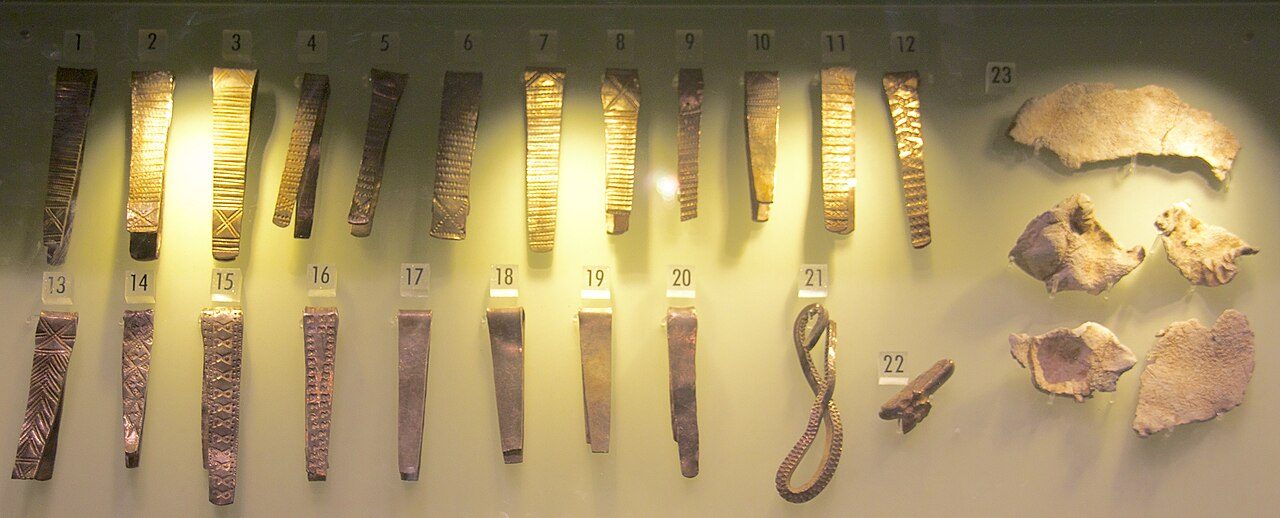
Photo: Mike Peel ( www.mikepeel.net )., CC BY-SA 4.0, via Wikimedia Commons
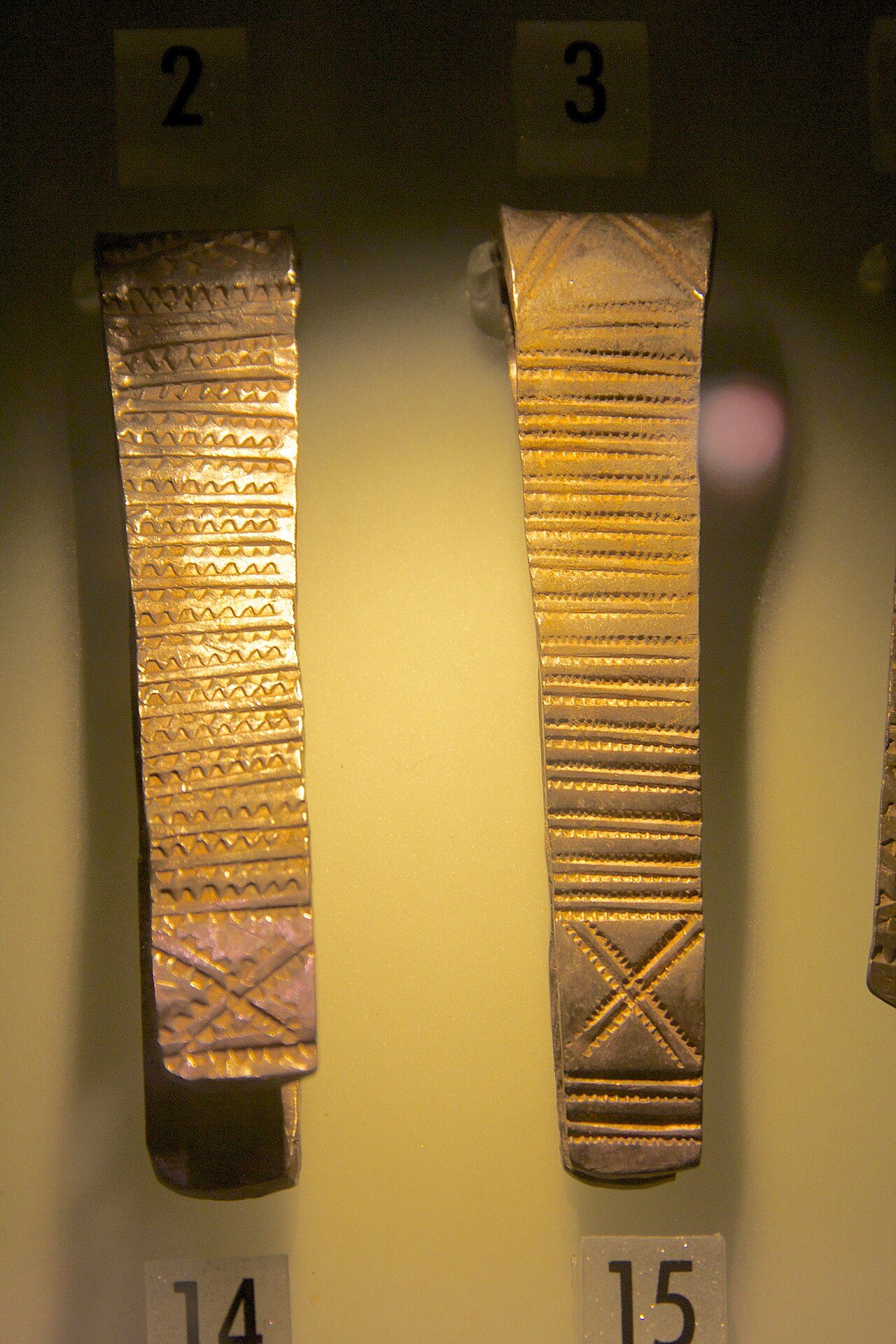
Photo: Mike Peel ( www.mikepeel.net )., CC BY-SA 4.0, via Wikimedia Commons
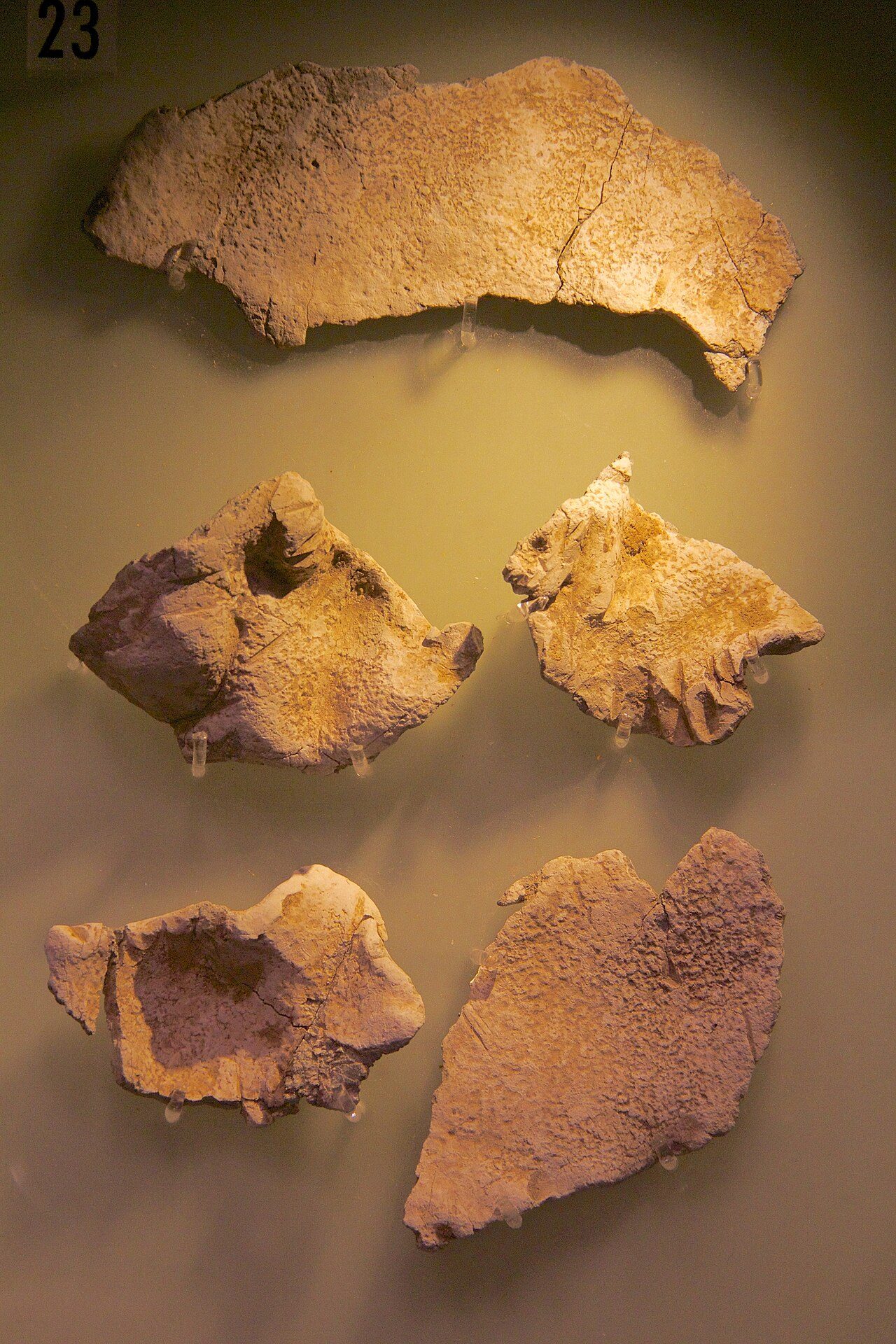
Photo: Mike Peel ( www.mikepeel.net )., CC BY-SA 4.0, via Wikimedia Commons
How it is dated
There are no coins. The arm-rings match a Dublin Norse type that is well dated by the coins in the Cuerdale Hoard (c. 905-910), so Huxley is placed around 900-910.
What happened after the find
Declared Treasure under the Treasure Act 1996 after examination at the British Museum. It was bought jointly by the Grosvenor Museum, Cheshire Museums Service and National Museums Liverpool with a £45,000 Heritage Lottery Fund grant.
Where sources differ
- Date: Wikipedia says around 900-910; Current Archaeology (2010) says 'the first decade of the 9th century', almost certainly a slip for the 10th, since it ties the hoard to Cuerdale and the 902 expulsion from Dublin.
- Current display at the Museum of Liverpool could not be confirmed directly; the museum's page did not load.
- Wikipedia's breakdown of the decorated patterns (6 + 6 + 2 + 1 + 1, plus the zig-zag bar) does not sum neatly to its own figure of 16; the page avoids giving a full tally.
Questions
Where is the Huxley Hoard?
It is jointly owned by the Grosvenor Museum in Chester, Cheshire Museums Service and National Museums Liverpool, and has been displayed at the Museum of Liverpool.
Why are the Huxley arm-rings flat?
They were folded or hammered flat before burial, probably to pack them into a small bundle. Their value lay in their weight of silver as much as in wearing them.
Who buried the Huxley Hoard?
Nobody knows. The rings were made by Dublin Norse silversmiths, and one suggestion is that Norse settlers from Ireland buried them soon after 902; another is that raiders hid them.