HacksilverBuried treasure, catalogued

Ingots: metal cast for storage and payment

From stamped late Roman silver bars to finger-sized Viking ingots: how ingots were cast, what they weighed and why so many were nicked and cut.

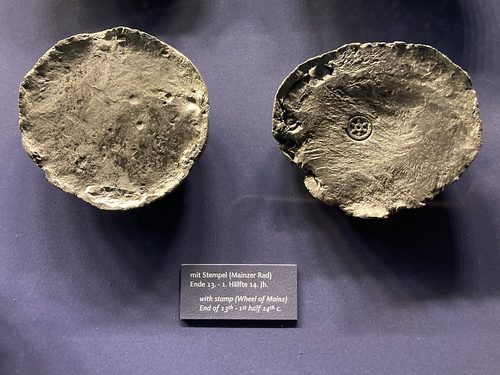
An ingot is metal cast into a simple shape so that it can be stored, carried, weighed and later turned into something else. In a hoard, ingots are the clearest sign that the owner thought of silver or gold as raw value rather than as objects. They are also the hardest finds to date on their own, since a plain bar looks much the same in any century; most are dated by the coins and ornaments buried with them.

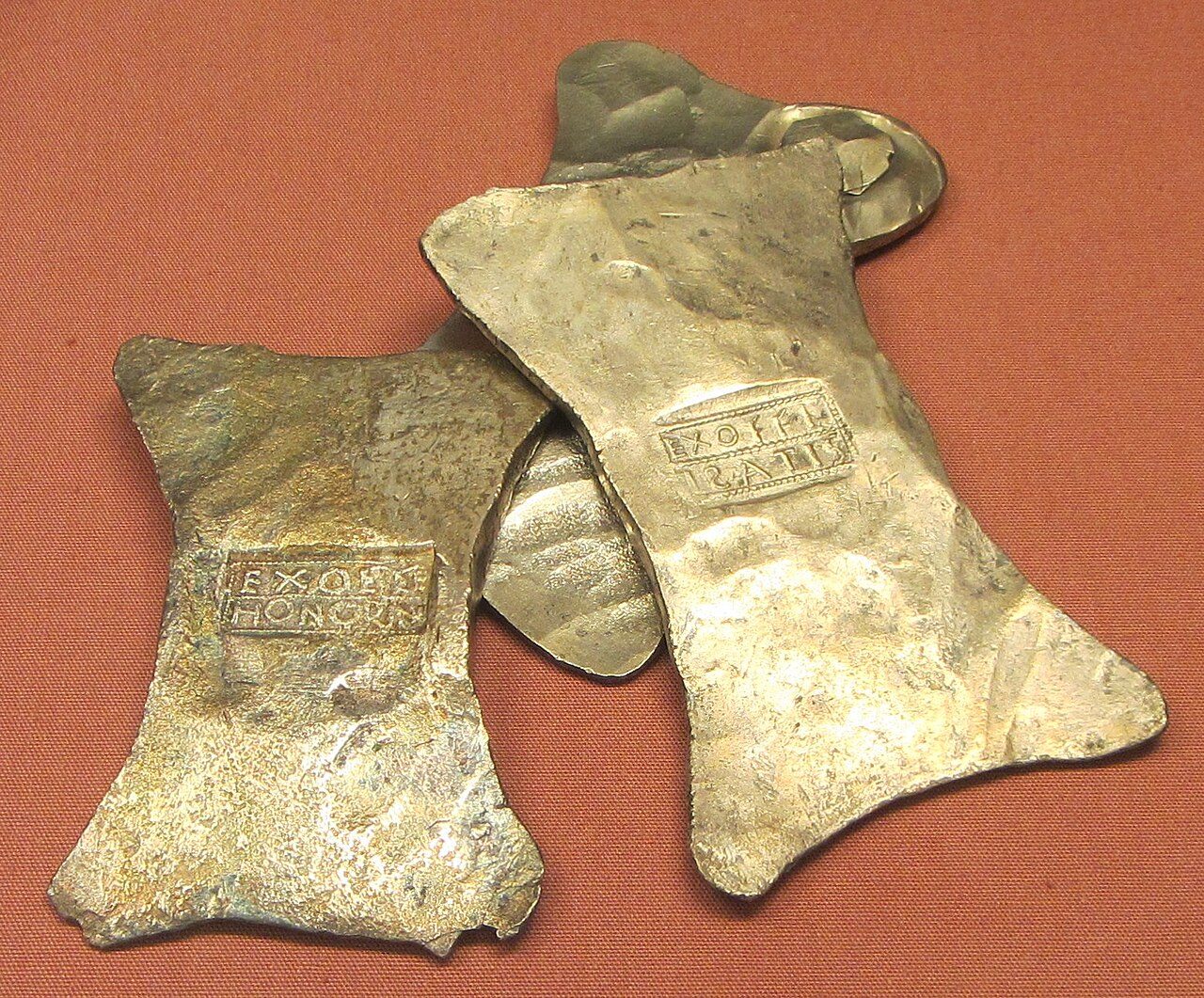
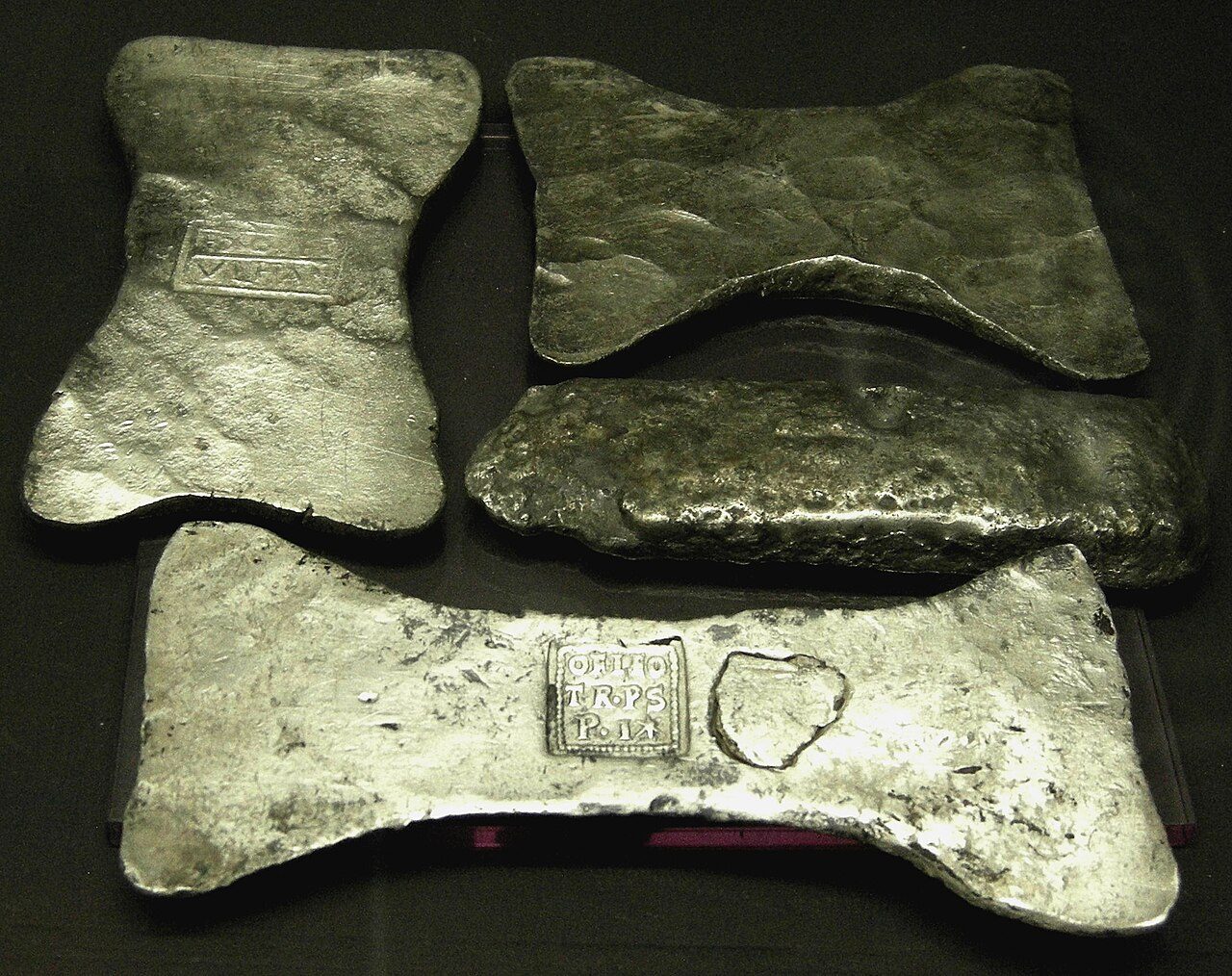
The late Roman state handled silver in stamped bars. The Kaiseraugst treasure from Switzerland, buried in the mid-4th century, includes three silver ingots stamped with the portrait and name of the usurper Magnentius (350-353) and the mark P III, three Roman pounds, roughly a kilogram each. In Britain, silver ingots of a flat 'double-axe' shape, some stamped with the name of the workshop that made them, date from the late 4th and early 5th centuries and are thought to have been used to pay officials and soldiers.

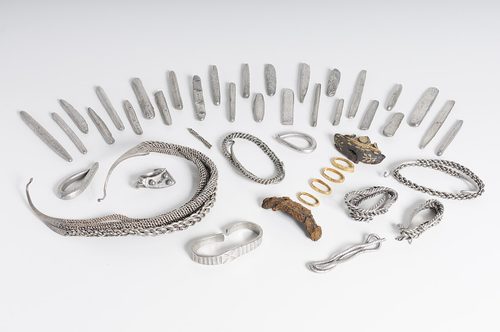
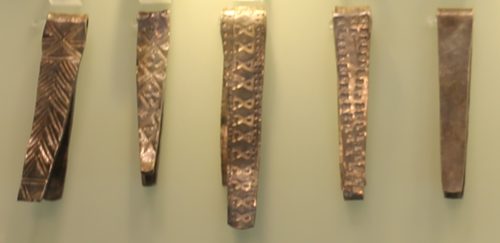
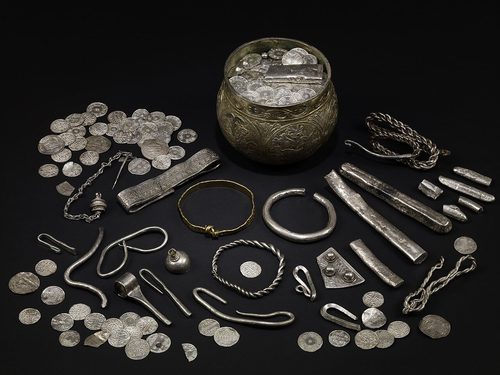
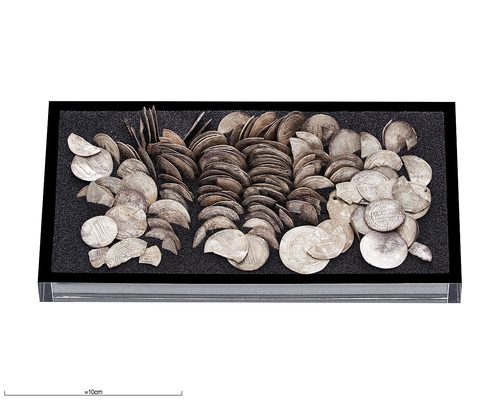
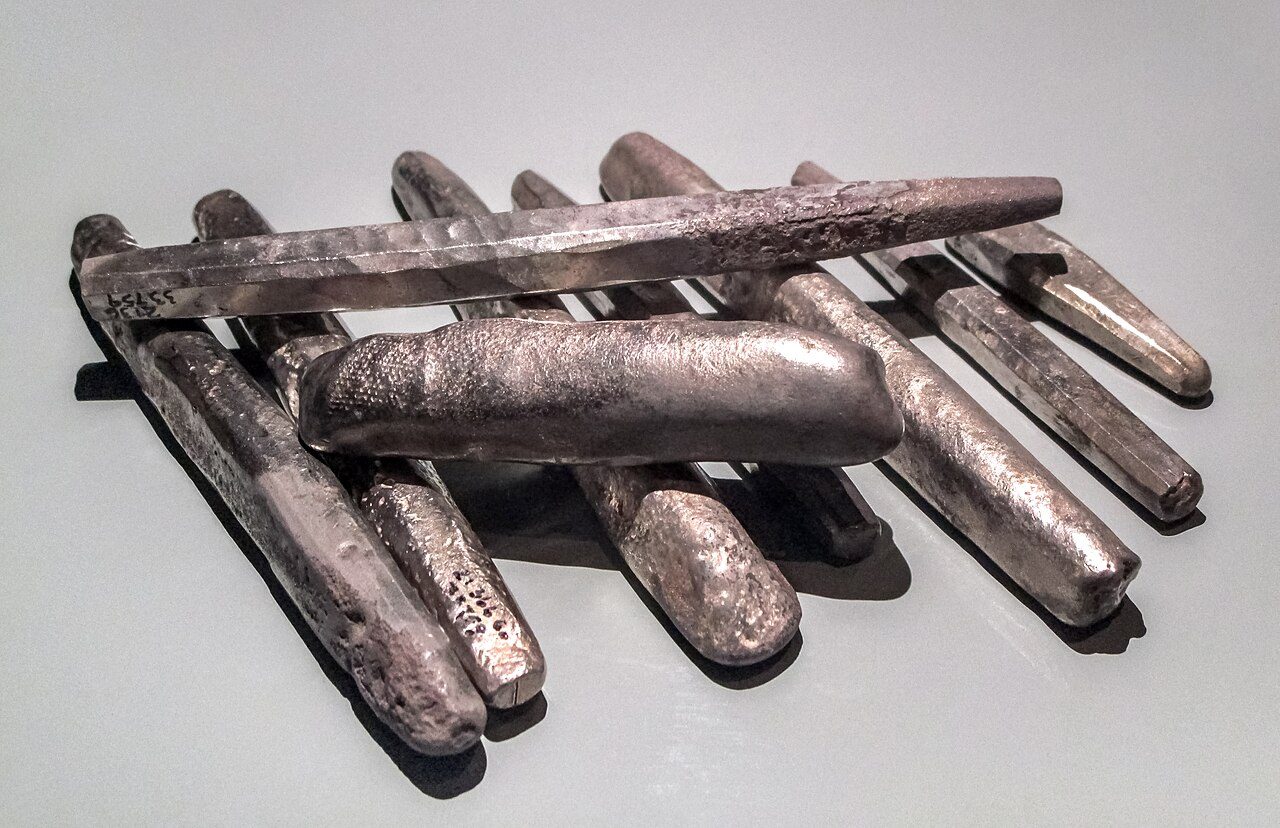
The great age of the ingot in north-west Europe was the Viking age. Silver from coins, plate and jewellery was melted down and poured into open moulds, often of soapstone or clay, giving a bar that is round, rectangular or roughly triangular in section, with rounded ends. Susan Kruse's study of cast ingots from England and Wales found weights from 2 g to 283 g, with a cluster at 20-30 g and a possible loose unit of about 25-26 g. The 29 cigar-shaped ingots in the Bedale hoard from North Yorkshire weigh between about 48 g and 144 g each; some have their ends chopped off, and one is cut with 16 test nicks. On Gotland, the Spillings hoard holds bundles of silver bars alongside its coins and arm-rings.

Signs to look for: a smooth upper surface that sank slightly as the metal cooled, pitting from a sand or stone mould, tapering rounded ends, and clean cut faces where a piece was taken off for payment. Knife-nicks along the edges show that the bar passed through several hands, each buyer testing that it was solid silver and not plated.

Ingots matter because they hide their origins in plain sight. Once coins were melted, their mint marks were gone, but their chemistry was not. A 2025 study of the Bedale ingots used lead isotopes and trace elements to show that some were cast from western European silver, some from Islamic dirhams and many from a mixture, which tells historians how loot and trade silver were pooled in Viking Yorkshire. In the Bronze Age Mediterranean, by contrast, copper travelled as heavy 'oxhide' slabs of about 20-30 kg, a reminder that ingots served trade in base metals too.

Examples
Sources

Hoards with ingots

22

Eberswalde Hoard (Eberswalder Goldschatz)

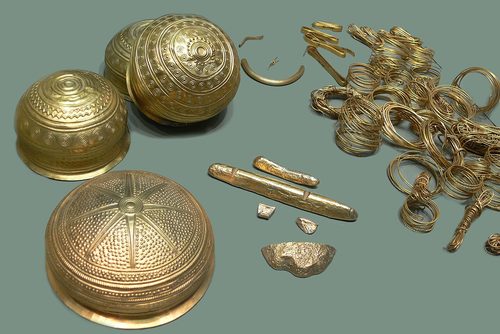
81 gold objects weighing 2.59 kg, including eight decorated bowls, found in a lidded pot near Eberswalde in 1913; taken to Moscow in 1945 and still there.

Bronze Age · Germany · found 1913

Mooghaun North Hoard (Great Clare Find)

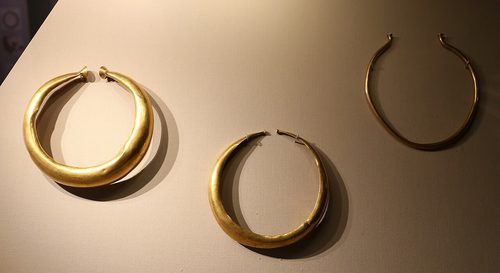
Over 150 Late Bronze Age gold objects, more than 5 kg, found by railway workers in County Clare in 1854; all but 29 were melted down.

Bronze Age · Ireland · found 1854

Snettisham Hoard

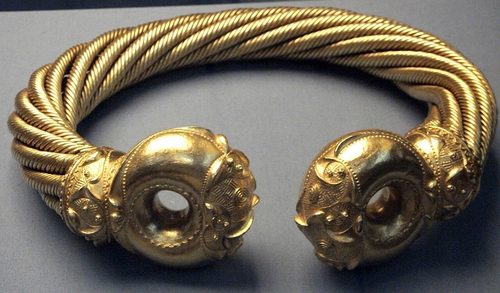
At least 14 Iron Age hoards of gold, silver and bronze torcs buried on one Norfolk hilltop around 60 BC, found between 1948 and the 1990s.

Iron Age & classical · England · found 1948

Grouville Hoard (Le Câtillon II)

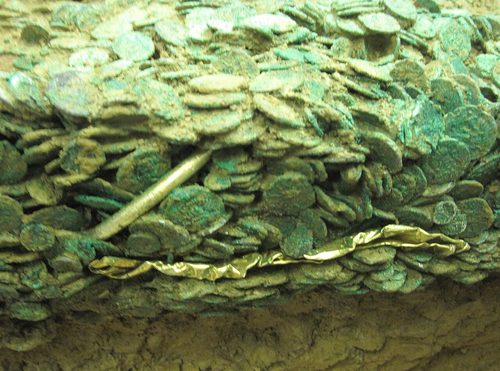
69,347 Celtic coins plus gold torcs, fused into one clay block about 1.4 m long, found in Jersey in 2012: the largest Iron Age coin hoard known.

Iron Age & classical · Jersey · found 2012

Hallaton Treasure

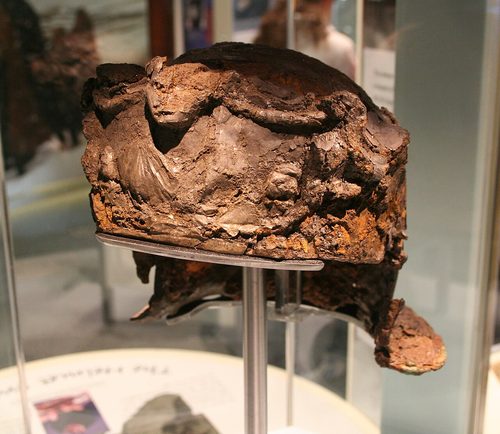
Over 5,000 Iron Age coins in 14 deposits, a silver-gilt Roman cavalry helmet and some 300 sacrificed pigs: a Leicestershire hilltop shrine of the AD 40s.

Iron Age & classical · England · found 2000

Kaiseraugst Treasure

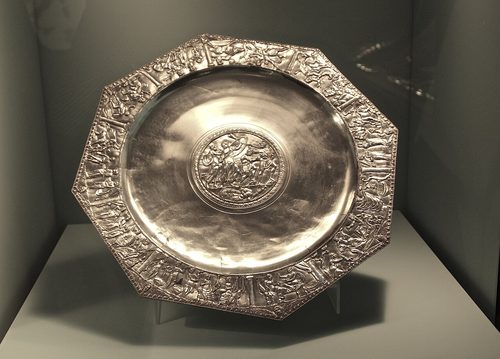
270 pieces and 58 kg of late Roman silver, buried in a Rhine fortress around AD 351 and scooped up by a digger in 1961, including the Achilles dish.

Roman · Switzerland · found 1961

Tureholm Treasure

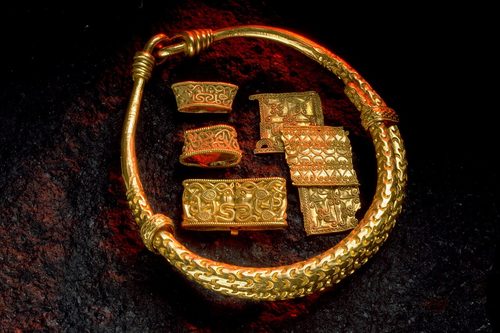
About 12 kg of Migration Period gold found at Tuna, Södermanland, in 1774. Most was melted down for coin; a neck-ring and sword fittings survive.

Migration period · Sweden · found 1774

Gaulcross Hoard

Pictish silver found in a stone circle near Fordyce in 1838; only three pieces survived until a 2013 dig recovered 100 more, with Roman coins.

Migration period · Scotland · found 1838

Sutton Hoo ship burial

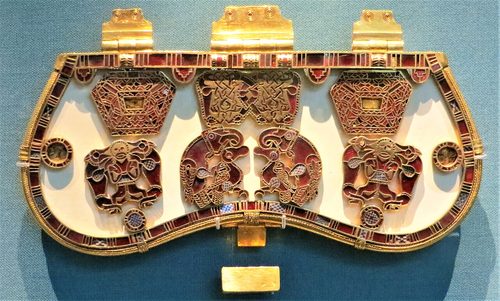
A 7th-century king's grave in a 27-metre ship, dug in Suffolk in 1939: gold and garnet regalia, a helmet, Byzantine silver and 37 Frankish coins.

Early medieval · England · found 1939

Herefordshire Hoard

A Viking hoard of about 300 coins and gold jewellery buried c. 879 near Leominster, found in 2015 and sold illegally; only a tenth is recovered.

Viking age · England · found 2015

Watlington Hoard

About 200 silver coins, ingots and arm-rings buried c. 879 in Oxfordshire, with rare Two Emperors pennies showing Alfred and Ceolwulf II as partners.

Viking age · England · found 2015

Spillings Hoard

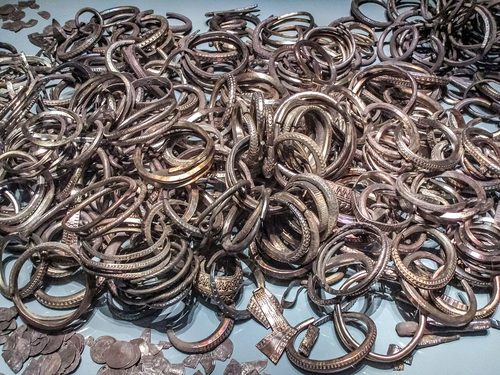
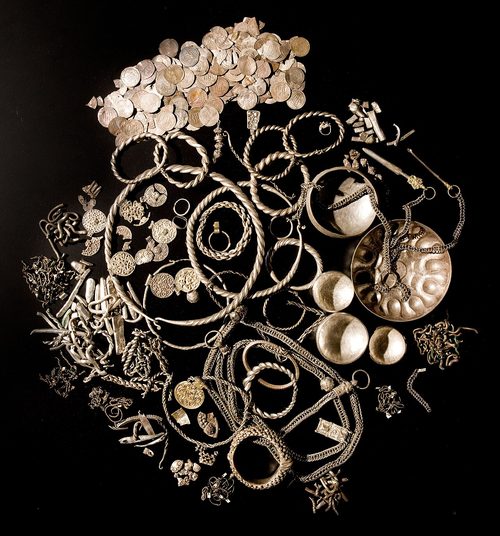
The largest Viking silver hoard known: about 67 kg of silver, 14,295 coins and nearly 500 arm-rings, buried in a Gotland storehouse after AD 870.

Viking age · Sweden · found 1999

Bedale Hoard

A gold-inlaid sword pommel, silver neck-rings and 29 ingots, buried in North Yorkshire around 900 and found in 2012. Now in the Yorkshire Museum.

Viking age · England · found 2012

Galloway Hoard

Over 100 objects, more than 5 kg of silver, gold, silk and crystal, buried c. AD 900 in Kirkcudbrightshire and found in 2014. Now in Edinburgh.

Viking age · Scotland · found 2014

Silverdale Hoard

201 pieces of Viking silver in a lead box, buried c. 900 near Silverdale, Lancashire, including a coin naming an unknown king, Airdeconut.

Viking age · England · found 2011

Huxley Hoard

21 flattened silver arm-rings and an ingot, about 1.5 kg of Hiberno-Norse silver buried c. 900-910 at Huxley, Cheshire, and found in 2004.

Viking age · England · found 2004

Cuerdale Hoard

About 8,600 pieces of Viking silver, some 40 kg of coins, ingots and chopped jewellery, buried c. 905-910 beside the River Ribble in Lancashire.

Viking age · England · found 1840

Vale of York Hoard

617 silver coins and dozens of ornaments packed into a Carolingian gilt cup, buried in North Yorkshire c. 928 and found by two detectorists in 2007.

Viking age · England · found 2007

Skaill Hoard

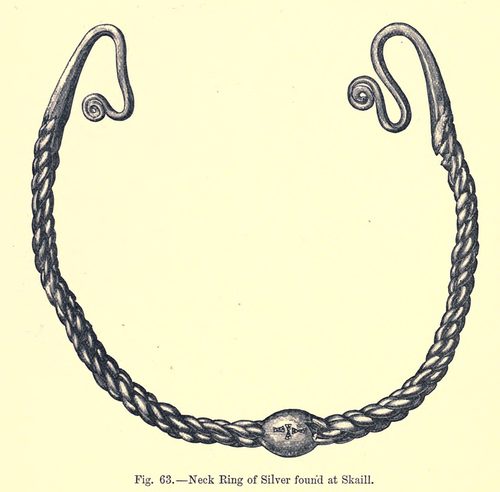
Over 100 pieces of Viking silver, about 8 kg, buried c. 950 at Skaill in Orkney and found in a rabbit hole in 1858: Scotland's largest Viking silver hoard.

Viking age · Scotland · found 1858

Terslev Hoard

6.6 kg of Viking silver dug up by two boys in a Zealand garden in 1911: 1,751 coins, silver cups and bowls, chains and fine filigree jewellery.

Viking age · Denmark · found 1911

Burge Hoard

Over 10 kg of silver ploughed up at Burge on Gotland in 1967: about 3,000 coins, Russian grivna ingots and cut silver, buried soon after 1143.

Medieval · Sweden · found 1967

Erfurt Treasure

Nearly 28 kg of silver coins, ingots, tableware and jewellery hidden by a Jewish household before the Erfurt massacre of March 1349, found in 1998.

Medieval · Germany · found 1998