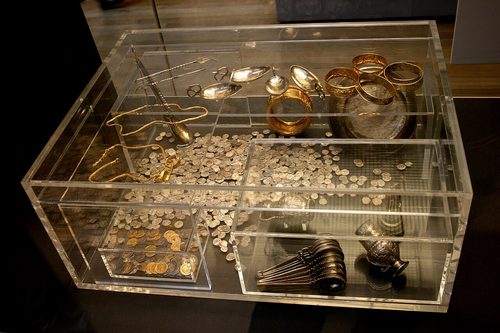
The Thetford Treasure is famous both for what it contains and for how badly it was found. In November 1979 a man with a metal detector went onto a site at Gallows Hill, on the edge of Thetford, that had been cleared for building. He had no permission to be there. Late in the day, in poor light, he dug up a mass of gold and silver, almost certainly missing some small pieces, and instead of reporting it he tried to sell it privately. By the time archaeologists heard of it, months later, the findspot had been built over. The finder was by then seriously ill, and he died in July 1980 before he could be questioned.
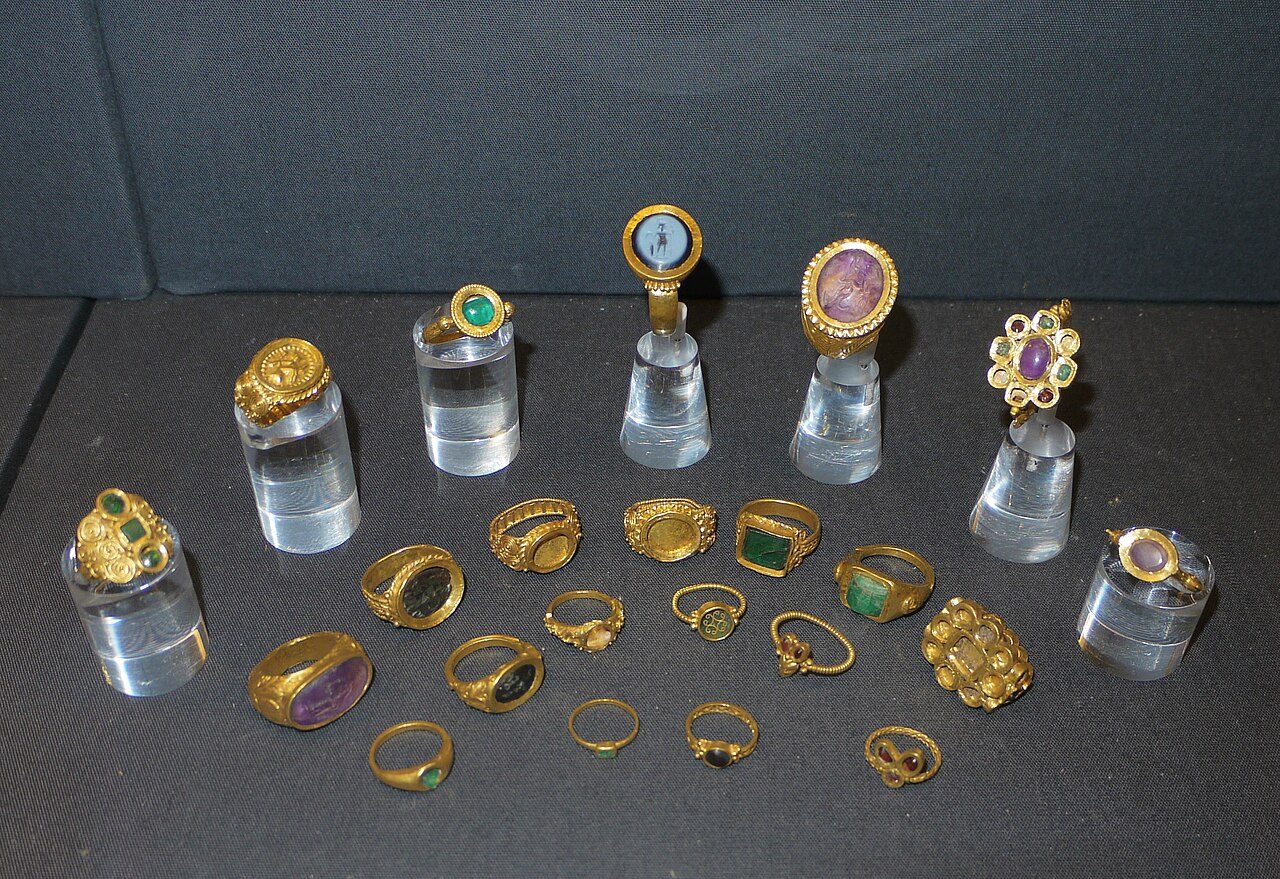
What survives is still remarkable. There are 22 gold finger rings, four gold bracelets, five gold necklaces with clasps and pendants, an amulet, an engraved gem, beads, a small shale box, and a gold belt buckle decorated with a dancing satyr holding a shepherd's crook and a bunch of grapes. Most of the gold looks brand new. Two pieces seem unfinished, and the rings share so many details that they probably came from a single workshop, which suggests a jeweller's or merchant's stock rather than a family's collection worn over years.
The silver is just as unusual. Of the 33 spoons, 31 carry inscriptions, and twelve name Faunus, an Italian woodland god related to the Greek Pan. His titles on the spoons include Celtic words, so this was a local British form of the cult rather than a foreign import. Other motifs, such as a running tiger and birds that may be woodpeckers, belong to the world of Bacchus and to stories about Faunus's family. With three strainers, the spoons may have served in ritual meals.
That makes Thetford one of very few late Roman treasures from Britain that is openly pagan. Hoxne and Water Newton are full of Christian monograms; Thetford has at most one spoon with a fish that might be a Christian sign. The traditional explanation, set out by Catherine Johns and Timothy Potter in 1983, is that the objects belonged to a group of Faunus worshippers who buried them in the 380s or early 390s, when imperial laws against pagan cults were tightening.
That date has recently been challenged. In 2024 Ellen Swift of the University of Kent published a re-examination comparing the rings and spoons with well-dated finds from graves and hoards in Europe, and argued that some of them could not have been made before the 5th century. If she is right, a wealthy pagan cult centre was still active at Thetford after Roman rule in Britain ended.
Excavations at Gallows Hill in 1980-82 uncovered a large Iron Age and early Roman enclosure, recorded locally as a possible temple site. Rumours that coins were found with the treasure have never been confirmed or disproved.
Highlights
A gold buckle whose plate shows a dancing satyr with a shepherd's crook and grapes. Elaborate belts marked rank in the late Roman world, so this was probably worn by a man of status.
Silver spoons engraved in the bowl with dedications to Faunus under Celtic titles, such as DEI FAVNI AVSECI, 'of the god Faunus Ausecus'.
A gold ring whose bezel is a tiny horned, Pan-like head, apparently without parallel and perhaps a direct reference to Faunus.
A chalcedony gem with a cock-headed, snake-legged god and the Greek words IAO and ABRASAX SABAOTH, a late antique magical charm.
What is in it
New gold jewellery, with a belt buckle, rings, bracelets, necklaces and pendants, and a set of inscribed silver spoons and strainers, with a small shale box.
Size: 81 objects.
| Item | Number | Notes |
|---|---|---|
| Gold finger rings | 22 | many with filigree, several set with gems or glass; probably from one workshop |
| Other gold jewellery | about 17 | 4 bracelets, 5 chain necklaces and 2 pairs of clasps, pendants, an amulet filled with sulphur, and a belt buckle with a dancing satyr |
| Gems and beads | 5 | an unmounted engraved gem, an emerald bead and three glass beads |
| Silver spoons | 33 | 17 long-handled cochlearia and 16 cigni; all but two inscribed, twelve naming Faunus |
| Silver strainers | 3 | |
| Shale box | 1 | a small lidded cylindrical box |
Photographs
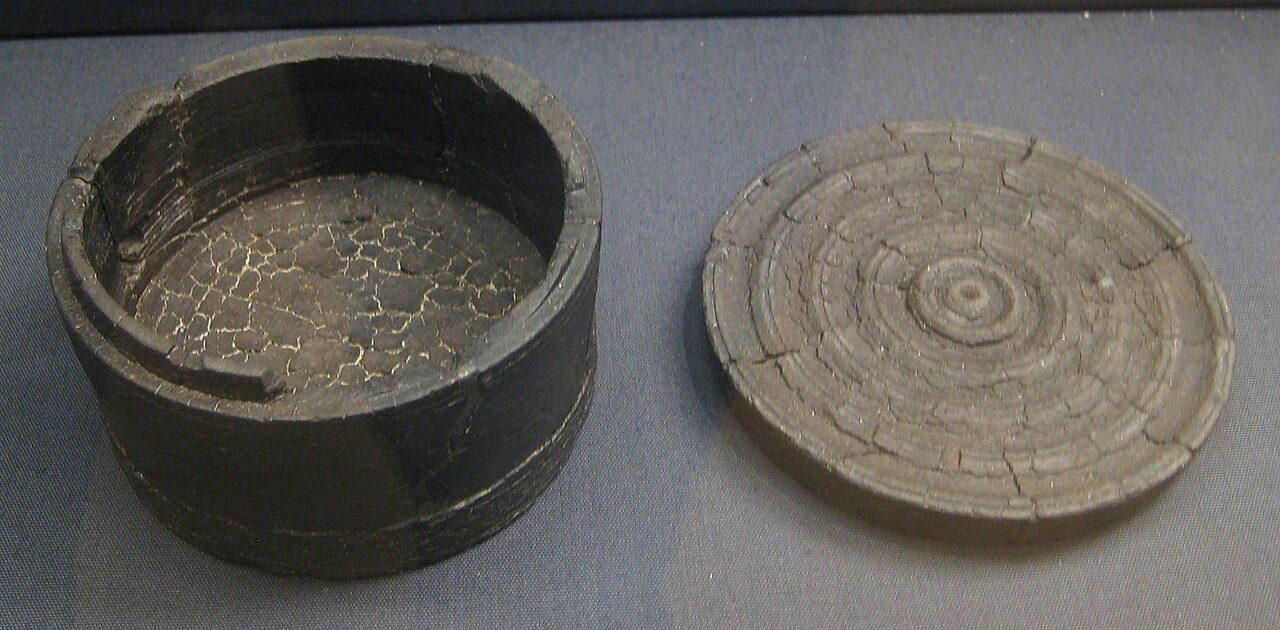
Photo: BabelStone, CC0, via Wikimedia Commons
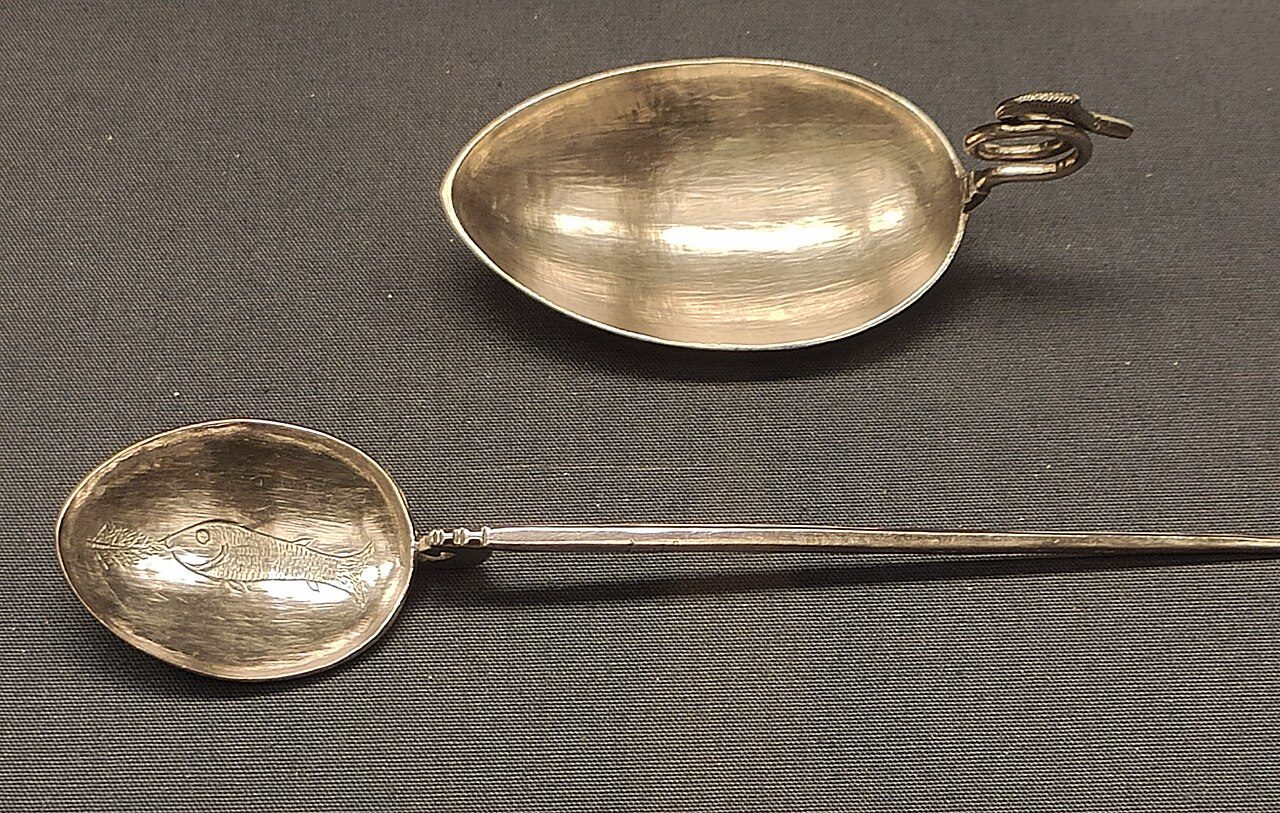
Photo: JASpencer, CC0, via Wikimedia Commons
How it is dated
With no coins, the date depends on comparing the jewellery and spoons with other finds. Johns and Potter (1983) placed manufacture and burial in the 380s or early 390s. Swift (2024) identifies ring and spoon types that she dates to the 5th century, which would move the burial into the post-Roman period.
What happened after the find
The find was not reported by the finder, who had been detecting without permission. Once it came to light it was declared treasure trove and acquired by the British Museum in 1981.
Where sources differ
- Burial date: late 4th century (Johns and Potter 1983) versus 5th century (Swift 2024).
- The hoard is probably incomplete; rumours that it included coins are unconfirmed.
- Whether the gold was a jeweller's stock, temple property or a votive deposit is debated.
Questions
Where is the Thetford Treasure?
In the British Museum in London, displayed in the Roman Britain gallery, Room 49. The museum acquired it in 1981.
Who was Faunus?
An old Italian god of woods and flocks, often equated with the Greek Pan. The Thetford spoons give him Celtic titles, showing a local British version of his cult.
When was the Thetford Treasure buried?
The standard view is the 380s or early 390s. A 2024 study argues that some pieces are 5th-century, which would put the burial after the end of Roman rule in Britain.