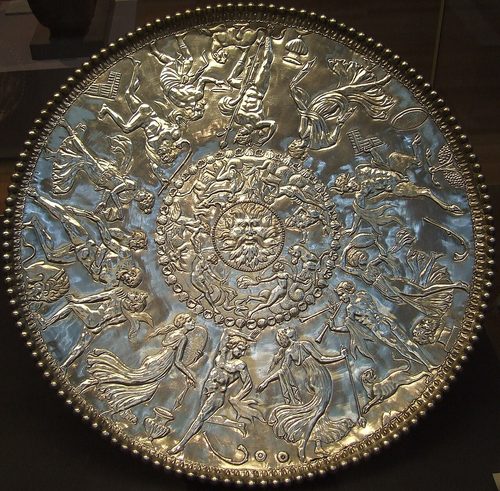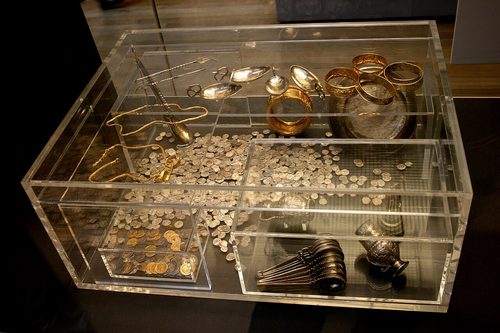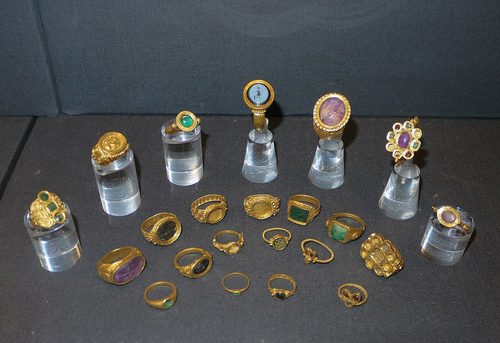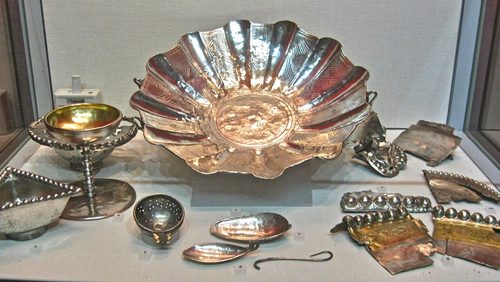
In February 1975 ploughing in a field at Water Newton, beside the Roman town of Durobrivae near modern Peterborough, broke into a group of silver objects. The plough damaged several of them, but what survived proved to be one of the most important finds ever made for the history of early Christianity: the oldest group of silver known to have been used in Christian worship anywhere in the Roman Empire.
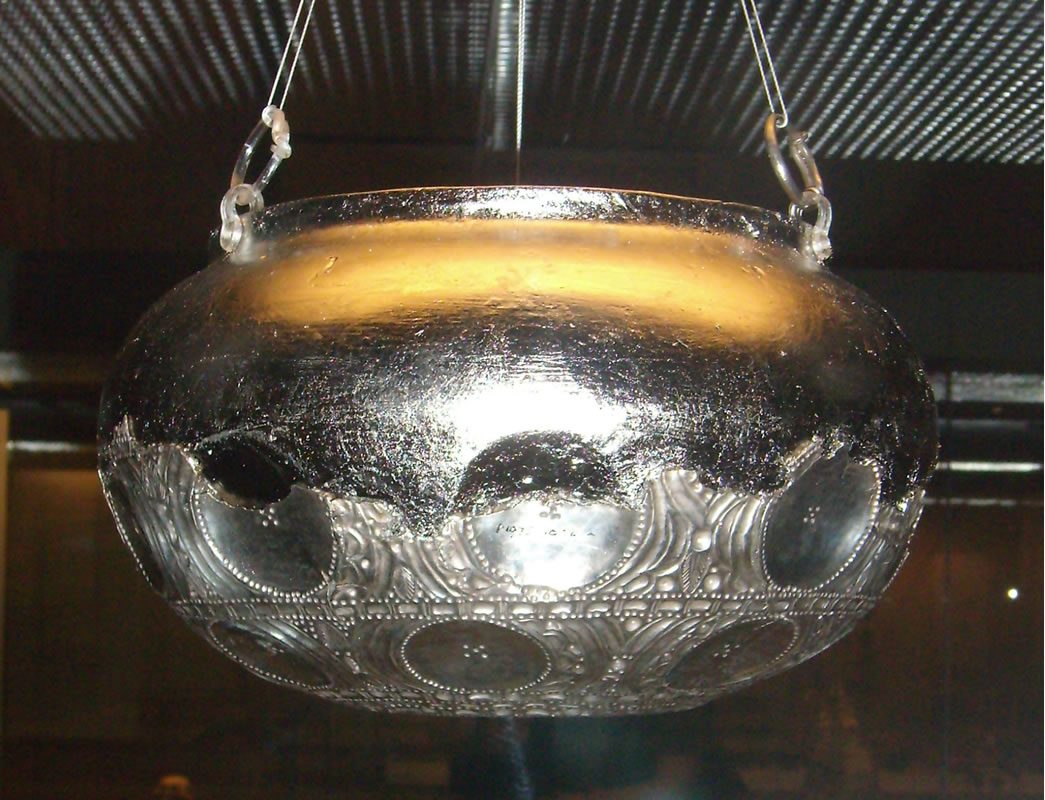
There are 27 silver pieces and a single small gold plaque. Nine are vessels: a tall jug with bands of acanthus and leaf scrolls, plain and decorated bowls, a dish, a strainer, a hanging bowl and a two-handled cup whose shape resembles later chalices. The rest are thin plaques, most of them shaped like leaves or triangles and stamped or engraved with the Chi-Rho, the monogram made from the first two Greek letters of Christ's name.
The inscriptions make the Christian reading hard to doubt. Round the rim of one bowl runs a Latin verse which, though debated in detail, seems to say: 'O Lord, I, Publianus, relying on you, honour your holy altar.' Another bowl names two women, Innocentia and Viventia, and one plaque records that Anicilla has fulfilled the vow she promised. On the gold plaque the Chi-Rho is flanked by alpha and omega, the first and last letters of the Greek alphabet.
The plaques are especially telling. Leaf-shaped silver plaques nailed up as thank-offerings were a familiar feature of pagan shrines in Roman Britain. Here the same custom has been taken over by Christians, with the Chi-Rho in place of a pagan god's image. They are the first finds to show that practice in a Christian setting, and they suggest the plaques hung on the walls of a church or a private chapel in or near Durobrivae.
Who hid the silver, and when, cannot be fixed. The pieces were made at different dates and probably in different places, some perhaps in Britain. The British Museum suggests they may have been buried at a time of persecution of Christians or of more general unrest. Since Christianity became a tolerated and then favoured religion after 313, a burial later in the 4th century, during raids or political upheaval, is at least as likely as concealment from the authorities.
Because there are no coins, the dating rests on the style of the objects. Taken together, they fit the 4th century, which makes Water Newton a rare witness to organised Christian worship in Britain while it was still part of the Empire.
Highlights
A silver bowl inscribed under the base with the name PUBLIANUS and round the rim with a Latin hexameter dedicating it to the Lord's altar, flanked by two Chi-Rho monograms.
The most elaborate and nearly complete vessel, 20.3 cm high and weighing 534 g, covered in acanthus foliage. Its handle had come away and survives only in fragments.
The only gold object: a small disc showing the Chi-Rho between alpha and omega, with holes for nailing it up.
An undecorated cantharus about 12.5 cm high, the shape later used for chalices, though its own function is not certain.
What is in it
A set of silver vessels and silver and gold votive plaques, many marked with the Chi-Rho, which appear to have belonged to an early Christian congregation.
Size: 28 items (27 silver, 1 gold).
| Item | Number | Notes |
|---|---|---|
| Silver vessels | 9 | jugs, bowls, a dish, a strainer, a hanging bowl and a two-handled cup |
| Silver votive plaques | about 18 | mostly leaf-shaped triangles with the Chi-Rho; one inscribed for a woman named Anicilla |
| Gold plaque | 1 | a small disc with the Chi-Rho flanked by alpha and omega |
Photographs
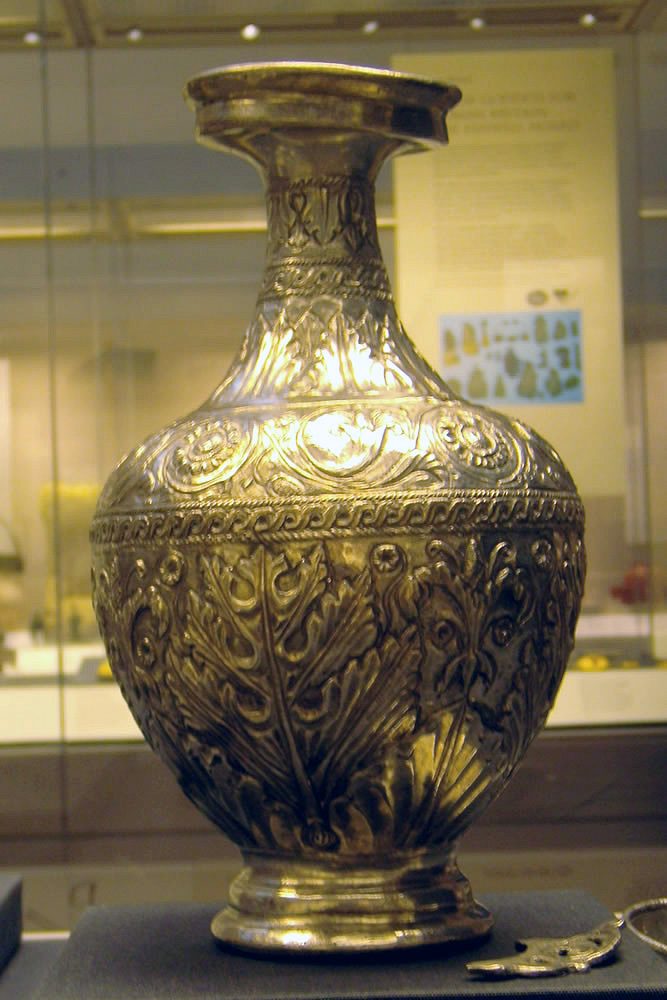
Photo: Unknown, CC BY-SA 3.0, via Wikimedia Commons
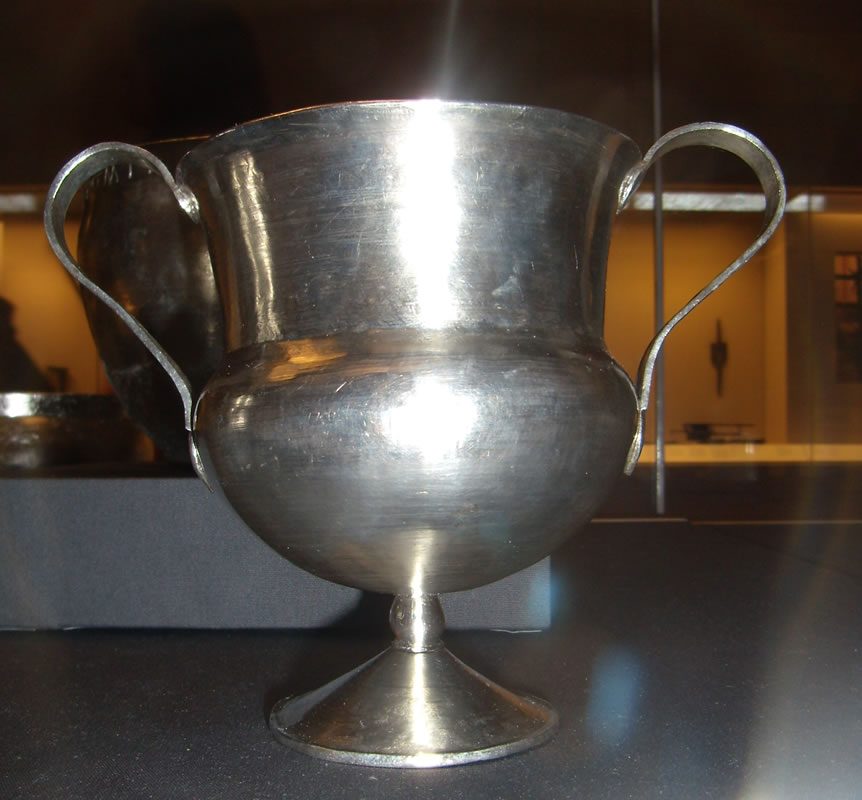
Photo: Unknown, CC BY-SA 3.0, via Wikimedia Commons
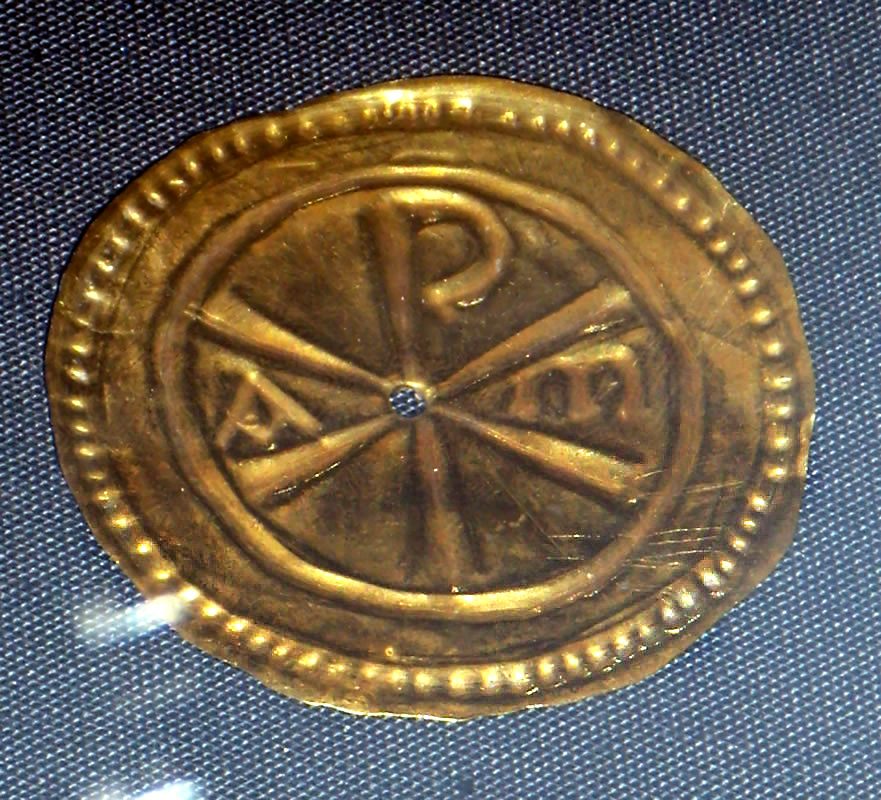
Photo: Unknown, CC BY-SA 3.0, via Wikimedia Commons
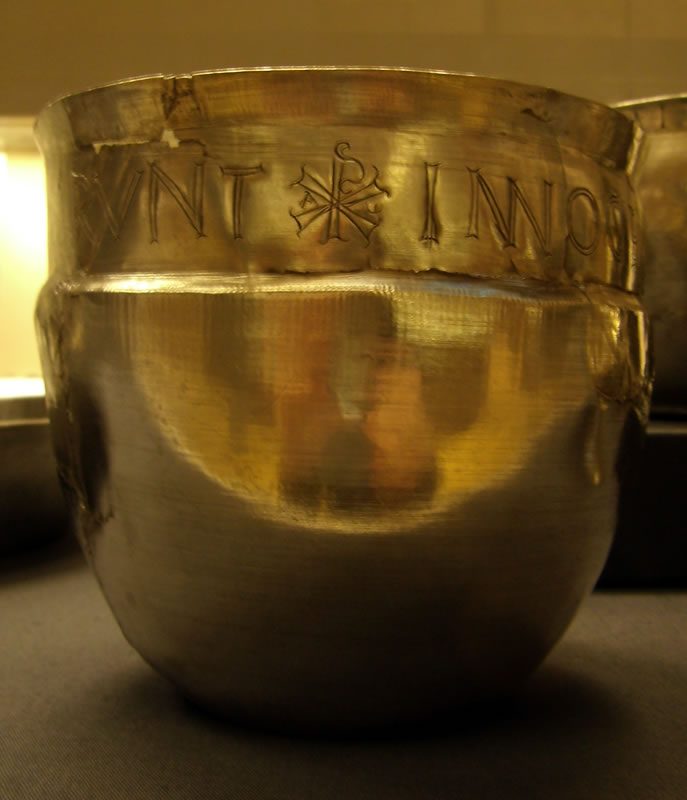
Photo: Unknown, CC BY 3.0, via Wikimedia Commons
How it is dated
There are no coins. The shapes, decoration and inscriptions of the vessels and plaques point to the 4th century, but the pieces were made at different times and the British Museum notes that the burial date cannot be established accurately.
What happened after the find
Declared treasure trove after its discovery and acquired by the British Museum (registration series 1975,1002). Part of the treasure was later displayed on loan at Peterborough Museum.
Where sources differ
- The number of plaques is given here as about 18 by subtraction (28 items minus nine vessels and the gold plaque); published counts of separate fragments may differ.
- The reading of the Publianus inscription is debated; 'altar' may mean the church itself.
- The burial date within the 4th century, and whether the silver belonged to a church or a private chapel, are uncertain.
- The name on the plaque is given as Anicilla in Wikipedia; a British Museum text reproduced on Google Arts & Culture prints it as 'Amcilla', probably a transcription error.
Questions
Why is the Water Newton Treasure important?
It is the earliest known group of silver used in Christian worship anywhere in the Roman Empire. Its inscriptions name members of a 4th-century congregation in Roman Britain.
Where is the Water Newton Treasure?
In the British Museum, London. Part of it was displayed at Peterborough Museum, near the findspot, until January 2019.
What does the Chi-Rho mean?
It is a monogram of the Greek letters chi (X) and rho (P), the first two letters of Christ's name in Greek. Early Christians used it widely as a symbol of their faith.