On 3 July 1799 a farmer digging near Nagyszentmiklós, a town in the Banat region of what was then the Kingdom of Hungary, uncovered a cache of gold vessels. There were 23 of them, weighing almost ten kilograms. Soon afterwards the find was sent to Vienna, capital of the Habsburg monarchy, and it has been in the imperial collections, now the Kunsthistorisches Museum, ever since. The town is today Sânnicolau Mare in western Romania.
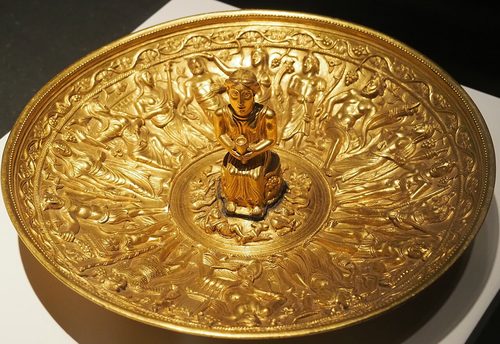
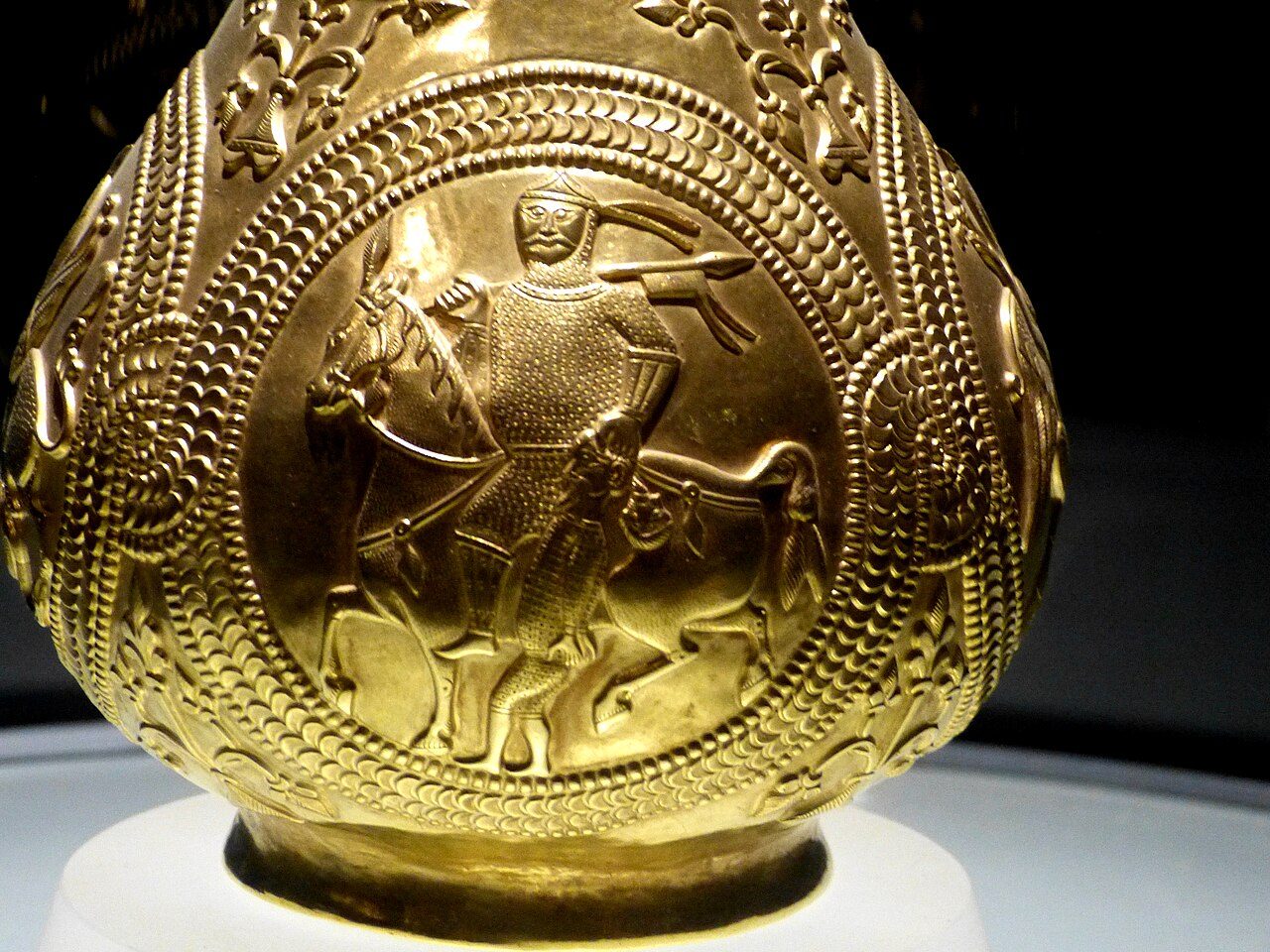
The vessels form a feasting service. There are jugs with tall necks and swelling bodies, round bowls, cups whose handles look like belt buckles, oval boat-shaped dishes, a drinking horn and two cups that rise into the heads of animals, one of them a bull looking back over the bowl. The most famous piece is a jug decorated with four large medallions. One shows a mounted warrior in mail dragging a captive by the hair; another an eagle carrying a human figure in its talons; others griffins and fantastic beasts. The imagery draws on Sasanian Persia, Byzantium and the steppe in about equal measure.
Several vessels carry inscriptions, which have made the debate harder rather than easier. One bowl has a text written in Greek letters but in a Turkic language, naming two officials with the title zoapan, Bouila and Boutaoul. Scholars agree it is Turkic but not on which language, and it has never been fully translated. A second inscription is in Greek, and several short texts are in a runiform script that also remains undeciphered.
For much of the 19th century the treasure was claimed as an heirloom of the early Hungarians; the bull's-head cup was popularly called Attila's cup, although the Hun king died in 453, centuries before it was made. Other scholars have argued for the Bulgars of the Danube, for Khazar craftsmen, or for a local ruler of the 11th century. Many recent specialists connect the treasure with the Avar Khaganate, which ruled the Carpathian Basin from the late 6th century until its defeat by the Franks around 800, and see it as the tableware of an Avar lord, perhaps hidden during that collapse.
Its location has also been contested. The vessels were found in present-day Romania, and in 2008 the Romanian government asked Austria to return them. They remain in Vienna, where all are on show in the museum's antiquities galleries.
Highlights
Its four relief medallions include the 'victorious prince', a mounted warrior dragging a prisoner by the hair, and an eagle carrying off a human figure.
A gold cup whose handle is a bull's head turned back over the bowl, nicknamed 'Attila's cup' in 19th-century Hungary.
A text in Greek letters but a Turkic language, naming officials called Bouila and Boutaoul; it has never been securely translated.
Oval dishes with fluted interiors and openwork rims, unusual shapes in early medieval goldwork.
What is in it
A set of gold drinking and serving vessels: jugs with figured medallions, bowls, cups with buckle-like handles, boat-shaped dishes, a drinking horn and two cups with animal heads.
Size: 23 vessels. Weight: about 9.95 kg.
| Item | Number | Notes |
|---|---|---|
| Jugs | several | Including the jug with four figured medallions (the 'victorious prince', an eagle carrying a figure, griffins) |
| Bowls and cups | most of the set | Round bowls, cups with buckle-shaped handles, boat-shaped dishes |
| Animal-headed cups | 2 | Including the bull's-head cup known as 'Attila's cup' |
| Drinking horn | 1 |
Photographs
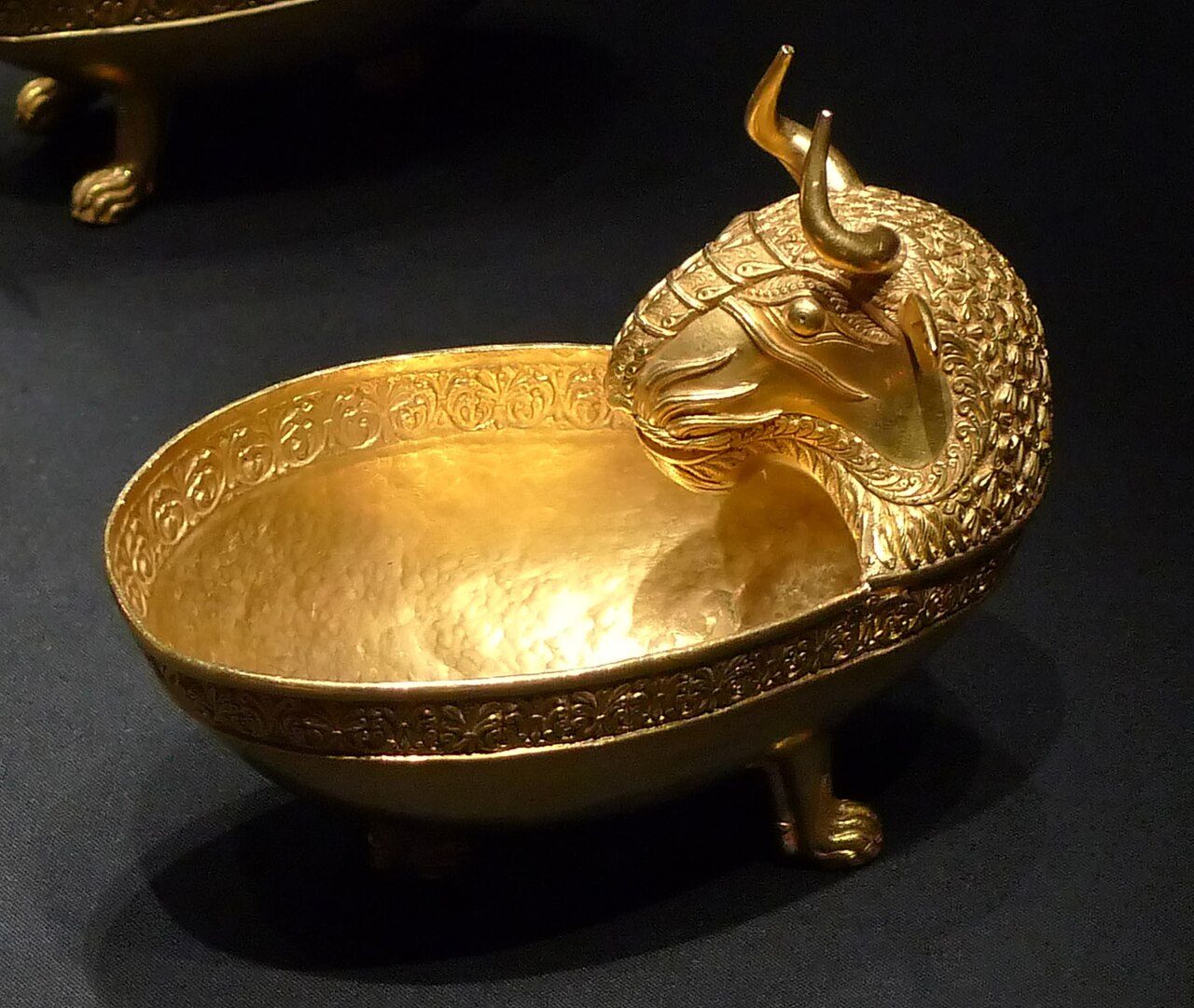
Photo: Unknown artist, CC BY 3.0, via Wikimedia Commons
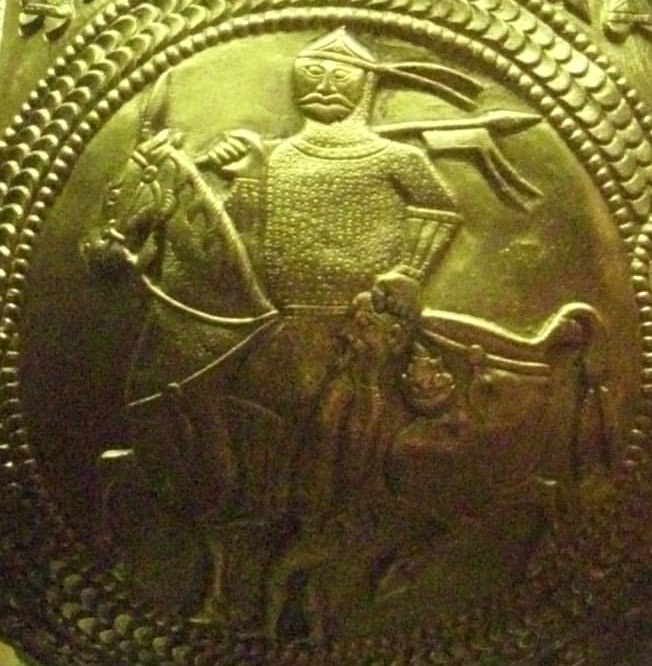
Photo: Mpb eu, CC0, via Wikimedia Commons
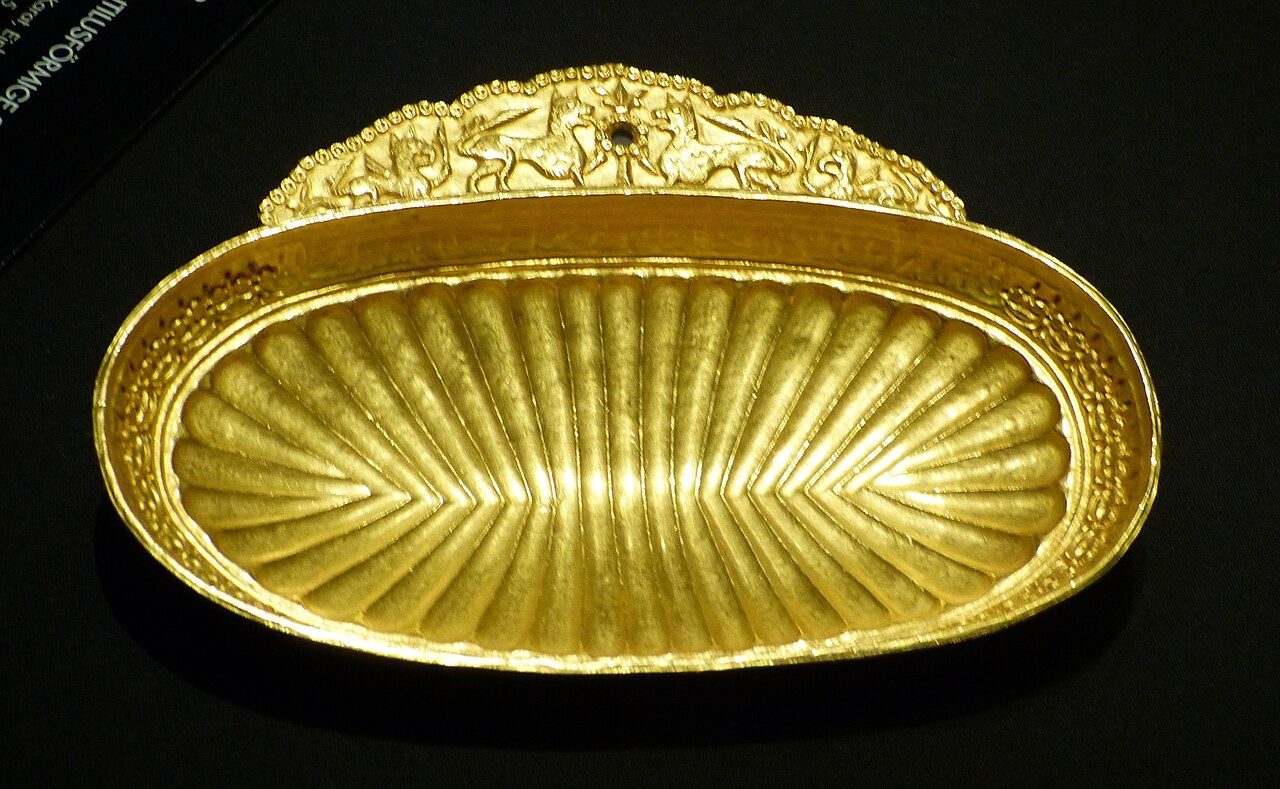
Photo: Wolfgang Sauber, CC BY-SA 4.0, via Wikimedia Commons
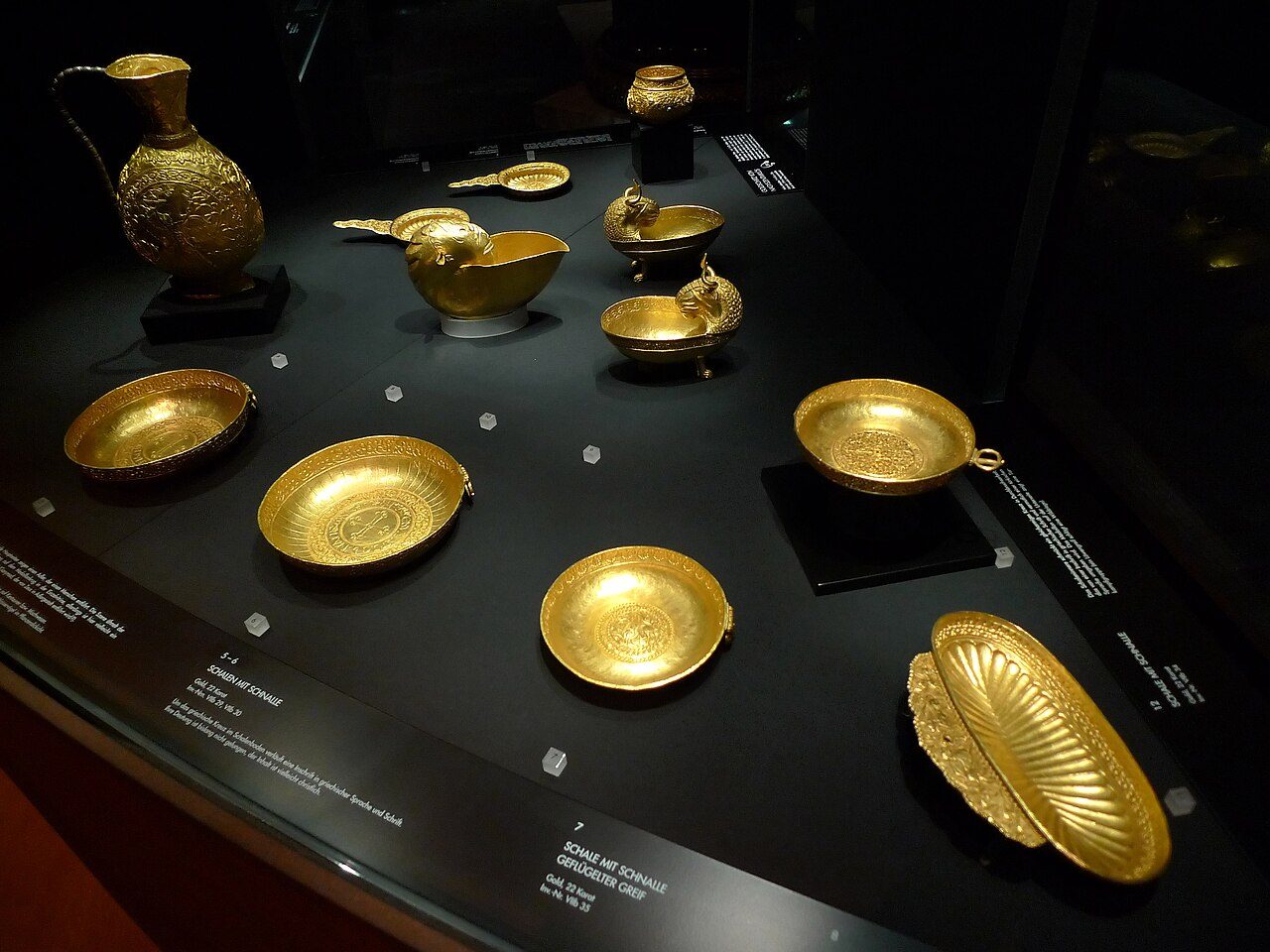
Photo: Unknown artist, CC BY 3.0, via Wikimedia Commons
How it is dated
There are no coins and no excavated context. Dates are argued from the style of the decoration, the vessel shapes and the inscriptions, and proposals range from the 6th to the 10th century. Many vessels may be of different dates. Recent work places the set in the Avar world, which ended around 800.
What happened after the find
The find was claimed for the Habsburg court and taken to Vienna in 1799; it has belonged to the imperial, later Austrian state, collections since. Romania asked for its repatriation in 2008.
Where sources differ
- Culture and date are actively disputed (Avar, Bulgar, Khazar, early Hungarian, local 11th-century ruler).
- Count: Wikipedia gives 23 vessels; the Kunsthistorisches Museum online collection search for the treasure returns 22 vessel records (one may be catalogued with another).
- My breakdown by vessel type is descriptive; I did not find a reliable published list giving the exact number of each type.
- Wikipedia names the finder (a Serbian peasant); not repeated.
Questions
Where is the Treasure of Nagyszentmiklós?
All the vessels are in the Kunsthistorisches Museum in Vienna, on permanent display in the Collection of Greek and Roman Antiquities. They have been in Vienna since the year of discovery, 1799.
Is the Nagyszentmiklós treasure Hungarian or Romanian?
It was found in 1799 in the Kingdom of Hungary, at a place that is now Sânnicolau Mare in Romania, and it has always been kept in Austria. Most current scholars attribute it to the Avars rather than to the Hungarians.
What does the inscription on the Nagyszentmiklós treasure say?
The best-known text is written in Greek letters in a Turkic language and names two officials, Bouila and Boutaoul, with the title zoapan. The rest of the sentence has never been translated with certainty.