Some time around 1877, people living on the north bank of the Oxus, the river now called the Amu Darya, began finding gold. The place was near an old fortified mound called Takht-i Kuwad, in what was then the Emirate of Bukhara and is now southern Tajikistan. Accounts disagree on almost every detail: whether the gold lay in the river sands exposed in the dry season, came from the ruins, or tumbled out of a collapsing bank. Diggers kept searching for years, and stories circulated of gold idols and a gold tiger that were never seen by any scholar.
What happened next is better documented. In May 1880 three merchants from Bukhara who had bought much of the gold were captured by tribesmen on the road from Kabul to Peshawar. A British political officer, Captain F. C. Burton, rode out, found the robbers quarrelling over the loot in a cave, and negotiated the return of a large part of it. In gratitude the merchants let him buy one of the finest pieces, a gold armlet, which he sold to the South Kensington Museum, now the V&A, in 1884. The merchants sold the rest in Rawalpindi. Some had already been cut up as bullion.
Dealers in northern India passed pieces to the archaeologist Alexander Cunningham and to the collector Augustus Wollaston Franks. Dealers also made copies and tried to pass them off; Franks bought some fakes at little more than the gold price before obtaining the originals. Franks bought Cunningham's share and left the collection to the British Museum on his death in 1897. An incomplete second chariot and a rider, presented to the Viceroy of India by the British envoy in Kabul, followed later: the rider in 1931 and the chariot group in 1953.
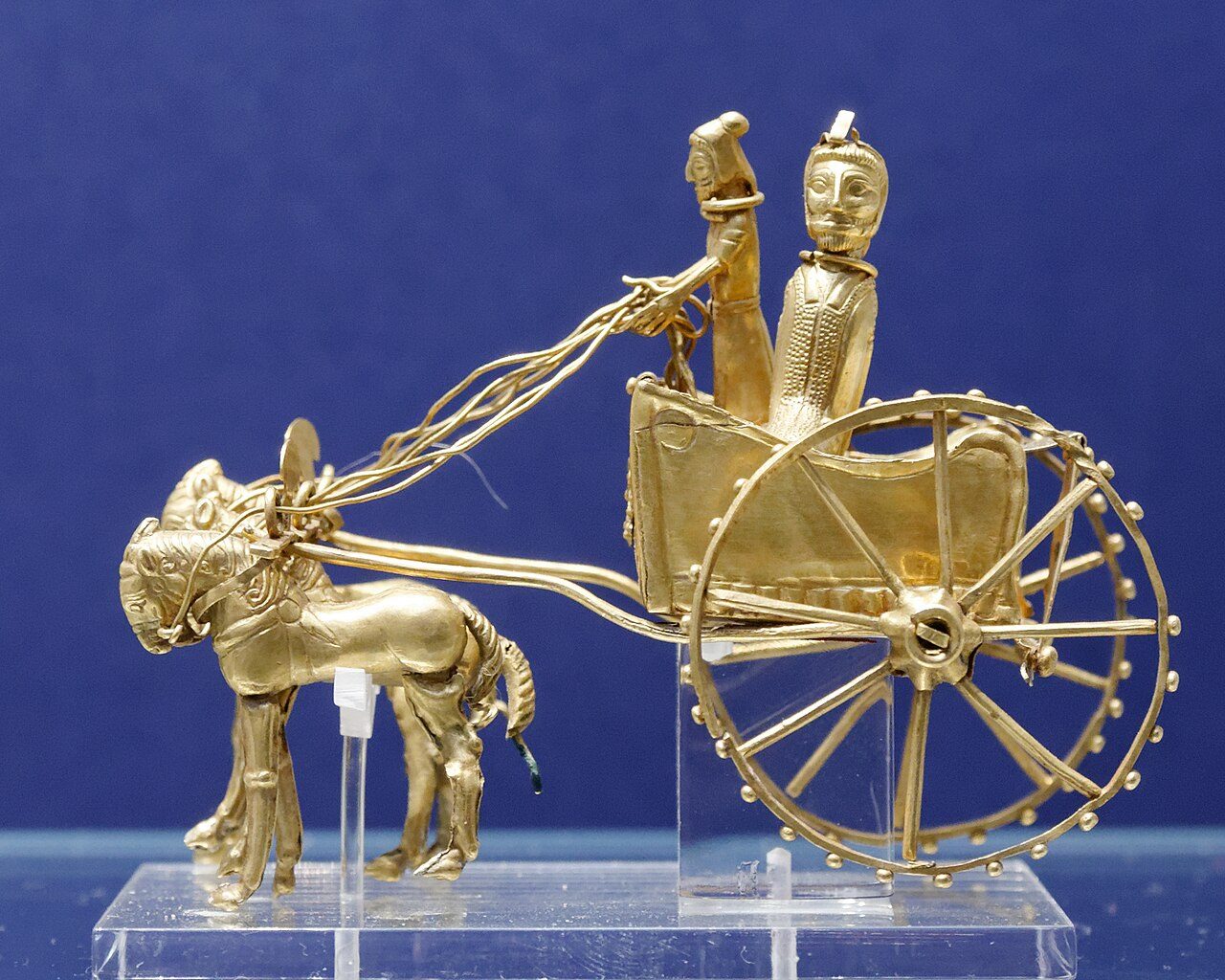
About 180 pieces of metalwork survive, with perhaps 200 coins, though early reports spoke of 1,500 coins and of objects that never reached a museum. The quality varies enormously. The pair of armlets ending in winged griffins, once inlaid with coloured stones, is court work of the highest order, matching the armlets carried as tribute on the reliefs at Persepolis. A small gold chariot drawn by four horses carries a driver and a seated passenger. Fifty-one thin gold plaques incised with worshippers, some crudely, look like offerings left at a shrine. That has led most scholars to see the treasure as the accumulated gifts of a temple, deposited over a long period.
The way it came to light has left lasting questions. In 1905 the British Museum's own cataloguer, O. M. Dalton, warned that the treasure had passed through hands that could not be trusted. In 2003 the archaeologist Oscar Muscarella challenged the idea that the objects formed a single find and doubted some plaques; the curator John Curtis replied that contemporary evidence firmly places the find on the north bank of the Oxus between 1877 and 1880 and that most if not all of the pieces are genuine. Close parallels from excavated Achaemenid sites, such as jewellery from Susa, support the authenticity of the main groups.
There is also the question of where it belongs. The treasure left Central Asia through local sale and the colonial-era art market, never through excavation. In 2007 the President of Tajikistan called for its return. No formal claim followed, and in 2013 the British Museum presented gold replicas of key pieces to Tajikistan's new National Museum.
Highlights
A pair of massive gold armlets ending in horned, winged griffins, their hollow cells once filled with inlay. One is in the British Museum, the other belongs to the V&A.
A four-horse chariot with a driver and a seated passenger, both wearing torcs; the front carries the face of the Egyptian god Bes.
Fifty-one thin gold sheets incised with figures holding barsom twigs, probably offerings left by worshippers at a temple.
A hollow gold flask in the shape of a fish, possibly a carp found in the Oxus, with a loop for hanging.
A gold scabbard decorated with a lion hunt, cut up by the 1880 robbers; dated to about 600 BC by some scholars and to the 5th-4th centuries BC by others.
What is in it
Small gold and silver objects: armlets and bracelets with animal-head terminals, model chariots, statuettes, votive plaques, dress ornaments, rings and seals, vessels, and a group of coins whose link to the hoard is debated.
Size: about 180 surviving pieces of metalwork.
| Item | Number | Notes |
|---|---|---|
| Votive plaques | 51 | Thin gold sheets incised with worshippers, many holding the barsom bundle of twigs |
| Armlets, bracelets and torcs | dozens | Including the pair of griffin-headed armlets |
| Statuettes and models | several | Two gold model chariots (one incomplete), a silver nude youth, gold heads, figures |
| Vessels | several | Bowls, a gold jug, an ibex-shaped handle, a fish-shaped flask |
| Rings and seals | 14 | 12 signet rings and 2 cylinder seals |
| Coins | about 200 (disputed) | Achaemenid, Greek and Graeco-Bactrian; early reports spoke of some 1,500 |
Photographs
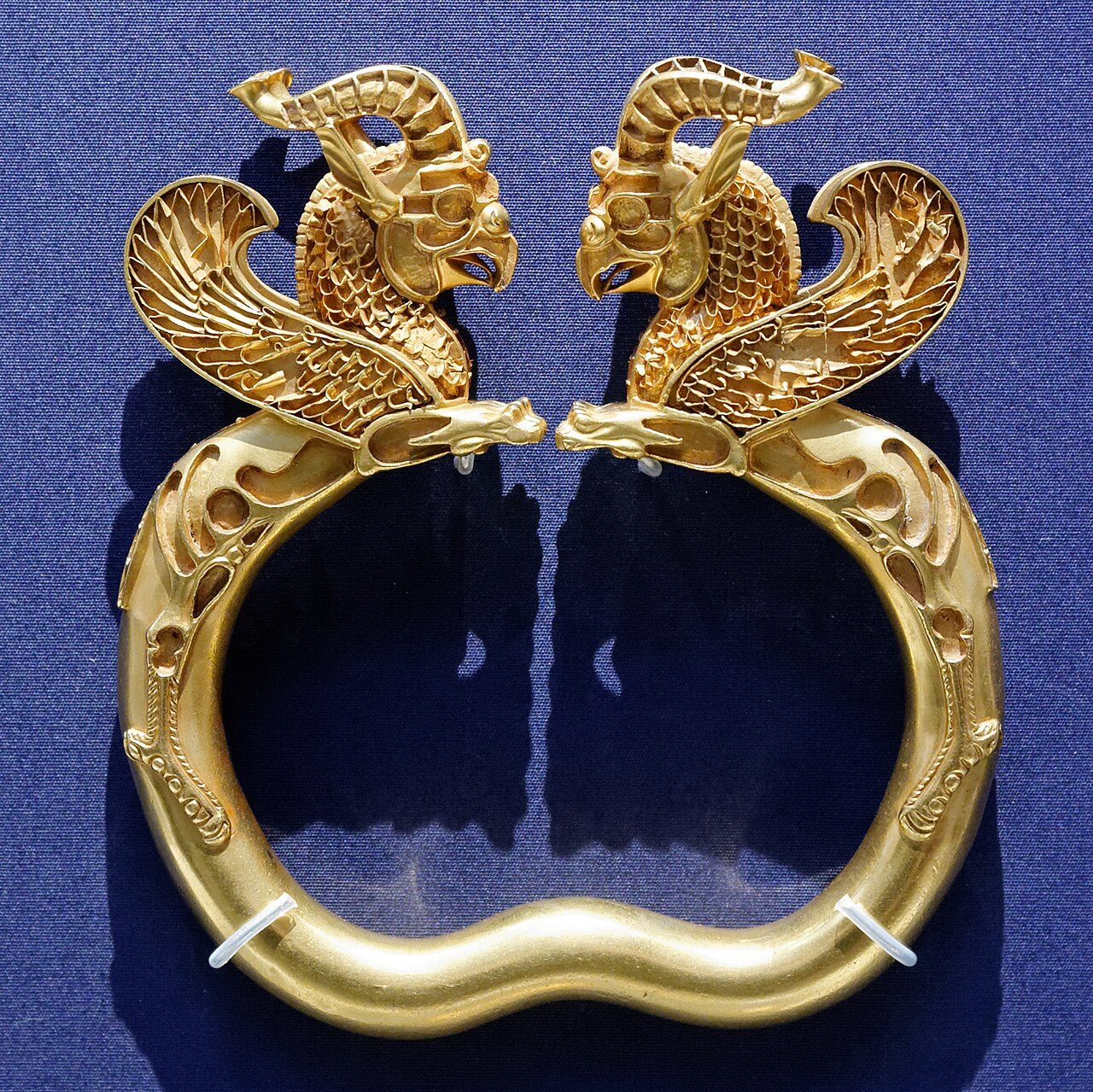
Photo: Marie-Lan Nguyen, Public domain, via Wikimedia Commons
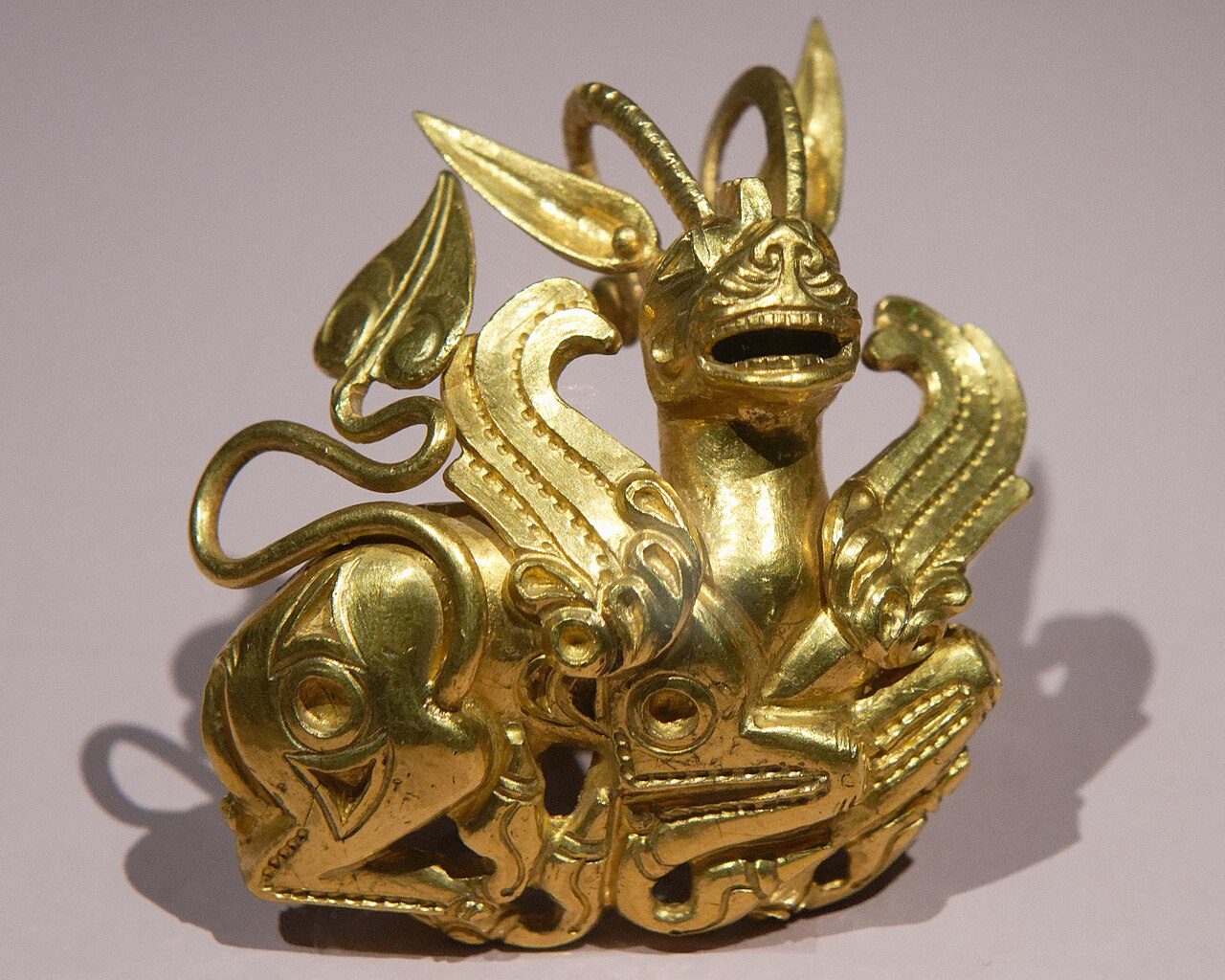
Photo: Marie-Lan Nguyen, Public domain, via Wikimedia Commons
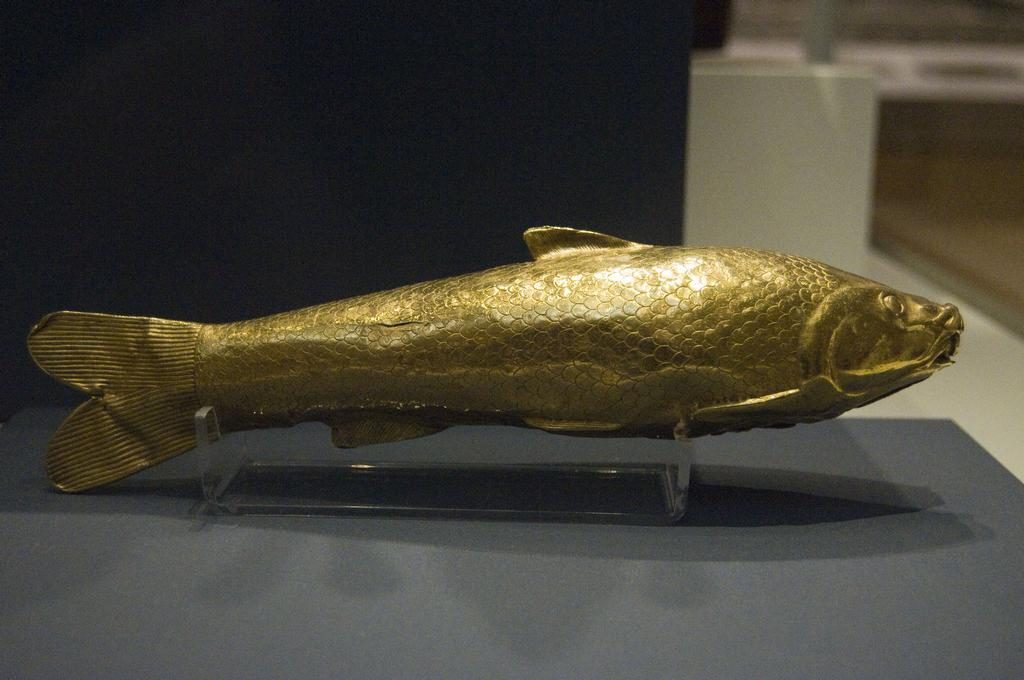
Photo: Nickmard Khoey, CC BY-SA 2.0, via Wikimedia Commons
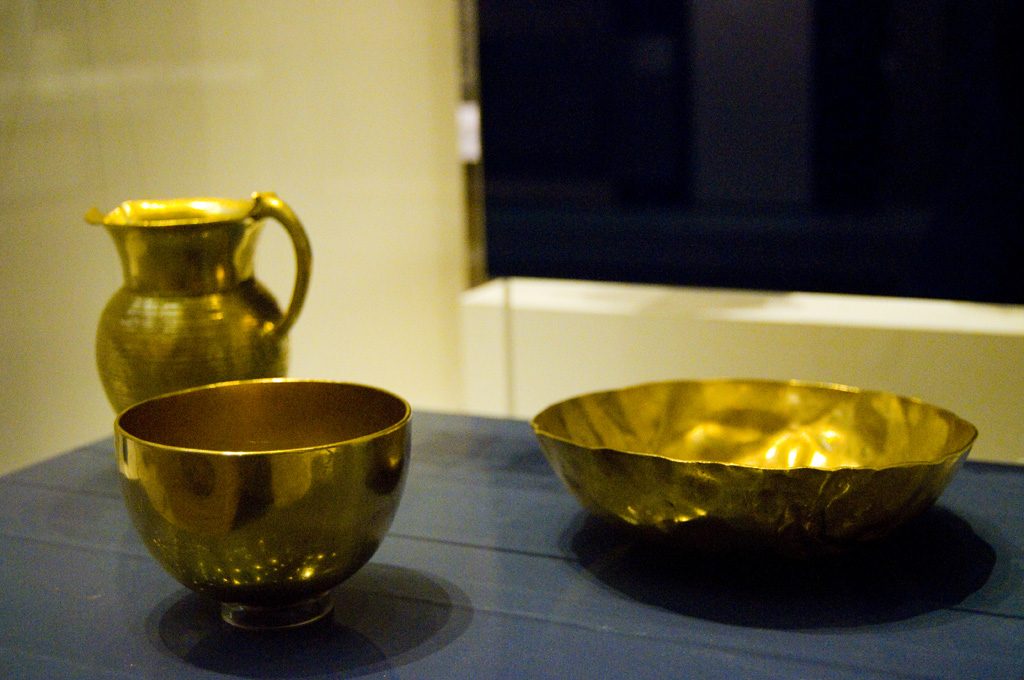
Photo: Nickmard Khoey, CC BY-SA 2.0, via Wikimedia Commons
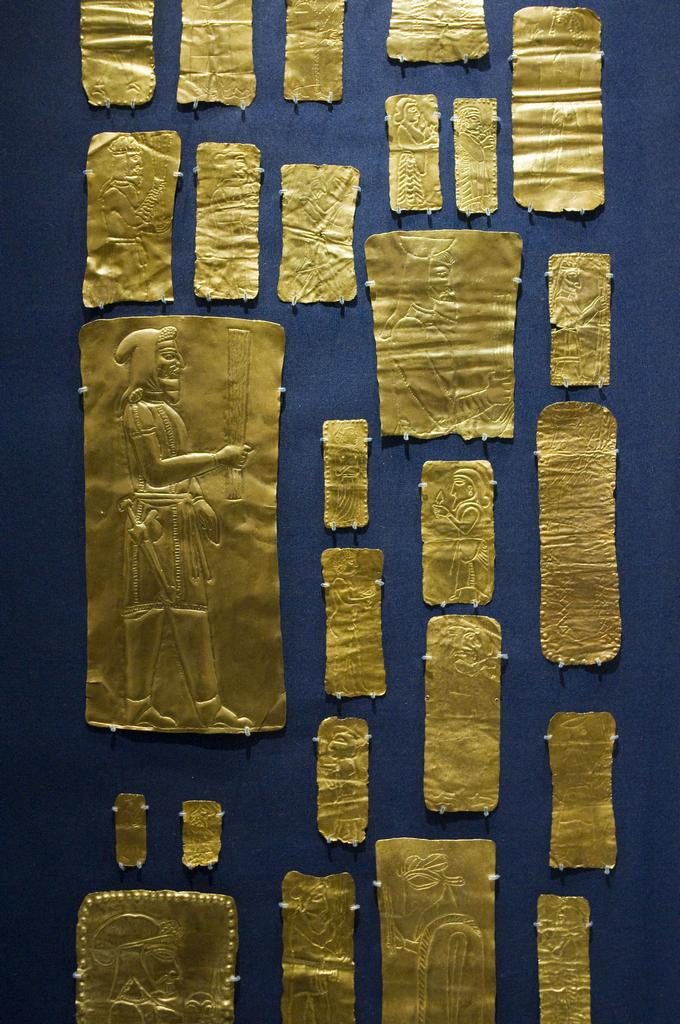
Photo: Nickmard Khoey, CC BY-SA 2.0, via Wikimedia Commons
How it is dated
Most of the metalwork is Achaemenid, made between the 6th and 4th centuries BC. The latest coins attributed to the treasure belong to Antiochus III and Euthydemus I, around 200 BC, which would put the final deposit after that, but whether these coins were part of the same find is debated.
What happened after the find
There was no legal process: the treasure was sold by its finders and passed through dealers in British India before entering the British Museum by bequest and purchase. Tajikistan has called for its return but has made no formal claim.
Where sources differ
- Find date and spot: accounts give 1876, 1877 and 1877-1880; the gold is variously said to have come from the river sands, a fort ruin, or a collapsed bank.
- Which coins belong to the treasure: Dalton identified none; Cunningham about 200; Zeymal 521.
- Authenticity of some votive plaques and the unity of the find (Muscarella versus Curtis).
- Date of the gold scabbard: about 600 BC (Boardman, Median) or 5th-4th century BC (British Museum).
- Gallery number: Wikipedia says Room 52; some Commons photo titles say Room 51.
Questions
Where is the Oxus Treasure now?
Almost all of it is in the British Museum in London, in the ancient Iran gallery (Room 52). One of the two griffin armlets belongs to the Victoria and Albert Museum and is on long-term loan to the British Museum.
Is the Oxus Treasure genuine?
Most specialists accept the main pieces as genuine Achaemenid work, supported by excavated parallels such as jewellery from Susa. Fakes were offered alongside the originals in the 1880s, and some scholars still question parts of the collection and whether all of it came from one find.
Has Tajikistan asked for the Oxus Treasure back?
Tajikistan's president called for its return in 2007, but no formal claim has been made. In 2013 the British Museum gave gold replicas of key pieces to Tajikistan's National Museum.